

The Renaissance was a vibrant period of rebirth and transformation...
 World History115 views·Updated Jul 11, 2026·3 pages
The Renaissance: Key Aspects and Influence
1 / 3
1
of 3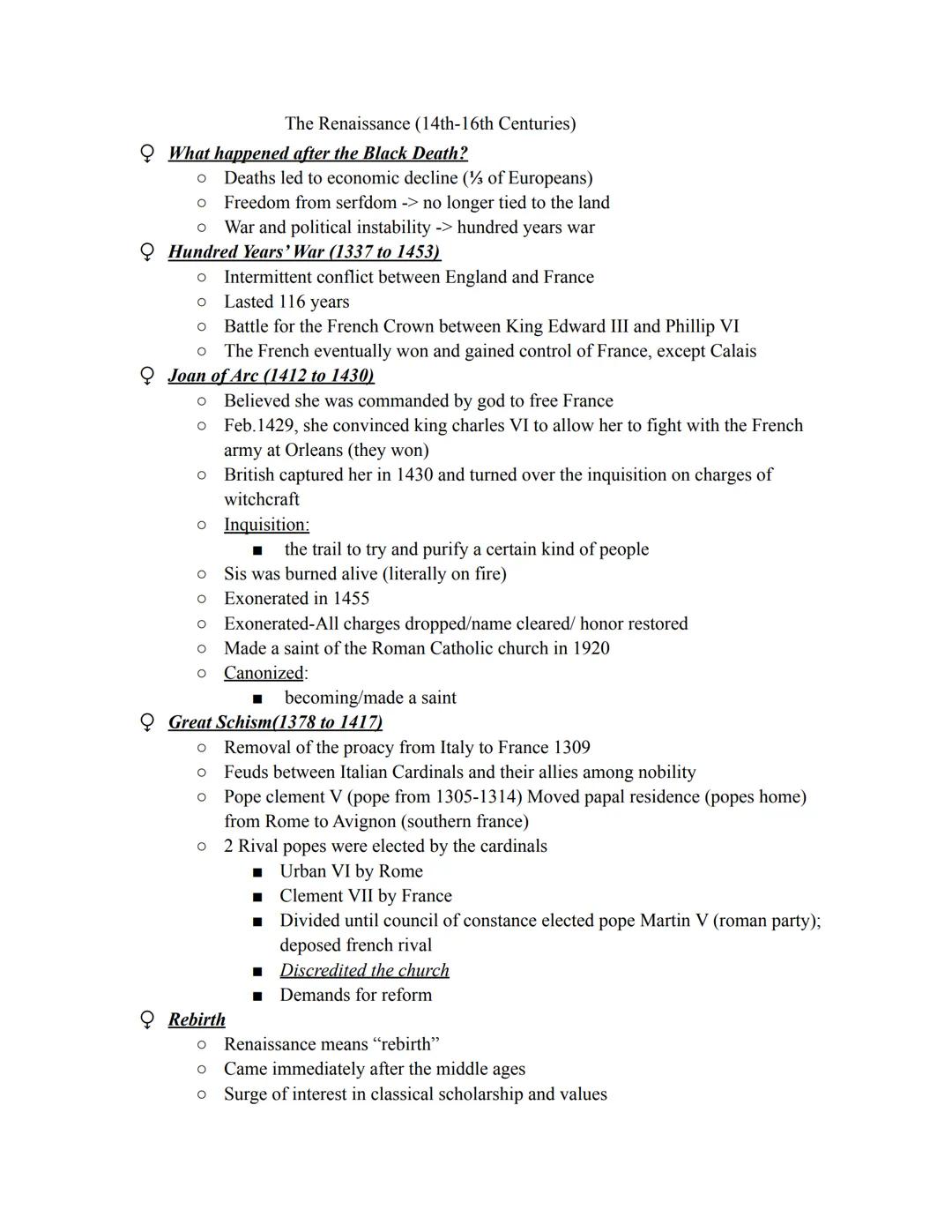
The Renaissance: Emergence from Crisis
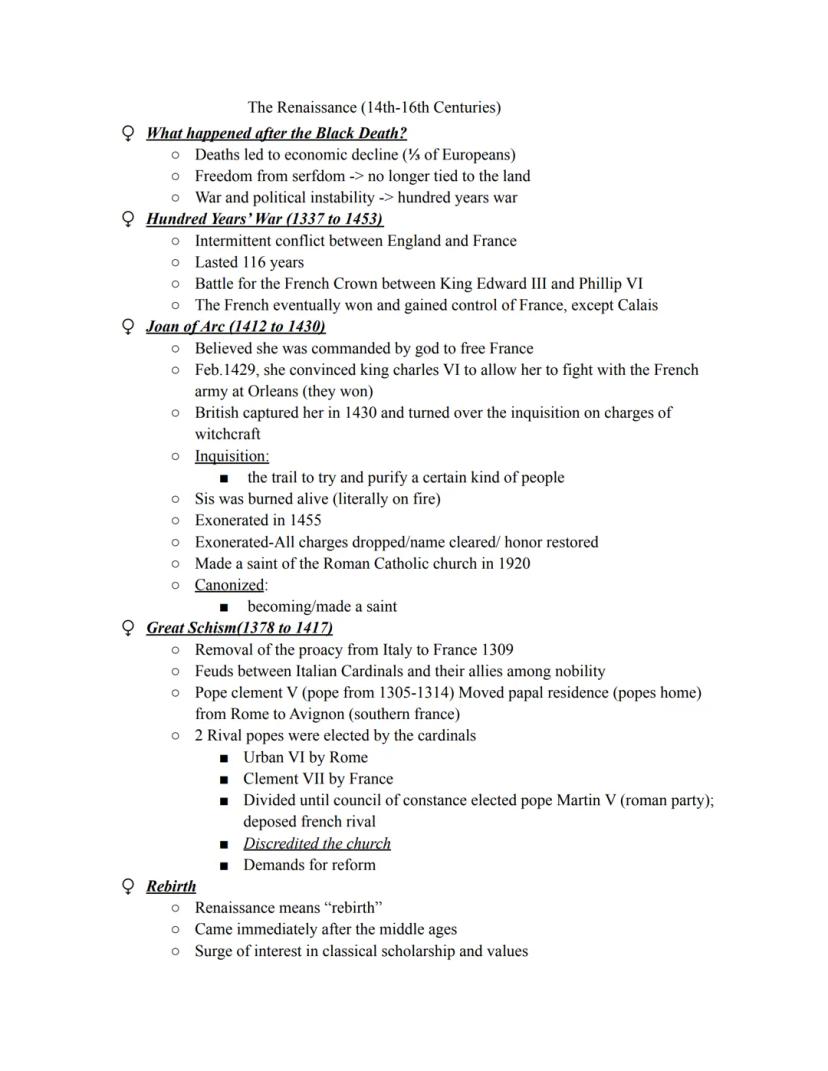
The Black Death wiped out nearly half of Europe's population, triggering massive economic decline but unexpectedly freeing many peasants from serfdom. This freedom of movement coincided with political instability during the Hundred Years' War between England and France, which despite its name lasted 116 years and ended with France regaining control of most territories.
Joan of Arc emerged as a pivotal figure during this conflict. Believing she was divinely commanded to free France, she convinced King Charles VI to let her join the French army at Orleans, helping secure victory. The British later captured her in 1430, charging her with witchcraft before burning her alive. Joan was exonerated in 1455 and eventually canonized as a saint in 1920.
Religious authority faced its own crisis during the Great Schism when rival popes were elected in Rome and France. This division severely discredited the church and fueled demands for reform. The conflict was finally resolved when the Council of Constance elected Pope Martin V from the Roman party.
Did you know? "Renaissance" literally means "rebirth" and represents a surge of interest in classical scholarship and values that had been largely forgotten during the Middle Ages.
2
of 3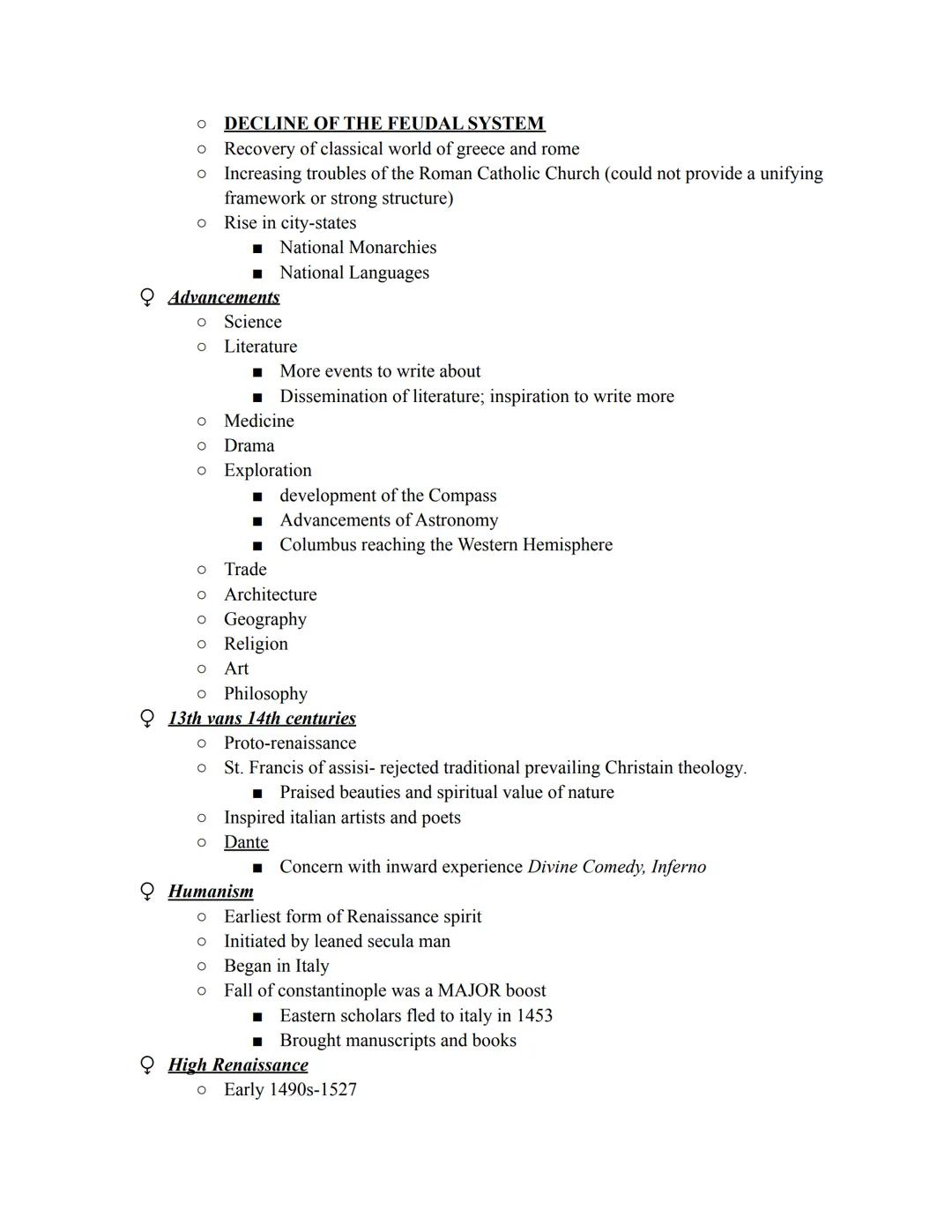
Renaissance Transformations
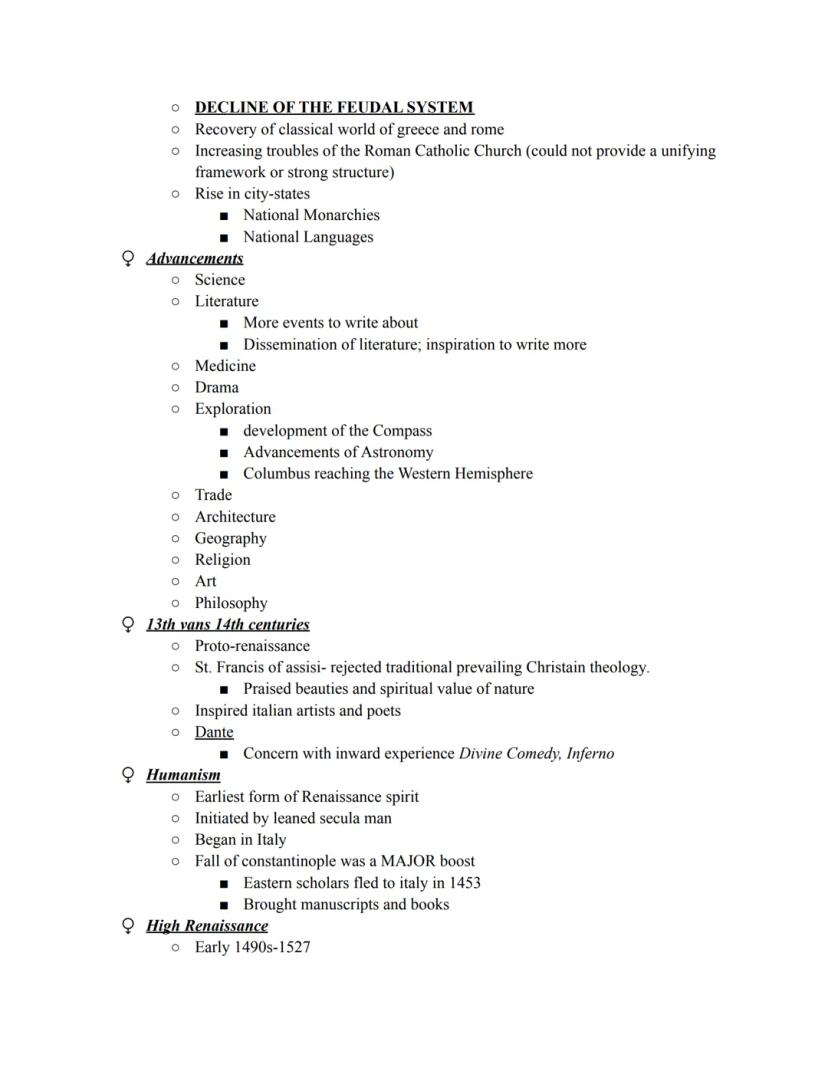
The Renaissance emerged as feudalism declined and city-states rose to prominence. This period saw the development of national monarchies, languages, and a renewed fascination with classical Greek and Roman knowledge. As the Catholic Church struggled to maintain its unifying framework, secular thinking began to flourish.
Advancements exploded across multiple fields. Science and medicine progressed rapidly, while literature and drama found new audiences. Exploration boomed thanks to the development of the compass and advances in astronomy, culminating in Columbus reaching the Western Hemisphere. Trade expanded, architecture evolved, and philosophy embraced new ideas.
The Proto-Renaissance of the 13th-14th centuries laid important foundations. St. Francis of Assisi rejected traditional Christian theology by praising the beauty and spiritual value of nature, inspiring Italian artists and poets. Dante explored inward experiences in his famous works like the Divine Comedy and Inferno.
Humanism became the earliest form of Renaissance spirit, initiated by secular scholars primarily in Italy. The fall of Constantinople in 1453 provided a major boost to this movement, as Eastern scholars fled to Italy bringing precious manuscripts and books with them. By the early 1490s, the High Renaissance had begun, ushering in an extraordinary period of artistic genius.
Remember this! Humanism placed humans, rather than God, at the center of intellectual and artistic focus—a revolutionary shift in thinking that defined the Renaissance.
3
of 3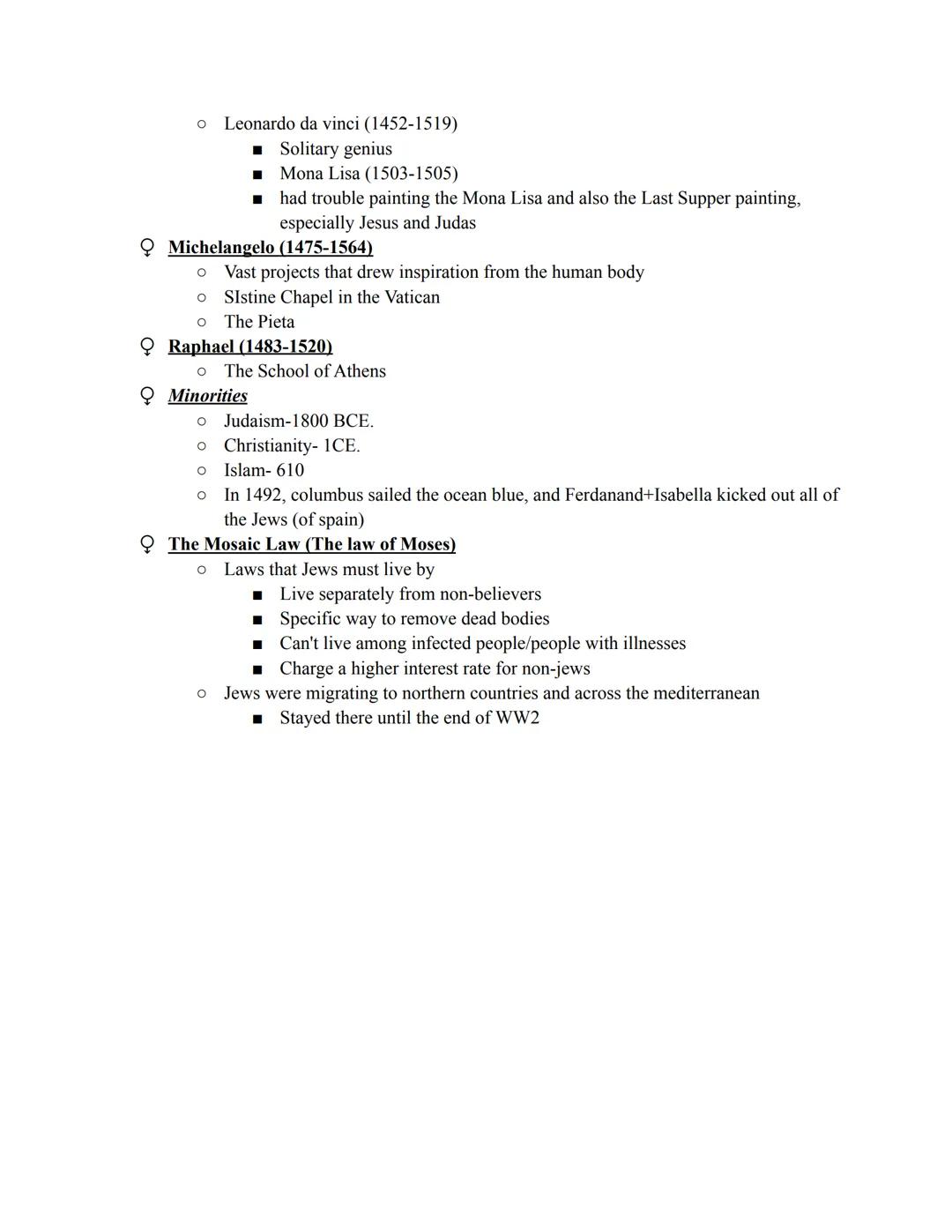
Renaissance Masters and Social Changes
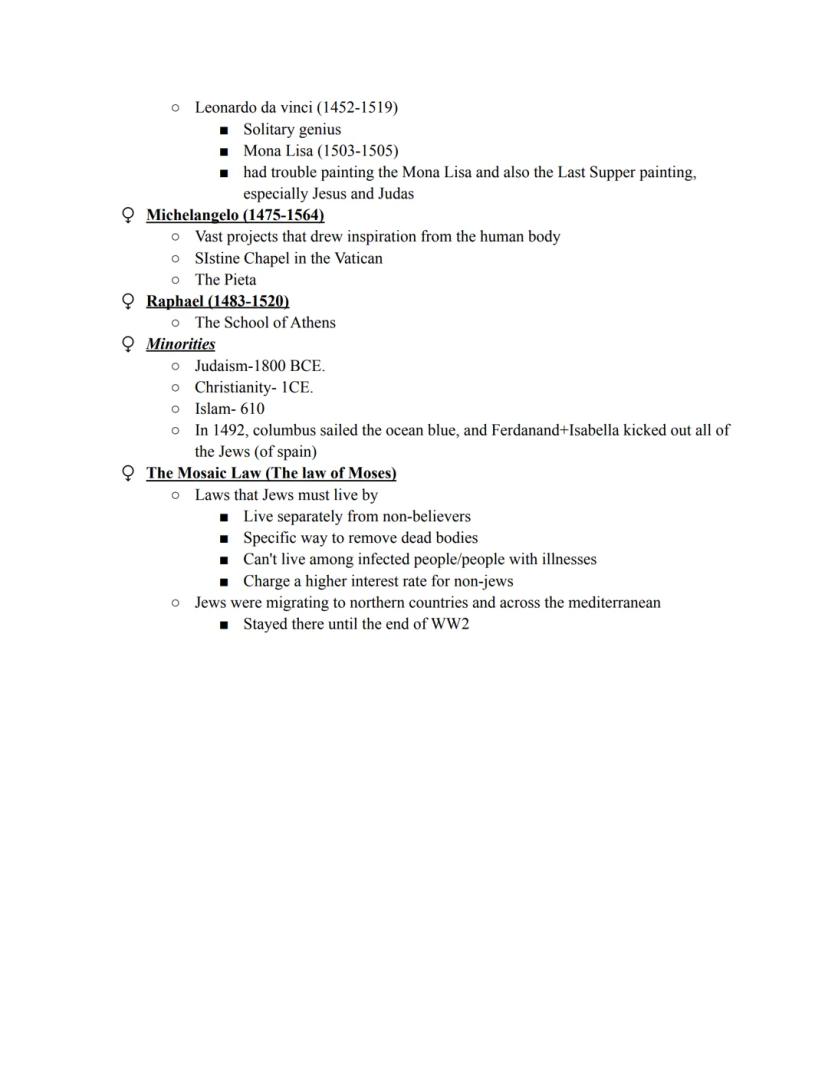
The High Renaissance produced some of history's greatest artistic geniuses. Leonardo da Vinci , the solitary master, created iconic works like the Mona Lisa despite struggling with elements of his famous paintings. Michelangelo drew inspiration from the human form for vast projects, including the breathtaking Sistine Chapel ceiling and The Pieta. Raphael created masterpieces like The School of Athens that embodied Renaissance ideals.
While art flourished, religious minorities faced significant challenges. In the same year Columbus sailed to the Americas (1492), Ferdinand and Isabella of Spain expelled all Jews from their kingdom. Jewish communities lived according to the Mosaic Law (Law of Moses), which required separation from non-believers, specific burial practices, isolation from illness, and different interest rates for non-Jews in financial dealings.
This expulsion forced Jewish communities to migrate northward and across the Mediterranean. These displaced communities would remain in these regions until the end of World War II, creating lasting cultural impacts across Europe.
Think about this: The Renaissance celebrated human potential and classical knowledge while simultaneously witnessing religious persecution—showing how progress and intolerance can exist in the same historical moment.
We thought you’d never ask...
Our AI companion is specifically built for the needs of students. Based on the millions of content pieces we have on the platform we can provide truly meaningful and relevant answers to students. But its not only about answers, the companion is even more about guiding students through their daily learning challenges, with personalised study plans, quizzes or content pieces in the chat and 100% personalisation based on the students skills and developments.
You can download the app in the Google Play Store and in the Apple App Store.
That's right! Enjoy free access to study content, connect with fellow students, and get instant help – all at your fingertips.
Similar Content
 European History
Most popular content: Renaissance
1Most popular content in World History
9W
World HistoryWorld War 1 Multiple Choice Question Quiz
This quiz was created to test your knowledge of World War 1. This quiz contains questions about the war's events, alliances, significant battles, and the aftermath.
7th3810
World HistoryHumanism in the European Renaissance
Learn about Renaissance Humanism, an intellectual movement emphasizing human potential, achievements, and the revival of classical learning during the European transformation.
9th2323
World HistoryAncient River Civilizations: Mesopotamia, Egypt, and the Indus Valley
Covers the rise and characteristics of foundational early societies in Mesopotamia, the Nile Valley (Egypt), and the Indus Valley regions.
9th3712
 English
A Raisin in the Sun Comprehension Questions [Act I, Scene One]
A Raisin in the Sun comprehension questions with answers.
9th1662
P
World HistoryPaleolithic Era
This is a short little quiz based off of my notes from Advanced Global
9th1340
World HistoryAP 10 - QUARTER 2 NOTES
Globalisasyon SDG Migrasyon Teritoryal Dinastiyang Politikal
10th900
World HistoryByzantine Empire Study Guide
Covers: Justinian and Theodora, Constantinople, art and architecture, split of Catholic Church, etc.
9th1855
World HistoryContext analysis on the eyewitness account of the Battle of Mactan by Pigafetta
Pigafetta remains the sole reliable source of that historic battle. Pigafetta’s eyewitness account is the “most detailed and only surviving account” of this critical event in Philippine history.
950
 Social Studies
5 Themes of Geography
The 5 themes of Geography and what they mean.
10th966
Most popular content
9O
 AP US History
Origins and Dynamics of the Columbian Exchange
Analyze the ecological and economic motivations behind the initial transfer of goods, people, and diseases between the Old and New Worlds.
9th3,1280
I
AP US HistoryIntroduction to Early Cultural Interactions
Analyze the initial social and religious encounters between Europeans, Africans, and Indigenous peoples in the colonial Americas.
9th2,7730
O
AP World HistoryOrigins of Ancient River Civilizations
Analyze the environmental factors and technological innovations that led to the rise of early states in Mesopotamia, Egypt, and the Indus Valley.
9th3,1870
M
AP US HistoryMotivations for European Exploration
Analyze the economic, religious, and political factors that drove European powers to the Americas during the 15th and 16th centuries.
9th1,7780
F
 AP Psychology
Foundations of Ethical Guidelines in Research
Practice the core principles of the APA ethical code including informed consent, debriefing, and the role of Institutional Review Boards.
9th1,3360
I
AP US HistoryIntroduction to Native American Societies
Examine the diverse social, political, and economic structures of North American indigenous groups prior to European contact.
9th1,1100
I
AP US HistoryIntroduction to the Spanish Encomienda System
Explore the fundamental economic and social structures of the Spanish colonial system, focusing on the encomienda and the casta social hierarchy.
9th8890
I
 AP Biology
Introduction to Biological Elements of Life
Practice identifying the essential elements including carbon, nitrogen, phosphorus, and sulfur that compose biological macromolecules.
9th1,7410
O
AP US Government & PoliticsOrigins of the Articles of Confederation
Practice identifying the motivations for a weak central government and the specific powers granted to the states under the first U.S. constitution.
9th9370
Students love us — and so will you.
4.6/5App Store
4.7/5Google Play
The app is very easy to use and well designed. I have found everything I was looking for so far and have been able to learn a lot from the presentations! I will definitely use the app for a class assignment! And of course it also helps a lot as an inspiration.
Stefan SiOS user
This app is really great. There are so many study notes and help [...]. My problem subject is French, for example, and the app has so many options for help. Thanks to this app, I have improved my French. I would recommend it to anyone.
Samantha KlichAndroid user
Wow, I am really amazed. I just tried the app because I've seen it advertised many times and was absolutely stunned. This app is THE HELP you want for school and above all, it offers so many things, such as workouts and fact sheets, which have been VERY helpful to me personally.
AnnaiOS user
World History115 views·Updated Jul 11, 2026·3 pagesThe Renaissance: Key Aspects and Influence
The Renaissance was a vibrant period of rebirth and transformation that followed the devastating Black Death and Middle Ages in Europe. This era (14th-16th centuries) saw remarkable advancements in art, science, literature, and philosophy as society broke away from feudal...
1
of 3
Sign up to see the content. It's free!
- Access to all documents
- Improve your grades
- Join milions of students
The Renaissance: Emergence from Crisis
The Black Death wiped out nearly half of Europe's population, triggering massive economic decline but unexpectedly freeing many peasants from serfdom. This freedom of movement coincided with political instability during the Hundred Years' War between England and France, which despite its name lasted 116 years and ended with France regaining control of most territories.
Joan of Arc emerged as a pivotal figure during this conflict. Believing she was divinely commanded to free France, she convinced King Charles VI to let her join the French army at Orleans, helping secure victory. The British later captured her in 1430, charging her with witchcraft before burning her alive. Joan was exonerated in 1455 and eventually canonized as a saint in 1920.
Religious authority faced its own crisis during the Great Schism when rival popes were elected in Rome and France. This division severely discredited the church and fueled demands for reform. The conflict was finally resolved when the Council of Constance elected Pope Martin V from the Roman party.
Did you know? "Renaissance" literally means "rebirth" and represents a surge of interest in classical scholarship and values that had been largely forgotten during the Middle Ages.
2
of 3Sign up to see the content. It's free!
- Access to all documents
- Improve your grades
- Join milions of students
Renaissance Transformations
The Renaissance emerged as feudalism declined and city-states rose to prominence. This period saw the development of national monarchies, languages, and a renewed fascination with classical Greek and Roman knowledge. As the Catholic Church struggled to maintain its unifying framework, secular thinking began to flourish.
Advancements exploded across multiple fields. Science and medicine progressed rapidly, while literature and drama found new audiences. Exploration boomed thanks to the development of the compass and advances in astronomy, culminating in Columbus reaching the Western Hemisphere. Trade expanded, architecture evolved, and philosophy embraced new ideas.
The Proto-Renaissance of the 13th-14th centuries laid important foundations. St. Francis of Assisi rejected traditional Christian theology by praising the beauty and spiritual value of nature, inspiring Italian artists and poets. Dante explored inward experiences in his famous works like the Divine Comedy and Inferno.
Humanism became the earliest form of Renaissance spirit, initiated by secular scholars primarily in Italy. The fall of Constantinople in 1453 provided a major boost to this movement, as Eastern scholars fled to Italy bringing precious manuscripts and books with them. By the early 1490s, the High Renaissance had begun, ushering in an extraordinary period of artistic genius.
Remember this! Humanism placed humans, rather than God, at the center of intellectual and artistic focus—a revolutionary shift in thinking that defined the Renaissance.
3
of 3Sign up to see the content. It's free!
- Access to all documents
- Improve your grades
- Join milions of students
Renaissance Masters and Social Changes
The High Renaissance produced some of history's greatest artistic geniuses. Leonardo da Vinci , the solitary master, created iconic works like the Mona Lisa despite struggling with elements of his famous paintings. Michelangelo drew inspiration from the human form for vast projects, including the breathtaking Sistine Chapel ceiling and The Pieta. Raphael created masterpieces like The School of Athens that embodied Renaissance ideals.
While art flourished, religious minorities faced significant challenges. In the same year Columbus sailed to the Americas (1492), Ferdinand and Isabella of Spain expelled all Jews from their kingdom. Jewish communities lived according to the Mosaic Law (Law of Moses), which required separation from non-believers, specific burial practices, isolation from illness, and different interest rates for non-Jews in financial dealings.
This expulsion forced Jewish communities to migrate northward and across the Mediterranean. These displaced communities would remain in these regions until the end of World War II, creating lasting cultural impacts across Europe.
Think about this: The Renaissance celebrated human potential and classical knowledge while simultaneously witnessing religious persecution—showing how progress and intolerance can exist in the same historical moment.
We thought you’d never ask...
Our AI companion is specifically built for the needs of students. Based on the millions of content pieces we have on the platform we can provide truly meaningful and relevant answers to students. But its not only about answers, the companion is even more about guiding students through their daily learning challenges, with personalised study plans, quizzes or content pieces in the chat and 100% personalisation based on the students skills and developments.
You can download the app in the Google Play Store and in the Apple App Store.
That's right! Enjoy free access to study content, connect with fellow students, and get instant help – all at your fingertips.
Similar Content
Most popular content: Renaissance
1Most popular content in World History
9W
World HistoryWorld War 1 Multiple Choice Question Quiz
This quiz was created to test your knowledge of World War 1. This quiz contains questions about the war's events, alliances, significant battles, and the aftermath.
7th3810
World HistoryHumanism in the European Renaissance
Learn about Renaissance Humanism, an intellectual movement emphasizing human potential, achievements, and the revival of classical learning during the European transformation.
9th2323
World HistoryAncient River Civilizations: Mesopotamia, Egypt, and the Indus Valley
Covers the rise and characteristics of foundational early societies in Mesopotamia, the Nile Valley (Egypt), and the Indus Valley regions.
9th3712
EnglishA Raisin in the Sun Comprehension Questions [Act I, Scene One]
A Raisin in the Sun comprehension questions with answers.
9th1662
P
World HistoryPaleolithic Era
This is a short little quiz based off of my notes from Advanced Global
9th1340
World HistoryAP 10 - QUARTER 2 NOTES
Globalisasyon SDG Migrasyon Teritoryal Dinastiyang Politikal
10th900
World HistoryByzantine Empire Study Guide
Covers: Justinian and Theodora, Constantinople, art and architecture, split of Catholic Church, etc.
9th1855
World HistoryContext analysis on the eyewitness account of the Battle of Mactan by Pigafetta
Pigafetta remains the sole reliable source of that historic battle. Pigafetta’s eyewitness account is the “most detailed and only surviving account” of this critical event in Philippine history.
950
Social Studies5 Themes of Geography
The 5 themes of Geography and what they mean.
10th966
Most popular content
9O
AP US HistoryOrigins and Dynamics of the Columbian Exchange
Analyze the ecological and economic motivations behind the initial transfer of goods, people, and diseases between the Old and New Worlds.
9th3,1280
I
AP US HistoryIntroduction to Early Cultural Interactions
Analyze the initial social and religious encounters between Europeans, Africans, and Indigenous peoples in the colonial Americas.
9th2,7730
O
AP World HistoryOrigins of Ancient River Civilizations
Analyze the environmental factors and technological innovations that led to the rise of early states in Mesopotamia, Egypt, and the Indus Valley.
9th3,1870
M
AP US HistoryMotivations for European Exploration
Analyze the economic, religious, and political factors that drove European powers to the Americas during the 15th and 16th centuries.
9th1,7780
F
AP PsychologyFoundations of Ethical Guidelines in Research
Practice the core principles of the APA ethical code including informed consent, debriefing, and the role of Institutional Review Boards.
9th1,3360
I
AP US HistoryIntroduction to Native American Societies
Examine the diverse social, political, and economic structures of North American indigenous groups prior to European contact.
9th1,1100
I
AP US HistoryIntroduction to the Spanish Encomienda System
Explore the fundamental economic and social structures of the Spanish colonial system, focusing on the encomienda and the casta social hierarchy.
9th8890
I
AP BiologyIntroduction to Biological Elements of Life
Practice identifying the essential elements including carbon, nitrogen, phosphorus, and sulfur that compose biological macromolecules.
9th1,7410
O
AP US Government & PoliticsOrigins of the Articles of Confederation
Practice identifying the motivations for a weak central government and the specific powers granted to the states under the first U.S. constitution.
9th9370
Students love us — and so will you.
4.6/5App Store
4.7/5Google Play
The app is very easy to use and well designed. I have found everything I was looking for so far and have been able to learn a lot from the presentations! I will definitely use the app for a class assignment! And of course it also helps a lot as an inspiration.
Stefan SiOS user
This app is really great. There are so many study notes and help [...]. My problem subject is French, for example, and the app has so many options for help. Thanks to this app, I have improved my French. I would recommend it to anyone.
Samantha KlichAndroid user
Wow, I am really amazed. I just tried the app because I've seen it advertised many times and was absolutely stunned. This app is THE HELP you want for school and above all, it offers so many things, such as workouts and fact sheets, which have been VERY helpful to me personally.
AnnaiOS user