
Probability is all about understanding how likely different events are... Show more
 Statistics175 views·Updated May 21, 2026·3 pages
Understanding Probability: Basics and Experiments
E
Ezjo @ez.jo
1 / 3
1
of 3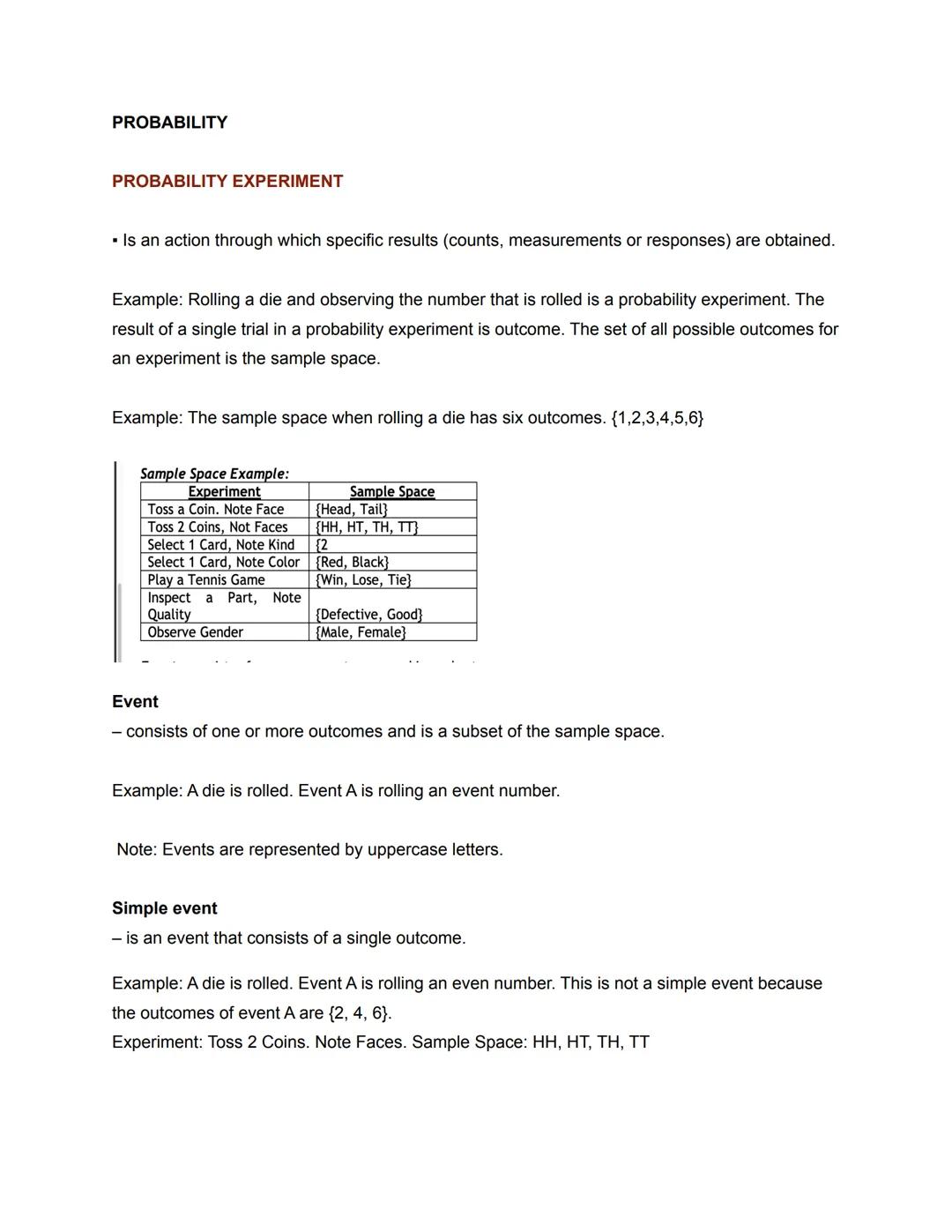
Probability Experiments
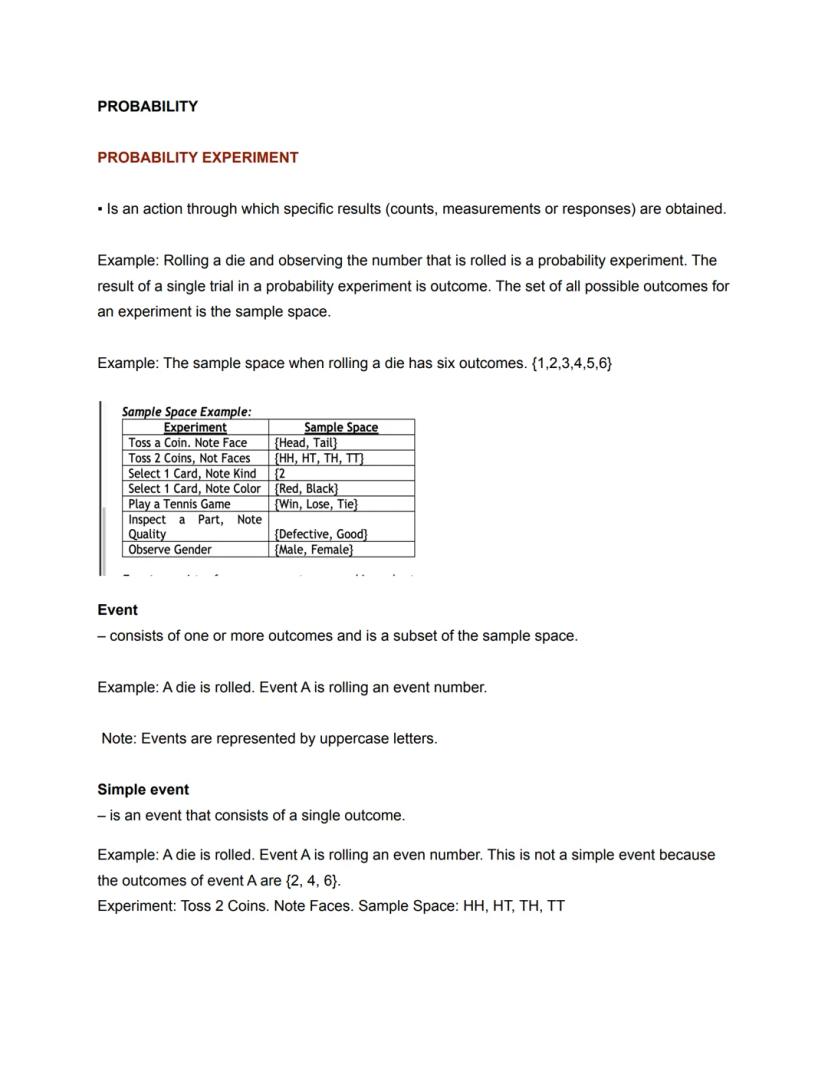
Ever wonder how we measure chance? A probability experiment is any action that produces specific results, like rolling a die or flipping a coin. When you roll a die once, what you get is an outcome. All possible outcomes together form the sample space.
For example, when rolling a die, the sample space includes six outcomes: {1, 2, 3, 4, 5, 6}. Different experiments have different sample spaces - flipping a coin gives you {Head, Tail}, while flipping two coins gives you {HH, HT, TH, TT}.
An event is a subset of outcomes from the sample space. If we roll a die and define Event A as "rolling an even number," then A includes the outcomes {2, 4, 6}. A simple event consists of just one outcome, while events with multiple outcomes (like our even number example) are not simple events.
Quick Tip: Think of the sample space as your "universe of possibilities" for any given experiment. Everything that could possibly happen lives in this space!
2
of 3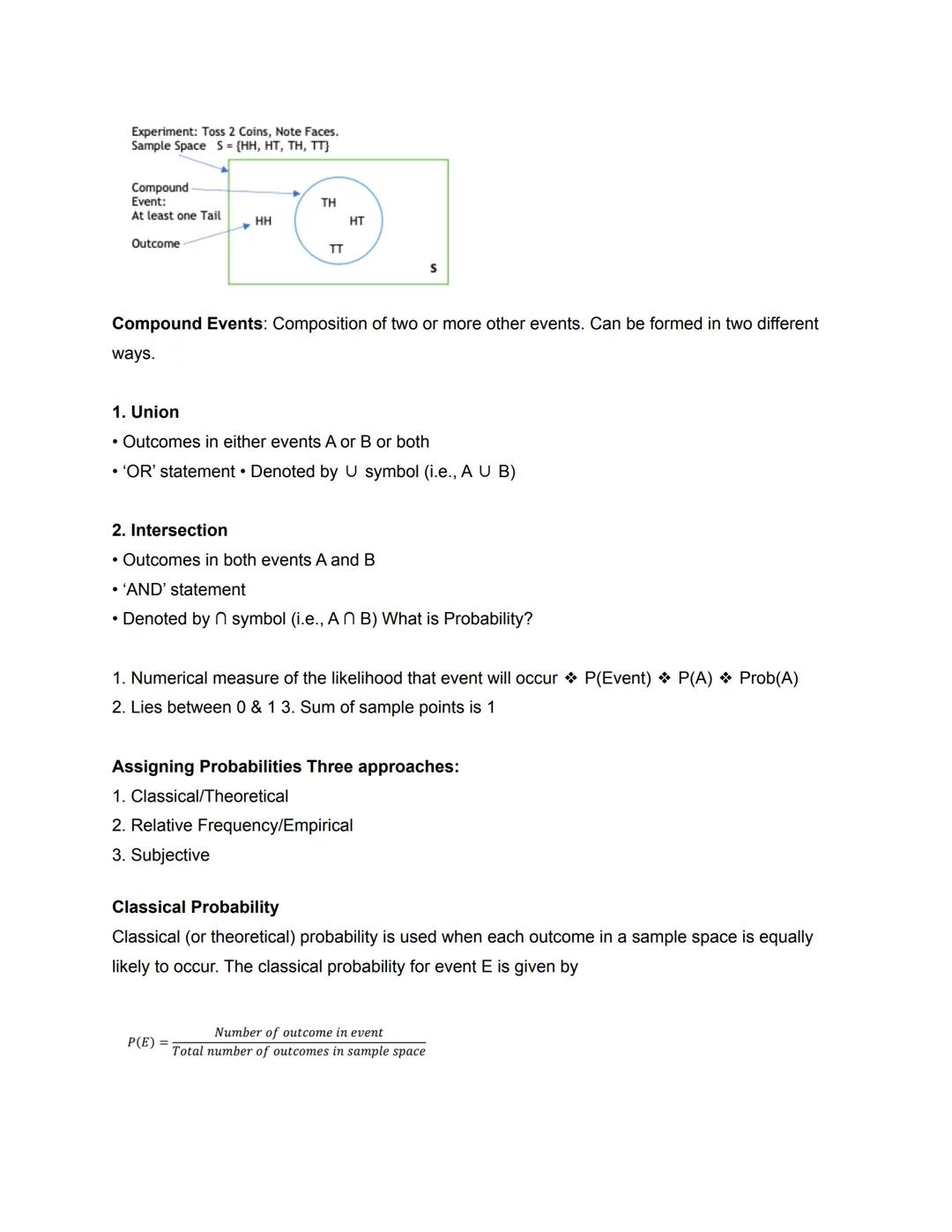
Compound Events and Probability Basics
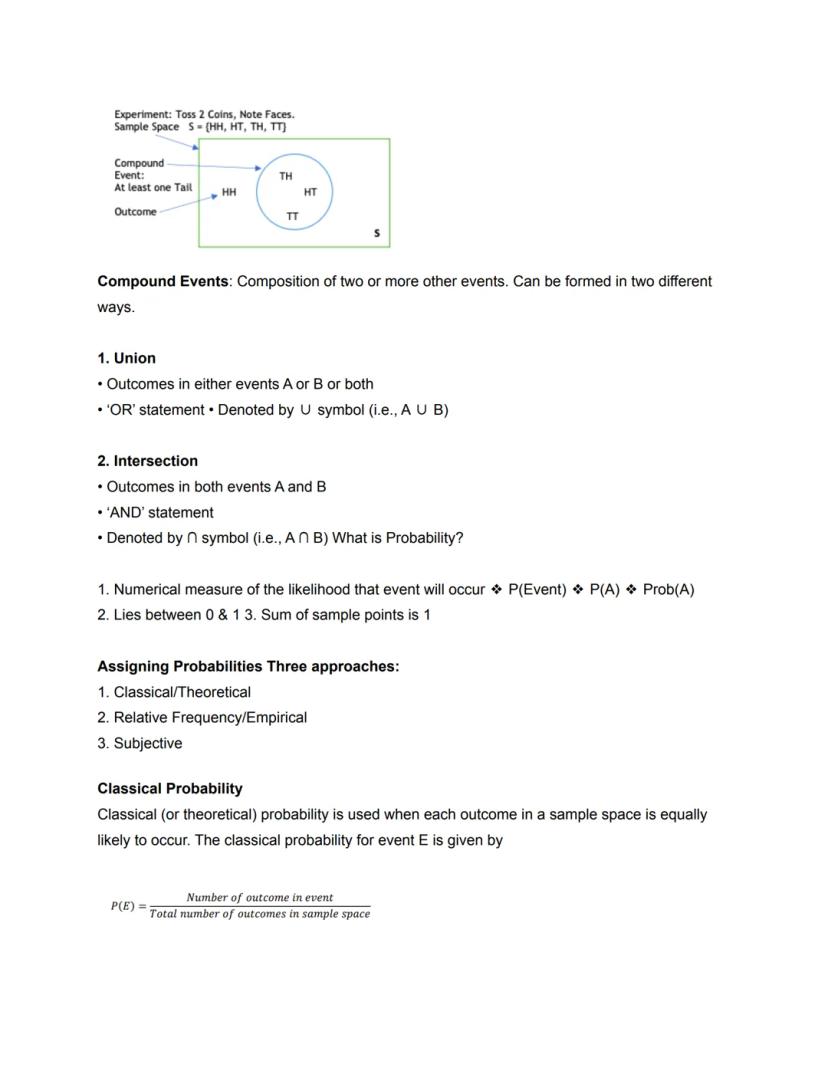
Compound events combine multiple outcomes. Looking at our two-coin toss example with sample space S={HH, HT, TH, TT}, we can form compound events two ways:
- Union (OR): Outcomes in either event A or B or both, written as A ∪ B
- Intersection (AND): Outcomes in both events A and B, written as A ∩ B
Probability itself is just a numerical measure of how likely an event is to occur. It always falls between 0 and 1, with all probabilities in a sample space adding up to 1.
There are three main approaches to assigning probabilities:
-
Classical/Theoretical: Used when all outcomes are equally likely P(E) = (Number of outcomes in event) ÷ (Total number of outcomes)
-
Relative Frequency/Empirical: Based on observed data
-
Subjective: Based on personal judgment
Remember: In classical probability, if you're calculating the probability of drawing a heart from a deck of cards, it's 13/52 = 1/4 because all cards have an equal chance of being drawn.
3
of 3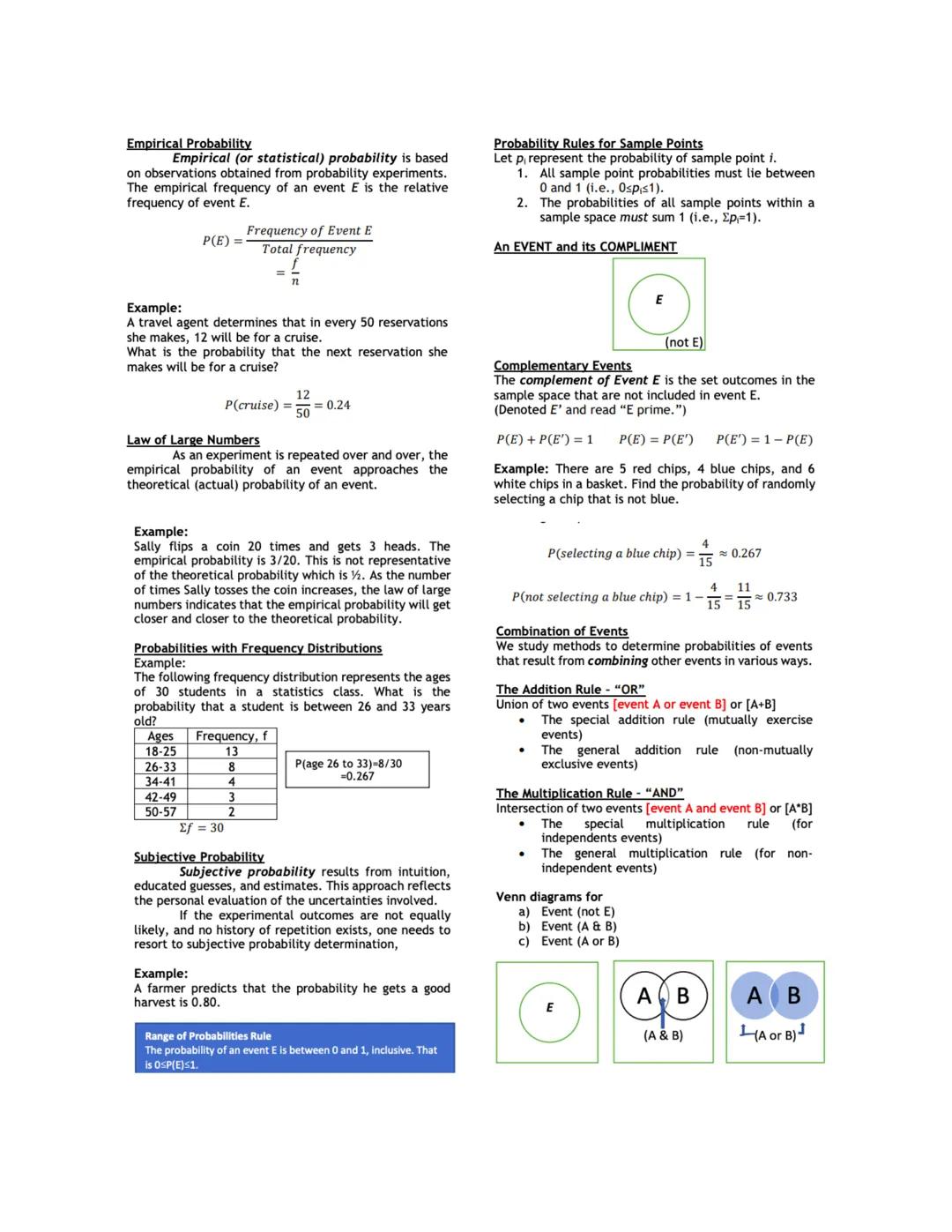
Probability Rules and Event Relationships
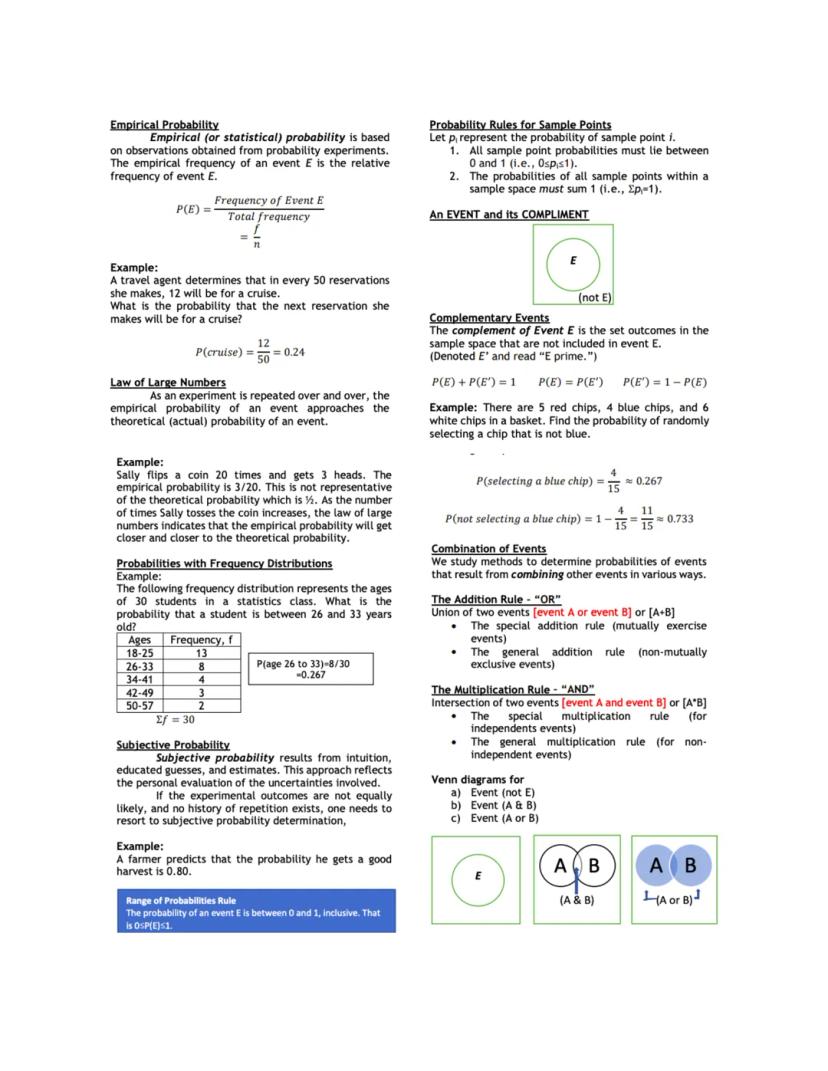
Empirical probability uses actual observations to calculate likelihood. If you flip a coin 100 times and get 48 heads, the empirical probability of heads would be 48/100 = 0.48. The Law of Large Numbers tells us that as you repeat an experiment many times, the empirical probability gets closer to the theoretical probability.
All probabilities must follow two basic rules:
- Every probability must be between 0 and 1
- All probabilities in a sample space must sum to 1
The complement of an event is everything that's NOT in that event. For any event E, its complement (E') gives us this useful formula: P(E) + P(E') = 1. This means you can find one probability by subtracting from 1: P(E) = 1 - P(E').
When combining events, we use two main rules:
- Addition Rule ("OR"): Finds probability of either event A or event B occurring
- Multiplication Rule ("AND"): Finds probability of both event A and event B occurring
Real-world connection: If the weather forecast says there's a 30% chance of rain tomorrow, that means there's a 70% chance it won't rain. That's complementary probability in action!
We thought you’d never ask...
What is the Knowunity AI companion?
Our AI companion is specifically built for the needs of students. Based on the millions of content pieces we have on the platform we can provide truly meaningful and relevant answers to students. But its not only about answers, the companion is even more about guiding students through their daily learning challenges, with personalised study plans, quizzes or content pieces in the chat and 100% personalisation based on the students skills and developments.
Where can I download the Knowunity app?
You can download the app in the Google Play Store and in the Apple App Store.
Is Knowunity really free of charge?
That's right! Enjoy free access to study content, connect with fellow students, and get instant help – all at your fingertips.
Similar Content
Most popular content in Statistics
5Most popular content
9Can't find what you're looking for? Explore other subjects.
Students love us — and so will you.
4.6/5App Store
4.7/5Google Play
The app is very easy to use and well designed. I have found everything I was looking for so far and have been able to learn a lot from the presentations! I will definitely use the app for a class assignment! And of course it also helps a lot as an inspiration.
Stefan SiOS user
This app is really great. There are so many study notes and help [...]. My problem subject is French, for example, and the app has so many options for help. Thanks to this app, I have improved my French. I would recommend it to anyone.
Samantha KlichAndroid user
Wow, I am really amazed. I just tried the app because I've seen it advertised many times and was absolutely stunned. This app is THE HELP you want for school and above all, it offers so many things, such as workouts and fact sheets, which have been VERY helpful to me personally.
AnnaiOS user
Statistics175 views·Updated May 21, 2026·3 pagesUnderstanding Probability: Basics and Experiments
E
Ezjo @ez.jo
Probability is all about understanding how likely different events are to happen. Whether you're flipping coins, rolling dice, or predicting outcomes, probability helps you make sense of randomness and uncertainty in a mathematical way.
1
of 3Sign up to see the content. It's free!
- Access to all documents
- Improve your grades
- Join milions of students
Probability Experiments
Ever wonder how we measure chance? A probability experiment is any action that produces specific results, like rolling a die or flipping a coin. When you roll a die once, what you get is an outcome. All possible outcomes together form the sample space.
For example, when rolling a die, the sample space includes six outcomes: {1, 2, 3, 4, 5, 6}. Different experiments have different sample spaces - flipping a coin gives you {Head, Tail}, while flipping two coins gives you {HH, HT, TH, TT}.
An event is a subset of outcomes from the sample space. If we roll a die and define Event A as "rolling an even number," then A includes the outcomes {2, 4, 6}. A simple event consists of just one outcome, while events with multiple outcomes (like our even number example) are not simple events.
Quick Tip: Think of the sample space as your "universe of possibilities" for any given experiment. Everything that could possibly happen lives in this space!
2
of 3Sign up to see the content. It's free!
- Access to all documents
- Improve your grades
- Join milions of students
Compound Events and Probability Basics
Compound events combine multiple outcomes. Looking at our two-coin toss example with sample space S={HH, HT, TH, TT}, we can form compound events two ways:
- Union (OR): Outcomes in either event A or B or both, written as A ∪ B
- Intersection (AND): Outcomes in both events A and B, written as A ∩ B
Probability itself is just a numerical measure of how likely an event is to occur. It always falls between 0 and 1, with all probabilities in a sample space adding up to 1.
There are three main approaches to assigning probabilities:
-
Classical/Theoretical: Used when all outcomes are equally likely P(E) = (Number of outcomes in event) ÷ (Total number of outcomes)
-
Relative Frequency/Empirical: Based on observed data
-
Subjective: Based on personal judgment
Remember: In classical probability, if you're calculating the probability of drawing a heart from a deck of cards, it's 13/52 = 1/4 because all cards have an equal chance of being drawn.
3
of 3Sign up to see the content. It's free!
- Access to all documents
- Improve your grades
- Join milions of students
Probability Rules and Event Relationships
Empirical probability uses actual observations to calculate likelihood. If you flip a coin 100 times and get 48 heads, the empirical probability of heads would be 48/100 = 0.48. The Law of Large Numbers tells us that as you repeat an experiment many times, the empirical probability gets closer to the theoretical probability.
All probabilities must follow two basic rules:
- Every probability must be between 0 and 1
- All probabilities in a sample space must sum to 1
The complement of an event is everything that's NOT in that event. For any event E, its complement (E') gives us this useful formula: P(E) + P(E') = 1. This means you can find one probability by subtracting from 1: P(E) = 1 - P(E').
When combining events, we use two main rules:
- Addition Rule ("OR"): Finds probability of either event A or event B occurring
- Multiplication Rule ("AND"): Finds probability of both event A and event B occurring
Real-world connection: If the weather forecast says there's a 30% chance of rain tomorrow, that means there's a 70% chance it won't rain. That's complementary probability in action!
We thought you’d never ask...
What is the Knowunity AI companion?
Our AI companion is specifically built for the needs of students. Based on the millions of content pieces we have on the platform we can provide truly meaningful and relevant answers to students. But its not only about answers, the companion is even more about guiding students through their daily learning challenges, with personalised study plans, quizzes or content pieces in the chat and 100% personalisation based on the students skills and developments.
Where can I download the Knowunity app?
You can download the app in the Google Play Store and in the Apple App Store.
Is Knowunity really free of charge?
That's right! Enjoy free access to study content, connect with fellow students, and get instant help – all at your fingertips.
Similar Content
Most popular content in Statistics
5Most popular content
9Can't find what you're looking for? Explore other subjects.
Students love us — and so will you.
4.6/5App Store
4.7/5Google Play
The app is very easy to use and well designed. I have found everything I was looking for so far and have been able to learn a lot from the presentations! I will definitely use the app for a class assignment! And of course it also helps a lot as an inspiration.
Stefan SiOS user
This app is really great. There are so many study notes and help [...]. My problem subject is French, for example, and the app has so many options for help. Thanks to this app, I have improved my French. I would recommend it to anyone.
Samantha KlichAndroid user
Wow, I am really amazed. I just tried the app because I've seen it advertised many times and was absolutely stunned. This app is THE HELP you want for school and above all, it offers so many things, such as workouts and fact sheets, which have been VERY helpful to me personally.
AnnaiOS user