

Statistics helps us make sense of data by finding its... Show more
 Statistics59 views·Updated May 27, 2026·2 pages
Understanding Measures of Location: Mean, Median, and Mode
1
of 2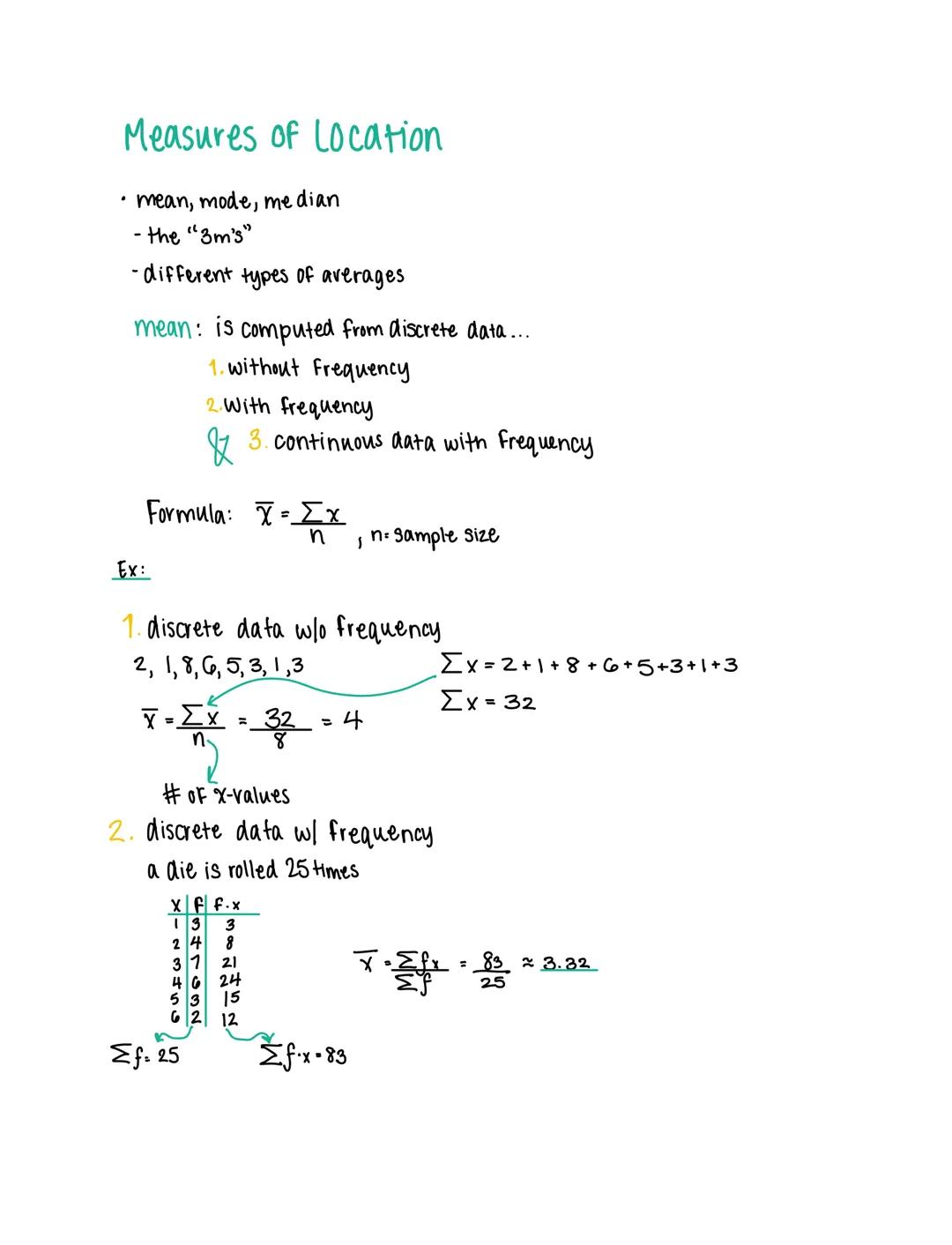
Understanding the Mean
The mean is the most common average, calculated by adding all values and dividing by the number of values. There are three ways to find the mean depending on your data.
For simple data without frequency (like 2, 1, 8, 6, 5, 3, 1, 3), just add all numbers and divide by how many there are: . This gives us the average value of our dataset.
When working with frequency data (like rolling a die 25 times), multiply each value by its frequency, add those products, and divide by the total frequency: . This technique saves time when dealing with repeated values.
Quick Tip: Always check that you're using the right version of the mean formula for your data type - simple discrete, frequency-based discrete, or continuous with frequency.
2
of 2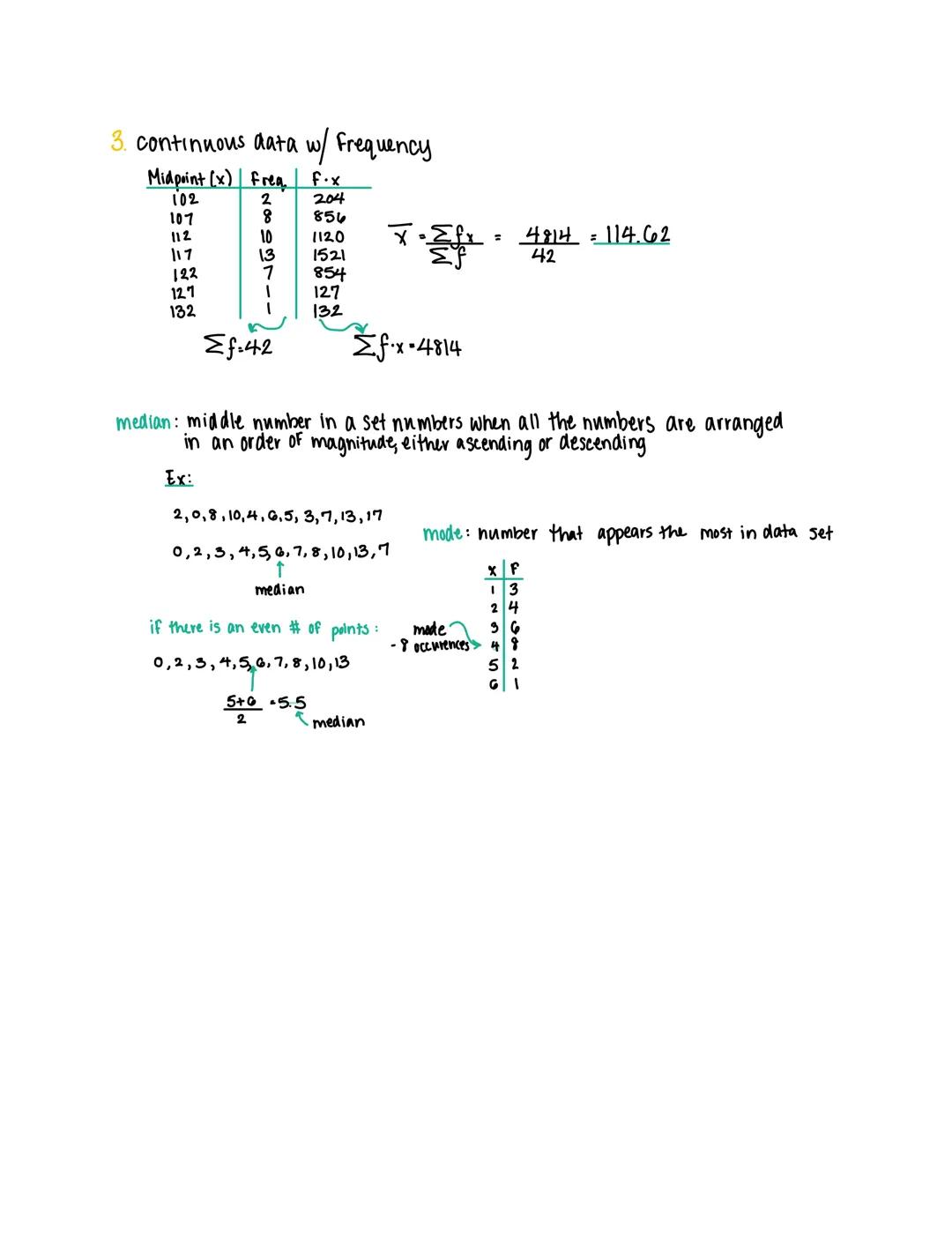
Finding Median and Mode
The median represents the middle value when all numbers are arranged in order. For an odd number of values (like 0,2,3,4,5,6,7,8,10,13,17), it's simply the middle number. For an even count, take the average of the two middle values like $\frac{5+6}{2} = 5.5$ in the sequence 0,2,3,4,5,6,7,8,10,13.
The mode is the value that appears most frequently in your dataset. In frequency tables, it's the value with the highest frequency. From our example table, 4 is the mode since it appears 8 times - more than any other value.
For continuous data with frequency, we use a similar approach as with discrete frequency data but work with midpoints of intervals. Calculate by multiplying each midpoint by its frequency, sum those products, and divide by the total frequency, just as we did with discrete data.
Why This Matters: Different measures of center tell different stories about your data. The mean can be affected by extreme values, while the median shows the middle point, and the mode shows what's most common - knowing all three gives you a complete picture!
We thought you’d never ask...
What is the Knowunity AI companion?
Our AI companion is specifically built for the needs of students. Based on the millions of content pieces we have on the platform we can provide truly meaningful and relevant answers to students. But its not only about answers, the companion is even more about guiding students through their daily learning challenges, with personalised study plans, quizzes or content pieces in the chat and 100% personalisation based on the students skills and developments.
Where can I download the Knowunity app?
You can download the app in the Google Play Store and in the Apple App Store.
Is Knowunity really free of charge?
That's right! Enjoy free access to study content, connect with fellow students, and get instant help – all at your fingertips.
Most popular content in Statistics
5Most popular content
9Can't find what you're looking for? Explore other subjects.
Students love us — and so will you.
4.6/5App Store
4.7/5Google Play
The app is very easy to use and well designed. I have found everything I was looking for so far and have been able to learn a lot from the presentations! I will definitely use the app for a class assignment! And of course it also helps a lot as an inspiration.
Stefan SiOS user
This app is really great. There are so many study notes and help [...]. My problem subject is French, for example, and the app has so many options for help. Thanks to this app, I have improved my French. I would recommend it to anyone.
Samantha KlichAndroid user
Wow, I am really amazed. I just tried the app because I've seen it advertised many times and was absolutely stunned. This app is THE HELP you want for school and above all, it offers so many things, such as workouts and fact sheets, which have been VERY helpful to me personally.
AnnaiOS user
Statistics59 views·Updated May 27, 2026·2 pagesUnderstanding Measures of Location: Mean, Median, and Mode
Statistics helps us make sense of data by finding its "center" in different ways. Measures of location, often called the "3 M's" - mean, median, and mode - are different types of averages that tell us where most of our... Show more
1
of 2Sign up to see the content. It's free!
- Access to all documents
- Improve your grades
- Join milions of students
Understanding the Mean
The mean is the most common average, calculated by adding all values and dividing by the number of values. There are three ways to find the mean depending on your data.
For simple data without frequency (like 2, 1, 8, 6, 5, 3, 1, 3), just add all numbers and divide by how many there are: . This gives us the average value of our dataset.
When working with frequency data (like rolling a die 25 times), multiply each value by its frequency, add those products, and divide by the total frequency: . This technique saves time when dealing with repeated values.
Quick Tip: Always check that you're using the right version of the mean formula for your data type - simple discrete, frequency-based discrete, or continuous with frequency.
2
of 2Sign up to see the content. It's free!
- Access to all documents
- Improve your grades
- Join milions of students
Finding Median and Mode
The median represents the middle value when all numbers are arranged in order. For an odd number of values (like 0,2,3,4,5,6,7,8,10,13,17), it's simply the middle number. For an even count, take the average of the two middle values like $\frac{5+6}{2} = 5.5$ in the sequence 0,2,3,4,5,6,7,8,10,13.
The mode is the value that appears most frequently in your dataset. In frequency tables, it's the value with the highest frequency. From our example table, 4 is the mode since it appears 8 times - more than any other value.
For continuous data with frequency, we use a similar approach as with discrete frequency data but work with midpoints of intervals. Calculate by multiplying each midpoint by its frequency, sum those products, and divide by the total frequency, just as we did with discrete data.
Why This Matters: Different measures of center tell different stories about your data. The mean can be affected by extreme values, while the median shows the middle point, and the mode shows what's most common - knowing all three gives you a complete picture!
We thought you’d never ask...
What is the Knowunity AI companion?
Our AI companion is specifically built for the needs of students. Based on the millions of content pieces we have on the platform we can provide truly meaningful and relevant answers to students. But its not only about answers, the companion is even more about guiding students through their daily learning challenges, with personalised study plans, quizzes or content pieces in the chat and 100% personalisation based on the students skills and developments.
Where can I download the Knowunity app?
You can download the app in the Google Play Store and in the Apple App Store.
Is Knowunity really free of charge?
That's right! Enjoy free access to study content, connect with fellow students, and get instant help – all at your fingertips.
Most popular content in Statistics
5Most popular content
9Can't find what you're looking for? Explore other subjects.
Students love us — and so will you.
4.6/5App Store
4.7/5Google Play
The app is very easy to use and well designed. I have found everything I was looking for so far and have been able to learn a lot from the presentations! I will definitely use the app for a class assignment! And of course it also helps a lot as an inspiration.
Stefan SiOS user
This app is really great. There are so many study notes and help [...]. My problem subject is French, for example, and the app has so many options for help. Thanks to this app, I have improved my French. I would recommend it to anyone.
Samantha KlichAndroid user
Wow, I am really amazed. I just tried the app because I've seen it advertised many times and was absolutely stunned. This app is THE HELP you want for school and above all, it offers so many things, such as workouts and fact sheets, which have been VERY helpful to me personally.
AnnaiOS user