
Imparare i tempi futuri e il congiuntivo in spagnolo può...
 Spagnolo1,202 views·Updated Jun 25, 2026·4 pages
Impara il Condizionale e Futuro in Spagnolo
G
Giada Siviero@giadasiviero_fdrz
1 / 4
1
of 4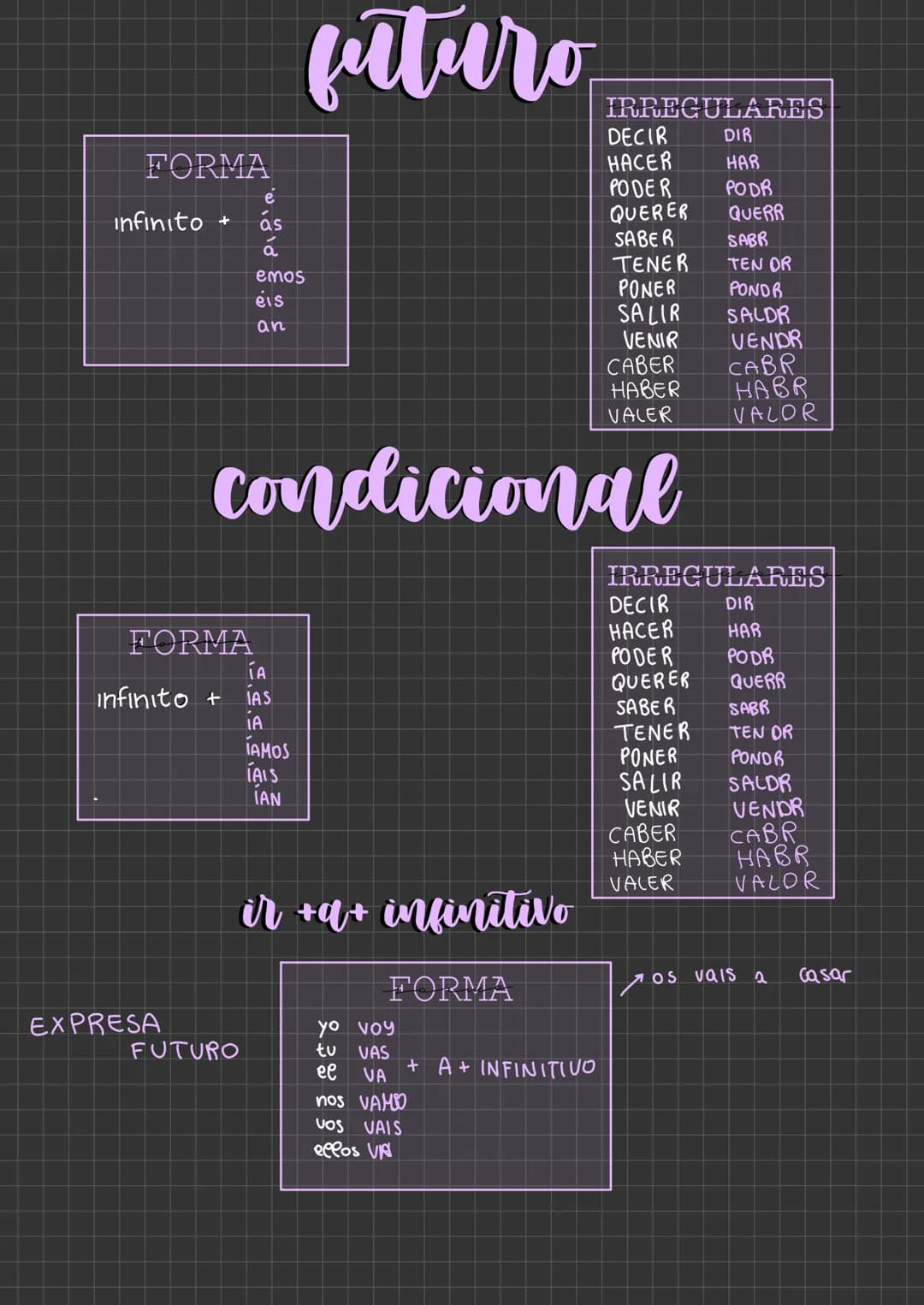
Futuro e Condizionale: Le Basi
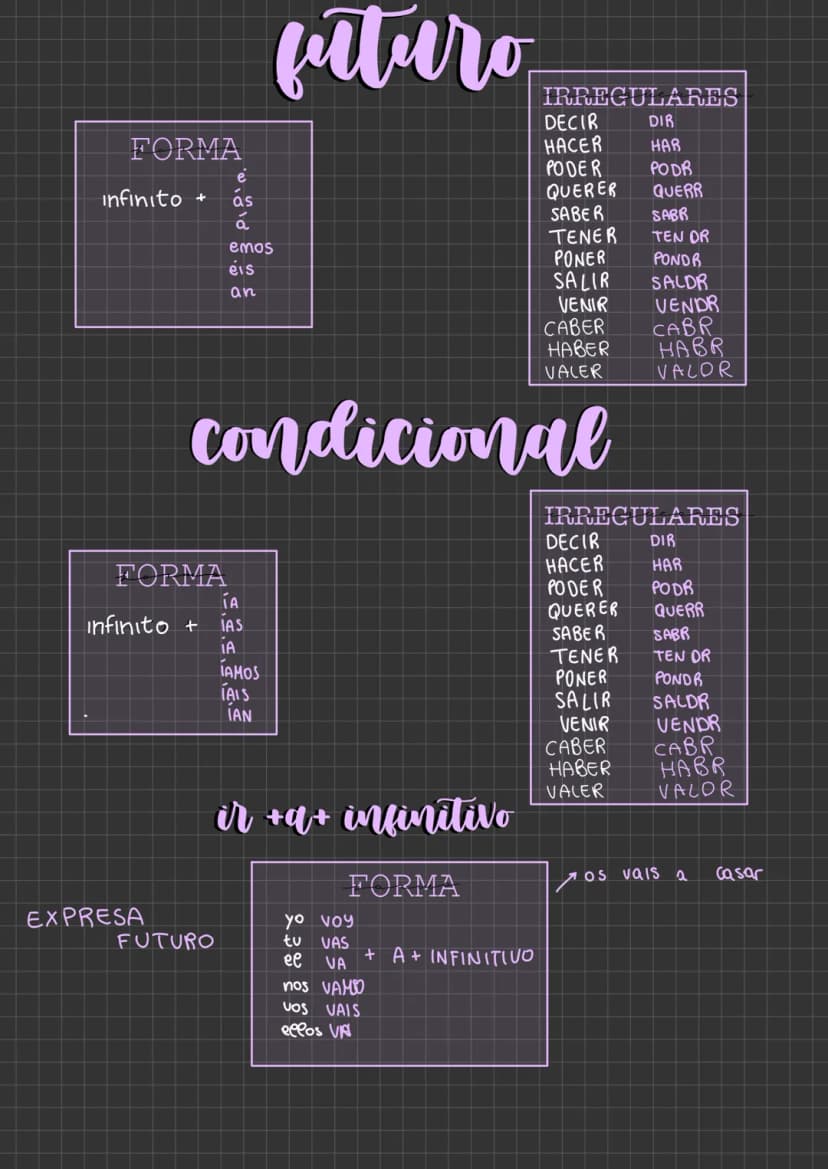
Il futuro in spagnolo si forma aggiungendo le terminazioni -é, -ás, -á, -emos, -éis, -án direttamente all'infinito del verbo. È super semplice perché funziona uguale per tutti i gruppi di verbi!
Il condizionale segue lo stesso principio: infinito + -ía, -ías, -ía, -íamos, -íais, -ían. Pensa al condizionale come al "would" inglese - esprime qualcosa che potrebbe accadere.
Alcuni verbi sono irregolari e cambiano la radice: DECIR diventa DIR-, HACER diventa HAR-, PODER diventa PODR-. Memorizza queste forme irregolari perché le userai spessissimo!
💡 Trucco: Puoi anche usare IR + A + infinitivo per il futuro immediato, come "voy a estudiar" (sto per studiare).
2
of 4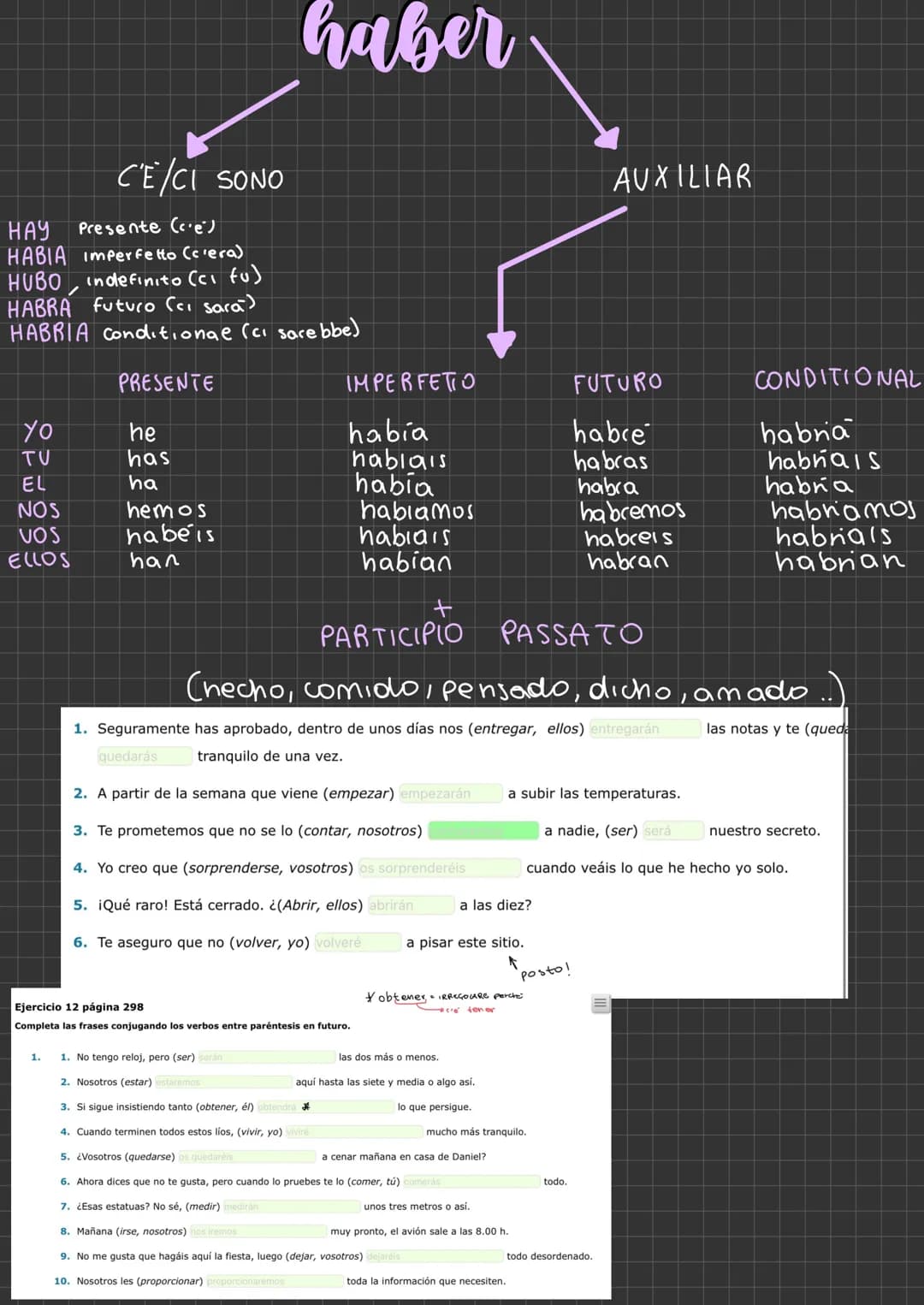
Il Verbo HABER: Il Tuo Migliore Alleato
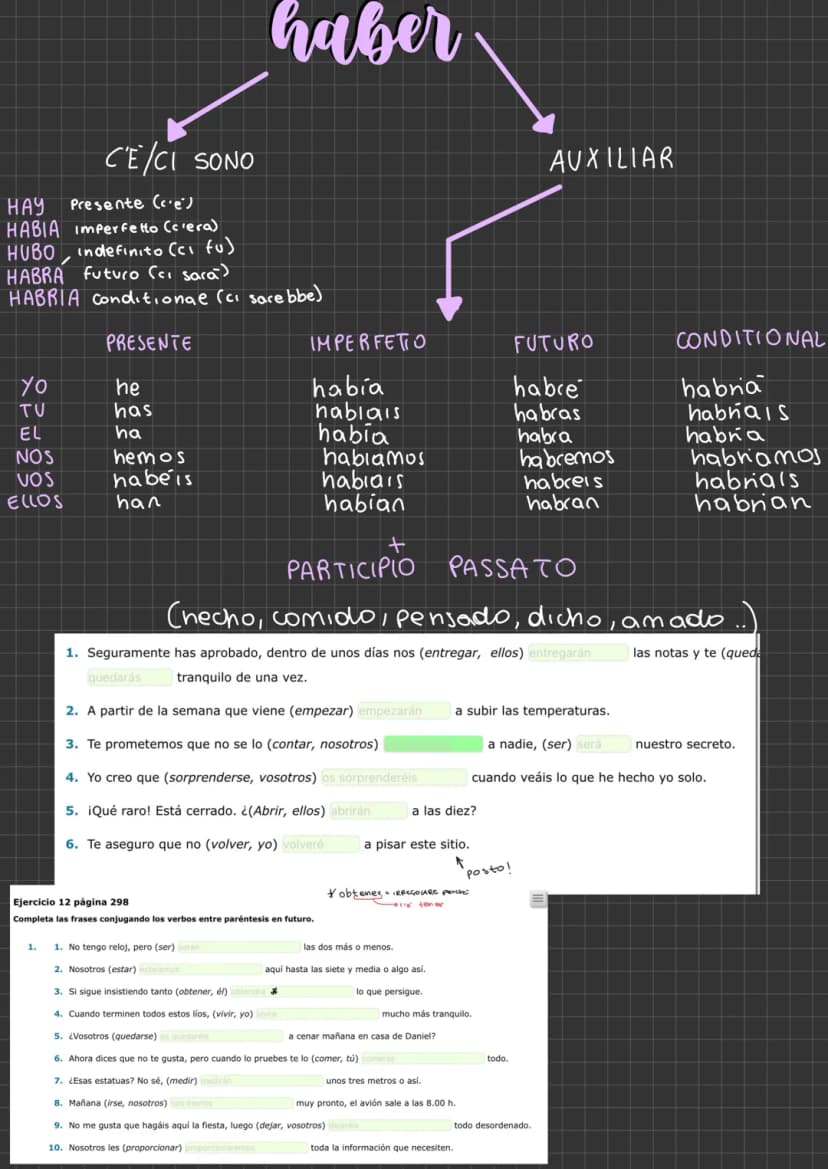
HABER è fondamentale perché ha due funzioni principali: esprime esistenza (c'è/ci sono) e funziona come ausiliare per i tempi composti. Quando significa "esserci", usa sempre la forma impersonale HAY (presente), HABÍA (imperfetto), HUBO (passato), HABRÁ (futuro).
Come ausiliare, HABER si coniuga normalmente: he, has, ha, hemos, habéis, han al presente. Si combina sempre con il participio passato per formare tempi come il passato prossimo.
Il participio si forma aggiungendo -ado (verbi in -ar) o -ido (verbi in -er/-ir). Attenzione ai participi irregolari come HECHO, DICHO, VISTO!
💡 Ricorda: HABER + participio = tempi composti. È la chiave per padroneggiare il passato prossimo e il futuro perfetto!
3
of 4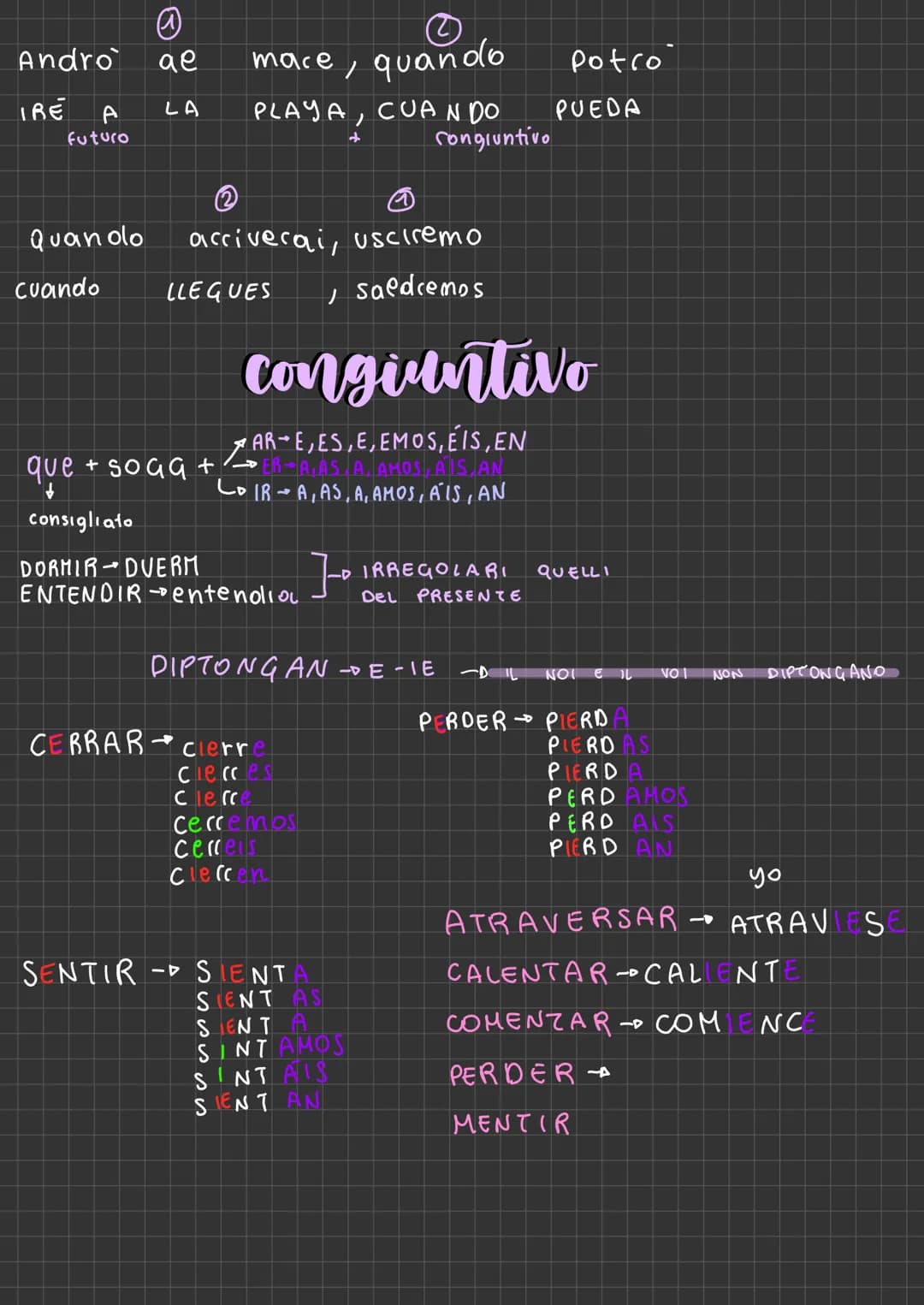
Il Congiuntivo: Quando Usarlo
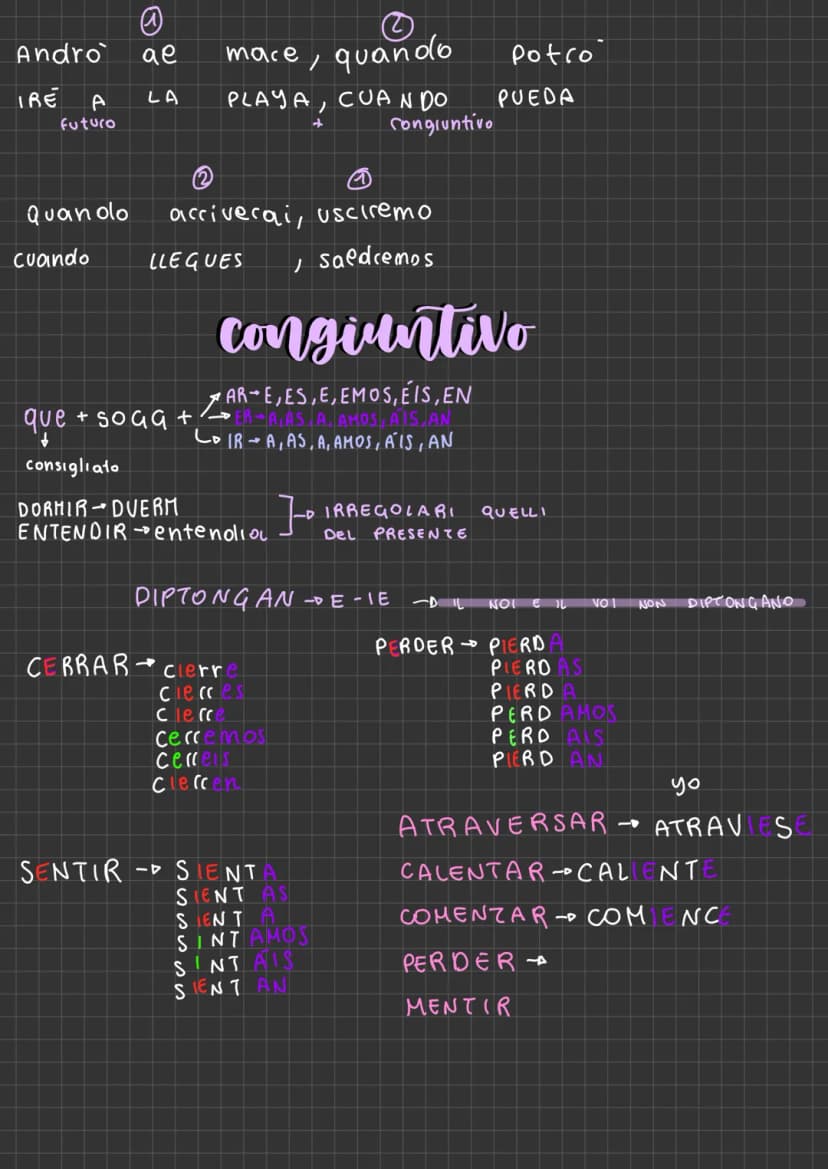
Il congiuntivo si usa dopo espressioni temporali come CUANDO, EN CUANTO, TAN PRONTO quando il senso è futuro. È diverso dall'italiano! Se dici "Quando arriverai, usciremo", in spagnolo è "Cuando LLEGUES, saldremos".
Per formarlo, parti dalla prima persona del presente indicativo e cambia le vocali: verbi in -ar diventano -e, -es, -e, -emos, -éis, -en. I verbi in -er/-ir diventano -a, -as, -a, -amos, -áis, -an.
I verbi con dittongo (e→ie, o→ue) mantengono questa caratteristica nel congiuntivo, eccetto nel NOI e VOI: CERRAR → cierre, cierres, cierre, cerremos, cerréis, cierren.
💡 Strategia: Se la frase esprime futuro dopo CUANDO/EN CUANTO/ANTES DE QUE, usa sempre il congiuntivo!
4
of 4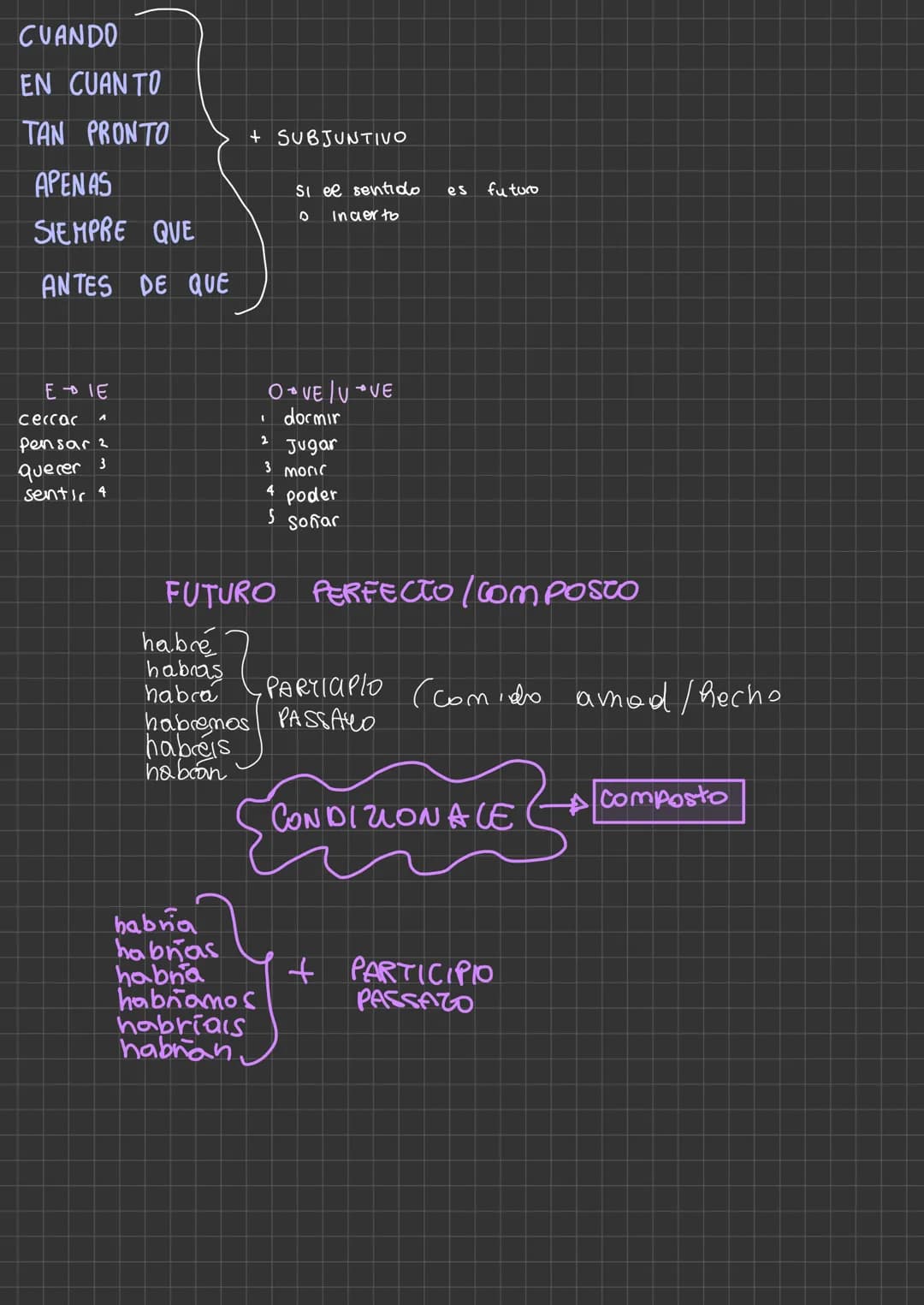
Tempi Composti del Futuro
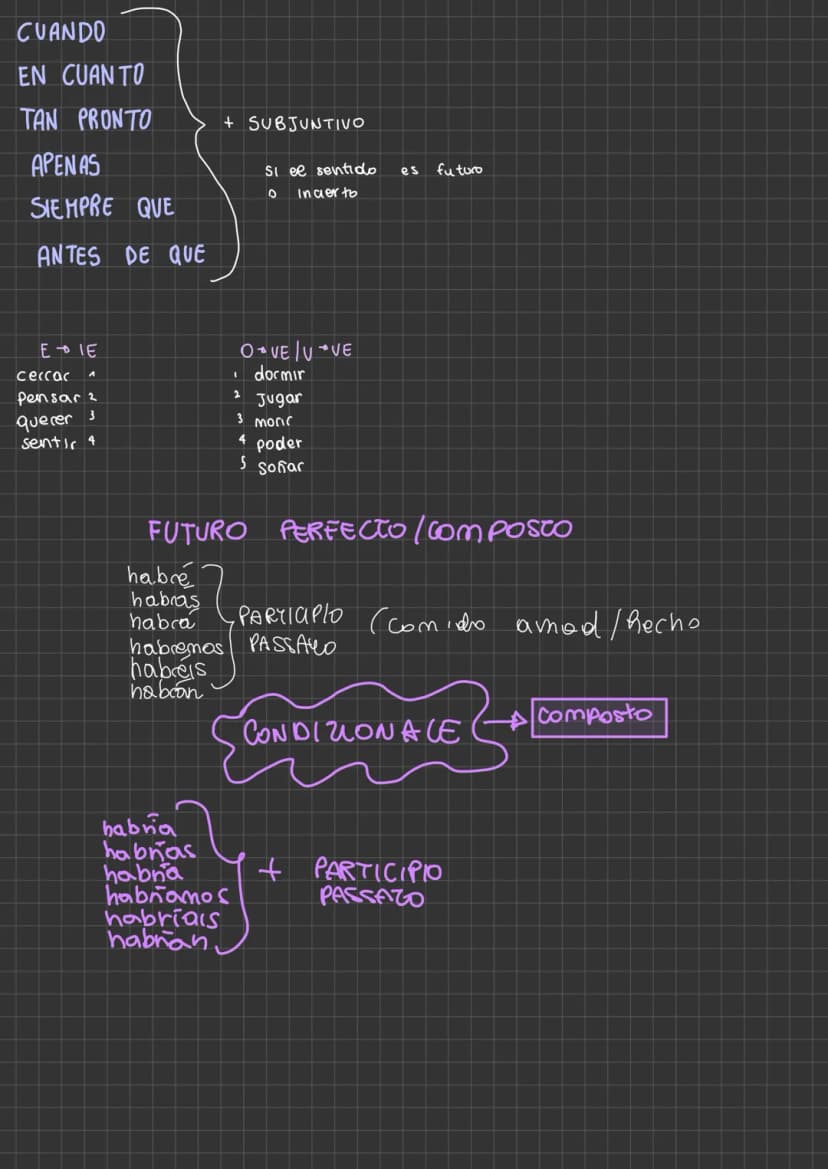
Il futuro perfetto (futuro composto) si forma con HABER al futuro + participio passato: habré, habrás, habrá, habremos, habréis, habrán + participio. Esprime un'azione che sarà completata prima di un momento futuro.
Il condizionale composto segue la stessa logica: HABER al condizionale + participio passato. Lo usi per esprimere qualcosa che sarebbe successo nel passato.
Le congiunzioni temporali come CUANDO, EN CUANTO, TAN PRONTO, APENAS, SIEMPRE QUE richiedono sempre il congiuntivo quando si riferiscono al futuro.
💡 Consiglio finale: Pratica questi tempi con frasi della vita quotidiana - diventeranno automatici più velocemente di quanto pensi!
We thought you’d never ask...
Our AI companion is specifically built for the needs of students. Based on the millions of content pieces we have on the platform we can provide truly meaningful and relevant answers to students. But its not only about answers, the companion is even more about guiding students through their daily learning challenges, with personalised study plans, quizzes or content pieces in the chat and 100% personalisation based on the students skills and developments.
You can download the app in the Google Play Store and in the Apple App Store.
That's right! Enjoy free access to study content, connect with fellow students, and get instant help – all at your fingertips.
Similar Content
 Espagnol
 Język hiszpański
Most popular content: conjugaciones verbales
9SpagnoloTempi del passato in spagnolo
Appunti per i tempi del passato in spagnolo
2ªl1,97539
Spagnolopresente congiuntivo spagnolo
presente subjuntivo con irregolari
3ªl1,04914
SpagnoloRipasso generale di spagnolo
Studio base di spanolo: giorni della settimana, mesi, colori, numeri… forma del verbo presente
3ªl2,669100
SpagnoloPretérito indefinido
appunti pretérito indefinido
1ªl64812
SpagnoloPresente de indicativo regolare e irregular
Presente indicativo regolare e i regolare in spagnolo
2ªm1,95324
SpagnoloLos cuatros tiempos verbales pasados
Pretérito perfecto, pretérito imperfecto, pretérito pluscuamperfecto y pretérito indefinido. Los marcadores temporales y los irregulares.
1ªl1,98054
Spagnolopreterito indefinido
passato remoto in spagnolo, con esempi di verbi coniugati e regole
2ªm2,24271
Spagnoloverbi spagnolo
cose essenziali da ricordare per i verbi più comuni della grammatica spagnola
3ªl6,591316
SpagnoloVerbos: modo subjuntivo
Conjugaciones, usos, marcadores temporales y verbos irregulares de: presente de subjuntivo, pretérito perfecto de subjuntivo, pretérito imperfecto de subjuntivo y pretérito pluscuamperfecto de subjuntivo.
3ªl1,36234
Most popular content in Spagnolo
9S
Spagnolospagnolo, descrizioni caratteri, verbi irregolari, ir e estar e ser
unità 3 del libro "venga vamos" della 1 media
1ªm1,2712
Q
SpagnoloQUIZ SPAGNOLI
semplice
1ªm1,2613
L
SpagnoloLos muebles y los objetos de la casa
Léxico unidad 3
1ªl6133
S
SpagnoloSER quiz
quiz sul verbo ser (essere) in spagnolo
1ªm7406
M
SpagnoloMUY O MUCHO?
indovina il termine corretto
1ªm3391
P
SpagnoloPOR / PARA
Esercizi sull’uso di Por e Para
1ªm2,7711
SpagnoloGrammatica spagnolo pt1
Basi della grammatica spagnola
1ªl2,03451
SpagnoloLessico base spagnolo
Numeri (Numeros), Profesiones, Colori (Colores),Mesi (Meses),Settimana (Semana),Famiglia(Familia),Animali (Animales), Asignaturas(Materie),Ore,Giorno(Horas, Día),Stagioni(Estaciones),Festività(Fiestas),Cibo(Comida),Casa,Vestiti(Ropa),Parti Corpo(Cuerpo)
1ªm20,4732,081
SpagnoloPROGRAMMA COMPLETO DI SPAGNOLO
El romanticismo (Josè de Espronceda y Bequer), el realismo (La Regenta), el modernismo (Rubén Darío), la generación del 98 (Antonio Machado y Miguel de Unamuno) y la generación del 27 (Federico Garcia Lorca)
5ªl56815
Most popular content
9 Italiano
Riassunto patente B
Riassunto patente B - appunti presi a lezione
5ªl29,376947
 Altro
AltroTeoria patente b
Tutti gli argomenti per la patente
1ªl21,333690
 Ed. civ.
Teoria patente di guida B: Segnali stradali
Segnali stradali di pericolo, luminosi, di prescrizione, di indicazione, temporanei, complementari, pannelli integrativi, segnaletica orizzontale, segnalazioni agenti del traffico, distanza di visibilità per l‘arresto, minima di sicurezza.
5ªl40,1961,649
 Filosofia
Aristotele
Aristotele: vita, metafisica, fisica, etica e politica, retorica e poetica
3ªl7,624216
ItalianoI promessi sposi
Riassunti completi di tutti i 38 capitoli dei Promessi sposi.
2ªl14,092314
AltroPATENTE
schemi per esame teorico della patente
Università22,177758
S
ItalianoSintesi finale di Analisi logica
Esercitazione completa di analisi logica su frasi articolate per consolidare la conoscenza di tutti i complementi.
3ªm5,5400
P
 Inglese
Present Simple vs Present Continuous
Develop the ability to choose correctly between the Present Simple for habits and the Present Continuous for ongoing actions.
3ªm4,2190
G
ItalianoGabriele D'Annunzio e l'Estetismo
Domande sull'ideale del superuomo, il panismo e la concezione dell'arte come valore assoluto in D'Annunzio.
4ªl2,6740
Students love us — and so will you.
4.6/5App Store
4.7/5Google Play
The app is very easy to use and well designed. I have found everything I was looking for so far and have been able to learn a lot from the presentations! I will definitely use the app for a class assignment! And of course it also helps a lot as an inspiration.
Stefan SiOS user
This app is really great. There are so many study notes and help [...]. My problem subject is French, for example, and the app has so many options for help. Thanks to this app, I have improved my French. I would recommend it to anyone.
Samantha KlichAndroid user
Wow, I am really amazed. I just tried the app because I've seen it advertised many times and was absolutely stunned. This app is THE HELP you want for school and above all, it offers so many things, such as workouts and fact sheets, which have been VERY helpful to me personally.
AnnaiOS user
Spagnolo1,202 views·Updated Jun 25, 2026·4 pagesImpara il Condizionale e Futuro in Spagnolo
G
Giada Siviero@giadasiviero_fdrz
Imparare i tempi futuri e il congiuntivo in spagnolo può sembrare complicato, ma in realtà seguono schemi logici che puoi padroneggiare facilmente! Scopriamo insieme come formare il futuro, il condizionale e quando usare il congiuntivo nelle frasi temporali.
1
of 4
Sign up to see the content. It's free!
- Access to all documents
- Improve your grades
- Join milions of students
Futuro e Condizionale: Le Basi
Il futuro in spagnolo si forma aggiungendo le terminazioni -é, -ás, -á, -emos, -éis, -án direttamente all'infinito del verbo. È super semplice perché funziona uguale per tutti i gruppi di verbi!
Il condizionale segue lo stesso principio: infinito + -ía, -ías, -ía, -íamos, -íais, -ían. Pensa al condizionale come al "would" inglese - esprime qualcosa che potrebbe accadere.
Alcuni verbi sono irregolari e cambiano la radice: DECIR diventa DIR-, HACER diventa HAR-, PODER diventa PODR-. Memorizza queste forme irregolari perché le userai spessissimo!
💡 Trucco: Puoi anche usare IR + A + infinitivo per il futuro immediato, come "voy a estudiar" (sto per studiare).
2
of 4Sign up to see the content. It's free!
- Access to all documents
- Improve your grades
- Join milions of students
Il Verbo HABER: Il Tuo Migliore Alleato
HABER è fondamentale perché ha due funzioni principali: esprime esistenza (c'è/ci sono) e funziona come ausiliare per i tempi composti. Quando significa "esserci", usa sempre la forma impersonale HAY (presente), HABÍA (imperfetto), HUBO (passato), HABRÁ (futuro).
Come ausiliare, HABER si coniuga normalmente: he, has, ha, hemos, habéis, han al presente. Si combina sempre con il participio passato per formare tempi come il passato prossimo.
Il participio si forma aggiungendo -ado (verbi in -ar) o -ido (verbi in -er/-ir). Attenzione ai participi irregolari come HECHO, DICHO, VISTO!
💡 Ricorda: HABER + participio = tempi composti. È la chiave per padroneggiare il passato prossimo e il futuro perfetto!
3
of 4Sign up to see the content. It's free!
- Access to all documents
- Improve your grades
- Join milions of students
Il Congiuntivo: Quando Usarlo
Il congiuntivo si usa dopo espressioni temporali come CUANDO, EN CUANTO, TAN PRONTO quando il senso è futuro. È diverso dall'italiano! Se dici "Quando arriverai, usciremo", in spagnolo è "Cuando LLEGUES, saldremos".
Per formarlo, parti dalla prima persona del presente indicativo e cambia le vocali: verbi in -ar diventano -e, -es, -e, -emos, -éis, -en. I verbi in -er/-ir diventano -a, -as, -a, -amos, -áis, -an.
I verbi con dittongo (e→ie, o→ue) mantengono questa caratteristica nel congiuntivo, eccetto nel NOI e VOI: CERRAR → cierre, cierres, cierre, cerremos, cerréis, cierren.
💡 Strategia: Se la frase esprime futuro dopo CUANDO/EN CUANTO/ANTES DE QUE, usa sempre il congiuntivo!
4
of 4Sign up to see the content. It's free!
- Access to all documents
- Improve your grades
- Join milions of students
Tempi Composti del Futuro
Il futuro perfetto (futuro composto) si forma con HABER al futuro + participio passato: habré, habrás, habrá, habremos, habréis, habrán + participio. Esprime un'azione che sarà completata prima di un momento futuro.
Il condizionale composto segue la stessa logica: HABER al condizionale + participio passato. Lo usi per esprimere qualcosa che sarebbe successo nel passato.
Le congiunzioni temporali come CUANDO, EN CUANTO, TAN PRONTO, APENAS, SIEMPRE QUE richiedono sempre il congiuntivo quando si riferiscono al futuro.
💡 Consiglio finale: Pratica questi tempi con frasi della vita quotidiana - diventeranno automatici più velocemente di quanto pensi!
We thought you’d never ask...
Our AI companion is specifically built for the needs of students. Based on the millions of content pieces we have on the platform we can provide truly meaningful and relevant answers to students. But its not only about answers, the companion is even more about guiding students through their daily learning challenges, with personalised study plans, quizzes or content pieces in the chat and 100% personalisation based on the students skills and developments.
You can download the app in the Google Play Store and in the Apple App Store.
That's right! Enjoy free access to study content, connect with fellow students, and get instant help – all at your fingertips.
Similar Content
Most popular content: conjugaciones verbales
9SpagnoloTempi del passato in spagnolo
Appunti per i tempi del passato in spagnolo
2ªl1,97539
Spagnolopresente congiuntivo spagnolo
presente subjuntivo con irregolari
3ªl1,04914
SpagnoloRipasso generale di spagnolo
Studio base di spanolo: giorni della settimana, mesi, colori, numeri… forma del verbo presente
3ªl2,669100
SpagnoloPretérito indefinido
appunti pretérito indefinido
1ªl64812
SpagnoloPresente de indicativo regolare e irregular
Presente indicativo regolare e i regolare in spagnolo
2ªm1,95324
SpagnoloLos cuatros tiempos verbales pasados
Pretérito perfecto, pretérito imperfecto, pretérito pluscuamperfecto y pretérito indefinido. Los marcadores temporales y los irregulares.
1ªl1,98054
Spagnolopreterito indefinido
passato remoto in spagnolo, con esempi di verbi coniugati e regole
2ªm2,24271
Spagnoloverbi spagnolo
cose essenziali da ricordare per i verbi più comuni della grammatica spagnola
3ªl6,591316
SpagnoloVerbos: modo subjuntivo
Conjugaciones, usos, marcadores temporales y verbos irregulares de: presente de subjuntivo, pretérito perfecto de subjuntivo, pretérito imperfecto de subjuntivo y pretérito pluscuamperfecto de subjuntivo.
3ªl1,36234
Most popular content in Spagnolo
9S
Spagnolospagnolo, descrizioni caratteri, verbi irregolari, ir e estar e ser
unità 3 del libro "venga vamos" della 1 media
1ªm1,2712
Q
SpagnoloQUIZ SPAGNOLI
semplice
1ªm1,2613
L
SpagnoloLos muebles y los objetos de la casa
Léxico unidad 3
1ªl6133
S
SpagnoloSER quiz
quiz sul verbo ser (essere) in spagnolo
1ªm7406
M
SpagnoloMUY O MUCHO?
indovina il termine corretto
1ªm3391
P
SpagnoloPOR / PARA
Esercizi sull’uso di Por e Para
1ªm2,7711
SpagnoloGrammatica spagnolo pt1
Basi della grammatica spagnola
1ªl2,03451
SpagnoloLessico base spagnolo
Numeri (Numeros), Profesiones, Colori (Colores),Mesi (Meses),Settimana (Semana),Famiglia(Familia),Animali (Animales), Asignaturas(Materie),Ore,Giorno(Horas, Día),Stagioni(Estaciones),Festività(Fiestas),Cibo(Comida),Casa,Vestiti(Ropa),Parti Corpo(Cuerpo)
1ªm20,4732,081
SpagnoloPROGRAMMA COMPLETO DI SPAGNOLO
El romanticismo (Josè de Espronceda y Bequer), el realismo (La Regenta), el modernismo (Rubén Darío), la generación del 98 (Antonio Machado y Miguel de Unamuno) y la generación del 27 (Federico Garcia Lorca)
5ªl56815
Most popular content
9ItalianoRiassunto patente B
Riassunto patente B - appunti presi a lezione
5ªl29,376947
AltroTeoria patente b
Tutti gli argomenti per la patente
1ªl21,333690
Ed. civ.Teoria patente di guida B: Segnali stradali
Segnali stradali di pericolo, luminosi, di prescrizione, di indicazione, temporanei, complementari, pannelli integrativi, segnaletica orizzontale, segnalazioni agenti del traffico, distanza di visibilità per l‘arresto, minima di sicurezza.
5ªl40,1961,649
FilosofiaAristotele
Aristotele: vita, metafisica, fisica, etica e politica, retorica e poetica
3ªl7,624216
ItalianoI promessi sposi
Riassunti completi di tutti i 38 capitoli dei Promessi sposi.
2ªl14,092314
AltroPATENTE
schemi per esame teorico della patente
Università22,177758
S
ItalianoSintesi finale di Analisi logica
Esercitazione completa di analisi logica su frasi articolate per consolidare la conoscenza di tutti i complementi.
3ªm5,5400
P
InglesePresent Simple vs Present Continuous
Develop the ability to choose correctly between the Present Simple for habits and the Present Continuous for ongoing actions.
3ªm4,2190
G
ItalianoGabriele D'Annunzio e l'Estetismo
Domande sull'ideale del superuomo, il panismo e la concezione dell'arte come valore assoluto in D'Annunzio.
4ªl2,6740
Students love us — and so will you.
4.6/5App Store
4.7/5Google Play
The app is very easy to use and well designed. I have found everything I was looking for so far and have been able to learn a lot from the presentations! I will definitely use the app for a class assignment! And of course it also helps a lot as an inspiration.
Stefan SiOS user
This app is really great. There are so many study notes and help [...]. My problem subject is French, for example, and the app has so many options for help. Thanks to this app, I have improved my French. I would recommend it to anyone.
Samantha KlichAndroid user
Wow, I am really amazed. I just tried the app because I've seen it advertised many times and was absolutely stunned. This app is THE HELP you want for school and above all, it offers so many things, such as workouts and fact sheets, which have been VERY helpful to me personally.
AnnaiOS user