
Energy transfer is happening all around you - from the...
 Physics190 views·Updated Jun 27, 2026·3 pages
Understanding Heat Energy Transfer - Physics P2 Study Guide

Patryk Wielgus@patryk_wielgus


1 / 3
1
of 3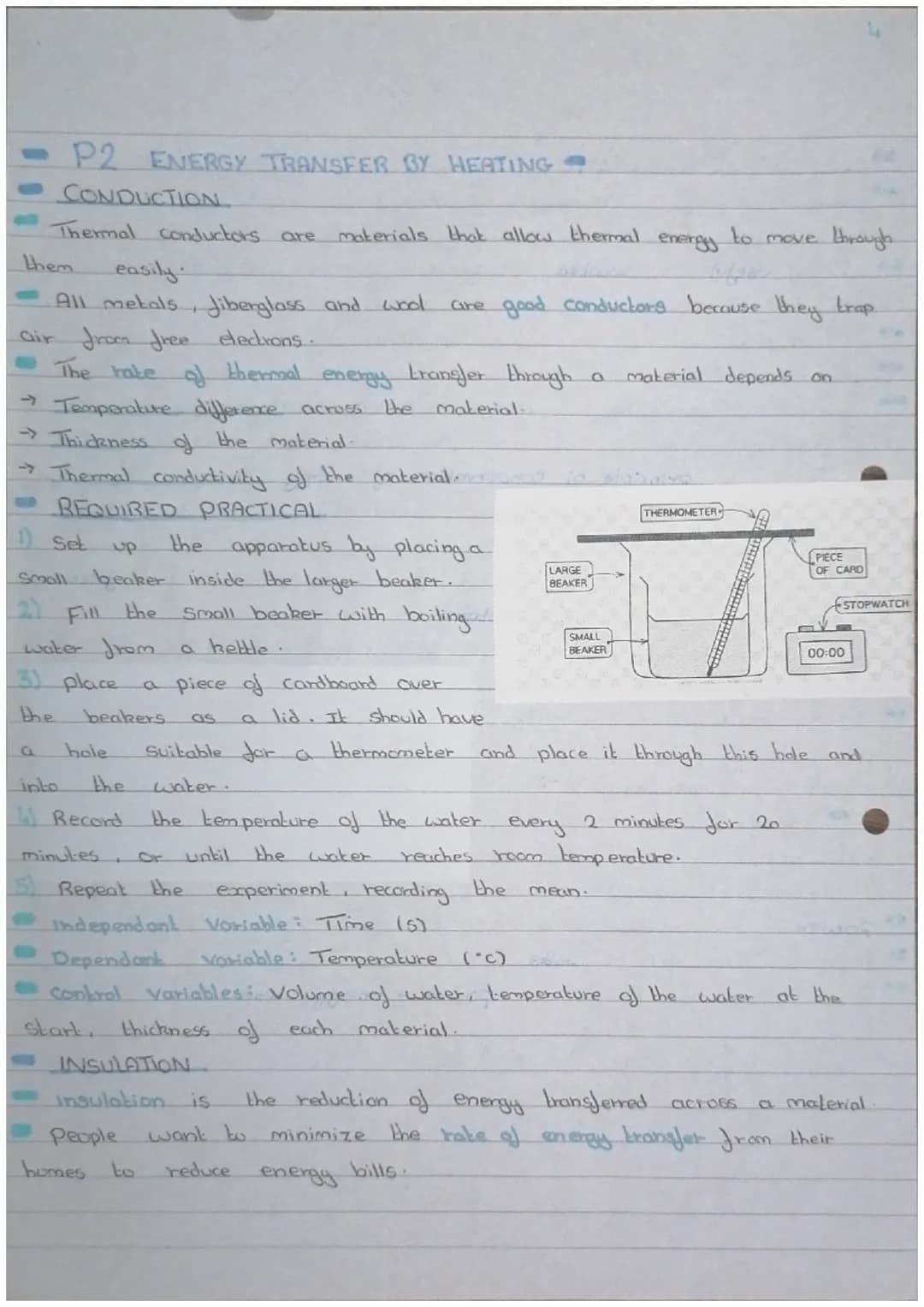
Understanding Heat Conduction
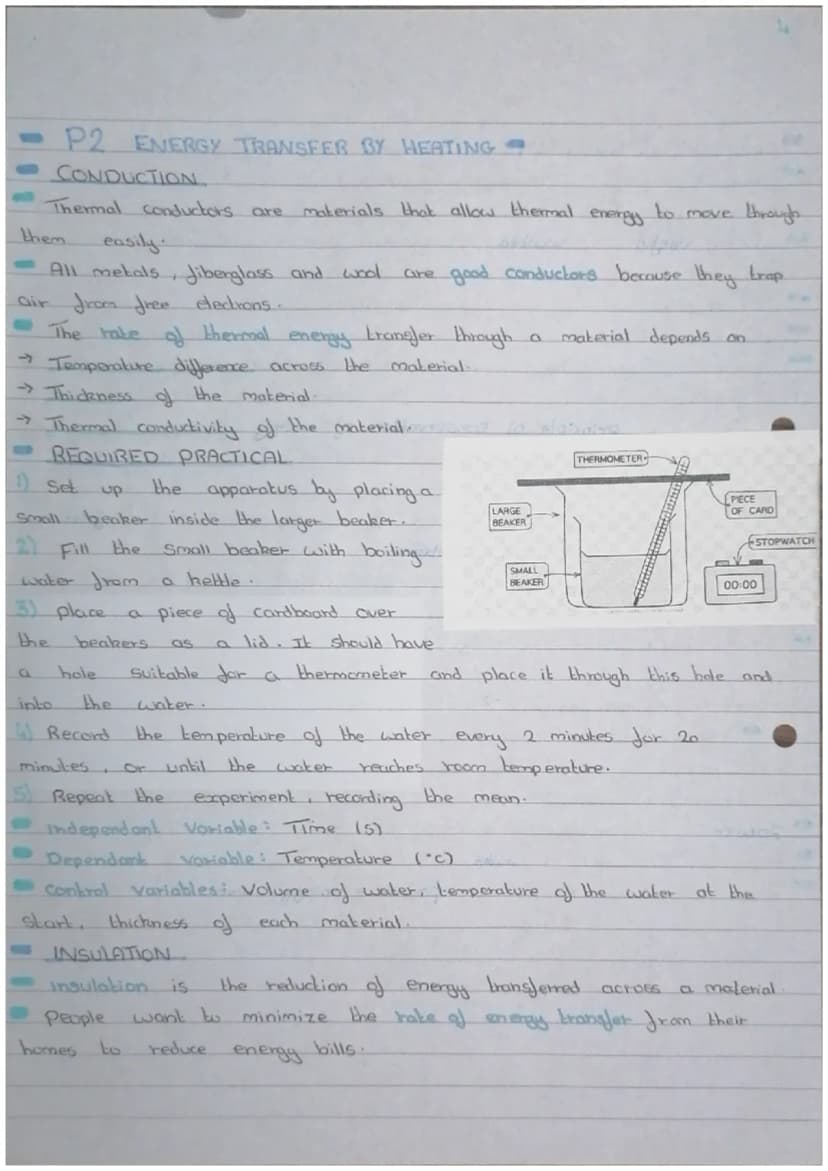
Ever wondered why metal spoons get hot in your tea but plastic ones don't? It's all about thermal conductors - materials that let heat move through them easily. Metals are brilliant at this because of their free electrons that carry energy around.
The speed at which heat moves depends on three key factors: how big the temperature difference is, how thick the material is, and what it's actually made of. Think of it like water flowing through a pipe - the bigger the pressure difference and the wider the pipe, the faster it flows.
Insulation works by doing the opposite - it reduces energy transfer to keep heat where you want it. This is why people spend money on home insulation - it literally saves them cash on heating bills by keeping warm air inside where it belongs.
Quick Tip: In your practical experiment, you'll measure how temperature changes over time by timing cooling water every 2 minutes for 20 minutes.
2
of 3
Keeping Homes Warm and Heat Loss Prevention
Your home is constantly losing heat through five main escape routes, but there are clever ways to block each one. Double glazing traps air between glass panes because air is rubbish at conducting heat. Loft insulation stops warm air from sneaking out through your roof.
Cavity wall insulation involves pumping special material into the gap between your walls. This stops heat escaping and prevents convection currents from forming. Even simple things like carpets and draught excluders make a real difference to your energy bills.
Infrared radiation is the invisible electromagnetic wave that carries heat energy - you can actually feel it on your skin when you're near something warm. All objects give off this radiation, and the hotter they are, the more they emit.
A perfect black body absorbs every bit of radiation that hits it, making it also the best possible emitter. This is why dark, matt surfaces heat up faster than shiny, light-coloured ones.
Real World Connection: Earth's temperature depends entirely on balancing the infrared radiation we absorb from the sun with what we emit back to space.
3
of 3
Measuring Heat and Specific Heat Capacity
The Leslie cube practical shows you how different surfaces emit infrared radiation at different rates. You'll fill it with boiling water, let the surfaces heat up for a minute, then use an infrared detector to measure emission intensity from each surface at the same distance.
Specific heat capacity tells you how much energy you need to heat up 1kg of something by 1°C. It's like asking "how stubborn is this material about getting warmer?" The formula is straightforward: Energy = mass × specific heat capacity × temperature change.
Materials with high specific heat capacity need loads of energy to warm up (like water), whilst others heat up quickly with just a little energy (like metals). This explains why water takes ages to boil but a metal pan heats up almost instantly.
In the required practical, you'll heat an aluminium block with an electrical heater, measuring voltage and current every minute for 10 minutes. Even after switching off, the temperature keeps rising for a bit - this is normal and shows heat is still spreading through the block.
Exam Success: Remember that specific heat capacity can be rearranged - you might need to find heat capacity = energy ÷ (mass × temperature change).
We thought you’d never ask...
Our AI companion is specifically built for the needs of students. Based on the millions of content pieces we have on the platform we can provide truly meaningful and relevant answers to students. But its not only about answers, the companion is even more about guiding students through their daily learning challenges, with personalised study plans, quizzes or content pieces in the chat and 100% personalisation based on the students skills and developments.
You can download the app in the Google Play Store and in the Apple App Store.
That's right! Enjoy free access to study content, connect with fellow students, and get instant help – all at your fingertips.
Similar Content
Most popular content: Heat Transfer
2PhysicsEnergy Resources Overview
Explore key concepts in energy resources, including types of energy, efficiency, and thermal insulation. This comprehensive guide covers essential topics such as gravitational potential energy, energy transfer, and the National Grid, with practical examples and past paper questions to enhance your understanding. Ideal for students preparing for AQA Physics exams.
92,342154
PhysicsThermal Energy Transfer Insights
Explore key concepts of thermal energy transfer, including black body radiation, specific heat capacity, and insulation materials. This summary covers the principles of energy transfer, thermal conductivity, and practical applications in heating systems and insulation methods. Ideal for AQA GCSE Physics students.
1145811
Most popular content in Physics
9PhysicsForces and Motion Overview
Explore key concepts in Forces and Motion, including Hooke's Law, velocity, acceleration, and the principles of moments. This summary covers essential topics such as the relationship between force and extension, terminal velocity, and the impact of safety devices in physics. Ideal for AQA Physics Unit 5 revision.
109,191872
G
PhysicsGCSE Physics - Energy stores and Systems
Pl-Energy topic to revise for GCSE
101,3742
C
PhysicsConservation of energy- energy types and stores
Build a strong foundation in physics with these easy flashcards covering key concepts and principles.
96391
PhysicsPhysics Paper 2 Essentials
Master key concepts for AQA Combined Physics Paper 2, including electromagnetic waves, mechanics, forces, and motion. This comprehensive summary covers essential topics like wave properties, Newton's laws, and the motor effect, ensuring you're well-prepared for your exam.
1116,072940
PhysicsGCSE Physics Practical Experiments
Explore essential GCSE Physics practicals for AQA, covering key concepts such as Hooke's Law, wave properties, thermal insulation, and electrical circuits. This comprehensive guide includes step-by-step procedures, variables, and safety considerations for each experiment, ensuring a thorough understanding of practical applications in physics.
1011,409477
P
PhysicsPhysics Made Easy: Essential Concepts for Grade 10 Students
Master the fundamentals of physics with this comprehensive flashcard set designed specifically for grade 10 students. Learn key concepts and principles in an easy and engaging way!
104531
Physicsphysics paper 2 foundation notes
aqa combined science physics paper 2 foundation notes
101,33038
PhysicsPhysics paper 2 notes
physics aqa gcse paper 2 combined higher notes
101,24111
P
PhysicsPhysics Quiz - Current, Charge and Power
AQA physics quiz.
111,0262
Most popular content
9 Sociology
Sociology of Education Overview
Explore comprehensive A-Level Sociology notes on the education system, covering key theories, policies, and sociological perspectives. This resource includes insights on marketisation, gender roles, cultural deprivation, and educational inequalities, providing a thorough understanding of how education shapes social stratification and individual achievement. Ideal for exam preparation and in-depth study.
12102,8913,041
SociologySociology of Families: Comprehensive Revision
Dive into an extensive overview of family dynamics, perspectives, and patterns in sociology. This resource covers key concepts such as family diversity, gender roles, marriage, and the impact of social policies on family structures. Perfect for A-Level Sociology students preparing for Paper 2.
1273,6832,307
CriminologyCriminology: Crime & Punishment Overview
Comprehensive mindmaps covering key concepts in the Crime and Punishment topic for WJEC Criminology Unit 4. This resource includes detailed insights into the Criminal Justice System, crime prevention strategies, sentencing models, and the roles of various agencies. Ideal for A-Level revision, ensuring you grasp essential theories and legislative processes to excel in your exams.
1254,8751,059
SociologyComprehensive Crime & Deviance Overview
Explore an extensive revision of crime and deviance topics, including theories, types of crime, and the impact of media. This resource covers key concepts such as Marxism, functionalism, gender and crime, and the influence of globalization on criminal behavior. Ideal for students seeking a thorough understanding of criminology and its various theories. Type: Full Topic Revision.
1251,6611,399
C
 Biology
Cell Biology and Cell structure
cell structures
93,2550
 English Literature
An Inspector Calls: Character Insights
Explore in-depth analysis and key quotes for characters in J.B. Priestley's 'An Inspector Calls'. This resource covers Gerald Croft, Inspector Goole, Sheila Birling, Mrs. Birling, Eric Birling, and Eva Smith, focusing on themes of class, gender roles, and social responsibility. Ideal for students aiming for Grade 8 and above.
1025,436907
CriminologyWJEC Unit 4 Criminology
Criminology unit 4 detailed revision note
127,156125
CriminologyCriminology Theories Overview
Explore key criminology theories and their implications on crime and deviance. This comprehensive summary covers biological, psychological, and sociological perspectives, including labelling theory, right realism, and the impact of social campaigns on policy development. Ideal for A-Level criminology students seeking to understand the complexities of criminal behaviour and the factors influencing crime prevention strategies.
129,763210
English LiteratureRomeo and Juliet: Key themes
Key Romeo and Juliet themes and analysed quotes
106,712198
Students love us — and so will you.
4.6/5App Store
4.7/5Google Play
The app is very easy to use and well designed. I have found everything I was looking for so far and have been able to learn a lot from the presentations! I will definitely use the app for a class assignment! And of course it also helps a lot as an inspiration.
Stefan SiOS user
This app is really great. There are so many study notes and help [...]. My problem subject is French, for example, and the app has so many options for help. Thanks to this app, I have improved my French. I would recommend it to anyone.
Samantha KlichAndroid user
Wow, I am really amazed. I just tried the app because I've seen it advertised many times and was absolutely stunned. This app is THE HELP you want for school and above all, it offers so many things, such as workouts and fact sheets, which have been VERY helpful to me personally.
AnnaiOS user
Physics190 views·Updated Jun 27, 2026·3 pagesUnderstanding Heat Energy Transfer - Physics P2 Study Guide
Patryk Wielgus@patryk_wielgus
Energy transfer is happening all around you - from the warmth you feel from sunlight to why your house stays cosy in winter. Understanding how heat moves through different materials is crucial for everything from building efficient homes to designing...
1
of 3
Sign up to see the content. It's free!
- Access to all documents
- Improve your grades
- Join milions of students
Understanding Heat Conduction
Ever wondered why metal spoons get hot in your tea but plastic ones don't? It's all about thermal conductors - materials that let heat move through them easily. Metals are brilliant at this because of their free electrons that carry energy around.
The speed at which heat moves depends on three key factors: how big the temperature difference is, how thick the material is, and what it's actually made of. Think of it like water flowing through a pipe - the bigger the pressure difference and the wider the pipe, the faster it flows.
Insulation works by doing the opposite - it reduces energy transfer to keep heat where you want it. This is why people spend money on home insulation - it literally saves them cash on heating bills by keeping warm air inside where it belongs.
Quick Tip: In your practical experiment, you'll measure how temperature changes over time by timing cooling water every 2 minutes for 20 minutes.
2
of 3Sign up to see the content. It's free!
- Access to all documents
- Improve your grades
- Join milions of students
Keeping Homes Warm and Heat Loss Prevention
Your home is constantly losing heat through five main escape routes, but there are clever ways to block each one. Double glazing traps air between glass panes because air is rubbish at conducting heat. Loft insulation stops warm air from sneaking out through your roof.
Cavity wall insulation involves pumping special material into the gap between your walls. This stops heat escaping and prevents convection currents from forming. Even simple things like carpets and draught excluders make a real difference to your energy bills.
Infrared radiation is the invisible electromagnetic wave that carries heat energy - you can actually feel it on your skin when you're near something warm. All objects give off this radiation, and the hotter they are, the more they emit.
A perfect black body absorbs every bit of radiation that hits it, making it also the best possible emitter. This is why dark, matt surfaces heat up faster than shiny, light-coloured ones.
Real World Connection: Earth's temperature depends entirely on balancing the infrared radiation we absorb from the sun with what we emit back to space.
3
of 3Sign up to see the content. It's free!
- Access to all documents
- Improve your grades
- Join milions of students
Measuring Heat and Specific Heat Capacity
The Leslie cube practical shows you how different surfaces emit infrared radiation at different rates. You'll fill it with boiling water, let the surfaces heat up for a minute, then use an infrared detector to measure emission intensity from each surface at the same distance.
Specific heat capacity tells you how much energy you need to heat up 1kg of something by 1°C. It's like asking "how stubborn is this material about getting warmer?" The formula is straightforward: Energy = mass × specific heat capacity × temperature change.
Materials with high specific heat capacity need loads of energy to warm up (like water), whilst others heat up quickly with just a little energy (like metals). This explains why water takes ages to boil but a metal pan heats up almost instantly.
In the required practical, you'll heat an aluminium block with an electrical heater, measuring voltage and current every minute for 10 minutes. Even after switching off, the temperature keeps rising for a bit - this is normal and shows heat is still spreading through the block.
Exam Success: Remember that specific heat capacity can be rearranged - you might need to find heat capacity = energy ÷ (mass × temperature change).
We thought you’d never ask...
Our AI companion is specifically built for the needs of students. Based on the millions of content pieces we have on the platform we can provide truly meaningful and relevant answers to students. But its not only about answers, the companion is even more about guiding students through their daily learning challenges, with personalised study plans, quizzes or content pieces in the chat and 100% personalisation based on the students skills and developments.
You can download the app in the Google Play Store and in the Apple App Store.
That's right! Enjoy free access to study content, connect with fellow students, and get instant help – all at your fingertips.
Similar Content
Most popular content: Heat Transfer
2PhysicsEnergy Resources Overview
Explore key concepts in energy resources, including types of energy, efficiency, and thermal insulation. This comprehensive guide covers essential topics such as gravitational potential energy, energy transfer, and the National Grid, with practical examples and past paper questions to enhance your understanding. Ideal for students preparing for AQA Physics exams.
92,342154
PhysicsThermal Energy Transfer Insights
Explore key concepts of thermal energy transfer, including black body radiation, specific heat capacity, and insulation materials. This summary covers the principles of energy transfer, thermal conductivity, and practical applications in heating systems and insulation methods. Ideal for AQA GCSE Physics students.
1145811
Most popular content in Physics
9PhysicsForces and Motion Overview
Explore key concepts in Forces and Motion, including Hooke's Law, velocity, acceleration, and the principles of moments. This summary covers essential topics such as the relationship between force and extension, terminal velocity, and the impact of safety devices in physics. Ideal for AQA Physics Unit 5 revision.
109,191872
G
PhysicsGCSE Physics - Energy stores and Systems
Pl-Energy topic to revise for GCSE
101,3742
C
PhysicsConservation of energy- energy types and stores
Build a strong foundation in physics with these easy flashcards covering key concepts and principles.
96391
PhysicsPhysics Paper 2 Essentials
Master key concepts for AQA Combined Physics Paper 2, including electromagnetic waves, mechanics, forces, and motion. This comprehensive summary covers essential topics like wave properties, Newton's laws, and the motor effect, ensuring you're well-prepared for your exam.
1116,072940
PhysicsGCSE Physics Practical Experiments
Explore essential GCSE Physics practicals for AQA, covering key concepts such as Hooke's Law, wave properties, thermal insulation, and electrical circuits. This comprehensive guide includes step-by-step procedures, variables, and safety considerations for each experiment, ensuring a thorough understanding of practical applications in physics.
1011,409477
P
PhysicsPhysics Made Easy: Essential Concepts for Grade 10 Students
Master the fundamentals of physics with this comprehensive flashcard set designed specifically for grade 10 students. Learn key concepts and principles in an easy and engaging way!
104531
Physicsphysics paper 2 foundation notes
aqa combined science physics paper 2 foundation notes
101,33038
PhysicsPhysics paper 2 notes
physics aqa gcse paper 2 combined higher notes
101,24111
P
PhysicsPhysics Quiz - Current, Charge and Power
AQA physics quiz.
111,0262
Most popular content
9SociologySociology of Education Overview
Explore comprehensive A-Level Sociology notes on the education system, covering key theories, policies, and sociological perspectives. This resource includes insights on marketisation, gender roles, cultural deprivation, and educational inequalities, providing a thorough understanding of how education shapes social stratification and individual achievement. Ideal for exam preparation and in-depth study.
12102,8913,041
SociologySociology of Families: Comprehensive Revision
Dive into an extensive overview of family dynamics, perspectives, and patterns in sociology. This resource covers key concepts such as family diversity, gender roles, marriage, and the impact of social policies on family structures. Perfect for A-Level Sociology students preparing for Paper 2.
1273,6832,307
CriminologyCriminology: Crime & Punishment Overview
Comprehensive mindmaps covering key concepts in the Crime and Punishment topic for WJEC Criminology Unit 4. This resource includes detailed insights into the Criminal Justice System, crime prevention strategies, sentencing models, and the roles of various agencies. Ideal for A-Level revision, ensuring you grasp essential theories and legislative processes to excel in your exams.
1254,8751,059
SociologyComprehensive Crime & Deviance Overview
Explore an extensive revision of crime and deviance topics, including theories, types of crime, and the impact of media. This resource covers key concepts such as Marxism, functionalism, gender and crime, and the influence of globalization on criminal behavior. Ideal for students seeking a thorough understanding of criminology and its various theories. Type: Full Topic Revision.
1251,6611,399
C
BiologyCell Biology and Cell structure
cell structures
93,2550
English LiteratureAn Inspector Calls: Character Insights
Explore in-depth analysis and key quotes for characters in J.B. Priestley's 'An Inspector Calls'. This resource covers Gerald Croft, Inspector Goole, Sheila Birling, Mrs. Birling, Eric Birling, and Eva Smith, focusing on themes of class, gender roles, and social responsibility. Ideal for students aiming for Grade 8 and above.
1025,436907
CriminologyWJEC Unit 4 Criminology
Criminology unit 4 detailed revision note
127,156125
CriminologyCriminology Theories Overview
Explore key criminology theories and their implications on crime and deviance. This comprehensive summary covers biological, psychological, and sociological perspectives, including labelling theory, right realism, and the impact of social campaigns on policy development. Ideal for A-Level criminology students seeking to understand the complexities of criminal behaviour and the factors influencing crime prevention strategies.
129,763210
English LiteratureRomeo and Juliet: Key themes
Key Romeo and Juliet themes and analysed quotes
106,712198
Students love us — and so will you.
4.6/5App Store
4.7/5Google Play
The app is very easy to use and well designed. I have found everything I was looking for so far and have been able to learn a lot from the presentations! I will definitely use the app for a class assignment! And of course it also helps a lot as an inspiration.
Stefan SiOS user
This app is really great. There are so many study notes and help [...]. My problem subject is French, for example, and the app has so many options for help. Thanks to this app, I have improved my French. I would recommend it to anyone.
Samantha KlichAndroid user
Wow, I am really amazed. I just tried the app because I've seen it advertised many times and was absolutely stunned. This app is THE HELP you want for school and above all, it offers so many things, such as workouts and fact sheets, which have been VERY helpful to me personally.
AnnaiOS user