
Your muscles are way more complex than you might think!...
 Physical Education323 views·Updated Jun 22, 2026·1 page
Understanding the Muscular System

evie@evesgrace
1
of 1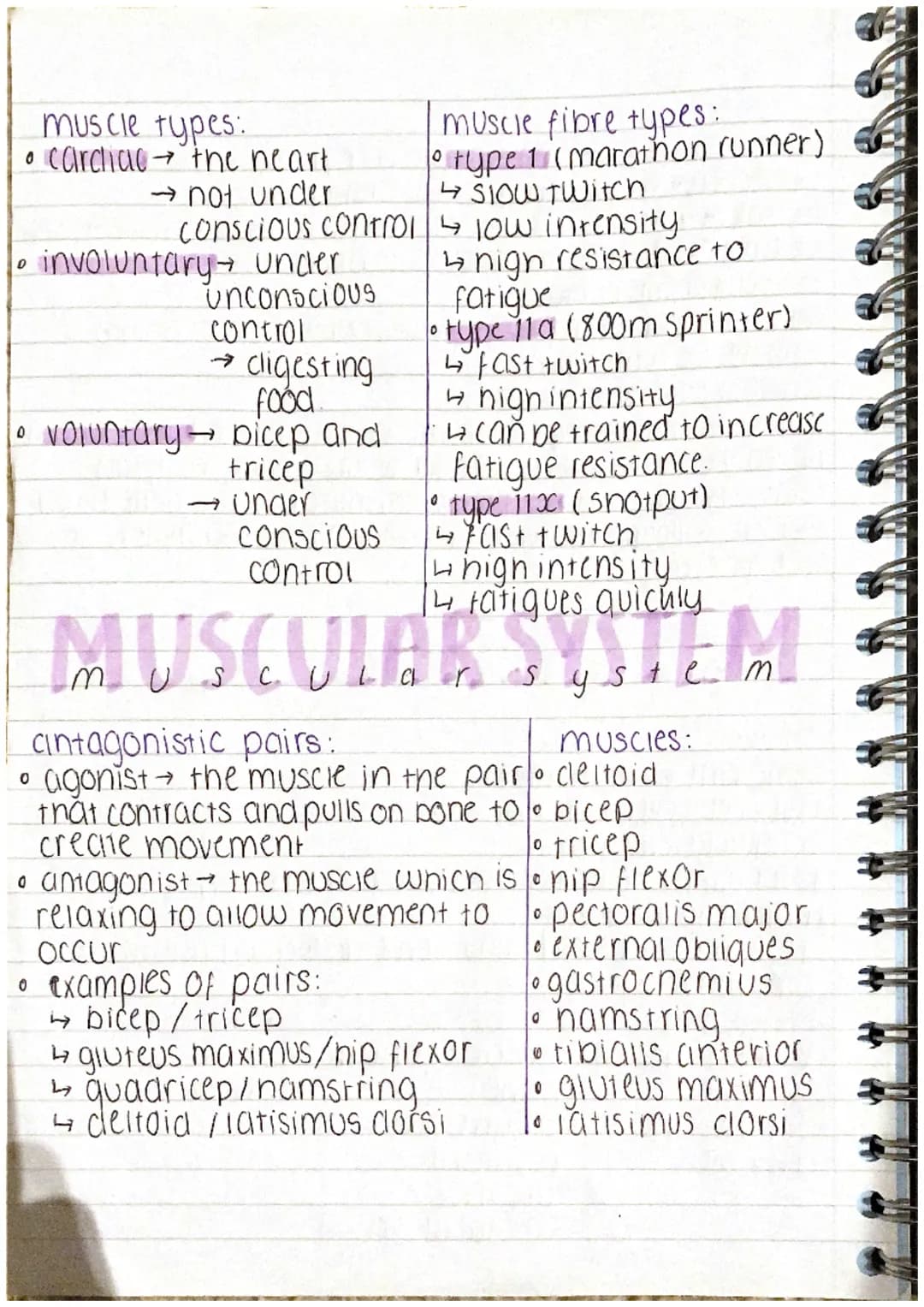
The Muscular System Breakdown
Ever wondered why your heart beats without you thinking about it, but you have to consciously flex your bicep? That's because we've got three different muscle types doing completely different jobs in your body.
Cardiac muscle keeps your heart pumping 24/7 without any conscious effort from you. Involuntary muscles handle things like digesting your lunch - again, no thinking required. Voluntary muscles are the ones you actually control, like your biceps and triceps when you're lifting weights or throwing a ball.
Now here's where it gets interesting for athletes: not all muscle fibres are created equal. Type 1 fibres are your marathon runner's best mate - they're slow twitch, perfect for low intensity work, and incredibly resistant to fatigue. Type 2a fibres are the middle ground, ideal for 800m sprinters who need fast twitch power but can actually train these fibres to resist fatigue better. Type 2x fibres are pure explosive power for shot putters, but they'll tire out quickly.
Your muscles work in antagonistic pairs - whilst one muscle (the agonist) contracts to create movement, its partner (the antagonist) relaxes to allow that movement. Think bicep contracting whilst tricep relaxes when you bend your arm, or your quadriceps working whilst your hamstring chills when you kick a football.
Quick Tip: Knowing your muscle pairs helps prevent injuries - if you're training your quads hard, don't forget to work those hamstrings too!
We thought you’d never ask...
Our AI companion is specifically built for the needs of students. Based on the millions of content pieces we have on the platform we can provide truly meaningful and relevant answers to students. But its not only about answers, the companion is even more about guiding students through their daily learning challenges, with personalised study plans, quizzes or content pieces in the chat and 100% personalisation based on the students skills and developments.
You can download the app in the Google Play Store and in the Apple App Store.
That's right! Enjoy free access to study content, connect with fellow students, and get instant help – all at your fingertips.
Similar Content
 Educación Física y Salud
 Gesundheit
Most popular content: Musculoskeletal System
9Physical EducationMuscle Function & Anatomy
Explore the muscular system, focusing on the roles of agonist and antagonist muscles, fixators, and the differences between voluntary and involuntary muscles. This summary covers key muscle groups, their functions during movement, and the importance of oxygen supply during exercise. Ideal for students studying Human Anatomy and Physiology.
104458
Physical EducationMovement Analysis in PE
Explore the fundamentals of Movement Analysis in Physical Education, covering types of levers, axes of rotation, and planes of movement. This summary highlights key concepts such as mechanical advantage and practical examples, essential for understanding functional anatomy and biomechanics. Ideal for GCSE PE students.
102,39371
Physical EducationBiomechanics: Levers & Movement
Explore the essential concepts of biomechanics in Physical Education, focusing on levers, planes of movement, and axes. This summary covers first, second, and third-class levers, along with sagittal, frontal, and transverse planes, providing practical examples from sports like football and gymnastics. Ideal for GCSE PE students preparing for exams.
113283
Physical EducationMuscle Movement Dynamics
Explore the intricacies of muscle contractions, joint types, and movement analysis in this comprehensive study resource. Covering key concepts such as agonist and antagonist roles, isotonic and isometric contractions, and the planes of movement, this material is essential for AQA A Level Physical Education students preparing for Paper 1. Enhance your understanding of human anatomy and physiology with detailed insights into the musculoskeletal system and functional anatomy.
122441
Physical EducationJoint Movements Explained
Explore the essential movements of joints in sports and physical education. This summary covers key concepts such as flexion, extension, abduction, and adduction, along with examples like biceps curls and jumping jacks. Ideal for A-Level Physical Education students seeking to understand functional anatomy and the role of joints in athletic performance.
121583
Physical EducationMuscle Types & Functions
Explore the three types of muscles: smooth, cardiac, and skeletal. Understand their roles, involuntary vs. voluntary control, and key muscle groups involved in physical activities. This summary covers essential concepts in functional anatomy and the muscular system, ideal for PE and sports science students.
102875
Physical EducationMuscle Types & Functions
Explore the muscular system, including the structure and roles of voluntary and involuntary muscles, muscle contraction mechanisms, and the differences between slow-twitch and fast-twitch muscle fibers. This summary provides essential insights into how muscles work together to facilitate movement and support bodily functions.
112443
Physical EducationMuscle Anatomy & Function
Explore the intricacies of the muscular system, including muscle types, contraction mechanisms, and their roles in sports performance. This comprehensive overview covers functional anatomy, muscle structure, and the relationship between skeletal and muscular systems, essential for OCR GCSE PE. Ideal for students aiming to understand how muscles work together to facilitate movement and enhance athletic performance.
116706
Physical EducationMuscular System & Lever Mechanics
Explore the key concepts of the muscular system and lever mechanics essential for GCSE Physical Education (OCR). This summary covers the 11 major muscles, their roles in movement, antagonistic pairs, and the three types of lever systems. Ideal for exam preparation and understanding functional anatomy.
1081016
Most popular content in Physical Education
9C
Physical EducationComponents of fitness- easy quiz
Master the fundamentals of PE with this comprehensive flashcard set designed specifically for grade 10 students. Learn key concepts, exercises, and rules in an easy and engaging way!
103760
T
Physical Educationthe musculo-skeletal system
the structure and functions of the musculo skeletal system
104173
M
Physical EducationMastering PE: A Comprehensive Guide to Physical Education
Equip yourself with the knowledge and skills to excel in Physical Education with this comprehensive flashcard set. Covering key concepts, exercises, and strategies, this guide will help you ace your PE exams and achieve your fitness goals.
122730
P
Physical EducationPE paper 1
anatomy
113292
T
 Biology
the heart
biology/pe knowledge of heart gcse
103631
G
Physical EducationGCSE PE Quiz
A quiz with random AO1 knowledge for GCSE PE
101,1087
Physical EducationData Collection in Sports Performance
Explore effective methods for collecting data in sports performance, including questionnaires, training diaries, and observational techniques. This summary covers the benefits and limitations of each method, the importance of goal setting, and how to monitor progress in physical education. Ideal for students studying sports science and psychology.
S51,56228
Physical EducationAQA PE Paper 1 Overview
Comprehensive summary of AQA Physical Education Paper 1, covering key topics such as muscle structure, training principles, biomechanics, respiratory movements, and the functions of the skeleton. Ideal for exam preparation and understanding core concepts in sports science and physical fitness.
104,948106
G
Physical EducationGCSE revision: the levers
The levers
111341
Most popular content
9 Sociology
Sociology of Education Overview
Explore comprehensive A-Level Sociology notes on the education system, covering key theories, policies, and sociological perspectives. This resource includes insights on marketisation, gender roles, cultural deprivation, and educational inequalities, providing a thorough understanding of how education shapes social stratification and individual achievement. Ideal for exam preparation and in-depth study.
12102,8933,041
SociologySociology of Families: Comprehensive Revision
Dive into an extensive overview of family dynamics, perspectives, and patterns in sociology. This resource covers key concepts such as family diversity, gender roles, marriage, and the impact of social policies on family structures. Perfect for A-Level Sociology students preparing for Paper 2.
1273,6842,307
CriminologyCriminology: Crime & Punishment Overview
Comprehensive mindmaps covering key concepts in the Crime and Punishment topic for WJEC Criminology Unit 4. This resource includes detailed insights into the Criminal Justice System, crime prevention strategies, sentencing models, and the roles of various agencies. Ideal for A-Level revision, ensuring you grasp essential theories and legislative processes to excel in your exams.
1254,8751,059
SociologyComprehensive Crime & Deviance Overview
Explore an extensive revision of crime and deviance topics, including theories, types of crime, and the impact of media. This resource covers key concepts such as Marxism, functionalism, gender and crime, and the influence of globalization on criminal behavior. Ideal for students seeking a thorough understanding of criminology and its various theories. Type: Full Topic Revision.
1251,6611,399
C
BiologyCell Biology and Cell structure
cell structures
93,2570
 English Literature
An Inspector Calls: Character Insights
Explore in-depth analysis and key quotes for characters in J.B. Priestley's 'An Inspector Calls'. This resource covers Gerald Croft, Inspector Goole, Sheila Birling, Mrs. Birling, Eric Birling, and Eva Smith, focusing on themes of class, gender roles, and social responsibility. Ideal for students aiming for Grade 8 and above.
1025,436907
CriminologyWJEC Unit 4 Criminology
Criminology unit 4 detailed revision note
127,156125
CriminologyCriminology Theories Overview
Explore key criminology theories and their implications on crime and deviance. This comprehensive summary covers biological, psychological, and sociological perspectives, including labelling theory, right realism, and the impact of social campaigns on policy development. Ideal for A-Level criminology students seeking to understand the complexities of criminal behaviour and the factors influencing crime prevention strategies.
129,763210
English LiteratureRomeo and Juliet: Key themes
Key Romeo and Juliet themes and analysed quotes
106,712198
Students love us — and so will you.
4.6/5App Store
4.7/5Google Play
The app is very easy to use and well designed. I have found everything I was looking for so far and have been able to learn a lot from the presentations! I will definitely use the app for a class assignment! And of course it also helps a lot as an inspiration.
Stefan SiOS user
This app is really great. There are so many study notes and help [...]. My problem subject is French, for example, and the app has so many options for help. Thanks to this app, I have improved my French. I would recommend it to anyone.
Samantha KlichAndroid user
Wow, I am really amazed. I just tried the app because I've seen it advertised many times and was absolutely stunned. This app is THE HELP you want for school and above all, it offers so many things, such as workouts and fact sheets, which have been VERY helpful to me personally.
AnnaiOS user
Physical Education323 views·Updated Jun 22, 2026·1 pageUnderstanding the Muscular System
evie@evesgrace
Your muscles are way more complex than you might think! Understanding how different muscle types and fibres work together is crucial for sports performance and everyday movement.
1
of 1
Sign up to see the content. It's free!
- Access to all documents
- Improve your grades
- Join milions of students
The Muscular System Breakdown
Ever wondered why your heart beats without you thinking about it, but you have to consciously flex your bicep? That's because we've got three different muscle types doing completely different jobs in your body.
Cardiac muscle keeps your heart pumping 24/7 without any conscious effort from you. Involuntary muscles handle things like digesting your lunch - again, no thinking required. Voluntary muscles are the ones you actually control, like your biceps and triceps when you're lifting weights or throwing a ball.
Now here's where it gets interesting for athletes: not all muscle fibres are created equal. Type 1 fibres are your marathon runner's best mate - they're slow twitch, perfect for low intensity work, and incredibly resistant to fatigue. Type 2a fibres are the middle ground, ideal for 800m sprinters who need fast twitch power but can actually train these fibres to resist fatigue better. Type 2x fibres are pure explosive power for shot putters, but they'll tire out quickly.
Your muscles work in antagonistic pairs - whilst one muscle (the agonist) contracts to create movement, its partner (the antagonist) relaxes to allow that movement. Think bicep contracting whilst tricep relaxes when you bend your arm, or your quadriceps working whilst your hamstring chills when you kick a football.
Quick Tip: Knowing your muscle pairs helps prevent injuries - if you're training your quads hard, don't forget to work those hamstrings too!
We thought you’d never ask...
Our AI companion is specifically built for the needs of students. Based on the millions of content pieces we have on the platform we can provide truly meaningful and relevant answers to students. But its not only about answers, the companion is even more about guiding students through their daily learning challenges, with personalised study plans, quizzes or content pieces in the chat and 100% personalisation based on the students skills and developments.
You can download the app in the Google Play Store and in the Apple App Store.
That's right! Enjoy free access to study content, connect with fellow students, and get instant help – all at your fingertips.
Similar Content
Most popular content: Musculoskeletal System
9Physical EducationMuscle Function & Anatomy
Explore the muscular system, focusing on the roles of agonist and antagonist muscles, fixators, and the differences between voluntary and involuntary muscles. This summary covers key muscle groups, their functions during movement, and the importance of oxygen supply during exercise. Ideal for students studying Human Anatomy and Physiology.
104458
Physical EducationMovement Analysis in PE
Explore the fundamentals of Movement Analysis in Physical Education, covering types of levers, axes of rotation, and planes of movement. This summary highlights key concepts such as mechanical advantage and practical examples, essential for understanding functional anatomy and biomechanics. Ideal for GCSE PE students.
102,39371
Physical EducationBiomechanics: Levers & Movement
Explore the essential concepts of biomechanics in Physical Education, focusing on levers, planes of movement, and axes. This summary covers first, second, and third-class levers, along with sagittal, frontal, and transverse planes, providing practical examples from sports like football and gymnastics. Ideal for GCSE PE students preparing for exams.
113283
Physical EducationMuscle Movement Dynamics
Explore the intricacies of muscle contractions, joint types, and movement analysis in this comprehensive study resource. Covering key concepts such as agonist and antagonist roles, isotonic and isometric contractions, and the planes of movement, this material is essential for AQA A Level Physical Education students preparing for Paper 1. Enhance your understanding of human anatomy and physiology with detailed insights into the musculoskeletal system and functional anatomy.
122441
Physical EducationJoint Movements Explained
Explore the essential movements of joints in sports and physical education. This summary covers key concepts such as flexion, extension, abduction, and adduction, along with examples like biceps curls and jumping jacks. Ideal for A-Level Physical Education students seeking to understand functional anatomy and the role of joints in athletic performance.
121583
Physical EducationMuscle Types & Functions
Explore the three types of muscles: smooth, cardiac, and skeletal. Understand their roles, involuntary vs. voluntary control, and key muscle groups involved in physical activities. This summary covers essential concepts in functional anatomy and the muscular system, ideal for PE and sports science students.
102875
Physical EducationMuscle Types & Functions
Explore the muscular system, including the structure and roles of voluntary and involuntary muscles, muscle contraction mechanisms, and the differences between slow-twitch and fast-twitch muscle fibers. This summary provides essential insights into how muscles work together to facilitate movement and support bodily functions.
112443
Physical EducationMuscle Anatomy & Function
Explore the intricacies of the muscular system, including muscle types, contraction mechanisms, and their roles in sports performance. This comprehensive overview covers functional anatomy, muscle structure, and the relationship between skeletal and muscular systems, essential for OCR GCSE PE. Ideal for students aiming to understand how muscles work together to facilitate movement and enhance athletic performance.
116706
Physical EducationMuscular System & Lever Mechanics
Explore the key concepts of the muscular system and lever mechanics essential for GCSE Physical Education (OCR). This summary covers the 11 major muscles, their roles in movement, antagonistic pairs, and the three types of lever systems. Ideal for exam preparation and understanding functional anatomy.
1081016
Most popular content in Physical Education
9C
Physical EducationComponents of fitness- easy quiz
Master the fundamentals of PE with this comprehensive flashcard set designed specifically for grade 10 students. Learn key concepts, exercises, and rules in an easy and engaging way!
103760
T
Physical Educationthe musculo-skeletal system
the structure and functions of the musculo skeletal system
104173
M
Physical EducationMastering PE: A Comprehensive Guide to Physical Education
Equip yourself with the knowledge and skills to excel in Physical Education with this comprehensive flashcard set. Covering key concepts, exercises, and strategies, this guide will help you ace your PE exams and achieve your fitness goals.
122730
P
Physical EducationPE paper 1
anatomy
113292
T
Biologythe heart
biology/pe knowledge of heart gcse
103631
G
Physical EducationGCSE PE Quiz
A quiz with random AO1 knowledge for GCSE PE
101,1087
Physical EducationData Collection in Sports Performance
Explore effective methods for collecting data in sports performance, including questionnaires, training diaries, and observational techniques. This summary covers the benefits and limitations of each method, the importance of goal setting, and how to monitor progress in physical education. Ideal for students studying sports science and psychology.
S51,56228
Physical EducationAQA PE Paper 1 Overview
Comprehensive summary of AQA Physical Education Paper 1, covering key topics such as muscle structure, training principles, biomechanics, respiratory movements, and the functions of the skeleton. Ideal for exam preparation and understanding core concepts in sports science and physical fitness.
104,948106
G
Physical EducationGCSE revision: the levers
The levers
111341
Most popular content
9SociologySociology of Education Overview
Explore comprehensive A-Level Sociology notes on the education system, covering key theories, policies, and sociological perspectives. This resource includes insights on marketisation, gender roles, cultural deprivation, and educational inequalities, providing a thorough understanding of how education shapes social stratification and individual achievement. Ideal for exam preparation and in-depth study.
12102,8933,041
SociologySociology of Families: Comprehensive Revision
Dive into an extensive overview of family dynamics, perspectives, and patterns in sociology. This resource covers key concepts such as family diversity, gender roles, marriage, and the impact of social policies on family structures. Perfect for A-Level Sociology students preparing for Paper 2.
1273,6842,307
CriminologyCriminology: Crime & Punishment Overview
Comprehensive mindmaps covering key concepts in the Crime and Punishment topic for WJEC Criminology Unit 4. This resource includes detailed insights into the Criminal Justice System, crime prevention strategies, sentencing models, and the roles of various agencies. Ideal for A-Level revision, ensuring you grasp essential theories and legislative processes to excel in your exams.
1254,8751,059
SociologyComprehensive Crime & Deviance Overview
Explore an extensive revision of crime and deviance topics, including theories, types of crime, and the impact of media. This resource covers key concepts such as Marxism, functionalism, gender and crime, and the influence of globalization on criminal behavior. Ideal for students seeking a thorough understanding of criminology and its various theories. Type: Full Topic Revision.
1251,6611,399
C
BiologyCell Biology and Cell structure
cell structures
93,2570
English LiteratureAn Inspector Calls: Character Insights
Explore in-depth analysis and key quotes for characters in J.B. Priestley's 'An Inspector Calls'. This resource covers Gerald Croft, Inspector Goole, Sheila Birling, Mrs. Birling, Eric Birling, and Eva Smith, focusing on themes of class, gender roles, and social responsibility. Ideal for students aiming for Grade 8 and above.
1025,436907
CriminologyWJEC Unit 4 Criminology
Criminology unit 4 detailed revision note
127,156125
CriminologyCriminology Theories Overview
Explore key criminology theories and their implications on crime and deviance. This comprehensive summary covers biological, psychological, and sociological perspectives, including labelling theory, right realism, and the impact of social campaigns on policy development. Ideal for A-Level criminology students seeking to understand the complexities of criminal behaviour and the factors influencing crime prevention strategies.
129,763210
English LiteratureRomeo and Juliet: Key themes
Key Romeo and Juliet themes and analysed quotes
106,712198
Students love us — and so will you.
4.6/5App Store
4.7/5Google Play
The app is very easy to use and well designed. I have found everything I was looking for so far and have been able to learn a lot from the presentations! I will definitely use the app for a class assignment! And of course it also helps a lot as an inspiration.
Stefan SiOS user
This app is really great. There are so many study notes and help [...]. My problem subject is French, for example, and the app has so many options for help. Thanks to this app, I have improved my French. I would recommend it to anyone.
Samantha KlichAndroid user
Wow, I am really amazed. I just tried the app because I've seen it advertised many times and was absolutely stunned. This app is THE HELP you want for school and above all, it offers so many things, such as workouts and fact sheets, which have been VERY helpful to me personally.
AnnaiOS user