
L'inglese può sembrare complicato all'inizio, ma con le basi giuste...
 Inglese3,231 views·Updated Jun 20, 2026·9 pages
Grammatica Inglese di Prima Superiore: Sintesi Completa
S
Saraa@user_bc33y3g2vd




1 / 9
1
of 9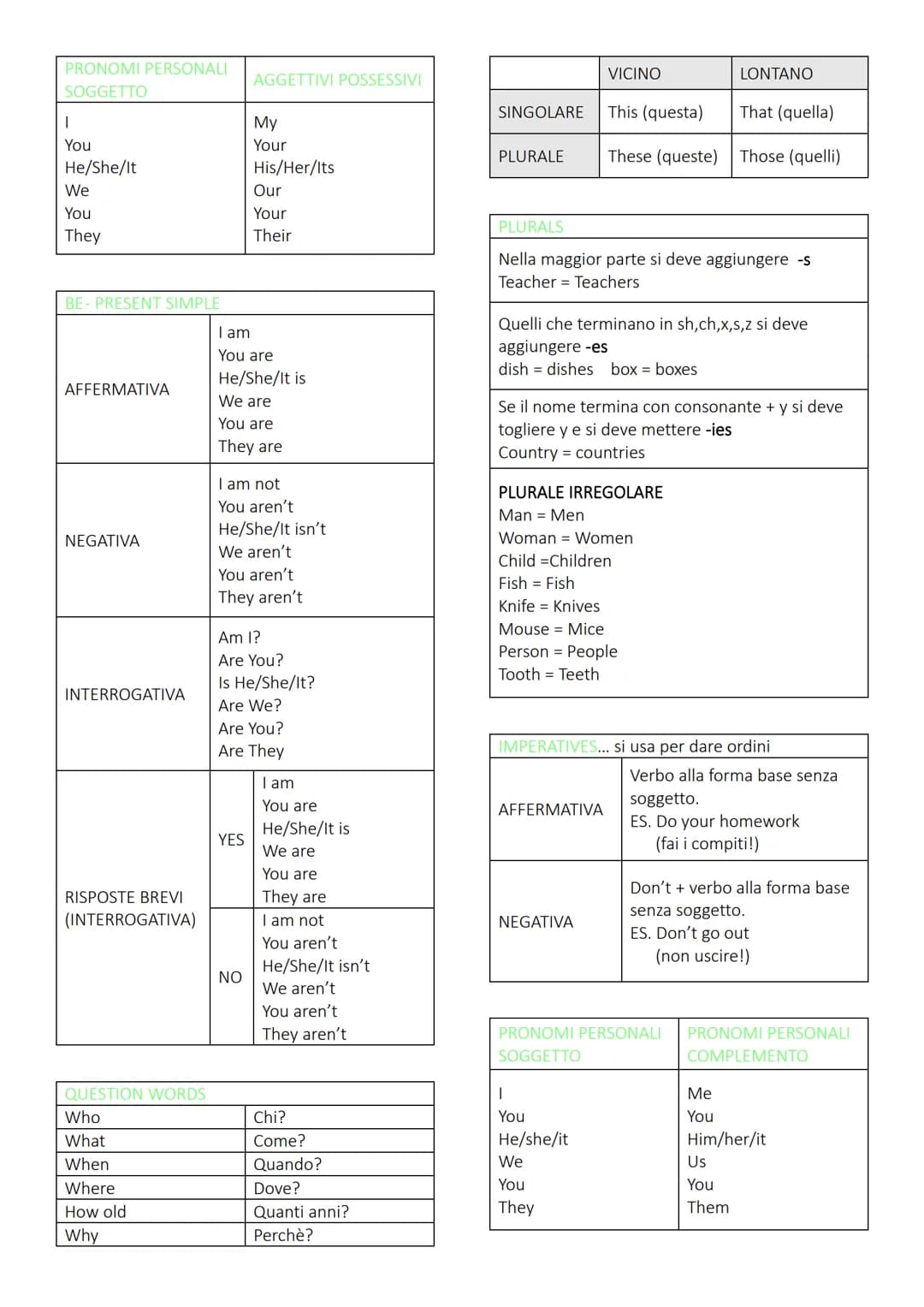
Le Basi della Grammatica Inglese
I pronomi personali sono il punto di partenza per qualsiasi frase. Come soggetto usi I, you, he/she/it, we, they, mentre come complemento diventano me, you, him/her/it, us, them. È come in italiano, ma molto più semplice!
Gli aggettivi possessivi (my, your, his/her/its, our, their) ti permettono di dire di chi è qualcosa. Ricorda che non cambiano mai forma, a differenza dell'italiano.
Il verbo essere (be) al presente ha solo tre forme: am (solo con I), is (con he/she/it) e are (con you, we, they). Per fare domande metti il verbo prima del soggetto, per negare aggiungi not.
Trucco importante: I dimostrativi this/these per cose vicine e that/those per cose lontane ti aiutano a essere preciso quando parli!
2
of 9
Esprimere Possesso e Posizione
Have got è perfetto per dire cosa possiedi. Usa have con tutti i pronomi tranne la terza persona singolare che vuole has. Nelle domande inverti l'ordine: Have you got...?
There is/there are ti serve per dire che qualcosa esiste in un posto. There is per il singolare, there are per il plurale. È semplicissimo una volta che ci prendi la mano!
Le preposizioni di luogo sono fondamentali per orientarsi. In per spazi chiusi, on per superfici, at per punti precisi. Next to significa accanto, between tra due cose.
Gli articoli seguono regole precise: a prima di consonanti, an prima di vocali. The si usa quando tutti sanno di cosa parli. Niente articolo per concetti generali come "I like music".
Consiglio pratico: Gli avverbi di frequenza (always, usually, often, sometimes, hardly ever, never) vanno sempre prima del verbo principale!
3
of 9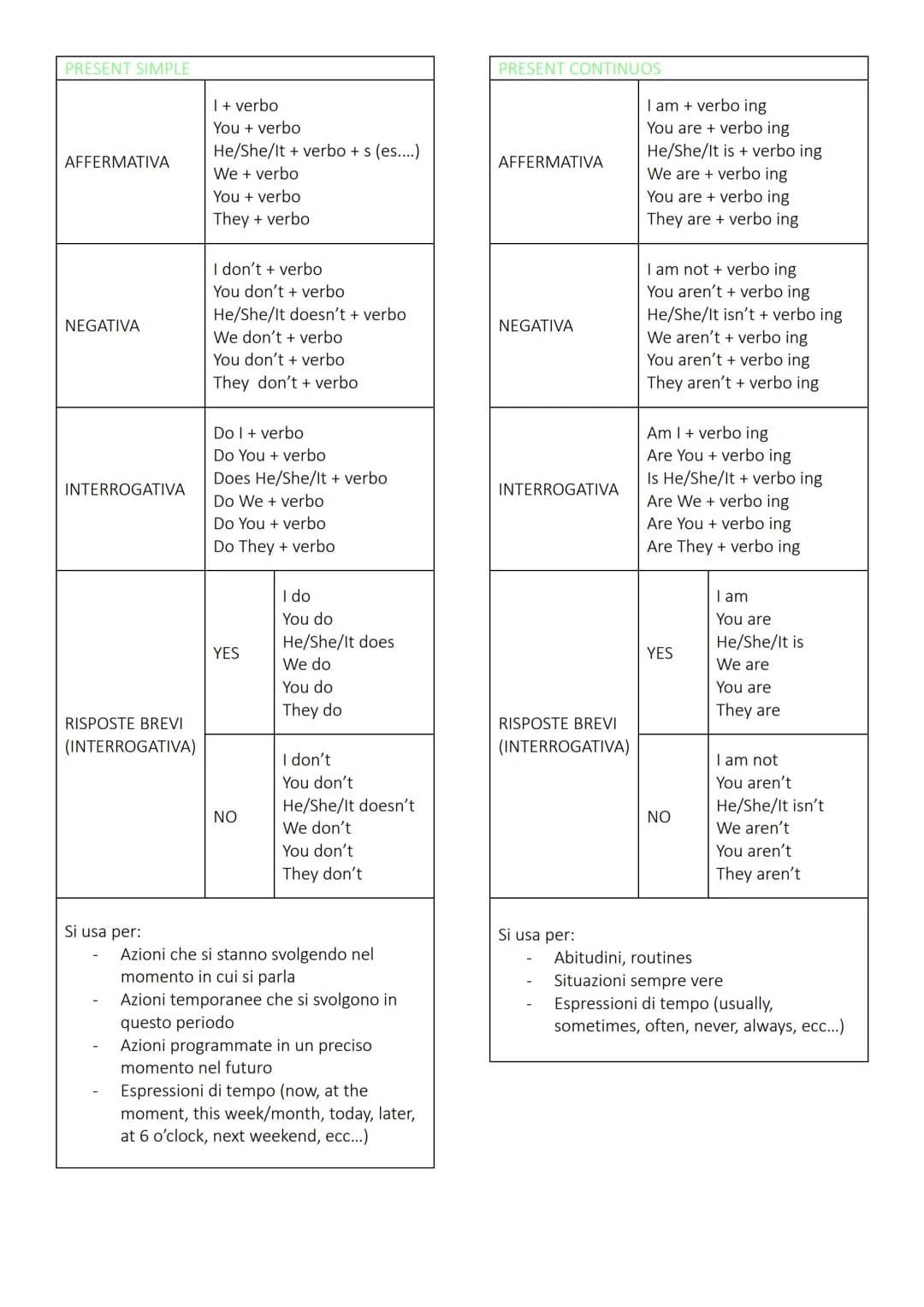
Present Simple vs Present Continuous
Il Present Simple descrive abitudini e verità sempre valide. Alla terza persona singolare aggiungi -s al verbo. Per domande e negazioni usa do/does + verbo base. È il tempo che usi di più in inglese!
Il Present Continuous invece cattura azioni in corso proprio ora. Formula: be + verbo-ing. Lo riconosci dalle espressioni come now, at the moment, today.
La differenza è chiara: "I work" (lavoro abitualmente) vs "I'm working" (sto lavorando adesso). Il Present Simple è per routine, il Continuous per il momento presente.
Le risposte brevi sono eleganti e naturali. Invece di ripetere tutto, rispondi "Yes, I do" o "No, I don't" alle domande con do, "Yes, I am" o "No, I'm not" a quelle con be.
Attenzione: Alcuni verbi come like, know, understand non si usano mai al continuous - sono "stative verbs"!
4
of 9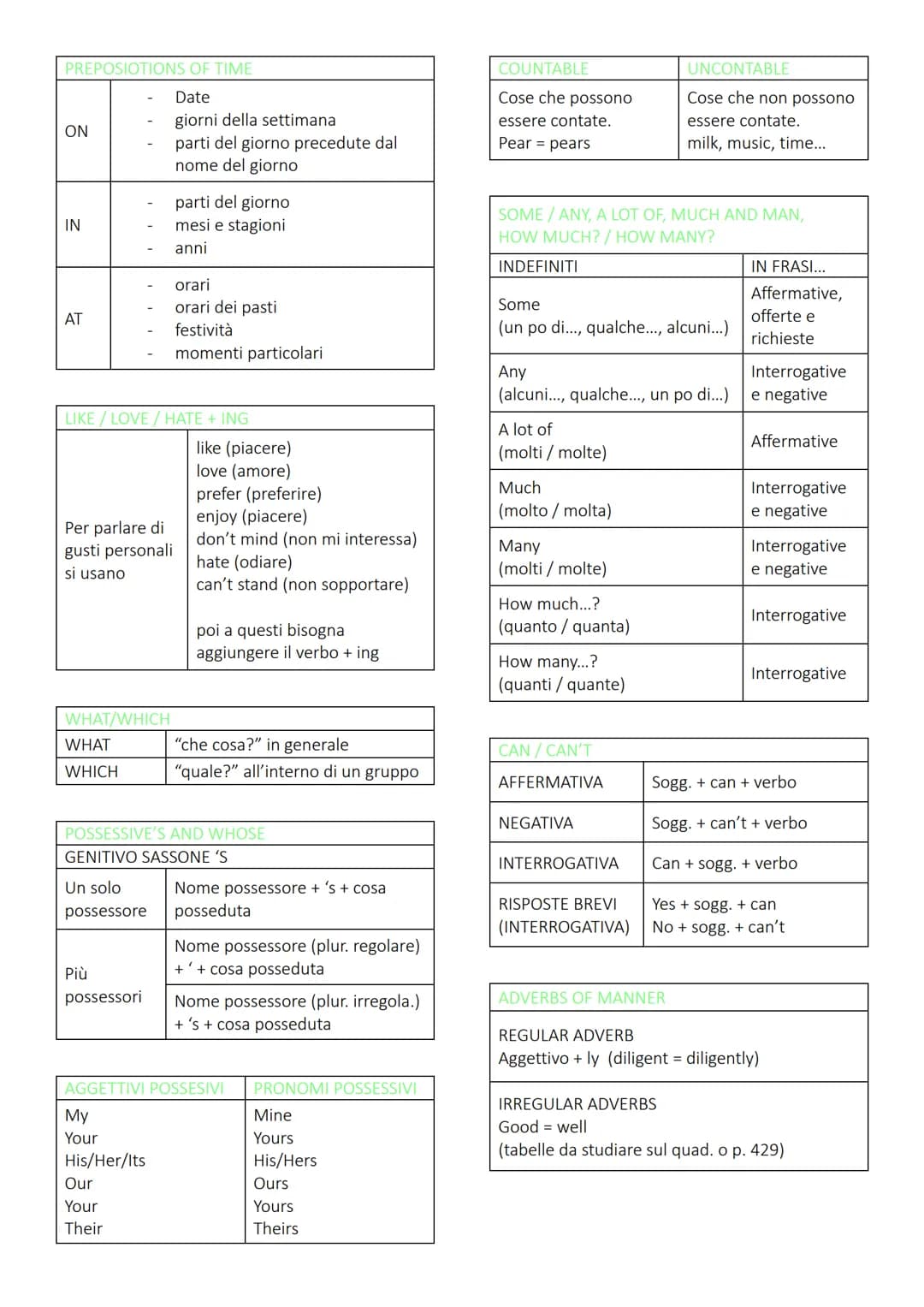
Quantità, Preferenze e Abilità
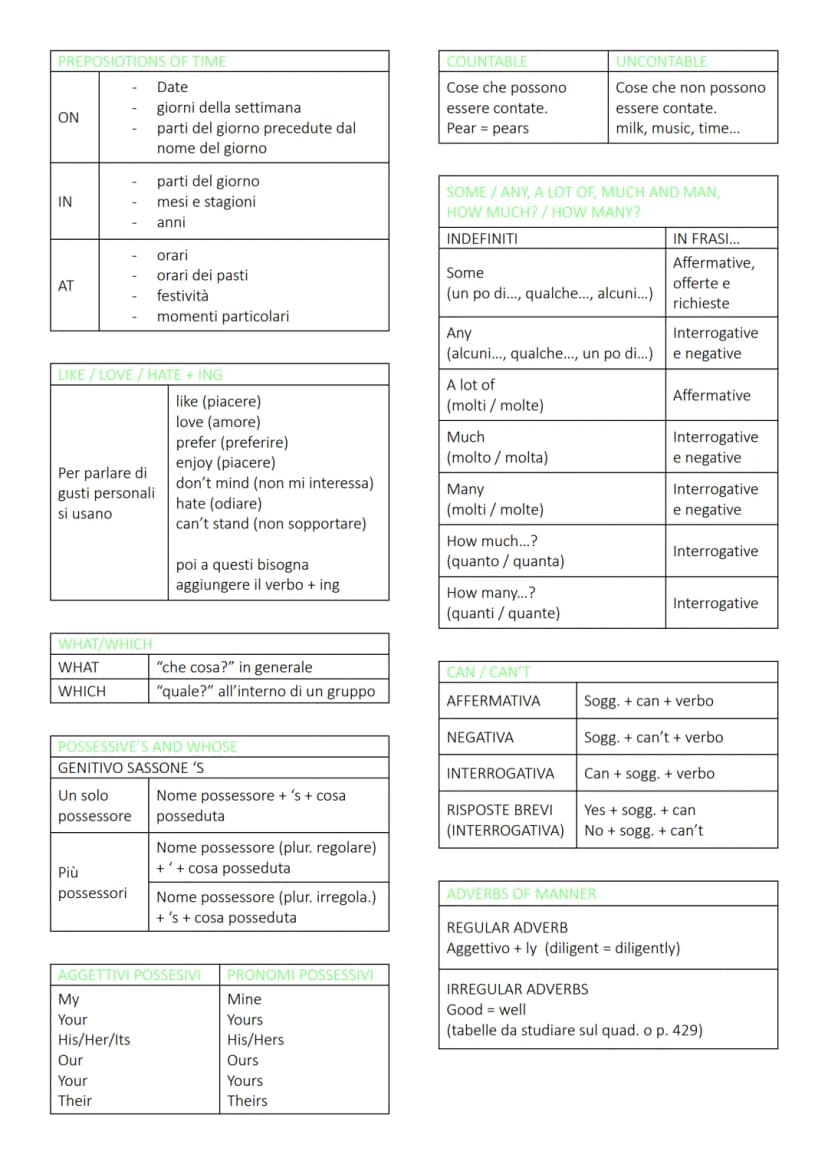
Some si usa nelle frasi positive, any in domande e negazioni. È una regola d'oro! Much per cose non contabili (much water), many per quelle contabili (many books).
Per esprimere gusti personali usa verbi come like, love, hate + -ing. "I love playing football" suona molto più naturale di costruzioni complicate. È il modo più diretto per parlare di te!
Can/can't esprime capacità e permessi. È un verbo modale, quindi non cambia forma e non ha bisogno di ausiliari. "Can you swim?" è una domanda perfetta.
Il genitivo sassone ('s) mostra possesso in modo elegante. John's car invece di "the car of John". Se il plurale finisce in -s, aggiungi solo l'apostrofo: students' books.
Trucco per le preposizioni di tempo: ON per giorni e date, IN per mesi/anni/parti del giorno, AT per orari precisi!
5
of 9
Parlare del Passato
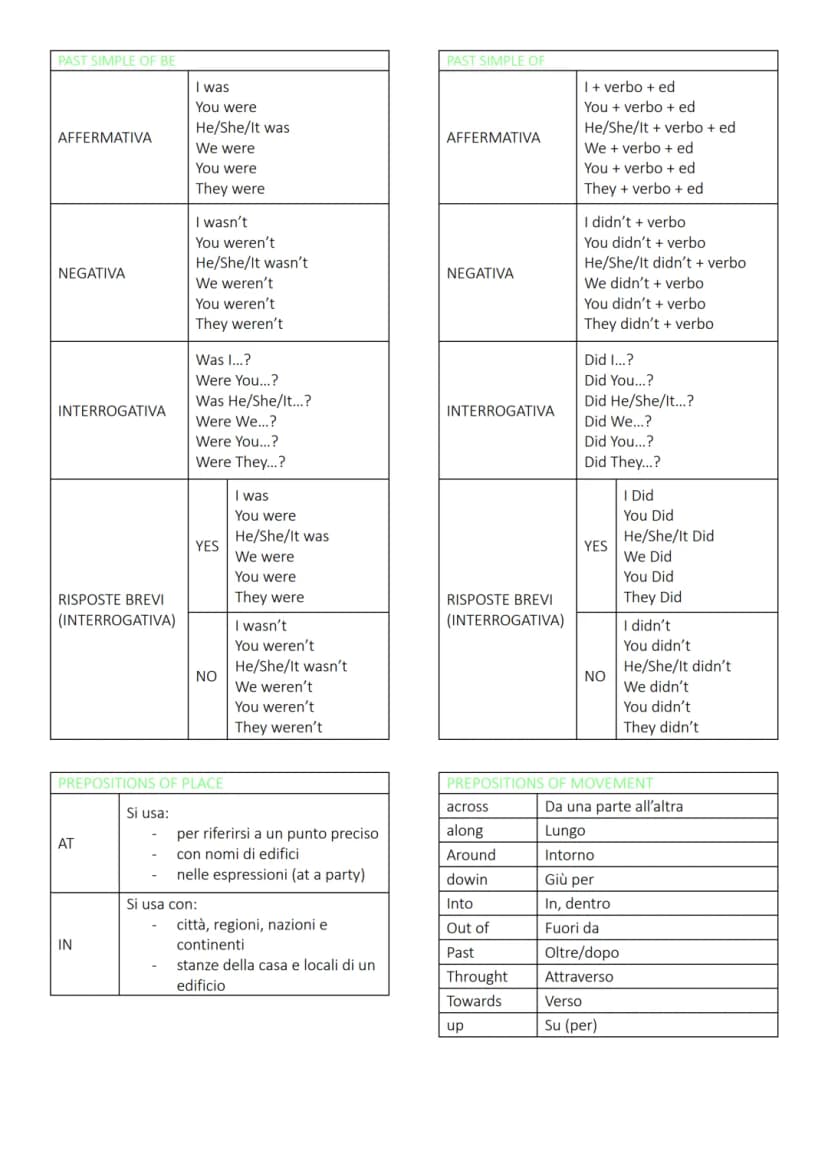
Il Past Simple del verbo essere ha solo due forme: was (I/he/she/it) e were (you/we/they). Per domande inverti l'ordine, per negare aggiungi not. Molto più semplice del presente!
Per tutti gli altri verbi, il Past Simple regolare aggiunge -ed. Ma attenzione: nelle domande e negazioni usi did/didn't + verbo base. "Did you work yesterday?" non "Did you worked?"
I verbi irregolari vanno imparati a memoria. Go-went-gone, see-saw-seen, take-took-taken. Sembrano tanti ma i più comuni li userai sempre, quindi li ricorderai facilmente.
Le preposizioni di movimento aggiungono dinamismo. Into per entrare, out of per uscire, across per attraversare, towards per dirigersi verso qualcosa.
Importante: Nel Past Simple, alla forma affermativa il verbo cambia, ma in domande e negazioni resta alla forma base dopo did/didn't!
6
of 9
Confrontare e Esprimere Desideri
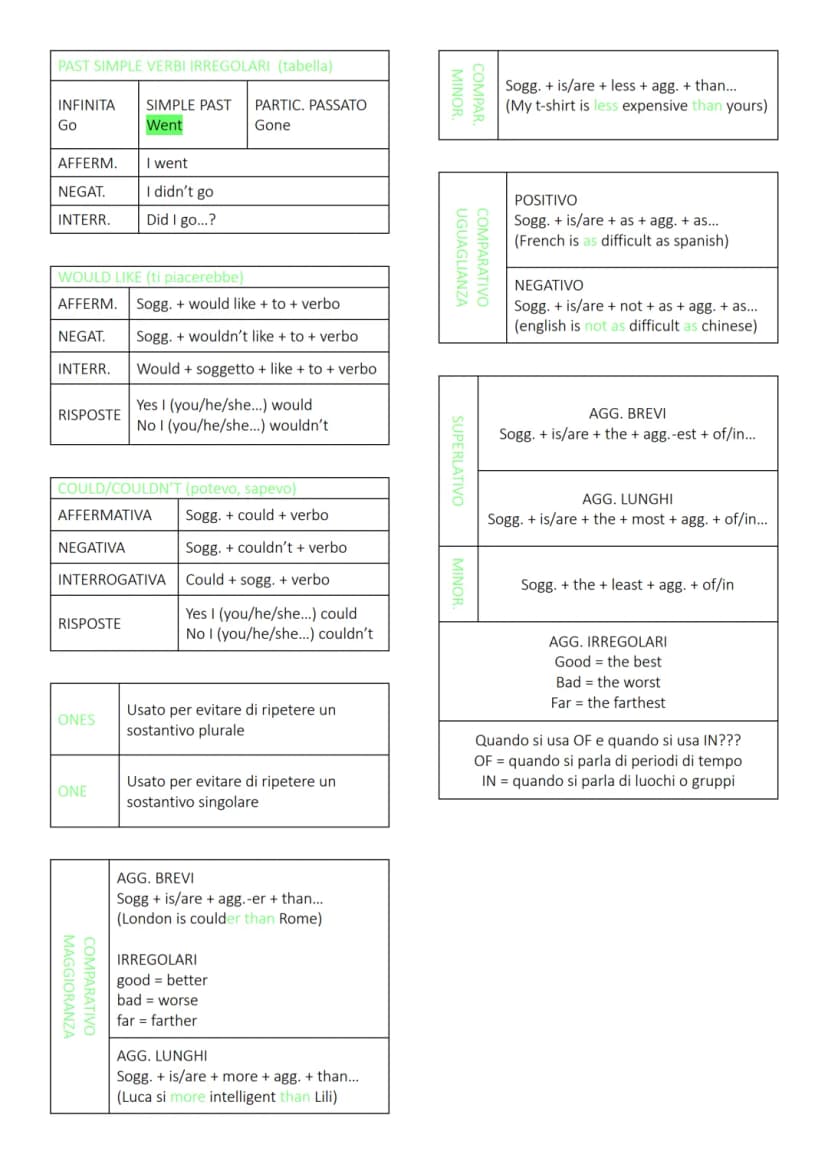
Il comparativo ti permette di confrontare. Aggettivi corti: -er + than (taller than). Aggettivi lunghi: more + aggettivo + than (more beautiful than). Alcuni sono irregolari: good-better, bad-worse.
Il superlativo indica il massimo. The + aggettivo-est (the tallest) o the most + aggettivo (the most beautiful). Usa in per luoghi, of per gruppi o periodi di tempo.
Would like esprime desideri educati. "I would like to travel" è più gentile di "I want to travel". Perfetto per essere cortesi in ogni situazione.
Could/couldn't è il passato di can ma anche un modo gentile per chiedere. "Could you help me?" suona molto meglio di "Can you help me?"
Trucco per evitare ripetizioni: Usa one per sostituire nomi singolari e ones per quelli plurali. "Which car? The red one!"
7
of 9
Verbi Irregolari - Prima Parte
I verbi irregolari sono il cuore dell'inglese autentico. Inizia con i più comuni: be-was/were-been, have-had-had, do-did-done, go-went-gone. Li senti in ogni conversazione!
Alcuni seguono schemi simili che facilitano la memorizzazione. Bring-brought-brought e buy-bought-bought hanno la stessa terminazione. Begin-began-begun e drink-drank-drunk cambiano le vocali in modo simile.
Molti verbi di movimento sono irregolari: come-came-come, run-ran-run, fly-flew-flown. È logico, visto che descrivono azioni fondamentali della vita quotidiana.
I verbi di percezione come see-saw-seen, hear-heard-heard, feel-felt-felt sono essenziali per descrivere esperienze. Li usi costantemente quando racconti cosa ti è successo.
Strategia vincente: Raggruppa i verbi per significato (movimento, percezione, possesso) invece di imparare liste alfabetiche!
8
of 9
Verbi Irregolari - Seconda Parte
I verbi di azione fisica sono spesso irregolari: hit-hit-hit, cut-cut-cut, put-put-put. Nota come alcuni non cambiano affatto - sono i più facili da ricordare!
Verbi di comunicazione come say-said-said, tell-told-told, speak-spoke-spoken sono fondamentali. Li usi ogni volta che riporti una conversazione o esprimi un'opinione.
Alcuni verbi hanno doppia forma al participio passato. Show-showed-shown/showed, dove entrambe le forme sono corrette. Non preoccuparti, imparerai naturalmente quella più comune.
I verbi che esprimono cambiamento tendono a essere irregolari: grow-grew-grown, become-became-become, break-broke-broken. Descrivono trasformazioni importanti, quindi sono molto usati.
Consiglio pratico: Crea frasi personali con ogni verbo irregolare. "I broke my phone" è più facile da ricordare di una lista astratta!
9
of 9
Verbi Irregolari - Completamento
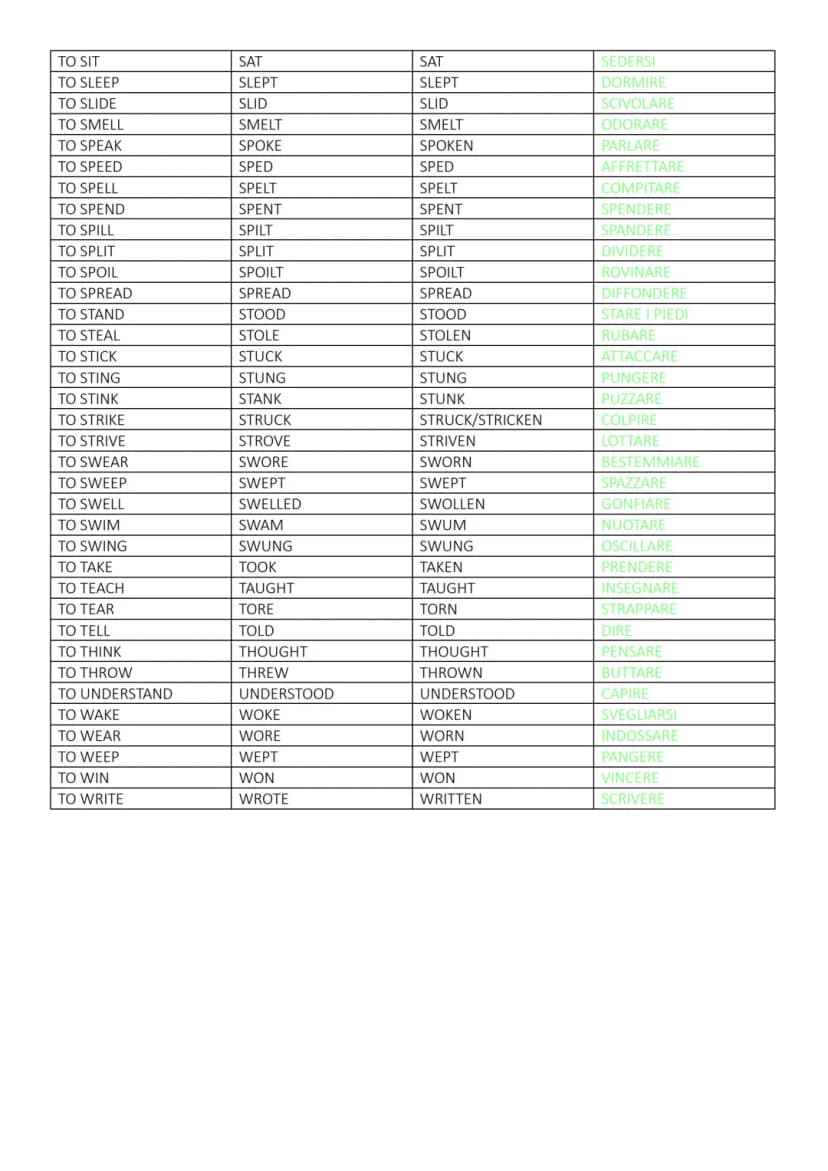
Gli ultimi verbi irregolari includono molte azioni quotidiane: sit-sat-sat, sleep-slept-slept, stand-stood-stood. Sono così comuni che li imparerai senza sforzo usando l'inglese regolarmente.
Verbi sensoriali come smell-smelt-smelt, taste-tasted-tasted (questo è regolare!) ti aiutano a descrivere esperienze complete. Aggiungono dettagli preziosi ai tuoi racconti.
Alcuni verbi hanno significati multipli: take può significare prendere, portare, accettare. Get è ancora più versatile: ottenere, diventare, arrivare. La pratica ti insegnerà tutti gli usi.
Verbi di movimento avanzati come swim-swam-swum, throw-threw-thrown, wear-wore-worn completano il tuo vocabolario. Con questi puoi descrivere praticamente qualsiasi situazione.
Traguardo raggiunto: Conoscendo questi verbi irregolari, puoi esprimerti fluentemente al passato in inglese. La pratica li renderà automatici!
We thought you’d never ask...
Our AI companion is specifically built for the needs of students. Based on the millions of content pieces we have on the platform we can provide truly meaningful and relevant answers to students. But its not only about answers, the companion is even more about guiding students through their daily learning challenges, with personalised study plans, quizzes or content pieces in the chat and 100% personalisation based on the students skills and developments.
You can download the app in the Google Play Store and in the Apple App Store.
That's right! Enjoy free access to study content, connect with fellow students, and get instant help – all at your fingertips.
Similar Content
 Anglais
Most popular content: verb to be
9IngleseBE GOING TO
be going to: quando si usa, forma affermativa, negativa e interrogativa (con esempi)
3ªm95626
Inglesepresent continuous
present continuous
2ªm13,252573
IngleseMAPPE DI GRAMMATICA INGLESE
Questi appunti parlano di tutte le regole grammaticali in inglese. Contengono tutti gli argomenti grammaticali inglesi.
3ªm1,26926
Ingleseconcetti base di inglese
inglese - molti appunti sui concetti base di inglese
1ªm2,619355
IngleseIl present continuous
Appunti sul present continuous
1ªl3,03135
Ingleseto be
verbo essere in inglese
1ªl9038
IngleseBe Going To
sintesi Be Going To
2ªm1,91447
InglesePast Simple
Be past simple, Question words + Be past simple, Have past since
1ªm3,983151
InglesePast continuos
Come si forma il past continuos e come si utilizza
1ªm1,36512
Most popular content in Inglese
9P
InglesePresent Simple vs Present Continuous
Develop the ability to choose correctly between the Present Simple for habits and the Present Continuous for ongoing actions.
3ªm4,2190
F
IngleseFormazione dei Verbi al Past Simple
Impara a trasformare i verbi dalla forma base al Past Simple, distinguendo tra verbi regolari e irregolari.
2ªm2,5590
B
IngleseBasics of Present Simple vs Continuous
Identify core differences between regular habits and temporary actions happening right now.
3ªm9990
I
IngleseIntroduzione ai Verbi Irregolari Inglesi
Impara a distinguere tra verbi regolari e irregolari e familiarizza con i paradigmi più comuni della lingua inglese.
2ªm4,9630
I
IngleseI conditionals
Un quiz su come formare i condizionali in inglese. Spero possa esservi utile♥️
3ªl2,1122
Inglesepresent simple, continuous, past simple, continuous, present perfect simple e continuous
Tempi verbali
2ªl11,644259
IngleseRipasso tempi verbali inglese
Ecco i tempi verbali inglesi spiegati in maniera riassuntiva e schematica
3ªl2,14049
F
IngleseFrasi e Domande al Past Simple
Crea frasi complete e domande utilizzando l'ausiliare 'did' per descrivere eventi avvenuti nel passato.
2ªm9330
InglesePROGRAMMA COMPLETO DI INGLESE
The Romantic Age (Blake, Wordsworth, Coleridge, Shelley, Keats and Jane Austen), The Victorian Age (Dickens, Oscar Wilde, Stevenson) and The Modern Age (War Poets, Eliot, Joyce and Orwell)
5ªl98629
Most popular content
9 Italiano
Riassunto patente B
Riassunto patente B - appunti presi a lezione
5ªl29,376947
 Altro
AltroTeoria patente b
Tutti gli argomenti per la patente
1ªl21,333690
 Ed. civ.
Teoria patente di guida B: Segnali stradali
Segnali stradali di pericolo, luminosi, di prescrizione, di indicazione, temporanei, complementari, pannelli integrativi, segnaletica orizzontale, segnalazioni agenti del traffico, distanza di visibilità per l‘arresto, minima di sicurezza.
5ªl40,1931,649
 Filosofia
Aristotele
Aristotele: vita, metafisica, fisica, etica e politica, retorica e poetica
3ªl7,624216
ItalianoI promessi sposi
Riassunti completi di tutti i 38 capitoli dei Promessi sposi.
2ªl14,092314
AltroPATENTE
schemi per esame teorico della patente
Università22,171758
S
ItalianoSintesi finale di Analisi logica
Esercitazione completa di analisi logica su frasi articolate per consolidare la conoscenza di tutti i complementi.
3ªm5,5400
P
InglesePresent Simple vs Present Continuous
Develop the ability to choose correctly between the Present Simple for habits and the Present Continuous for ongoing actions.
3ªm4,2190
G
ItalianoGabriele D'Annunzio e l'Estetismo
Domande sull'ideale del superuomo, il panismo e la concezione dell'arte come valore assoluto in D'Annunzio.
4ªl2,6740
Students love us — and so will you.
4.6/5App Store
4.7/5Google Play
The app is very easy to use and well designed. I have found everything I was looking for so far and have been able to learn a lot from the presentations! I will definitely use the app for a class assignment! And of course it also helps a lot as an inspiration.
Stefan SiOS user
This app is really great. There are so many study notes and help [...]. My problem subject is French, for example, and the app has so many options for help. Thanks to this app, I have improved my French. I would recommend it to anyone.
Samantha KlichAndroid user
Wow, I am really amazed. I just tried the app because I've seen it advertised many times and was absolutely stunned. This app is THE HELP you want for school and above all, it offers so many things, such as workouts and fact sheets, which have been VERY helpful to me personally.
AnnaiOS user
Inglese3,231 views·Updated Jun 20, 2026·9 pagesGrammatica Inglese di Prima Superiore: Sintesi Completa
S
Saraa@user_bc33y3g2vd
L'inglese può sembrare complicato all'inizio, ma con le basi giuste diventa molto più semplice! Questo riassunto copre tutti gli elementi fondamentali che ti servono per costruire frasi corrette e comunicare efficacemente in inglese.
1
of 9
Sign up to see the content. It's free!
- Access to all documents
- Improve your grades
- Join milions of students
Le Basi della Grammatica Inglese
I pronomi personali sono il punto di partenza per qualsiasi frase. Come soggetto usi I, you, he/she/it, we, they, mentre come complemento diventano me, you, him/her/it, us, them. È come in italiano, ma molto più semplice!
Gli aggettivi possessivi (my, your, his/her/its, our, their) ti permettono di dire di chi è qualcosa. Ricorda che non cambiano mai forma, a differenza dell'italiano.
Il verbo essere (be) al presente ha solo tre forme: am (solo con I), is (con he/she/it) e are (con you, we, they). Per fare domande metti il verbo prima del soggetto, per negare aggiungi not.
Trucco importante: I dimostrativi this/these per cose vicine e that/those per cose lontane ti aiutano a essere preciso quando parli!
2
of 9Sign up to see the content. It's free!
- Access to all documents
- Improve your grades
- Join milions of students
Esprimere Possesso e Posizione
Have got è perfetto per dire cosa possiedi. Usa have con tutti i pronomi tranne la terza persona singolare che vuole has. Nelle domande inverti l'ordine: Have you got...?
There is/there are ti serve per dire che qualcosa esiste in un posto. There is per il singolare, there are per il plurale. È semplicissimo una volta che ci prendi la mano!
Le preposizioni di luogo sono fondamentali per orientarsi. In per spazi chiusi, on per superfici, at per punti precisi. Next to significa accanto, between tra due cose.
Gli articoli seguono regole precise: a prima di consonanti, an prima di vocali. The si usa quando tutti sanno di cosa parli. Niente articolo per concetti generali come "I like music".
Consiglio pratico: Gli avverbi di frequenza (always, usually, often, sometimes, hardly ever, never) vanno sempre prima del verbo principale!
3
of 9Sign up to see the content. It's free!
- Access to all documents
- Improve your grades
- Join milions of students
Present Simple vs Present Continuous
Il Present Simple descrive abitudini e verità sempre valide. Alla terza persona singolare aggiungi -s al verbo. Per domande e negazioni usa do/does + verbo base. È il tempo che usi di più in inglese!
Il Present Continuous invece cattura azioni in corso proprio ora. Formula: be + verbo-ing. Lo riconosci dalle espressioni come now, at the moment, today.
La differenza è chiara: "I work" (lavoro abitualmente) vs "I'm working" (sto lavorando adesso). Il Present Simple è per routine, il Continuous per il momento presente.
Le risposte brevi sono eleganti e naturali. Invece di ripetere tutto, rispondi "Yes, I do" o "No, I don't" alle domande con do, "Yes, I am" o "No, I'm not" a quelle con be.
Attenzione: Alcuni verbi come like, know, understand non si usano mai al continuous - sono "stative verbs"!
4
of 9Sign up to see the content. It's free!
- Access to all documents
- Improve your grades
- Join milions of students
Quantità, Preferenze e Abilità
Some si usa nelle frasi positive, any in domande e negazioni. È una regola d'oro! Much per cose non contabili (much water), many per quelle contabili (many books).
Per esprimere gusti personali usa verbi come like, love, hate + -ing. "I love playing football" suona molto più naturale di costruzioni complicate. È il modo più diretto per parlare di te!
Can/can't esprime capacità e permessi. È un verbo modale, quindi non cambia forma e non ha bisogno di ausiliari. "Can you swim?" è una domanda perfetta.
Il genitivo sassone ('s) mostra possesso in modo elegante. John's car invece di "the car of John". Se il plurale finisce in -s, aggiungi solo l'apostrofo: students' books.
Trucco per le preposizioni di tempo: ON per giorni e date, IN per mesi/anni/parti del giorno, AT per orari precisi!
5
of 9Sign up to see the content. It's free!
- Access to all documents
- Improve your grades
- Join milions of students
Parlare del Passato
Il Past Simple del verbo essere ha solo due forme: was (I/he/she/it) e were (you/we/they). Per domande inverti l'ordine, per negare aggiungi not. Molto più semplice del presente!
Per tutti gli altri verbi, il Past Simple regolare aggiunge -ed. Ma attenzione: nelle domande e negazioni usi did/didn't + verbo base. "Did you work yesterday?" non "Did you worked?"
I verbi irregolari vanno imparati a memoria. Go-went-gone, see-saw-seen, take-took-taken. Sembrano tanti ma i più comuni li userai sempre, quindi li ricorderai facilmente.
Le preposizioni di movimento aggiungono dinamismo. Into per entrare, out of per uscire, across per attraversare, towards per dirigersi verso qualcosa.
Importante: Nel Past Simple, alla forma affermativa il verbo cambia, ma in domande e negazioni resta alla forma base dopo did/didn't!
6
of 9Sign up to see the content. It's free!
- Access to all documents
- Improve your grades
- Join milions of students
Confrontare e Esprimere Desideri
Il comparativo ti permette di confrontare. Aggettivi corti: -er + than (taller than). Aggettivi lunghi: more + aggettivo + than (more beautiful than). Alcuni sono irregolari: good-better, bad-worse.
Il superlativo indica il massimo. The + aggettivo-est (the tallest) o the most + aggettivo (the most beautiful). Usa in per luoghi, of per gruppi o periodi di tempo.
Would like esprime desideri educati. "I would like to travel" è più gentile di "I want to travel". Perfetto per essere cortesi in ogni situazione.
Could/couldn't è il passato di can ma anche un modo gentile per chiedere. "Could you help me?" suona molto meglio di "Can you help me?"
Trucco per evitare ripetizioni: Usa one per sostituire nomi singolari e ones per quelli plurali. "Which car? The red one!"
7
of 9Sign up to see the content. It's free!
- Access to all documents
- Improve your grades
- Join milions of students
Verbi Irregolari - Prima Parte
I verbi irregolari sono il cuore dell'inglese autentico. Inizia con i più comuni: be-was/were-been, have-had-had, do-did-done, go-went-gone. Li senti in ogni conversazione!
Alcuni seguono schemi simili che facilitano la memorizzazione. Bring-brought-brought e buy-bought-bought hanno la stessa terminazione. Begin-began-begun e drink-drank-drunk cambiano le vocali in modo simile.
Molti verbi di movimento sono irregolari: come-came-come, run-ran-run, fly-flew-flown. È logico, visto che descrivono azioni fondamentali della vita quotidiana.
I verbi di percezione come see-saw-seen, hear-heard-heard, feel-felt-felt sono essenziali per descrivere esperienze. Li usi costantemente quando racconti cosa ti è successo.
Strategia vincente: Raggruppa i verbi per significato (movimento, percezione, possesso) invece di imparare liste alfabetiche!
8
of 9Sign up to see the content. It's free!
- Access to all documents
- Improve your grades
- Join milions of students
Verbi Irregolari - Seconda Parte
I verbi di azione fisica sono spesso irregolari: hit-hit-hit, cut-cut-cut, put-put-put. Nota come alcuni non cambiano affatto - sono i più facili da ricordare!
Verbi di comunicazione come say-said-said, tell-told-told, speak-spoke-spoken sono fondamentali. Li usi ogni volta che riporti una conversazione o esprimi un'opinione.
Alcuni verbi hanno doppia forma al participio passato. Show-showed-shown/showed, dove entrambe le forme sono corrette. Non preoccuparti, imparerai naturalmente quella più comune.
I verbi che esprimono cambiamento tendono a essere irregolari: grow-grew-grown, become-became-become, break-broke-broken. Descrivono trasformazioni importanti, quindi sono molto usati.
Consiglio pratico: Crea frasi personali con ogni verbo irregolare. "I broke my phone" è più facile da ricordare di una lista astratta!
9
of 9Sign up to see the content. It's free!
- Access to all documents
- Improve your grades
- Join milions of students
Verbi Irregolari - Completamento
Gli ultimi verbi irregolari includono molte azioni quotidiane: sit-sat-sat, sleep-slept-slept, stand-stood-stood. Sono così comuni che li imparerai senza sforzo usando l'inglese regolarmente.
Verbi sensoriali come smell-smelt-smelt, taste-tasted-tasted (questo è regolare!) ti aiutano a descrivere esperienze complete. Aggiungono dettagli preziosi ai tuoi racconti.
Alcuni verbi hanno significati multipli: take può significare prendere, portare, accettare. Get è ancora più versatile: ottenere, diventare, arrivare. La pratica ti insegnerà tutti gli usi.
Verbi di movimento avanzati come swim-swam-swum, throw-threw-thrown, wear-wore-worn completano il tuo vocabolario. Con questi puoi descrivere praticamente qualsiasi situazione.
Traguardo raggiunto: Conoscendo questi verbi irregolari, puoi esprimerti fluentemente al passato in inglese. La pratica li renderà automatici!
We thought you’d never ask...
Our AI companion is specifically built for the needs of students. Based on the millions of content pieces we have on the platform we can provide truly meaningful and relevant answers to students. But its not only about answers, the companion is even more about guiding students through their daily learning challenges, with personalised study plans, quizzes or content pieces in the chat and 100% personalisation based on the students skills and developments.
You can download the app in the Google Play Store and in the Apple App Store.
That's right! Enjoy free access to study content, connect with fellow students, and get instant help – all at your fingertips.
Similar Content
Most popular content: verb to be
9IngleseBE GOING TO
be going to: quando si usa, forma affermativa, negativa e interrogativa (con esempi)
3ªm95626
Inglesepresent continuous
present continuous
2ªm13,252573
IngleseMAPPE DI GRAMMATICA INGLESE
Questi appunti parlano di tutte le regole grammaticali in inglese. Contengono tutti gli argomenti grammaticali inglesi.
3ªm1,26926
Ingleseconcetti base di inglese
inglese - molti appunti sui concetti base di inglese
1ªm2,619355
IngleseIl present continuous
Appunti sul present continuous
1ªl3,03135
Ingleseto be
verbo essere in inglese
1ªl9038
IngleseBe Going To
sintesi Be Going To
2ªm1,91447
InglesePast Simple
Be past simple, Question words + Be past simple, Have past since
1ªm3,983151
InglesePast continuos
Come si forma il past continuos e come si utilizza
1ªm1,36512
Most popular content in Inglese
9P
InglesePresent Simple vs Present Continuous
Develop the ability to choose correctly between the Present Simple for habits and the Present Continuous for ongoing actions.
3ªm4,2190
F
IngleseFormazione dei Verbi al Past Simple
Impara a trasformare i verbi dalla forma base al Past Simple, distinguendo tra verbi regolari e irregolari.
2ªm2,5590
B
IngleseBasics of Present Simple vs Continuous
Identify core differences between regular habits and temporary actions happening right now.
3ªm9990
I
IngleseIntroduzione ai Verbi Irregolari Inglesi
Impara a distinguere tra verbi regolari e irregolari e familiarizza con i paradigmi più comuni della lingua inglese.
2ªm4,9630
I
IngleseI conditionals
Un quiz su come formare i condizionali in inglese. Spero possa esservi utile♥️
3ªl2,1122
Inglesepresent simple, continuous, past simple, continuous, present perfect simple e continuous
Tempi verbali
2ªl11,644259
IngleseRipasso tempi verbali inglese
Ecco i tempi verbali inglesi spiegati in maniera riassuntiva e schematica
3ªl2,14049
F
IngleseFrasi e Domande al Past Simple
Crea frasi complete e domande utilizzando l'ausiliare 'did' per descrivere eventi avvenuti nel passato.
2ªm9330
InglesePROGRAMMA COMPLETO DI INGLESE
The Romantic Age (Blake, Wordsworth, Coleridge, Shelley, Keats and Jane Austen), The Victorian Age (Dickens, Oscar Wilde, Stevenson) and The Modern Age (War Poets, Eliot, Joyce and Orwell)
5ªl98629
Most popular content
9ItalianoRiassunto patente B
Riassunto patente B - appunti presi a lezione
5ªl29,376947
AltroTeoria patente b
Tutti gli argomenti per la patente
1ªl21,333690
Ed. civ.Teoria patente di guida B: Segnali stradali
Segnali stradali di pericolo, luminosi, di prescrizione, di indicazione, temporanei, complementari, pannelli integrativi, segnaletica orizzontale, segnalazioni agenti del traffico, distanza di visibilità per l‘arresto, minima di sicurezza.
5ªl40,1931,649
FilosofiaAristotele
Aristotele: vita, metafisica, fisica, etica e politica, retorica e poetica
3ªl7,624216
ItalianoI promessi sposi
Riassunti completi di tutti i 38 capitoli dei Promessi sposi.
2ªl14,092314
AltroPATENTE
schemi per esame teorico della patente
Università22,171758
S
ItalianoSintesi finale di Analisi logica
Esercitazione completa di analisi logica su frasi articolate per consolidare la conoscenza di tutti i complementi.
3ªm5,5400
P
InglesePresent Simple vs Present Continuous
Develop the ability to choose correctly between the Present Simple for habits and the Present Continuous for ongoing actions.
3ªm4,2190
G
ItalianoGabriele D'Annunzio e l'Estetismo
Domande sull'ideale del superuomo, il panismo e la concezione dell'arte come valore assoluto in D'Annunzio.
4ªl2,6740
Students love us — and so will you.
4.6/5App Store
4.7/5Google Play
The app is very easy to use and well designed. I have found everything I was looking for so far and have been able to learn a lot from the presentations! I will definitely use the app for a class assignment! And of course it also helps a lot as an inspiration.
Stefan SiOS user
This app is really great. There are so many study notes and help [...]. My problem subject is French, for example, and the app has so many options for help. Thanks to this app, I have improved my French. I would recommend it to anyone.
Samantha KlichAndroid user
Wow, I am really amazed. I just tried the app because I've seen it advertised many times and was absolutely stunned. This app is THE HELP you want for school and above all, it offers so many things, such as workouts and fact sheets, which have been VERY helpful to me personally.
AnnaiOS user