
Questa mappa di sintesi copre tutti gli elementi essenziali della...
 Inglese1,269 views·Updated Jul 1, 2026·11 pages
Regole di Grammatica Inglese: Una Guida Completa

Annamaria @annamaria_dj2lj
1 / 10
1
of 10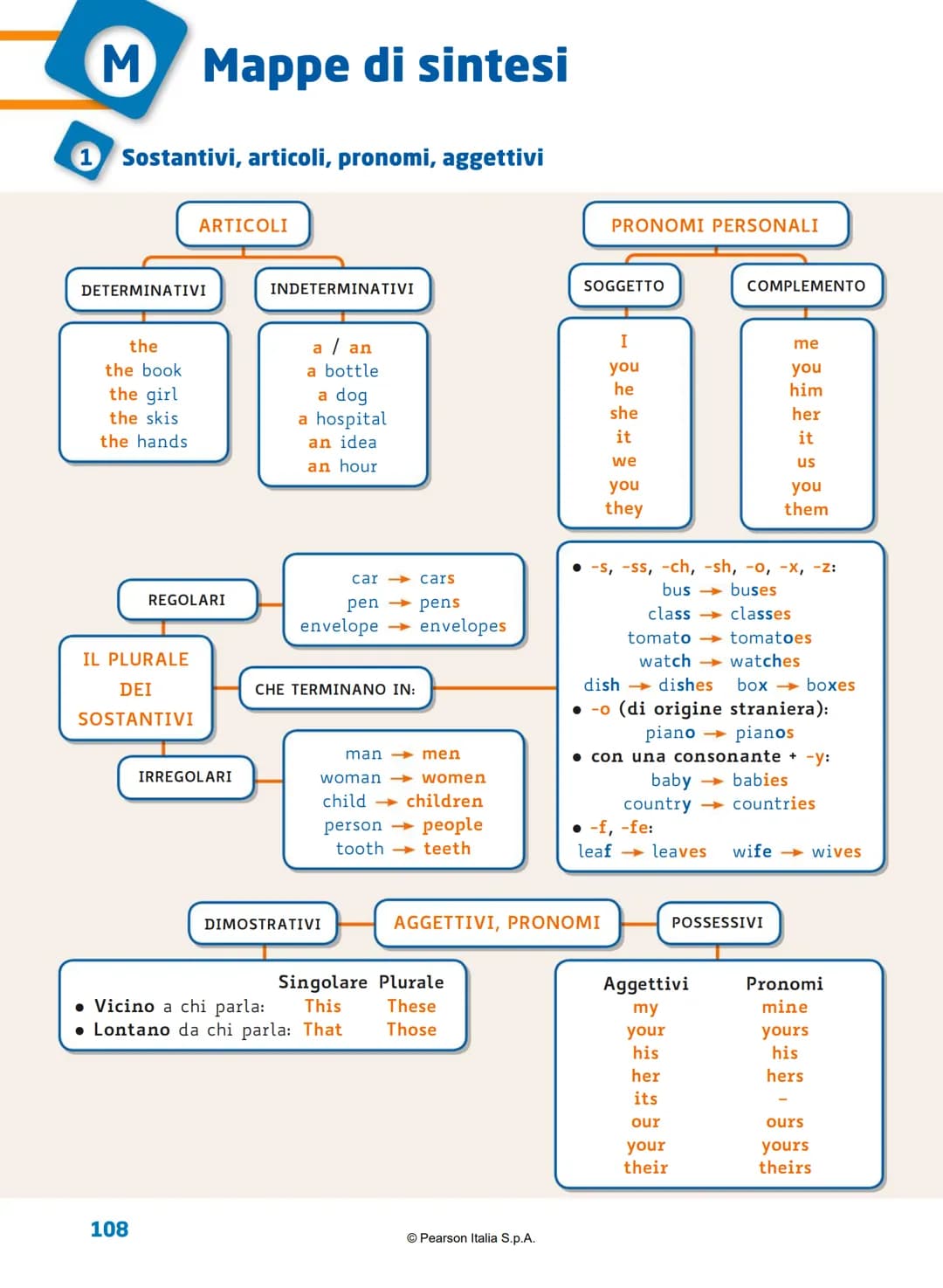
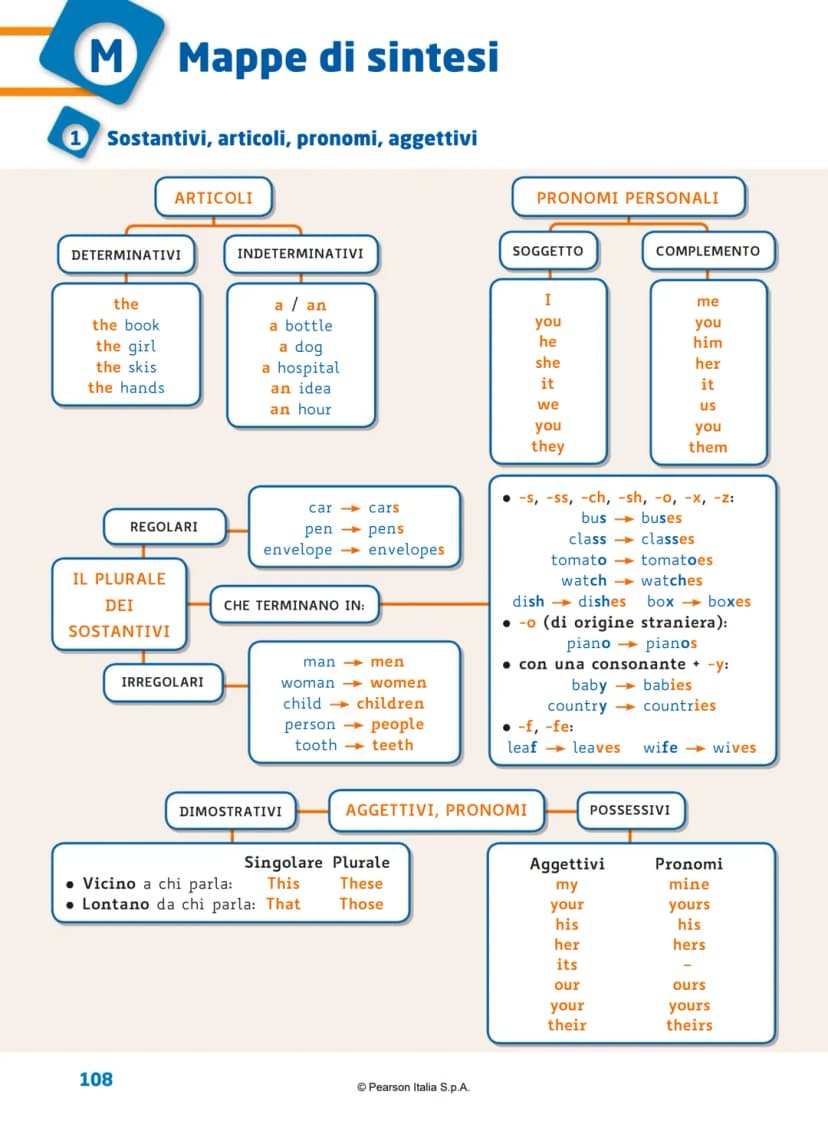
Sostantivi, articoli, pronomi e aggettivi
Iniziamo dalle fondamenta: gli articoli sono semplicissimi in inglese! Hai solo "the" (determinativo) per dire "il/la/i/le" e "a/an" (indeterminativi) per "un/una". Usa "an" solo davanti alle vocali, come "an idea" o "an hour".
Per il plurale dei sostantivi, la regola base è aggiungere "-s": car→cars, pen→pens. Ma occhio alle eccezioni! Se il sostantivo finisce con -s, -ss, -ch, -sh, -o, -x, -z, aggiungi "-es": bus→buses, tomato→tomatoes. Alcuni plurali sono completamente irregolari come man→men, child→children.
I pronomi personali cambiano forma: "I" diventa "me", "he" diventa "him", "she" diventa "her". Gli aggettivi possessivi (my, your, his) sono diversi dai pronomi possessivi (mine, yours, his). Per i dimostrativi, ricorda: this/these per le cose vicine, that/those per quelle lontane.
💡 Trucco: Se non sai se usare "a" o "an", prova a pronunciare la parola: se inizia con suono di vocale, usa "an"!
2
of 10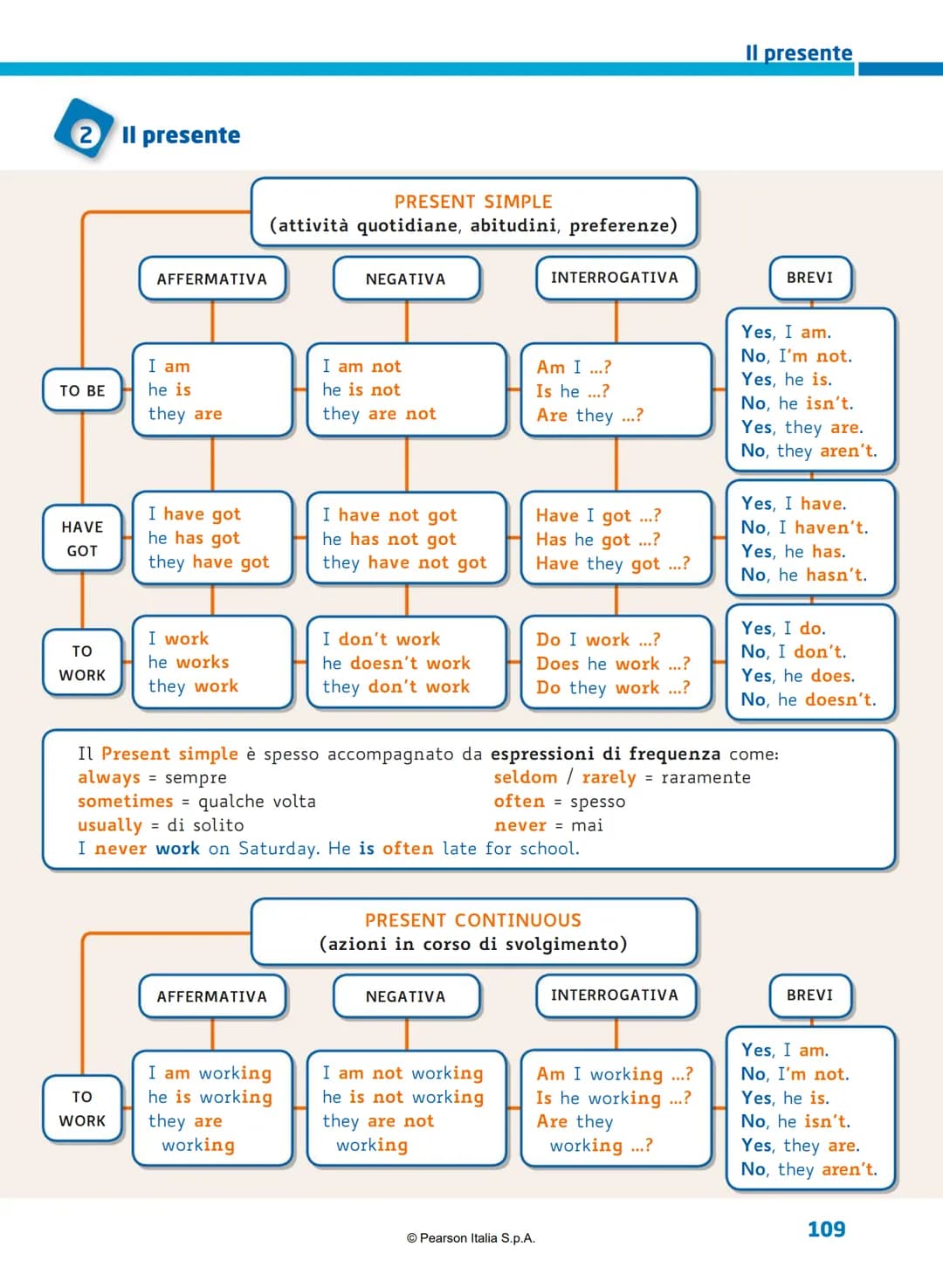
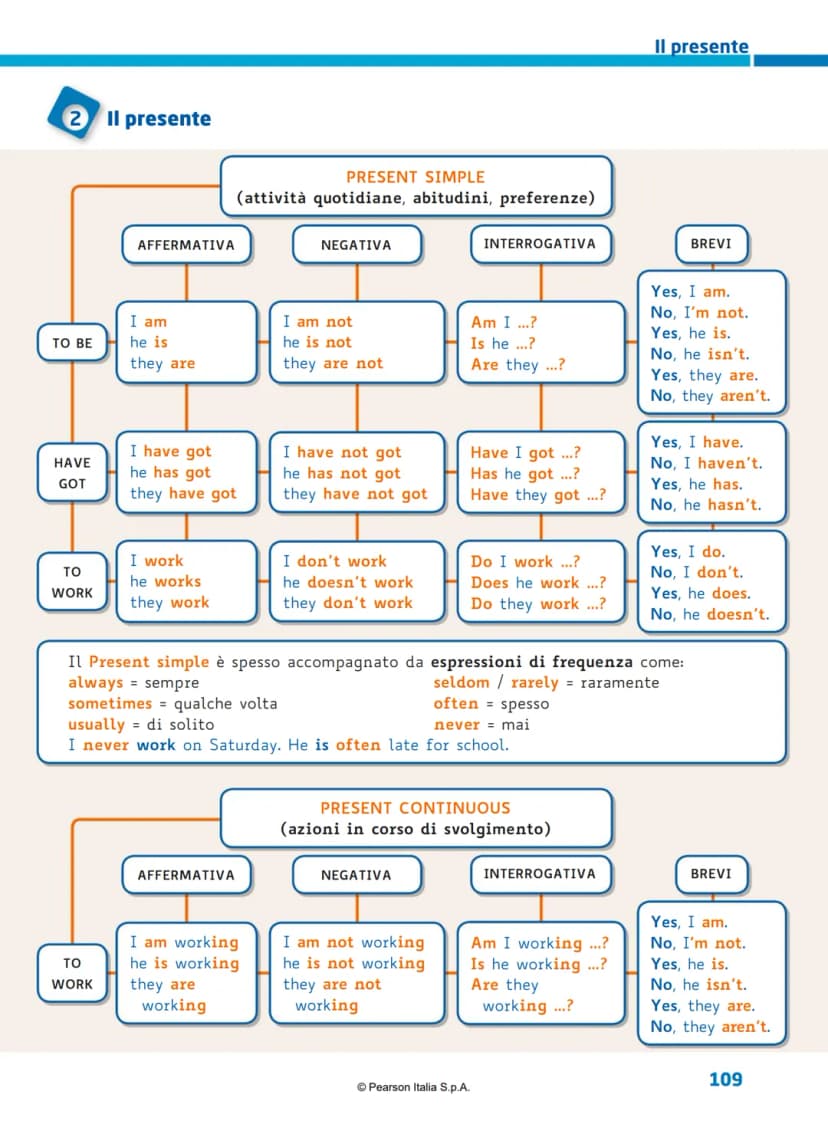
Il presente
Il Present Simple è il tuo migliore amico per parlare di abitudini e routine quotidiane. Con "I/you/we/they" usi la forma base del verbo, ma con "he/she/it" aggiungi sempre la "-s": I work, he works. Per le negazioni usa "don't" o "doesn't", per le domande "do" o "does".
Il verbo "to be" è irregolare: I am, you are, he/she/it is, we/you/they are. Forma negativa: am not, isn't, aren't. "Have got" funziona come "to be": I have got, he has got, con negative "haven't got" e "hasn't got".
Il Present Continuous descrive azioni che stanno succedendo ora. Formula magica: verbo "to be" + verbo con "-ing". I am working, he is working, they are working. È perfetto per dire cosa stai facendo in questo momento!
💡 Ricorda: Le espressioni di frequenza come "always", "often", "never" ti aiutano col Present Simple. "Never" e "always" vanno prima del verbo principale!
3
of 10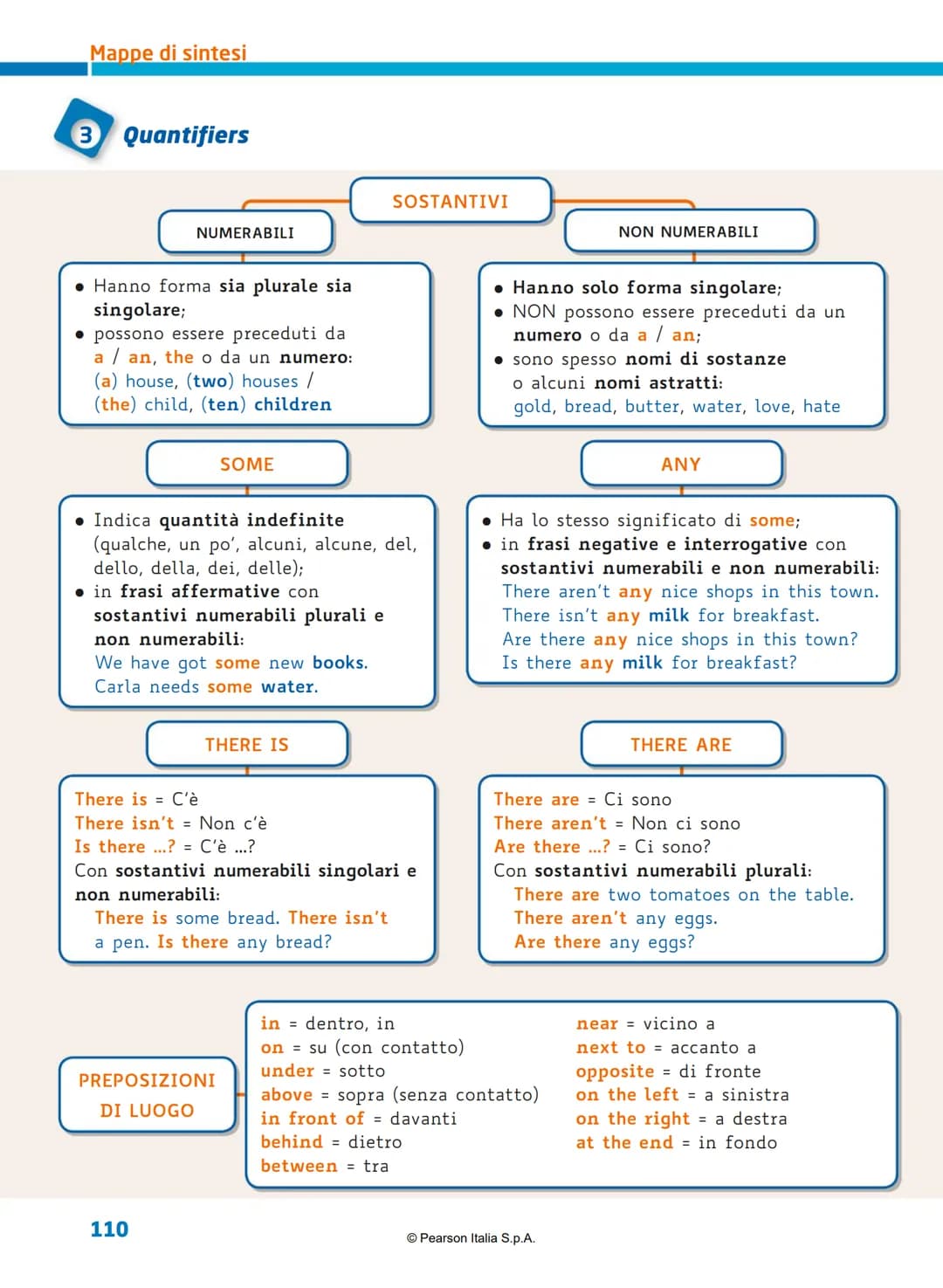
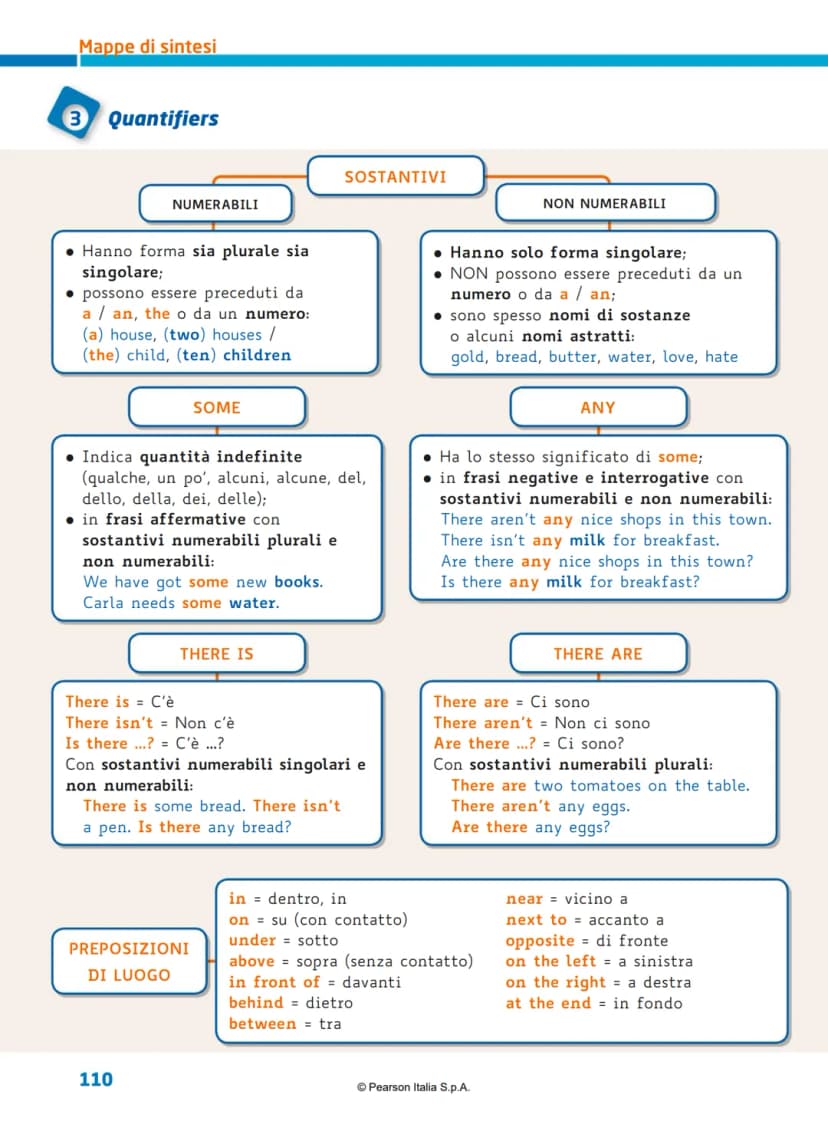
I quantificatori - parte 1
I sostantivi numerabili li puoi contare (one book, two books), mentre i non numerabili no (water, love, bread). Questa distinzione è fondamentale per usare correttamente i quantificatori!
Some significa "qualche/un po'" e lo usi nelle frasi affermative: "We have some books". Any ha lo stesso significato ma va nelle frasi negative e interrogative: "We don't have any books" o "Do we have any books?".
There is/There are ti serve per dire "c'è/ci sono". Usa "there is" con sostantivi singolari e non numerabili, "there are" con i plurali. There is a book, there are two books. Nelle negative: there isn't, there aren't.
Le preposizioni di luogo sono essenziali: "in" (dentro), "on" (sopra con contatto), "under" (sotto), "next to" (accanto), "between" (tra), "in front of" (davanti), "behind" (dietro).
💡 Trucco: Se puoi dire "one, two, three..." davanti a una parola, è numerabile!
4
of 10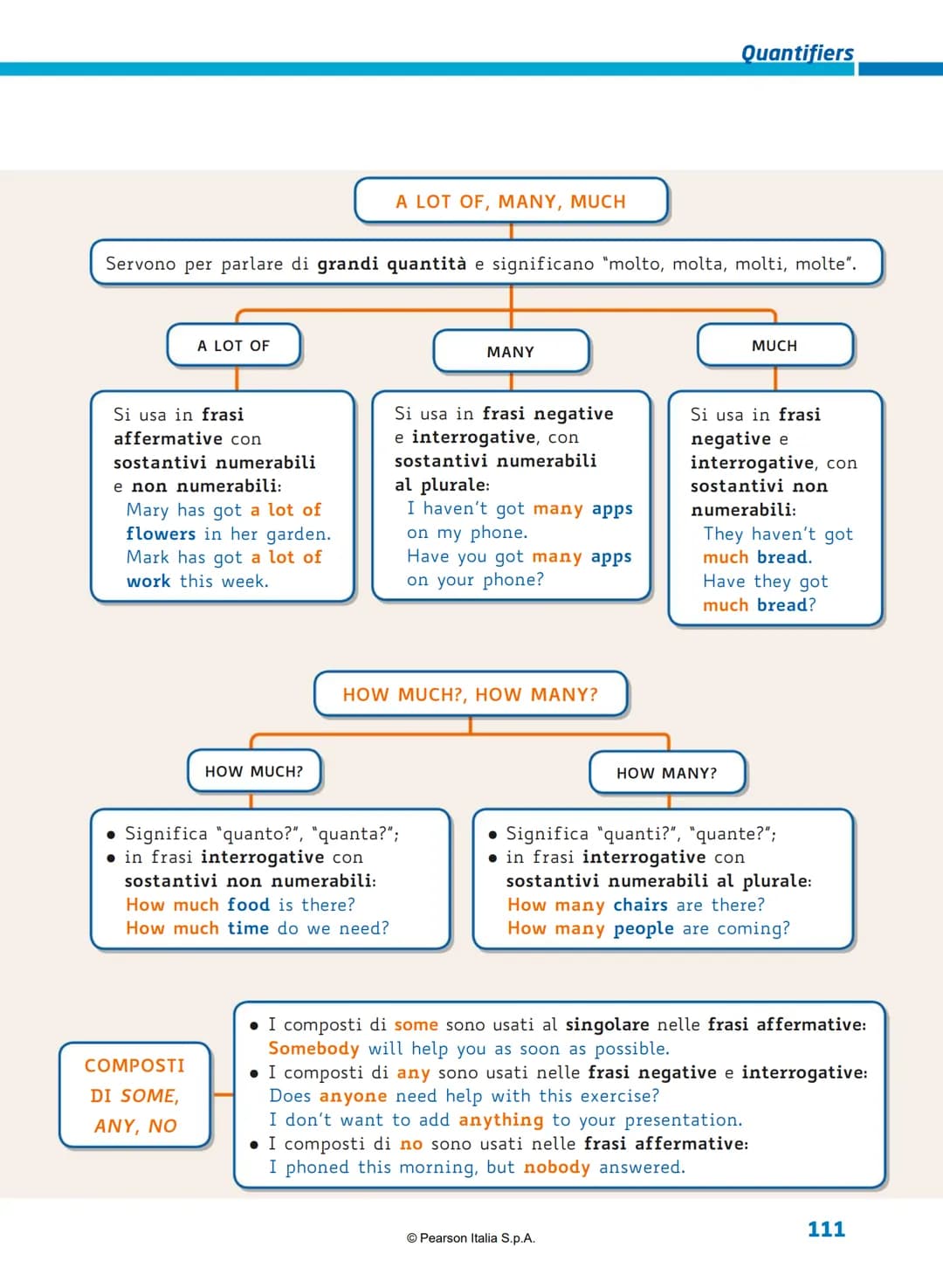
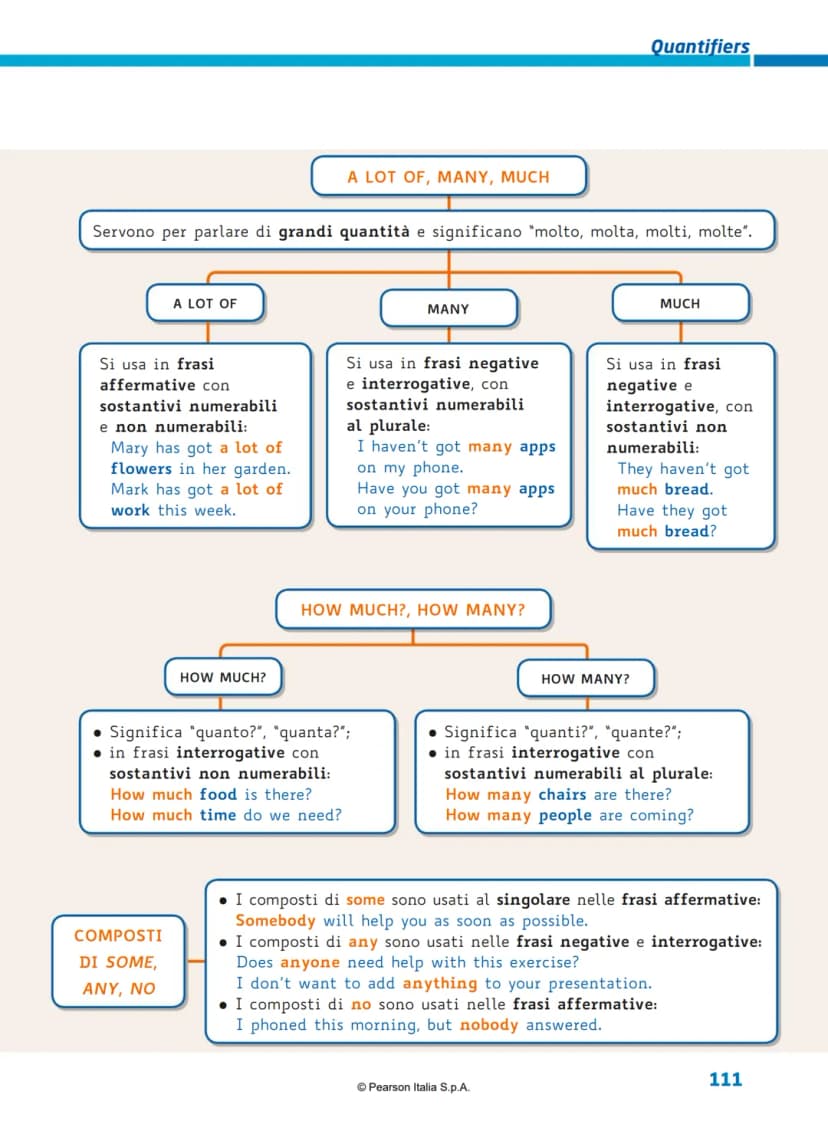
I quantificatori - parte 2
Per parlare di grandi quantità hai tre opzioni: "a lot of" va bene sempre (frasi affermative), "many" solo con numerabili plurali (negative/interrogative), "much" solo con non numerabili (negative/interrogative).
"How much?" e "How many?" ti servono per fare domande sulle quantità. "How much" con non numerabili (How much time?), "How many" con numerabili plurali (How many books?).
I composti di some/any/no sono super utili! Con "some": somebody, something, somewhere (frasi affermative). Con "any": anybody, anything, anywhere (negative/interrogative). Con "no": nobody, nothing, nowhere (frasi affermative con significato negativo).
💡 Attenzione: "I don't want anything" e "I want nothing" significano la stessa cosa, ma la costruzione è diversa!
5
of 10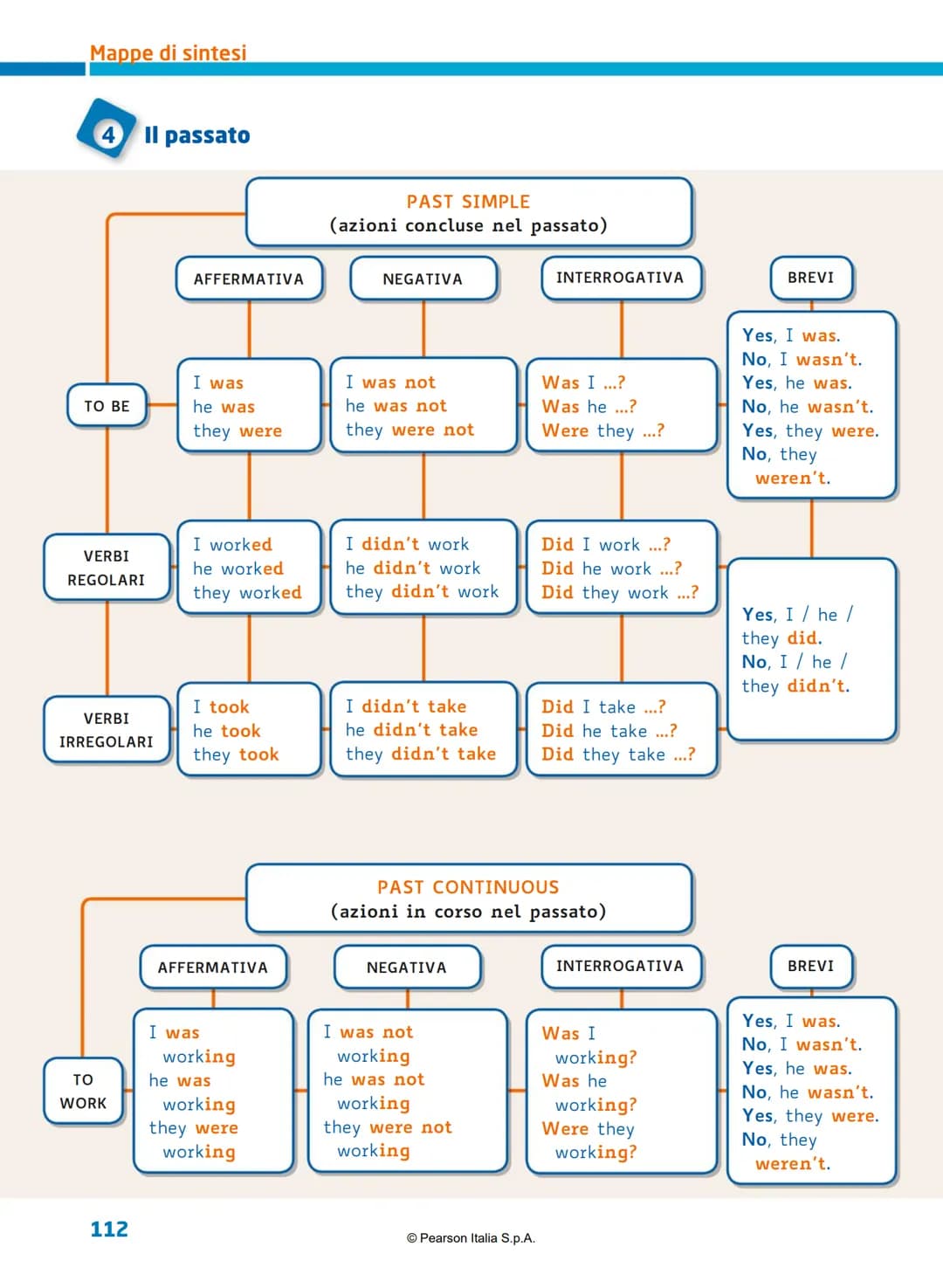
Il passato
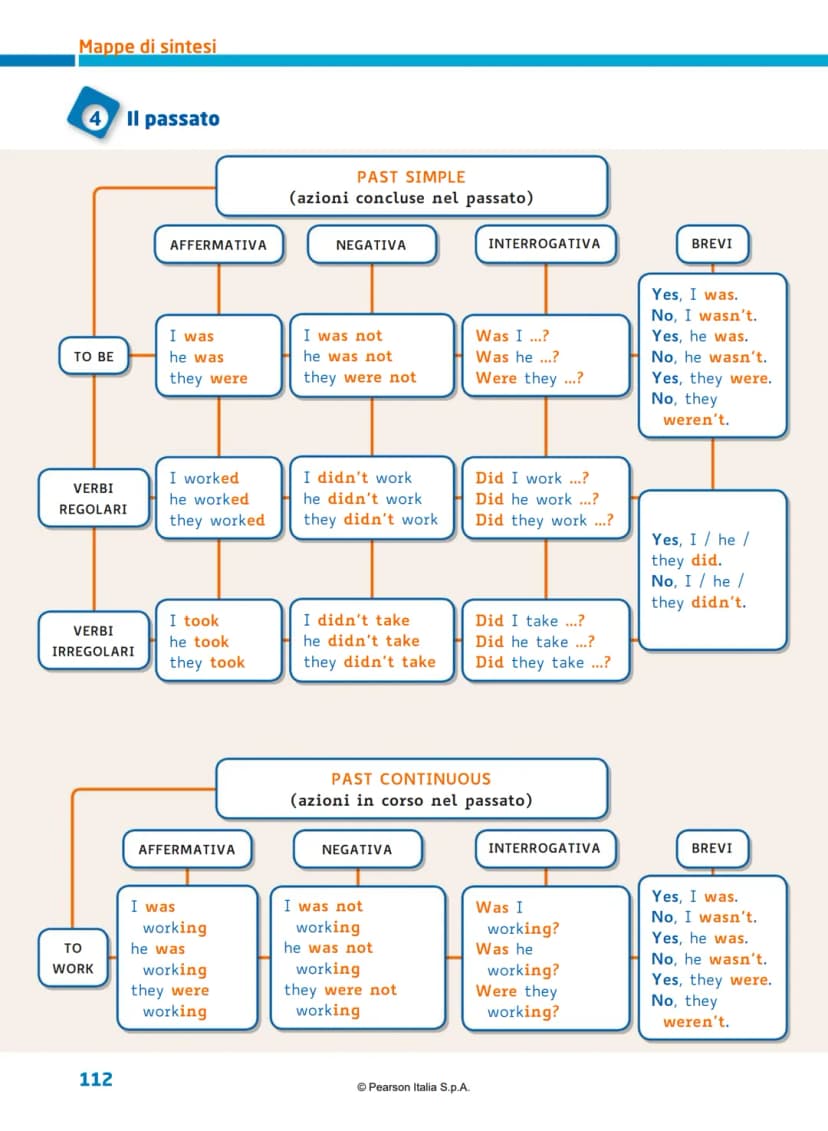
Il Past Simple racconta azioni concluse nel passato. I verbi regolari aggiungono "-ed": work→worked. I verbi irregolari cambiano completamente: go→went, take→took, see→saw. Devi impararli a memoria!
Per "to be" al passato: I/he/she/it was, you/we/they were. Nelle negative: wasn't, weren't. Nelle domande: Was I? Were they?
Il Past Continuous descrive azioni in corso nel passato. Formula: "was/were" + verbo con "-ing". I was studying, they were playing. È perfetto per descrivere il contesto di un'azione passata.
💡 Ricorda: Con tutti i verbi (tranne "to be"), usi "did" per domande e "didn't" per negative al Past Simple: "Did you go?" "I didn't go".
6
of 10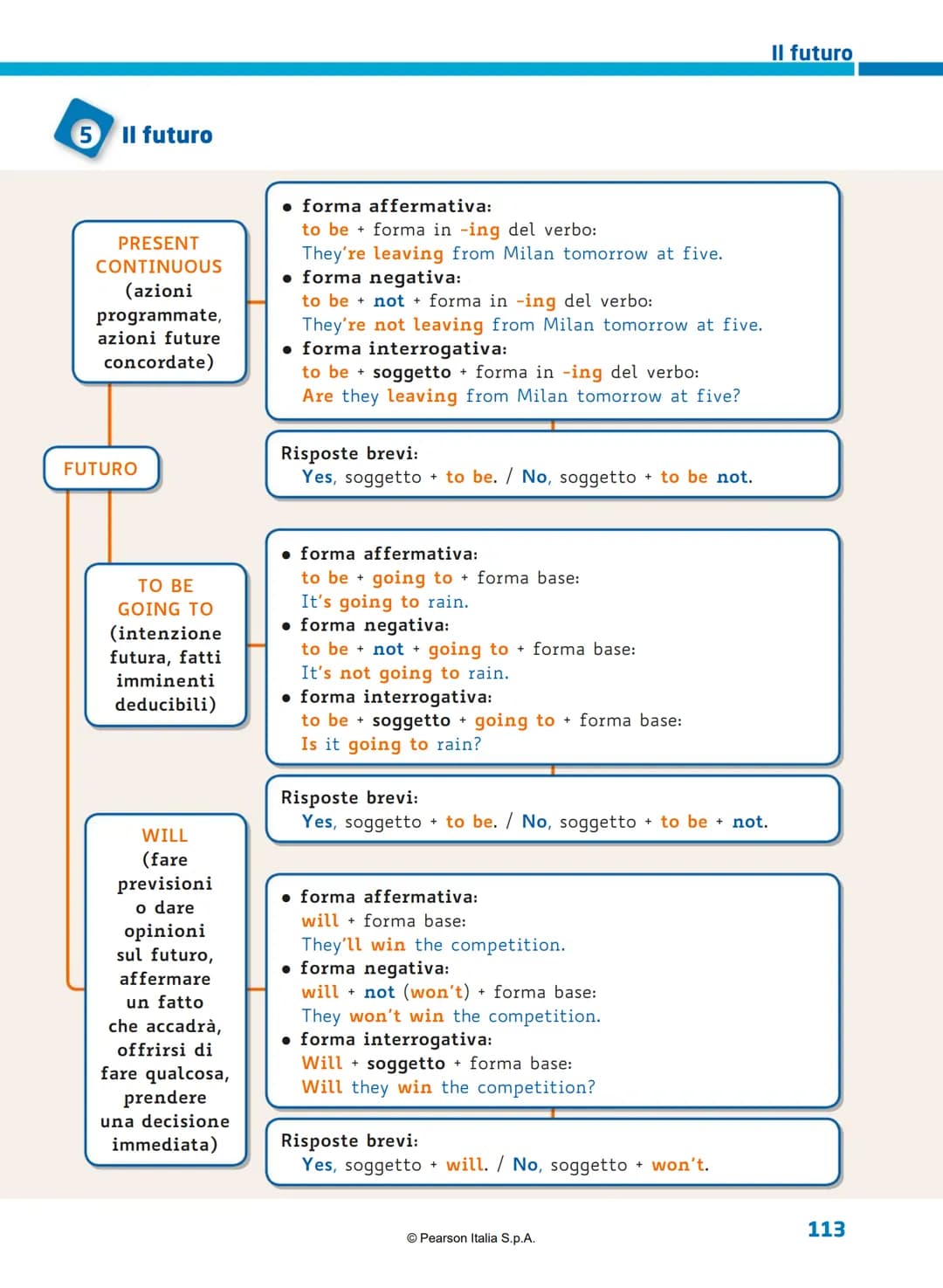
Il futuro
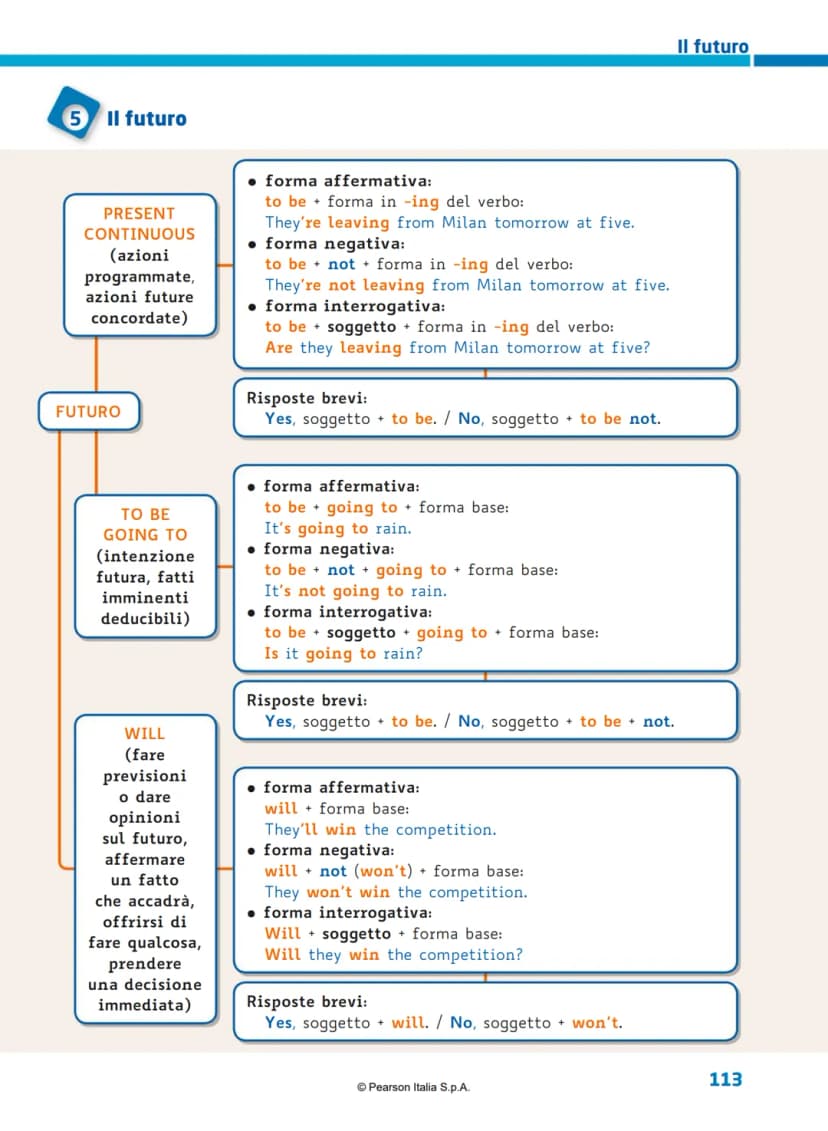
Hai tre modi per parlare del futuro! Il Present Continuous per programmi già fissati: "I'm meeting John tomorrow at 5". È come avere già tutto organizzato nell'agenda.
"To be going to" esprime intenzioni future o fatti imminenti che puoi prevedere: "It's going to rain" (vedi le nuvole nere). Formula: verbo "to be" + going to + verbo base.
"Will" è perfetto per previsioni, opinioni sul futuro, promesse o decisioni immediate: "I think it will rain tomorrow" o "I'll help you!". Forma contratta: I'll, he'll, they'll. Negativa: won't.
💡 Trucco: Se hai già deciso e organizzato → Present Continuous. Se hai intenzione → going to. Se è una previsione o decisione al momento → will.
7
of 10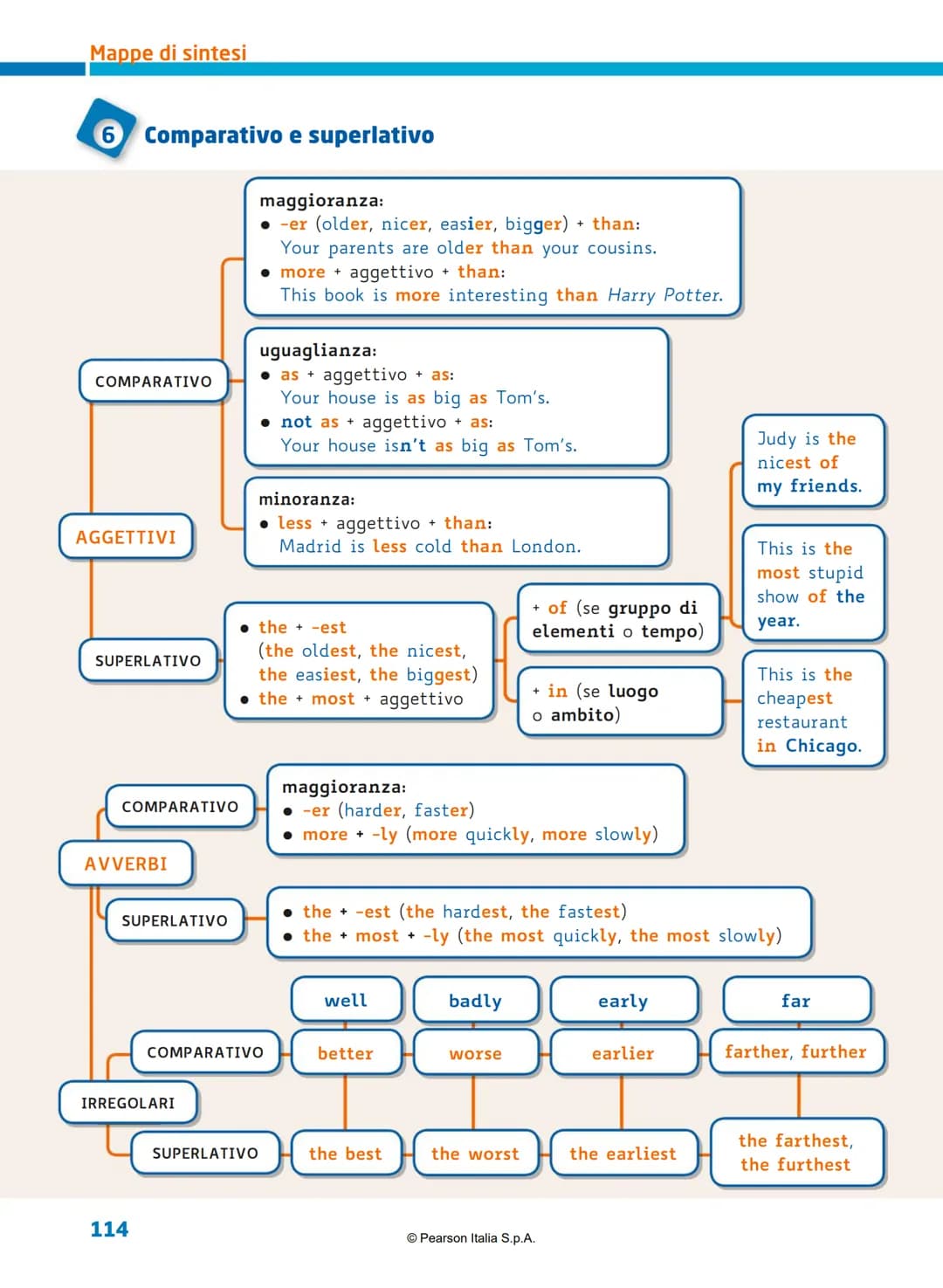
Comparativo e superlativo
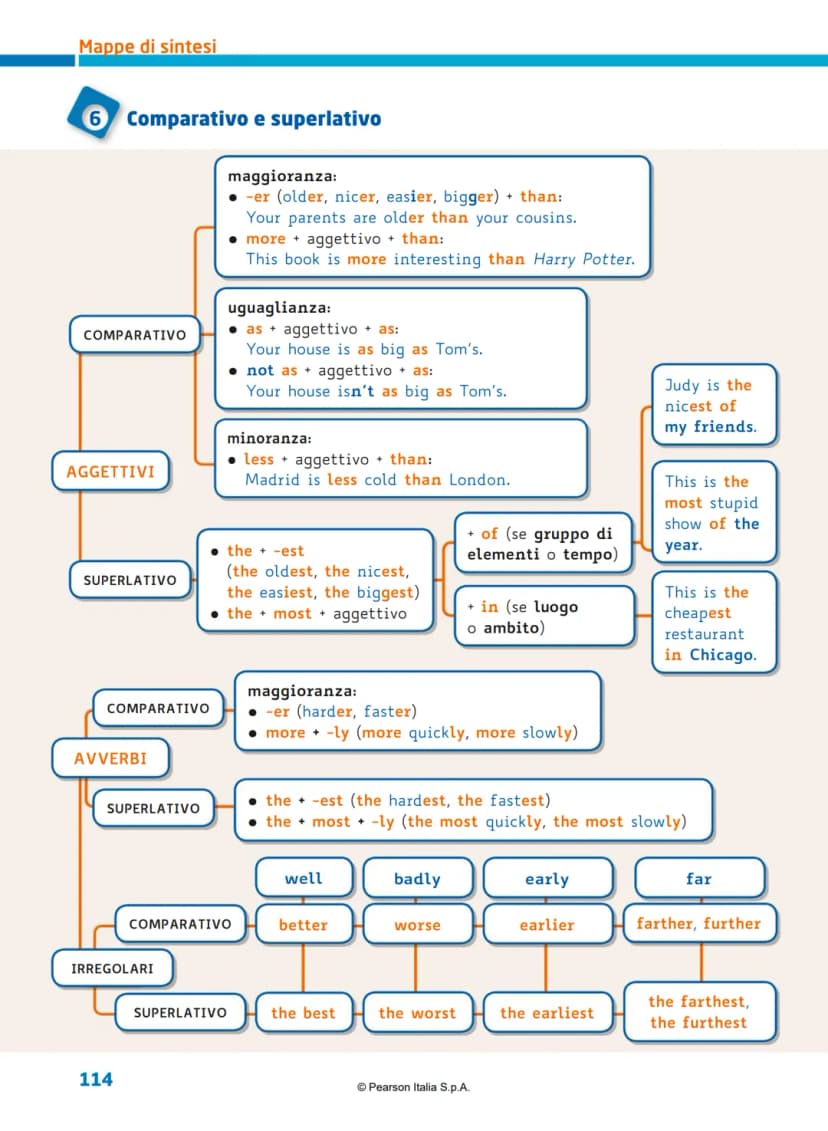
Per confrontare due cose usi il comparativo. Aggettivi corti (1-2 sillabe): aggiungi "-er" + than: older than, nicer than, bigger than. Aggettivi lunghi: "more" + aggettivo + than: more interesting than.
Il superlativo esprime il massimo grado. Aggettivi corti: "the" + aggettivo + "-est": the oldest, the nicest. Aggettivi lunghi: "the most" + aggettivo: the most interesting.
Per l'uguaglianza usi "as...as": "Your house is as big as mine". Per la minoranza: "less...than": "Madrid is less cold than London".
Alcuni sono irregolari: good→better→the best, bad→worse→the worst, far→farther→the farthest. Con gli avverbi funziona uguale: quickly→more quickly→the most quickly.
💡 Regola d'oro: Una sillaba = -er/-est. Due+ sillabe = more/most. Ma "easy" diventa "easier/easiest"!
8
of 10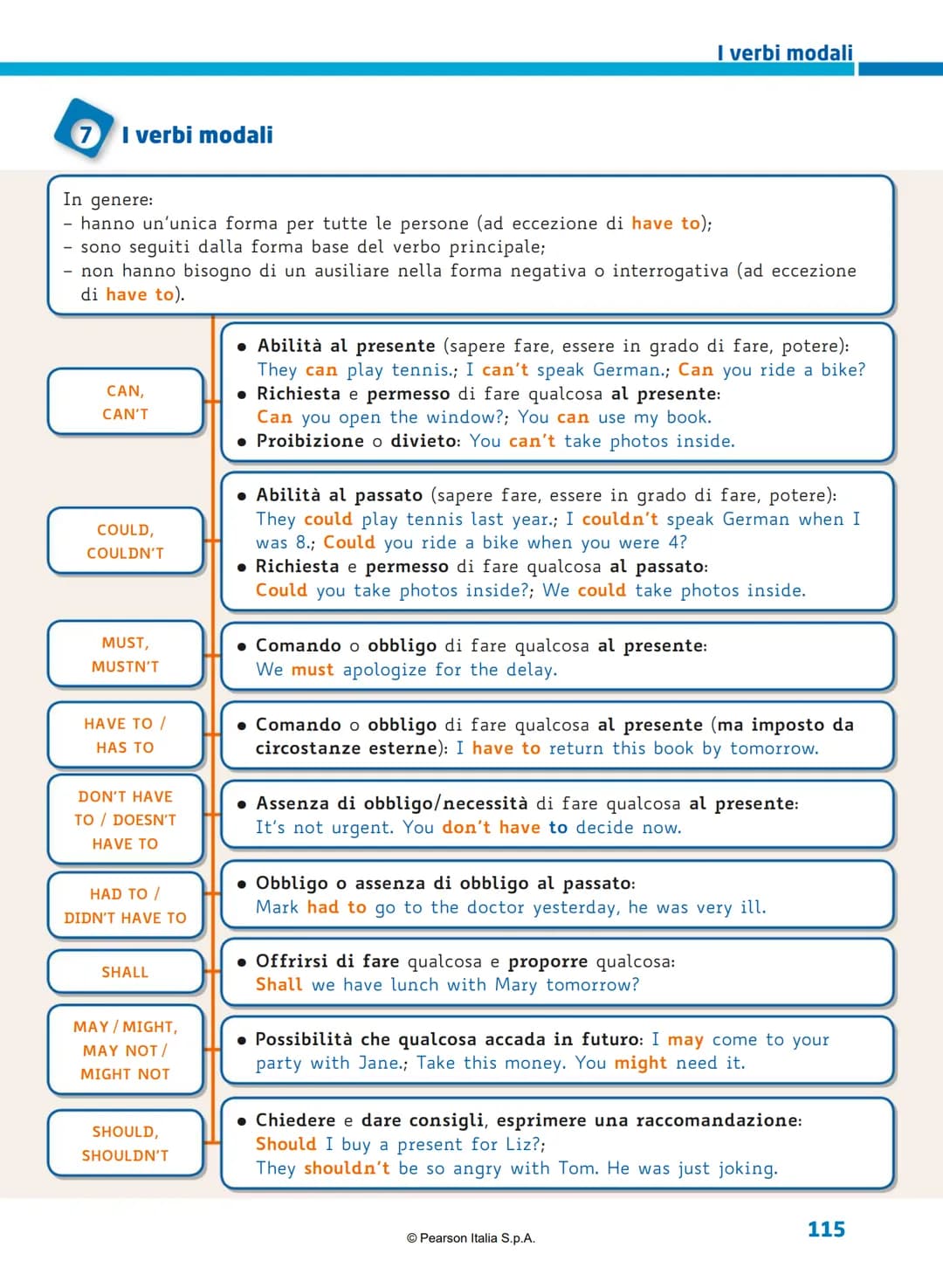
I verbi modali
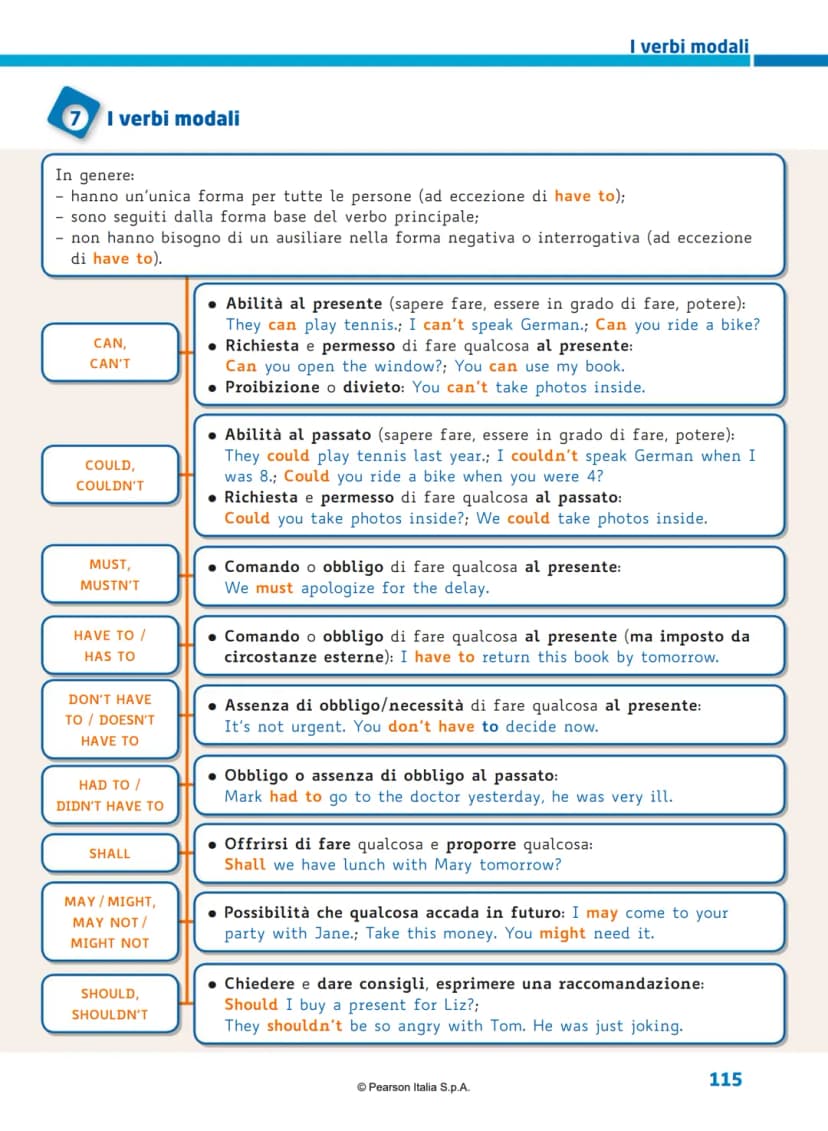
I verbi modali sono speciali: hanno una forma unica per tutte le persone e sono seguiti dal verbo base (senza "to"). Non usano ausiliari per negative e domande (tranne "have to").
Can/Can't esprime abilità nel presente, richieste e permessi: "I can swim", "Can you help me?". Could/Couldn't è il passato di "can" o una richiesta più gentile.
Must/Mustn't esprime obbligo forte: "You must study!". Have to è obbligo esterno: "I have to wear uniform at school". Don't have to = non è necessario.
Should/Shouldn't dà consigli: "You should rest". May/Might esprime possibilità: "It might rain". Shall fa proposte: "Shall we go?".
💡 Differenza importante: "You mustn't smoke" = è vietato. "You don't have to smoke" = non è obbligatorio.
9
of 10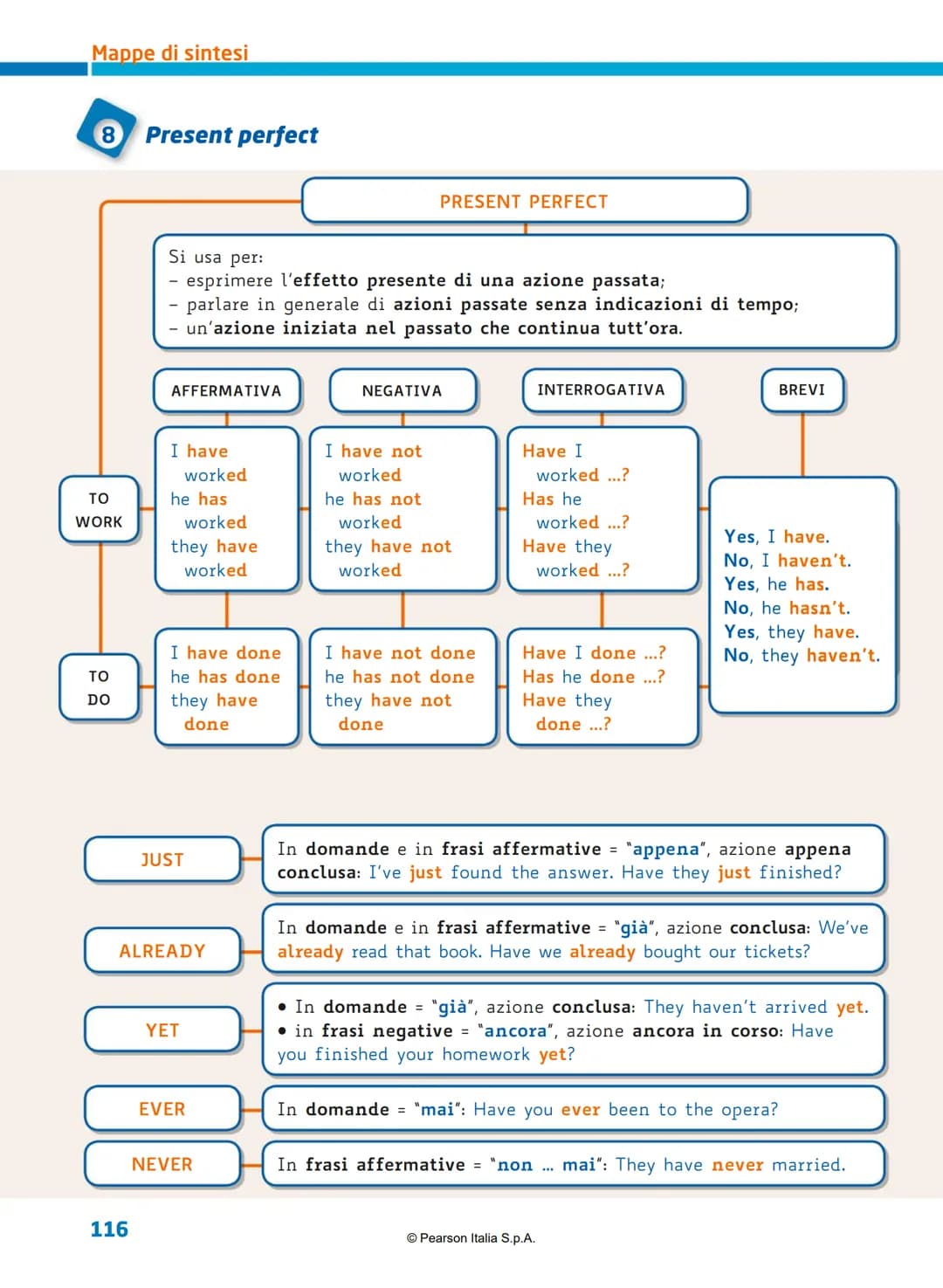
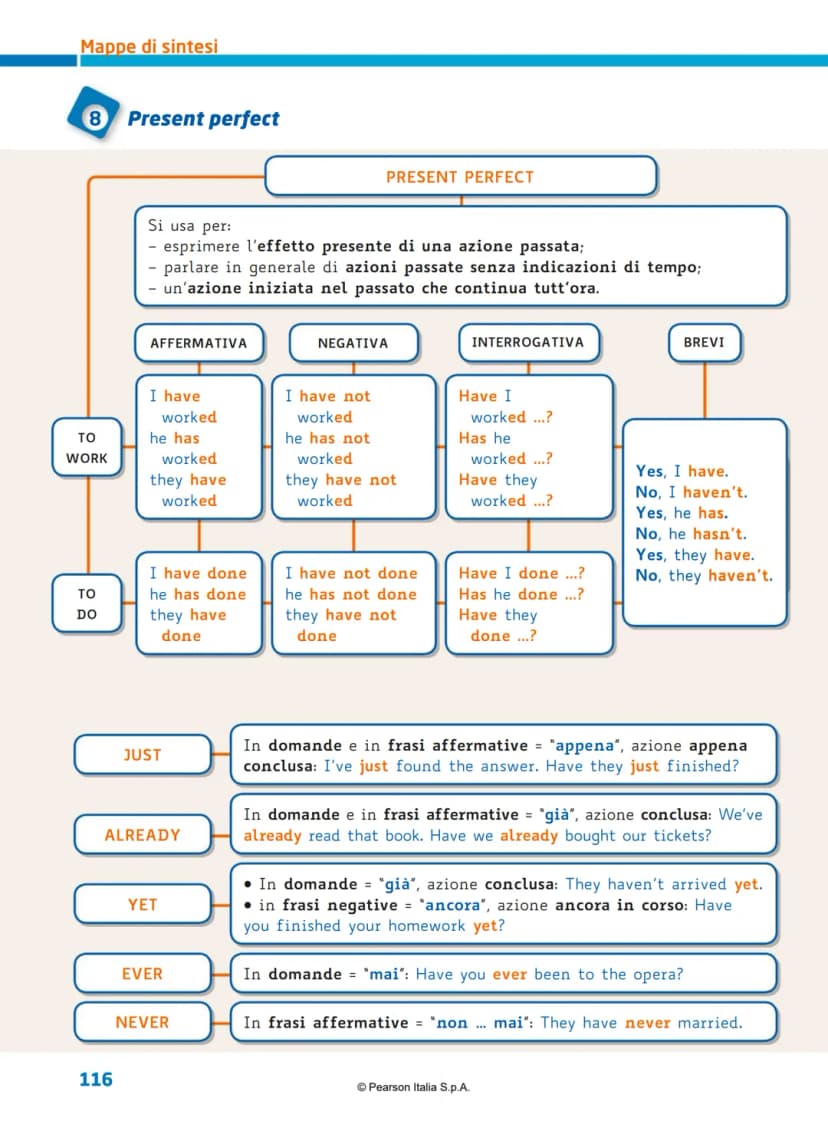
Present Perfect
Il Present Perfect collega passato e presente. Formula: "have/has" + participio passato. Si usa per azioni passate con effetti sul presente, esperienze di vita, azioni iniziate nel passato che continuano ora.
Gli avverbi sono fondamentali! "Just" = appena: "I've just finished". "Already" = già (affermative/interrogative): "I've already eaten". "Yet" = già (domande) o ancora (negative): "Have you finished yet?" "I haven't finished yet".
"Ever" nelle domande = mai: "Have you ever been to London?". "Never" nelle affermative = non...mai: "I've never seen that movie".
💡 Trucco: Se c'è un tempo specifico (yesterday, last week), usa Past Simple. Se non c'è tempo specifico, usa Present Perfect!
10
of 10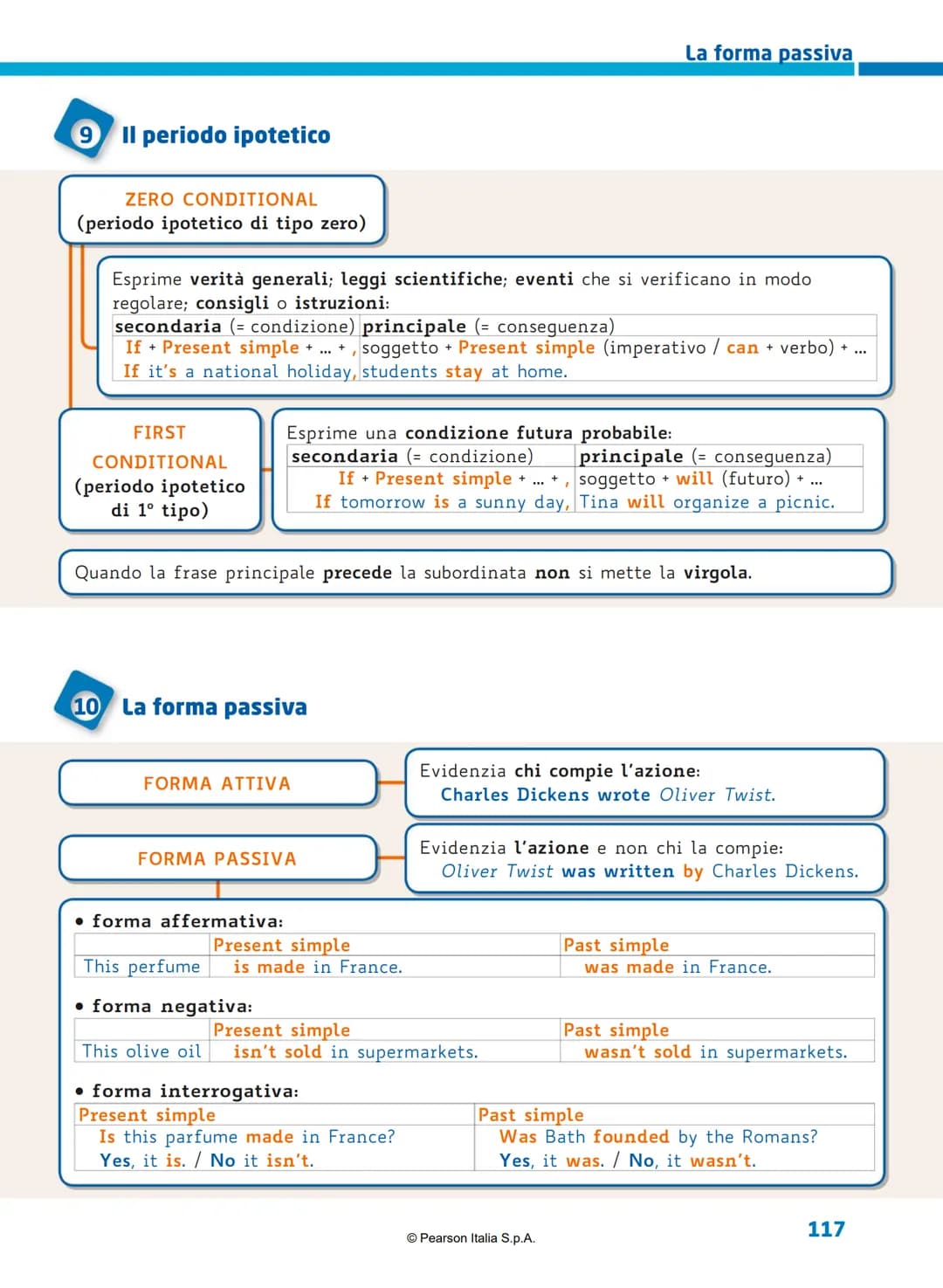
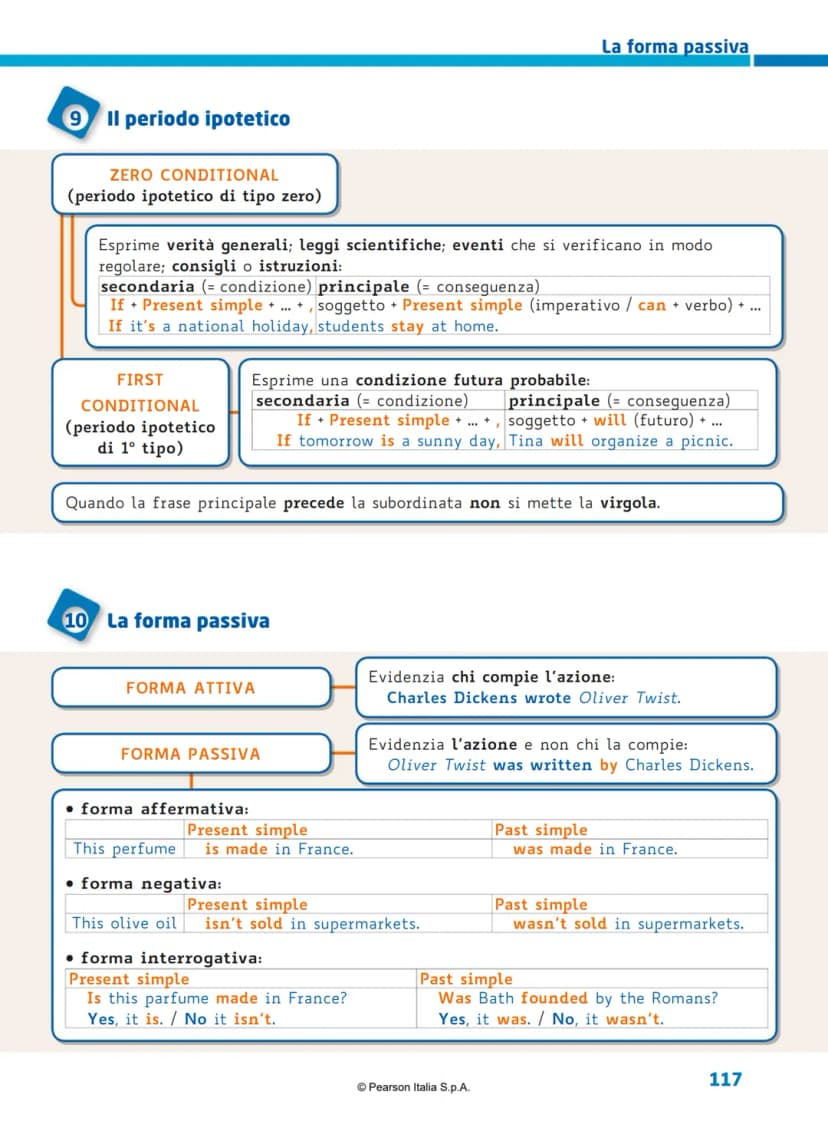
Periodo ipotetico e forma passiva
Il Zero Conditional esprime verità generali: "If you heat water, it boils". Formula: If + Present Simple, Present Simple. È perfetto per leggi scientifiche e consigli generali.
Il First Conditional parla di possibilità future: "If it rains tomorrow, I'll stay home". Formula: If + Present Simple, will + verbo base. La virgola va solo se inizi con "if".
La forma passiva sposta l'attenzione dall'azione a chi la subisce. Attiva: "Shakespeare wrote Hamlet". Passiva: "Hamlet was written by Shakespeare". Formula: verbo "to be" + participio passato.
💡 Quando usare il passivo: Quando non sai chi ha fatto l'azione o quando l'azione è più importante di chi la fa!
We thought you’d never ask...
Our AI companion is specifically built for the needs of students. Based on the millions of content pieces we have on the platform we can provide truly meaningful and relevant answers to students. But its not only about answers, the companion is even more about guiding students through their daily learning challenges, with personalised study plans, quizzes or content pieces in the chat and 100% personalisation based on the students skills and developments.
You can download the app in the Google Play Store and in the Apple App Store.
That's right! Enjoy free access to study content, connect with fellow students, and get instant help – all at your fingertips.
Similar Content
 Anglais
Most popular content: verb to be
9IngleseBE GOING TO
be going to: quando si usa, forma affermativa, negativa e interrogativa (con esempi)
3ªm95626
Inglesepresent continuous
present continuous
2ªm13,252573
Ingleseconcetti base di inglese
inglese - molti appunti sui concetti base di inglese
1ªm2,619355
IngleseIl present continuous
Appunti sul present continuous
1ªl3,03135
Inglesesintesi della grammatica
regole schematizzate della grammatica inglese di prima superiore
1ªl3,231109
Ingleseto be
verbo essere in inglese
1ªl9038
IngleseBe Going To
sintesi Be Going To
2ªm1,91447
InglesePast Simple
Be past simple, Question words + Be past simple, Have past since
1ªm3,983151
InglesePast continuos
Come si forma il past continuos e come si utilizza
1ªm1,36512
Most popular content in Inglese
9P
InglesePresent Simple vs Present Continuous
Develop the ability to choose correctly between the Present Simple for habits and the Present Continuous for ongoing actions.
3ªm4,2190
F
IngleseFormazione dei Verbi al Past Simple
Impara a trasformare i verbi dalla forma base al Past Simple, distinguendo tra verbi regolari e irregolari.
2ªm2,5590
B
IngleseBasics of Present Simple vs Continuous
Identify core differences between regular habits and temporary actions happening right now.
3ªm9990
I
IngleseIntroduzione ai Verbi Irregolari Inglesi
Impara a distinguere tra verbi regolari e irregolari e familiarizza con i paradigmi più comuni della lingua inglese.
2ªm4,9630
I
IngleseI conditionals
Un quiz su come formare i condizionali in inglese. Spero possa esservi utile♥️
3ªl2,1122
Inglesepresent simple, continuous, past simple, continuous, present perfect simple e continuous
Tempi verbali
2ªl11,644259
IngleseRipasso tempi verbali inglese
Ecco i tempi verbali inglesi spiegati in maniera riassuntiva e schematica
3ªl2,14049
F
IngleseFrasi e Domande al Past Simple
Crea frasi complete e domande utilizzando l'ausiliare 'did' per descrivere eventi avvenuti nel passato.
2ªm9330
InglesePROGRAMMA COMPLETO DI INGLESE
The Romantic Age (Blake, Wordsworth, Coleridge, Shelley, Keats and Jane Austen), The Victorian Age (Dickens, Oscar Wilde, Stevenson) and The Modern Age (War Poets, Eliot, Joyce and Orwell)
5ªl98629
Most popular content
9 Italiano
Riassunto patente B
Riassunto patente B - appunti presi a lezione
5ªl29,376947
 Altro
AltroTeoria patente b
Tutti gli argomenti per la patente
1ªl21,333690
 Ed. civ.
Teoria patente di guida B: Segnali stradali
Segnali stradali di pericolo, luminosi, di prescrizione, di indicazione, temporanei, complementari, pannelli integrativi, segnaletica orizzontale, segnalazioni agenti del traffico, distanza di visibilità per l‘arresto, minima di sicurezza.
5ªl40,1931,649
 Filosofia
Aristotele
Aristotele: vita, metafisica, fisica, etica e politica, retorica e poetica
3ªl7,624216
ItalianoI promessi sposi
Riassunti completi di tutti i 38 capitoli dei Promessi sposi.
2ªl14,092314
AltroPATENTE
schemi per esame teorico della patente
Università22,171758
S
ItalianoSintesi finale di Analisi logica
Esercitazione completa di analisi logica su frasi articolate per consolidare la conoscenza di tutti i complementi.
3ªm5,5400
P
InglesePresent Simple vs Present Continuous
Develop the ability to choose correctly between the Present Simple for habits and the Present Continuous for ongoing actions.
3ªm4,2190
G
ItalianoGabriele D'Annunzio e l'Estetismo
Domande sull'ideale del superuomo, il panismo e la concezione dell'arte come valore assoluto in D'Annunzio.
4ªl2,6740
Students love us — and so will you.
4.6/5App Store
4.7/5Google Play
The app is very easy to use and well designed. I have found everything I was looking for so far and have been able to learn a lot from the presentations! I will definitely use the app for a class assignment! And of course it also helps a lot as an inspiration.
Stefan SiOS user
This app is really great. There are so many study notes and help [...]. My problem subject is French, for example, and the app has so many options for help. Thanks to this app, I have improved my French. I would recommend it to anyone.
Samantha KlichAndroid user
Wow, I am really amazed. I just tried the app because I've seen it advertised many times and was absolutely stunned. This app is THE HELP you want for school and above all, it offers so many things, such as workouts and fact sheets, which have been VERY helpful to me personally.
AnnaiOS user
Inglese1,269 views·Updated Jul 1, 2026·11 pagesRegole di Grammatica Inglese: Una Guida Completa
Annamaria @annamaria_dj2lj
Questa mappa di sintesi copre tutti gli elementi essenziali della grammatica inglese che ti servono per affrontare con sicurezza i primi anni di studio. Dalle basi come articoli e sostantivi fino ai concetti più avanzati come il present perfect e...
1
of 10
Sign up to see the content. It's free!
- Access to all documents
- Improve your grades
- Join milions of students
Sostantivi, articoli, pronomi e aggettivi
Iniziamo dalle fondamenta: gli articoli sono semplicissimi in inglese! Hai solo "the" (determinativo) per dire "il/la/i/le" e "a/an" (indeterminativi) per "un/una". Usa "an" solo davanti alle vocali, come "an idea" o "an hour".
Per il plurale dei sostantivi, la regola base è aggiungere "-s": car→cars, pen→pens. Ma occhio alle eccezioni! Se il sostantivo finisce con -s, -ss, -ch, -sh, -o, -x, -z, aggiungi "-es": bus→buses, tomato→tomatoes. Alcuni plurali sono completamente irregolari come man→men, child→children.
I pronomi personali cambiano forma: "I" diventa "me", "he" diventa "him", "she" diventa "her". Gli aggettivi possessivi (my, your, his) sono diversi dai pronomi possessivi (mine, yours, his). Per i dimostrativi, ricorda: this/these per le cose vicine, that/those per quelle lontane.
💡 Trucco: Se non sai se usare "a" o "an", prova a pronunciare la parola: se inizia con suono di vocale, usa "an"!
2
of 10Sign up to see the content. It's free!
- Access to all documents
- Improve your grades
- Join milions of students
Il presente
Il Present Simple è il tuo migliore amico per parlare di abitudini e routine quotidiane. Con "I/you/we/they" usi la forma base del verbo, ma con "he/she/it" aggiungi sempre la "-s": I work, he works. Per le negazioni usa "don't" o "doesn't", per le domande "do" o "does".
Il verbo "to be" è irregolare: I am, you are, he/she/it is, we/you/they are. Forma negativa: am not, isn't, aren't. "Have got" funziona come "to be": I have got, he has got, con negative "haven't got" e "hasn't got".
Il Present Continuous descrive azioni che stanno succedendo ora. Formula magica: verbo "to be" + verbo con "-ing". I am working, he is working, they are working. È perfetto per dire cosa stai facendo in questo momento!
💡 Ricorda: Le espressioni di frequenza come "always", "often", "never" ti aiutano col Present Simple. "Never" e "always" vanno prima del verbo principale!
3
of 10Sign up to see the content. It's free!
- Access to all documents
- Improve your grades
- Join milions of students
I quantificatori - parte 1
I sostantivi numerabili li puoi contare (one book, two books), mentre i non numerabili no (water, love, bread). Questa distinzione è fondamentale per usare correttamente i quantificatori!
Some significa "qualche/un po'" e lo usi nelle frasi affermative: "We have some books". Any ha lo stesso significato ma va nelle frasi negative e interrogative: "We don't have any books" o "Do we have any books?".
There is/There are ti serve per dire "c'è/ci sono". Usa "there is" con sostantivi singolari e non numerabili, "there are" con i plurali. There is a book, there are two books. Nelle negative: there isn't, there aren't.
Le preposizioni di luogo sono essenziali: "in" (dentro), "on" (sopra con contatto), "under" (sotto), "next to" (accanto), "between" (tra), "in front of" (davanti), "behind" (dietro).
💡 Trucco: Se puoi dire "one, two, three..." davanti a una parola, è numerabile!
4
of 10Sign up to see the content. It's free!
- Access to all documents
- Improve your grades
- Join milions of students
I quantificatori - parte 2
Per parlare di grandi quantità hai tre opzioni: "a lot of" va bene sempre (frasi affermative), "many" solo con numerabili plurali (negative/interrogative), "much" solo con non numerabili (negative/interrogative).
"How much?" e "How many?" ti servono per fare domande sulle quantità. "How much" con non numerabili (How much time?), "How many" con numerabili plurali (How many books?).
I composti di some/any/no sono super utili! Con "some": somebody, something, somewhere (frasi affermative). Con "any": anybody, anything, anywhere (negative/interrogative). Con "no": nobody, nothing, nowhere (frasi affermative con significato negativo).
💡 Attenzione: "I don't want anything" e "I want nothing" significano la stessa cosa, ma la costruzione è diversa!
5
of 10Sign up to see the content. It's free!
- Access to all documents
- Improve your grades
- Join milions of students
Il passato
Il Past Simple racconta azioni concluse nel passato. I verbi regolari aggiungono "-ed": work→worked. I verbi irregolari cambiano completamente: go→went, take→took, see→saw. Devi impararli a memoria!
Per "to be" al passato: I/he/she/it was, you/we/they were. Nelle negative: wasn't, weren't. Nelle domande: Was I? Were they?
Il Past Continuous descrive azioni in corso nel passato. Formula: "was/were" + verbo con "-ing". I was studying, they were playing. È perfetto per descrivere il contesto di un'azione passata.
💡 Ricorda: Con tutti i verbi (tranne "to be"), usi "did" per domande e "didn't" per negative al Past Simple: "Did you go?" "I didn't go".
6
of 10Sign up to see the content. It's free!
- Access to all documents
- Improve your grades
- Join milions of students
Il futuro
Hai tre modi per parlare del futuro! Il Present Continuous per programmi già fissati: "I'm meeting John tomorrow at 5". È come avere già tutto organizzato nell'agenda.
"To be going to" esprime intenzioni future o fatti imminenti che puoi prevedere: "It's going to rain" (vedi le nuvole nere). Formula: verbo "to be" + going to + verbo base.
"Will" è perfetto per previsioni, opinioni sul futuro, promesse o decisioni immediate: "I think it will rain tomorrow" o "I'll help you!". Forma contratta: I'll, he'll, they'll. Negativa: won't.
💡 Trucco: Se hai già deciso e organizzato → Present Continuous. Se hai intenzione → going to. Se è una previsione o decisione al momento → will.
7
of 10Sign up to see the content. It's free!
- Access to all documents
- Improve your grades
- Join milions of students
Comparativo e superlativo
Per confrontare due cose usi il comparativo. Aggettivi corti (1-2 sillabe): aggiungi "-er" + than: older than, nicer than, bigger than. Aggettivi lunghi: "more" + aggettivo + than: more interesting than.
Il superlativo esprime il massimo grado. Aggettivi corti: "the" + aggettivo + "-est": the oldest, the nicest. Aggettivi lunghi: "the most" + aggettivo: the most interesting.
Per l'uguaglianza usi "as...as": "Your house is as big as mine". Per la minoranza: "less...than": "Madrid is less cold than London".
Alcuni sono irregolari: good→better→the best, bad→worse→the worst, far→farther→the farthest. Con gli avverbi funziona uguale: quickly→more quickly→the most quickly.
💡 Regola d'oro: Una sillaba = -er/-est. Due+ sillabe = more/most. Ma "easy" diventa "easier/easiest"!
8
of 10Sign up to see the content. It's free!
- Access to all documents
- Improve your grades
- Join milions of students
I verbi modali
I verbi modali sono speciali: hanno una forma unica per tutte le persone e sono seguiti dal verbo base (senza "to"). Non usano ausiliari per negative e domande (tranne "have to").
Can/Can't esprime abilità nel presente, richieste e permessi: "I can swim", "Can you help me?". Could/Couldn't è il passato di "can" o una richiesta più gentile.
Must/Mustn't esprime obbligo forte: "You must study!". Have to è obbligo esterno: "I have to wear uniform at school". Don't have to = non è necessario.
Should/Shouldn't dà consigli: "You should rest". May/Might esprime possibilità: "It might rain". Shall fa proposte: "Shall we go?".
💡 Differenza importante: "You mustn't smoke" = è vietato. "You don't have to smoke" = non è obbligatorio.
9
of 10Sign up to see the content. It's free!
- Access to all documents
- Improve your grades
- Join milions of students
Present Perfect
Il Present Perfect collega passato e presente. Formula: "have/has" + participio passato. Si usa per azioni passate con effetti sul presente, esperienze di vita, azioni iniziate nel passato che continuano ora.
Gli avverbi sono fondamentali! "Just" = appena: "I've just finished". "Already" = già (affermative/interrogative): "I've already eaten". "Yet" = già (domande) o ancora (negative): "Have you finished yet?" "I haven't finished yet".
"Ever" nelle domande = mai: "Have you ever been to London?". "Never" nelle affermative = non...mai: "I've never seen that movie".
💡 Trucco: Se c'è un tempo specifico (yesterday, last week), usa Past Simple. Se non c'è tempo specifico, usa Present Perfect!
10
of 10Sign up to see the content. It's free!
- Access to all documents
- Improve your grades
- Join milions of students
Periodo ipotetico e forma passiva
Il Zero Conditional esprime verità generali: "If you heat water, it boils". Formula: If + Present Simple, Present Simple. È perfetto per leggi scientifiche e consigli generali.
Il First Conditional parla di possibilità future: "If it rains tomorrow, I'll stay home". Formula: If + Present Simple, will + verbo base. La virgola va solo se inizi con "if".
La forma passiva sposta l'attenzione dall'azione a chi la subisce. Attiva: "Shakespeare wrote Hamlet". Passiva: "Hamlet was written by Shakespeare". Formula: verbo "to be" + participio passato.
💡 Quando usare il passivo: Quando non sai chi ha fatto l'azione o quando l'azione è più importante di chi la fa!
We thought you’d never ask...
Our AI companion is specifically built for the needs of students. Based on the millions of content pieces we have on the platform we can provide truly meaningful and relevant answers to students. But its not only about answers, the companion is even more about guiding students through their daily learning challenges, with personalised study plans, quizzes or content pieces in the chat and 100% personalisation based on the students skills and developments.
You can download the app in the Google Play Store and in the Apple App Store.
That's right! Enjoy free access to study content, connect with fellow students, and get instant help – all at your fingertips.
Similar Content
Most popular content: verb to be
9IngleseBE GOING TO
be going to: quando si usa, forma affermativa, negativa e interrogativa (con esempi)
3ªm95626
Inglesepresent continuous
present continuous
2ªm13,252573
Ingleseconcetti base di inglese
inglese - molti appunti sui concetti base di inglese
1ªm2,619355
IngleseIl present continuous
Appunti sul present continuous
1ªl3,03135
Inglesesintesi della grammatica
regole schematizzate della grammatica inglese di prima superiore
1ªl3,231109
Ingleseto be
verbo essere in inglese
1ªl9038
IngleseBe Going To
sintesi Be Going To
2ªm1,91447
InglesePast Simple
Be past simple, Question words + Be past simple, Have past since
1ªm3,983151
InglesePast continuos
Come si forma il past continuos e come si utilizza
1ªm1,36512
Most popular content in Inglese
9P
InglesePresent Simple vs Present Continuous
Develop the ability to choose correctly between the Present Simple for habits and the Present Continuous for ongoing actions.
3ªm4,2190
F
IngleseFormazione dei Verbi al Past Simple
Impara a trasformare i verbi dalla forma base al Past Simple, distinguendo tra verbi regolari e irregolari.
2ªm2,5590
B
IngleseBasics of Present Simple vs Continuous
Identify core differences between regular habits and temporary actions happening right now.
3ªm9990
I
IngleseIntroduzione ai Verbi Irregolari Inglesi
Impara a distinguere tra verbi regolari e irregolari e familiarizza con i paradigmi più comuni della lingua inglese.
2ªm4,9630
I
IngleseI conditionals
Un quiz su come formare i condizionali in inglese. Spero possa esservi utile♥️
3ªl2,1122
Inglesepresent simple, continuous, past simple, continuous, present perfect simple e continuous
Tempi verbali
2ªl11,644259
IngleseRipasso tempi verbali inglese
Ecco i tempi verbali inglesi spiegati in maniera riassuntiva e schematica
3ªl2,14049
F
IngleseFrasi e Domande al Past Simple
Crea frasi complete e domande utilizzando l'ausiliare 'did' per descrivere eventi avvenuti nel passato.
2ªm9330
InglesePROGRAMMA COMPLETO DI INGLESE
The Romantic Age (Blake, Wordsworth, Coleridge, Shelley, Keats and Jane Austen), The Victorian Age (Dickens, Oscar Wilde, Stevenson) and The Modern Age (War Poets, Eliot, Joyce and Orwell)
5ªl98629
Most popular content
9ItalianoRiassunto patente B
Riassunto patente B - appunti presi a lezione
5ªl29,376947
AltroTeoria patente b
Tutti gli argomenti per la patente
1ªl21,333690
Ed. civ.Teoria patente di guida B: Segnali stradali
Segnali stradali di pericolo, luminosi, di prescrizione, di indicazione, temporanei, complementari, pannelli integrativi, segnaletica orizzontale, segnalazioni agenti del traffico, distanza di visibilità per l‘arresto, minima di sicurezza.
5ªl40,1931,649
FilosofiaAristotele
Aristotele: vita, metafisica, fisica, etica e politica, retorica e poetica
3ªl7,624216
ItalianoI promessi sposi
Riassunti completi di tutti i 38 capitoli dei Promessi sposi.
2ªl14,092314
AltroPATENTE
schemi per esame teorico della patente
Università22,171758
S
ItalianoSintesi finale di Analisi logica
Esercitazione completa di analisi logica su frasi articolate per consolidare la conoscenza di tutti i complementi.
3ªm5,5400
P
InglesePresent Simple vs Present Continuous
Develop the ability to choose correctly between the Present Simple for habits and the Present Continuous for ongoing actions.
3ªm4,2190
G
ItalianoGabriele D'Annunzio e l'Estetismo
Domande sull'ideale del superuomo, il panismo e la concezione dell'arte come valore assoluto in D'Annunzio.
4ªl2,6740
Students love us — and so will you.
4.6/5App Store
4.7/5Google Play
The app is very easy to use and well designed. I have found everything I was looking for so far and have been able to learn a lot from the presentations! I will definitely use the app for a class assignment! And of course it also helps a lot as an inspiration.
Stefan SiOS user
This app is really great. There are so many study notes and help [...]. My problem subject is French, for example, and the app has so many options for help. Thanks to this app, I have improved my French. I would recommend it to anyone.
Samantha KlichAndroid user
Wow, I am really amazed. I just tried the app because I've seen it advertised many times and was absolutely stunned. This app is THE HELP you want for school and above all, it offers so many things, such as workouts and fact sheets, which have been VERY helpful to me personally.
AnnaiOS user