
• Condicionales en inglésare essential grammatical structures for expressing...
 Inglés195 views·Updated Jun 26, 2026·2 pages
20 Conditional Sentences in English and Spanish - Learn All Types!
J
Jessica Valeria Parra Idarraga@valeria.parra
1
of 2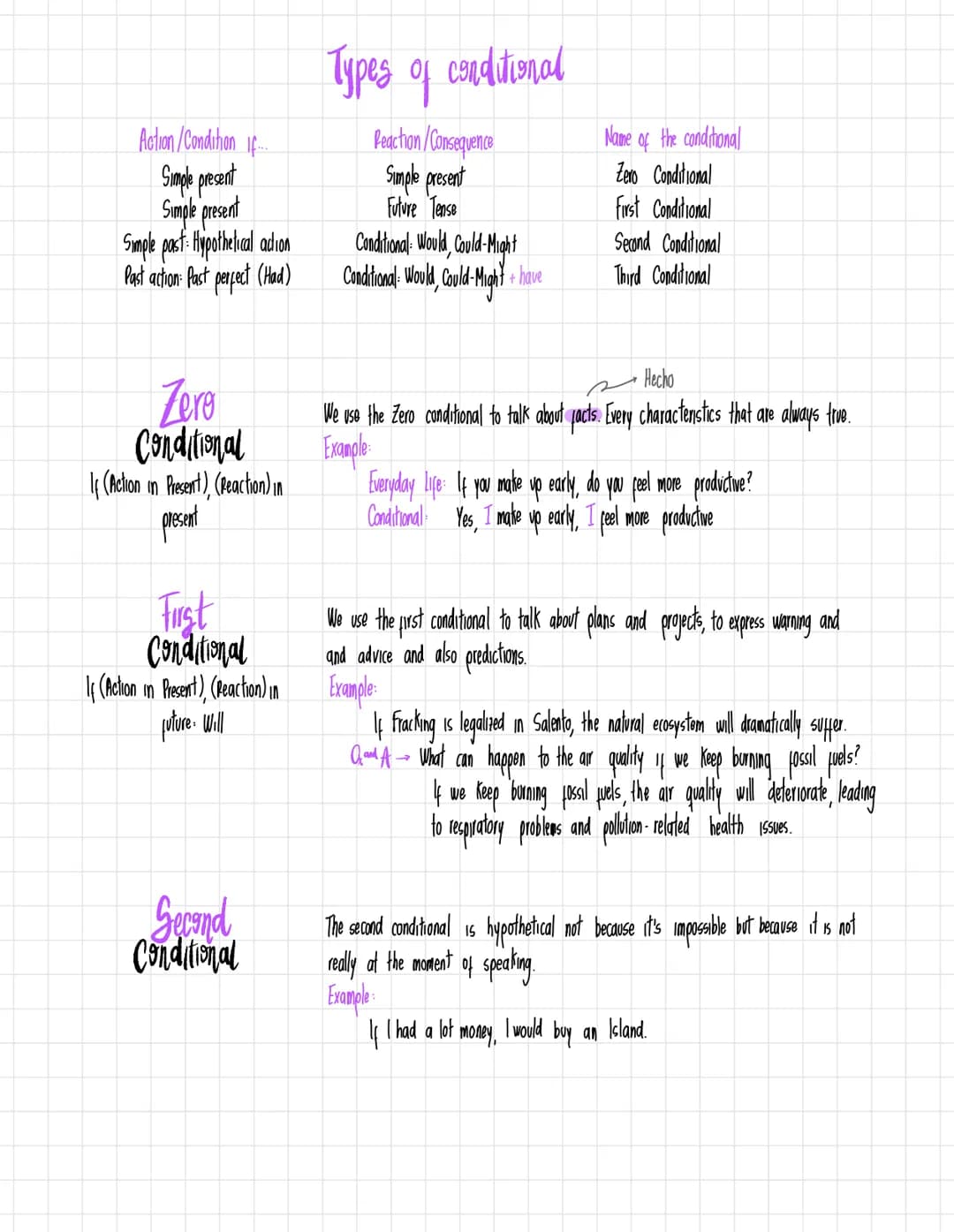
Comparing Conditionals
This page focuses on comparing the different types of condicionales en inglés, providing clear examples to illustrate the distinctions between zero, first, and second conditionals. It also introduces the concept of the third conditional.
The comparison shows how the same basic idea can be expressed using different conditional structures, each conveying a distinct level of possibility or likelihood:
Zero Conditional: "I have money, I can travel to Dubai." First Conditional: "I have money, I'll travel to Dubai." Second Conditional: "If I had the money, I would travel to Dubai."
Example: These sentences demonstrate how the choice of conditional affects the perceived likelihood of the action occurring.
The third conditional is briefly introduced as a structure used for imaginary situations in the past. An example is provided: "If I had got a gold medal, I would have been happy."
Highlight: Understanding the differences between these condicionales en inglés is crucial for expressing nuanced meanings in various temporal and hypothetical contexts.
This comparison helps learners grasp the subtle differences in meaning and usage between the conditional types, enhancing their ability to choose the appropriate structure for different communicative purposes.
2
of 2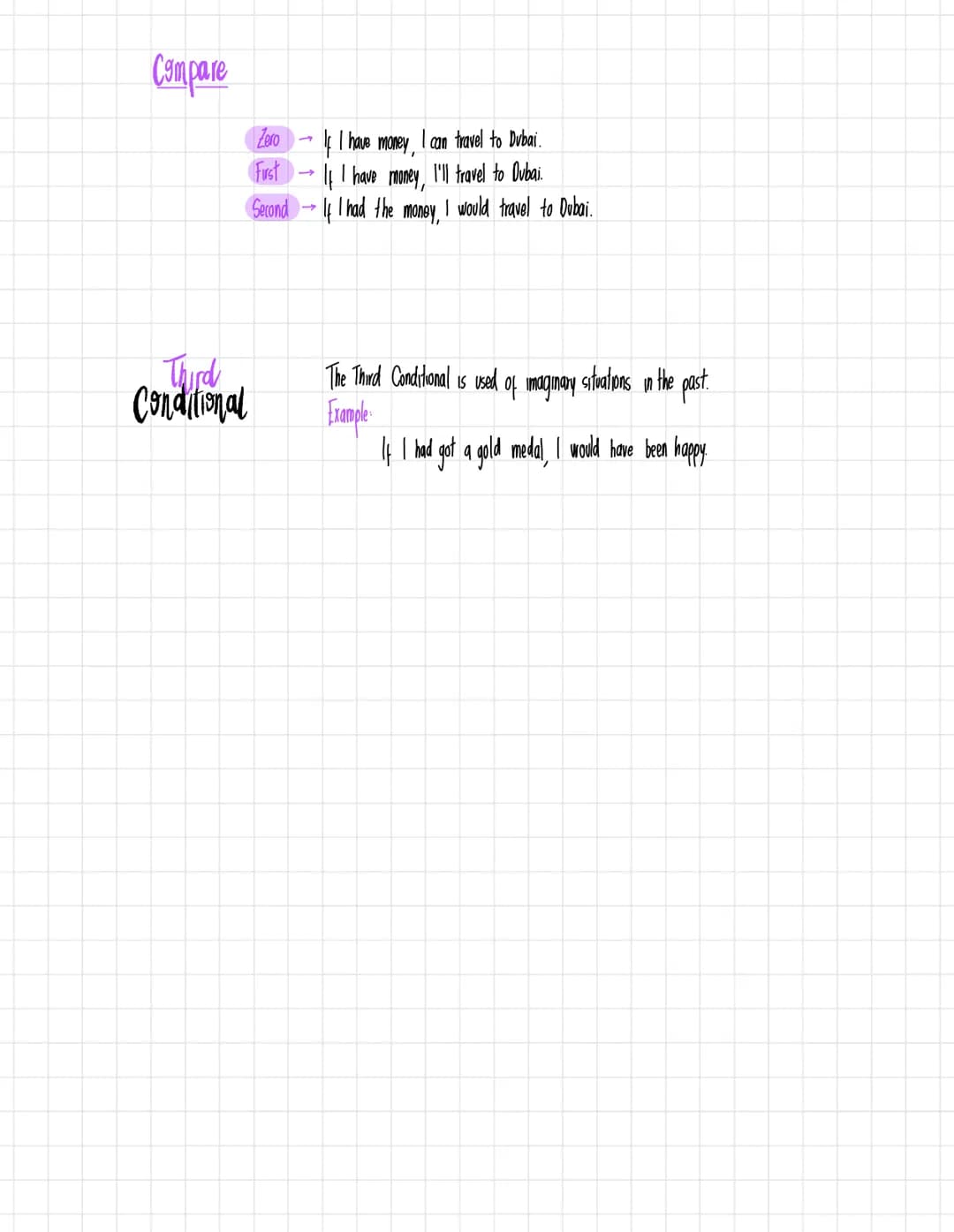
Types of Conditionals
This page provides an overview of the four main types of condicionales en inglés. It explains the structure and usage of each conditional type, along with examples to illustrate their application in various contexts.
The zero conditional uses simple present tense in both clauses to express general truths or facts. For instance, "If you wake up early, you feel more productive." This structure is commonly used to describe everyday life situations and consistent outcomes.
Example: If you make up early, do you feel more productive? Yes, I make up early, I feel more productive.
The first conditional combines simple present in the if-clause with future tense in the main clause. It's used for realistic future possibilities, warnings, and predictions. An example given is, "If fracking is legalized in Salento, the natural ecosystem will dramatically suffer."
Highlight: The first conditional is particularly useful for discussing environmental issues and potential consequences of actions.
The second conditional uses simple past in the if-clause and would/could/might in the main clause. It's used for hypothetical situations that are unlikely but possible. The example provided is, "If I had a million dollars, I would buy an island."
The third conditional, though not fully explained on this page, is mentioned to use past perfect in the if-clause and would/could/might have in the main clause, typically for imaginary past situations.
We thought you’d never ask...
Our AI companion is specifically built for the needs of students. Based on the millions of content pieces we have on the platform we can provide truly meaningful and relevant answers to students. But its not only about answers, the companion is even more about guiding students through their daily learning challenges, with personalised study plans, quizzes or content pieces in the chat and 100% personalisation based on the students skills and developments.
You can download the app in the Google Play Store and in the Apple App Store.
That's right! Enjoy free access to study content, connect with fellow students, and get instant help – all at your fingertips.
Similar Content
 Anglais
Most popular content: Type 1 Conditional
9InglésZero conditional
Condicional cero y su uso
93101
InglésFirst conditional
Primer condicional con su respectivo ejercicio
101371
InglésSecond conditional
Segundo condicional y ejercicios
101750
InglésCondicionales
Cero condicional y primer condicional
72341
InglésConditionals
Zero conditional, first conditional and second conditional explicación y ejemplos
9911
InglésPrimer y segundo condicional
Oraciones en primer y segundo condicional
2°M3111
InglésPrimer condicional
Condicional tipo 1
101562
InglésFirst conditional
Explicación del first conditional y ejemplos
9713
InglésInglés - 11
Diapositivas del first conditional
112265
Most popular content in Inglés
9InglésVocabulario
Palabras en inglés y su significado
92,45627
Ingléspresente simple
como usar los pronombres en el presente simple y ejemplos
74709
InglésVerbos modales
Verbos modales (modal verbs)
113843
V
InglésVerbos: Presente, Pasado y Futuro
Conceptos clave sobre verbos en inglés: conjugación, tiempos y verbos irregulares.
10740
V
InglésVerbos en Presente Simple
Aprende a conjugar verbos en presente simple, incluyendo reglas y excepciones.
8530
P
InglésPronombres Personales en Inglés
Aprende los pronombres personales básicos en inglés y su significado en español.
6290
P
InglésPresente Simple: Frases Cotidianas
Aprende frases comunes en inglés usando el Presente Simple para el día a día.
7320
InglésZero conditional
Condicional cero y su uso
93101
V
InglésVerbos Irregulares en Inglés: Fundamentos Clave
Aprende los verbos irregulares esenciales para grado 8. ¡Mejora tu inglés!
8310
Most popular content
9 ICFES: Matemáticas
Simulacro ICFES primera sesión calendario B filtrado 2025
Este simulacro te ayudará a sacar un buen puntaje en las pruebas ICFES este 2025. Vamos por ese 500/500. Y poder ser admitido en la universidad que quieras, estudiar la carrera que quieres y no la que te toque. Vamos con toda para sacar un buen puntaje.
1017,012174
 ICFES: Lectura Crítica
Simulacro icfes
Simulacro
111,92248
ICFES: InglésCuadernillo Preguntaa Saber 11 Inglés.
Aprovecha los cuadernillos de Inglés para practicar y mejorar tus habilidades en el ítem de Inglés de la Prueba Saber 11. 🫡
Universidad85513
ICFES: MatemáticasMaterial de estudio ICFES
Material de estudio, preguntas icfes de matemáticas resueltas
117,047109
 Química
Trucos para ganar icfes
Lo mejor
111,04212
S
 Otros
Otrossimulacro icfes
Este simulacro evalúa tus conocimientos en las áreas clave del examen ICFES, preparándote para obtener un excelente puntaje.
114570
 ICFES: Sociales y Ciudadanas
SIMULACRO ICFES
Simulacro icfes
111,07315
ICFES: Lectura CríticaICFES segunda sesión calendario B 2025
Segunda sesión simulacro ICFES 2025 calendario B filtrado, aprovecha y se el mejor ICFES de tu colegio y poder ingresar a universidad, y estudiar aquella carrera con la que tanto sueñas.
119,818123
ICFES: Lectura CríticaPrueba icfes 2024
Prueba icfes para practicar todas las asignaturas
118318
Students love us — and so will you.
4.6/5App Store
4.7/5Google Play
The app is very easy to use and well designed. I have found everything I was looking for so far and have been able to learn a lot from the presentations! I will definitely use the app for a class assignment! And of course it also helps a lot as an inspiration.
Stefan SiOS user
This app is really great. There are so many study notes and help [...]. My problem subject is French, for example, and the app has so many options for help. Thanks to this app, I have improved my French. I would recommend it to anyone.
Samantha KlichAndroid user
Wow, I am really amazed. I just tried the app because I've seen it advertised many times and was absolutely stunned. This app is THE HELP you want for school and above all, it offers so many things, such as workouts and fact sheets, which have been VERY helpful to me personally.
AnnaiOS user
Inglés195 views·Updated Jun 26, 2026·2 pages20 Conditional Sentences in English and Spanish - Learn All Types!
J
Jessica Valeria Parra Idarraga@valeria.parra
• Condicionales en inglés are essential grammatical structures for expressing various scenarios and their consequences.
• There are four main types of conditionals: zero conditional, first conditional, second conditional, and third conditional.
• Each conditional type...
1
of 2
Sign up to see the content. It's free!
- Access to all documents
- Improve your grades
- Join milions of students
Comparing Conditionals
This page focuses on comparing the different types of condicionales en inglés, providing clear examples to illustrate the distinctions between zero, first, and second conditionals. It also introduces the concept of the third conditional.
The comparison shows how the same basic idea can be expressed using different conditional structures, each conveying a distinct level of possibility or likelihood:
Zero Conditional: "I have money, I can travel to Dubai." First Conditional: "I have money, I'll travel to Dubai." Second Conditional: "If I had the money, I would travel to Dubai."
Example: These sentences demonstrate how the choice of conditional affects the perceived likelihood of the action occurring.
The third conditional is briefly introduced as a structure used for imaginary situations in the past. An example is provided: "If I had got a gold medal, I would have been happy."
Highlight: Understanding the differences between these condicionales en inglés is crucial for expressing nuanced meanings in various temporal and hypothetical contexts.
This comparison helps learners grasp the subtle differences in meaning and usage between the conditional types, enhancing their ability to choose the appropriate structure for different communicative purposes.
2
of 2Sign up to see the content. It's free!
- Access to all documents
- Improve your grades
- Join milions of students
Types of Conditionals
This page provides an overview of the four main types of condicionales en inglés. It explains the structure and usage of each conditional type, along with examples to illustrate their application in various contexts.
The zero conditional uses simple present tense in both clauses to express general truths or facts. For instance, "If you wake up early, you feel more productive." This structure is commonly used to describe everyday life situations and consistent outcomes.
Example: If you make up early, do you feel more productive? Yes, I make up early, I feel more productive.
The first conditional combines simple present in the if-clause with future tense in the main clause. It's used for realistic future possibilities, warnings, and predictions. An example given is, "If fracking is legalized in Salento, the natural ecosystem will dramatically suffer."
Highlight: The first conditional is particularly useful for discussing environmental issues and potential consequences of actions.
The second conditional uses simple past in the if-clause and would/could/might in the main clause. It's used for hypothetical situations that are unlikely but possible. The example provided is, "If I had a million dollars, I would buy an island."
The third conditional, though not fully explained on this page, is mentioned to use past perfect in the if-clause and would/could/might have in the main clause, typically for imaginary past situations.
We thought you’d never ask...
Our AI companion is specifically built for the needs of students. Based on the millions of content pieces we have on the platform we can provide truly meaningful and relevant answers to students. But its not only about answers, the companion is even more about guiding students through their daily learning challenges, with personalised study plans, quizzes or content pieces in the chat and 100% personalisation based on the students skills and developments.
You can download the app in the Google Play Store and in the Apple App Store.
That's right! Enjoy free access to study content, connect with fellow students, and get instant help – all at your fingertips.
Similar Content
Most popular content: Type 1 Conditional
9InglésZero conditional
Condicional cero y su uso
93101
InglésFirst conditional
Primer condicional con su respectivo ejercicio
101371
InglésSecond conditional
Segundo condicional y ejercicios
101750
InglésCondicionales
Cero condicional y primer condicional
72341
InglésConditionals
Zero conditional, first conditional and second conditional explicación y ejemplos
9911
InglésPrimer y segundo condicional
Oraciones en primer y segundo condicional
2°M3111
InglésPrimer condicional
Condicional tipo 1
101562
InglésFirst conditional
Explicación del first conditional y ejemplos
9713
InglésInglés - 11
Diapositivas del first conditional
112265
Most popular content in Inglés
9InglésVocabulario
Palabras en inglés y su significado
92,45627
Ingléspresente simple
como usar los pronombres en el presente simple y ejemplos
74709
InglésVerbos modales
Verbos modales (modal verbs)
113843
V
InglésVerbos: Presente, Pasado y Futuro
Conceptos clave sobre verbos en inglés: conjugación, tiempos y verbos irregulares.
10740
V
InglésVerbos en Presente Simple
Aprende a conjugar verbos en presente simple, incluyendo reglas y excepciones.
8530
P
InglésPronombres Personales en Inglés
Aprende los pronombres personales básicos en inglés y su significado en español.
6290
P
InglésPresente Simple: Frases Cotidianas
Aprende frases comunes en inglés usando el Presente Simple para el día a día.
7320
InglésZero conditional
Condicional cero y su uso
93101
V
InglésVerbos Irregulares en Inglés: Fundamentos Clave
Aprende los verbos irregulares esenciales para grado 8. ¡Mejora tu inglés!
8310
Most popular content
9ICFES: MatemáticasSimulacro ICFES primera sesión calendario B filtrado 2025
Este simulacro te ayudará a sacar un buen puntaje en las pruebas ICFES este 2025. Vamos por ese 500/500. Y poder ser admitido en la universidad que quieras, estudiar la carrera que quieres y no la que te toque. Vamos con toda para sacar un buen puntaje.
1017,012174
ICFES: Lectura CríticaSimulacro icfes
Simulacro
111,92248
ICFES: InglésCuadernillo Preguntaa Saber 11 Inglés.
Aprovecha los cuadernillos de Inglés para practicar y mejorar tus habilidades en el ítem de Inglés de la Prueba Saber 11. 🫡
Universidad85513
ICFES: MatemáticasMaterial de estudio ICFES
Material de estudio, preguntas icfes de matemáticas resueltas
117,047109
QuímicaTrucos para ganar icfes
Lo mejor
111,04212
S
Otrossimulacro icfes
Este simulacro evalúa tus conocimientos en las áreas clave del examen ICFES, preparándote para obtener un excelente puntaje.
114570
ICFES: Sociales y CiudadanasSIMULACRO ICFES
Simulacro icfes
111,07315
ICFES: Lectura CríticaICFES segunda sesión calendario B 2025
Segunda sesión simulacro ICFES 2025 calendario B filtrado, aprovecha y se el mejor ICFES de tu colegio y poder ingresar a universidad, y estudiar aquella carrera con la que tanto sueñas.
119,818123
ICFES: Lectura CríticaPrueba icfes 2024
Prueba icfes para practicar todas las asignaturas
118318
Students love us — and so will you.
4.6/5App Store
4.7/5Google Play
The app is very easy to use and well designed. I have found everything I was looking for so far and have been able to learn a lot from the presentations! I will definitely use the app for a class assignment! And of course it also helps a lot as an inspiration.
Stefan SiOS user
This app is really great. There are so many study notes and help [...]. My problem subject is French, for example, and the app has so many options for help. Thanks to this app, I have improved my French. I would recommend it to anyone.
Samantha KlichAndroid user
Wow, I am really amazed. I just tried the app because I've seen it advertised many times and was absolutely stunned. This app is THE HELP you want for school and above all, it offers so many things, such as workouts and fact sheets, which have been VERY helpful to me personally.
AnnaiOS user