
Patterns are everywhere in math, from sequences of numbers to... Show more
 Geometry105 views·Updated May 28, 2026·6 pages
Exploring Patterns and Inductive Thinking in Logic

C@cnnotes
1 / 6
1
of 6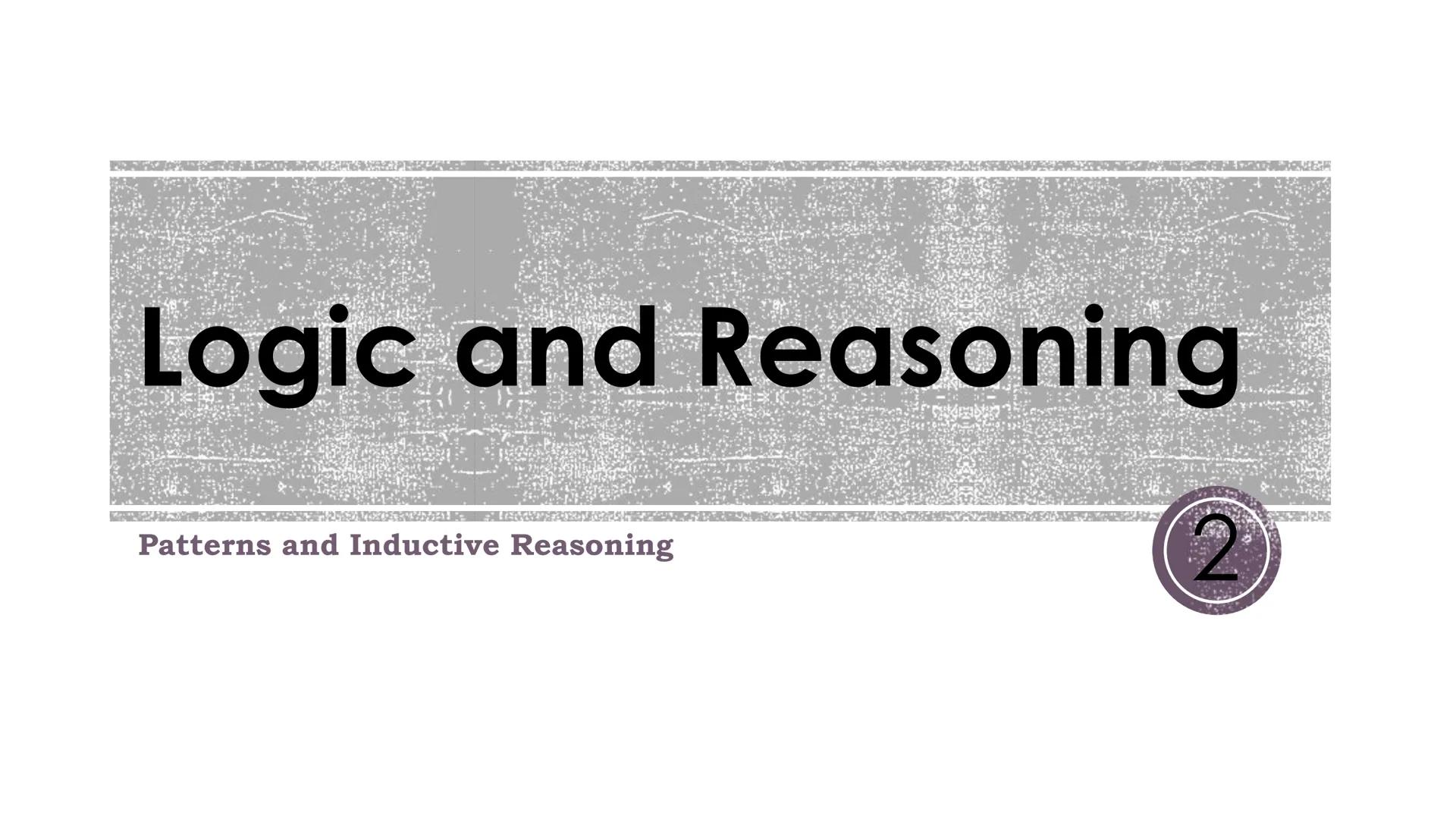
Logic and Reasoning: Patterns and Inductive Reasoning
When you look around, you'll notice that our world is full of patterns. From the changing seasons to the way numbers increase in a sequence, patterns help us make sense of things.
In this section, we'll learn how to recognize these patterns and use them to predict what comes next. This skill is super useful not just in math class, but in everyday life too!
Did You Know? Your brain naturally looks for patterns - it's how we learn language, music, and even predict what might happen next in a story.
2
of 6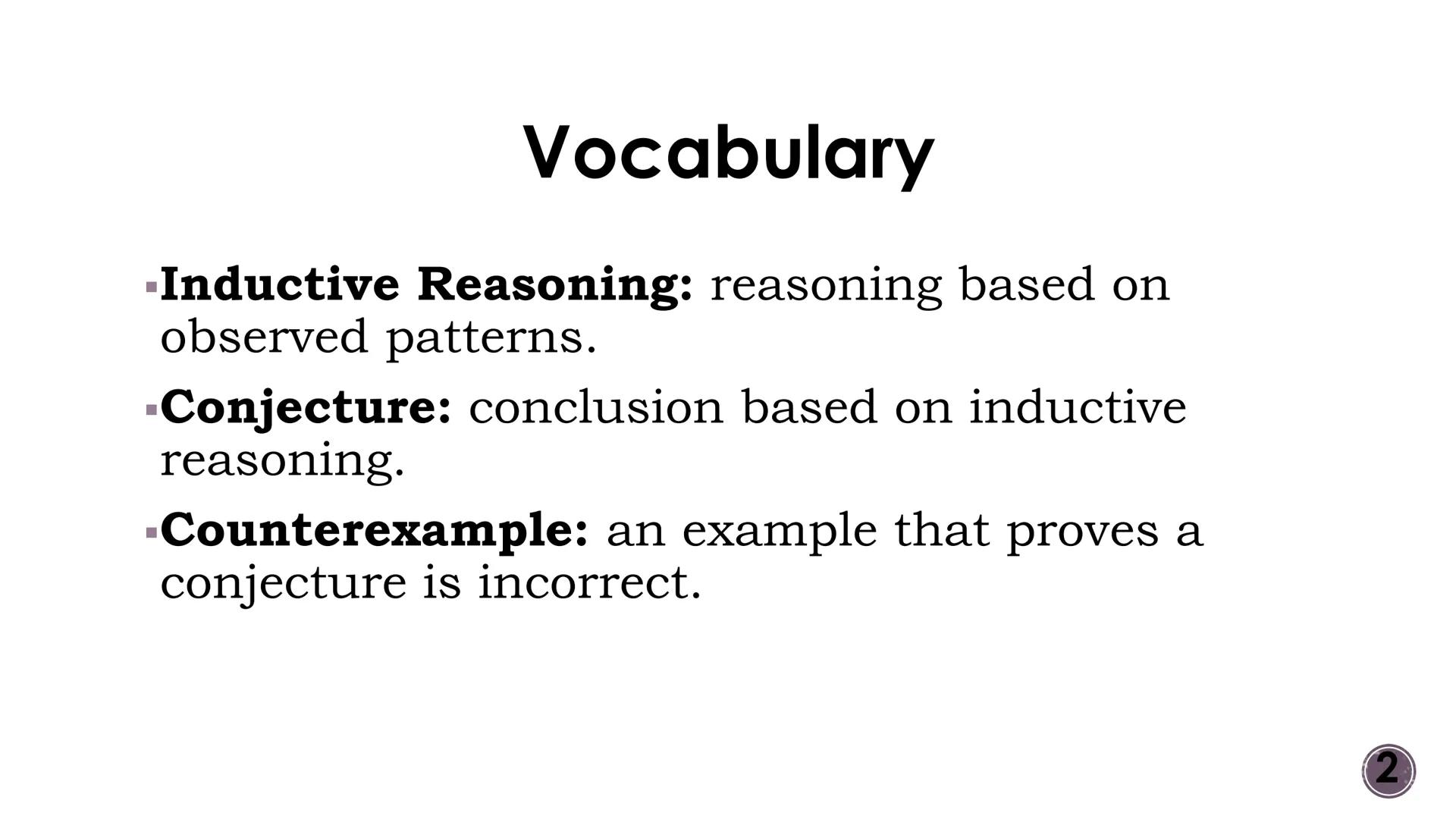
Key Vocabulary
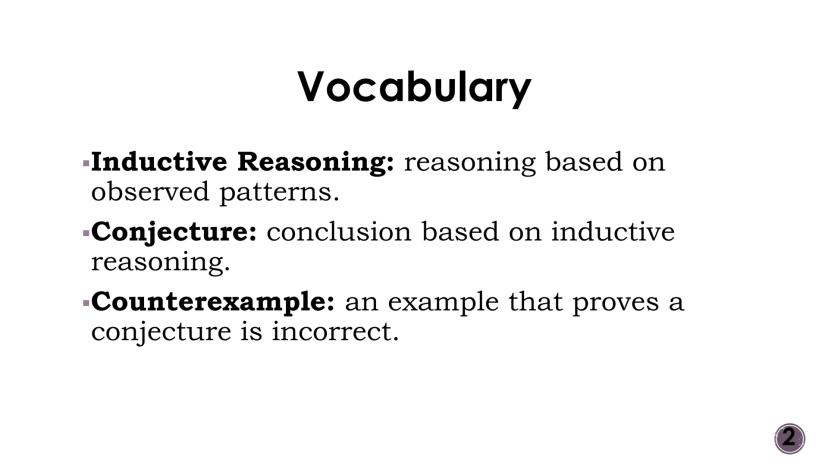
Before diving in, let's understand the important terms we'll be using:
Inductive reasoning happens when we look at examples, spot a pattern, and then make a prediction based on that pattern. It's like figuring out what happens next in a sequence.
A conjecture is the educated guess or conclusion you make after observing a pattern. It's not proven yet, but it's your best prediction based on what you've seen.
A counterexample is just one example that proves a conjecture wrong. Even if your guess works for many cases, a single counterexample shows it isn't always true.
Quick Tip: Think of a conjecture as a hypothesis and a counterexample as evidence that disproves it.
3
of 6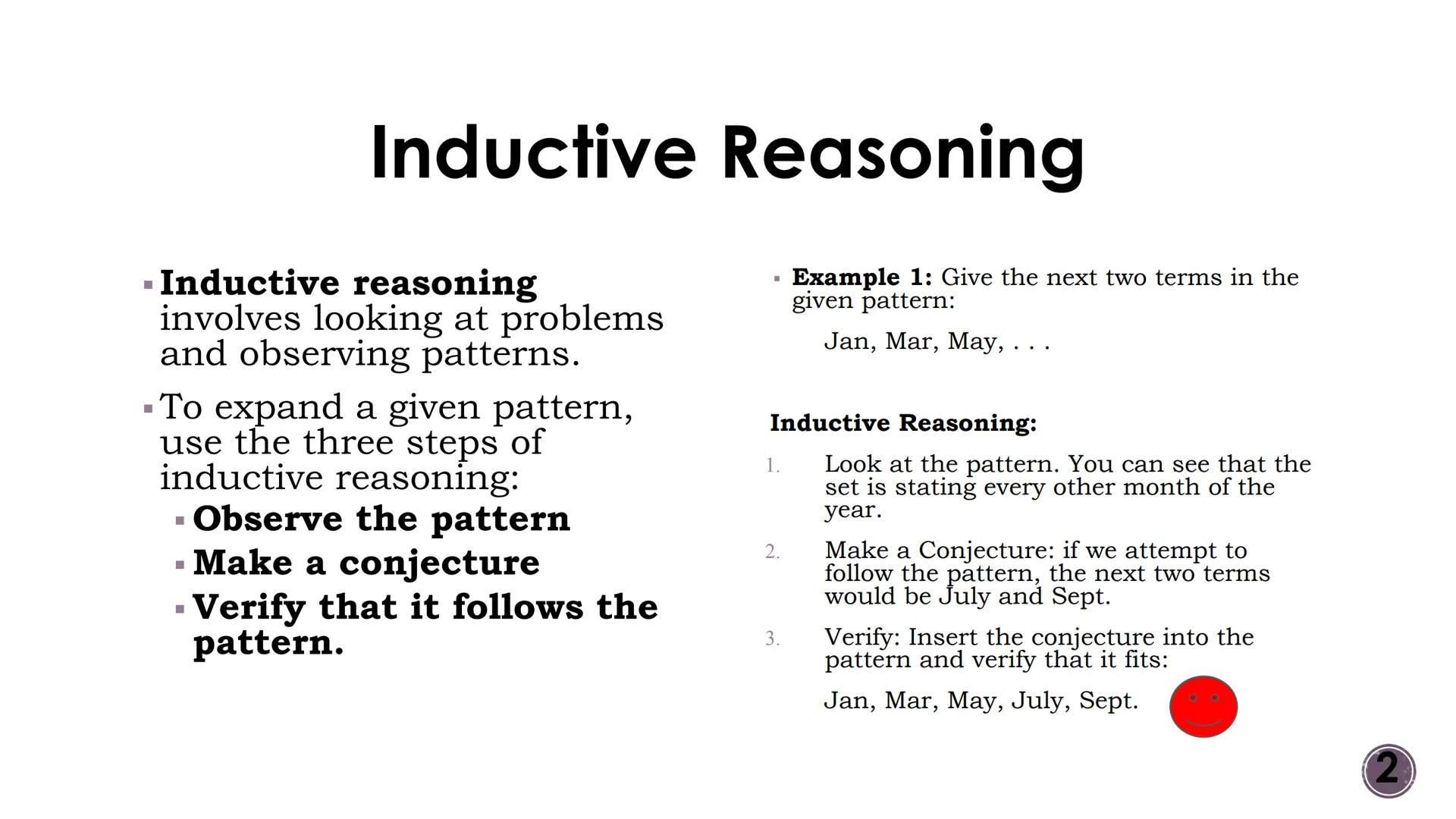
Inductive Reasoning Process
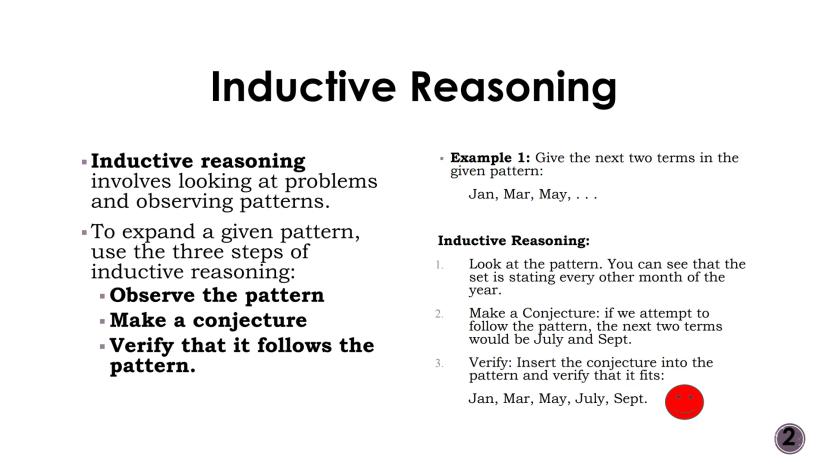
Inductive reasoning follows three simple steps that you can apply to any pattern:
- Observe the pattern carefully - look for how things are changing or repeating
- Make a conjecture about what will come next based on what you've observed
- Verify that your prediction actually follows the pattern you identified
For example, if given the sequence "Jan, Mar, May...", you'd notice these are months of the year, specifically every other month. Your conjecture would be that July and Sept come next. When you verify by checking the pattern (Jan, Mar, May, July, Sept), you can see it works!
Remember: Good inductive reasoning requires careful observation - don't rush to conclusions before you've fully analyzed the pattern.
4
of 6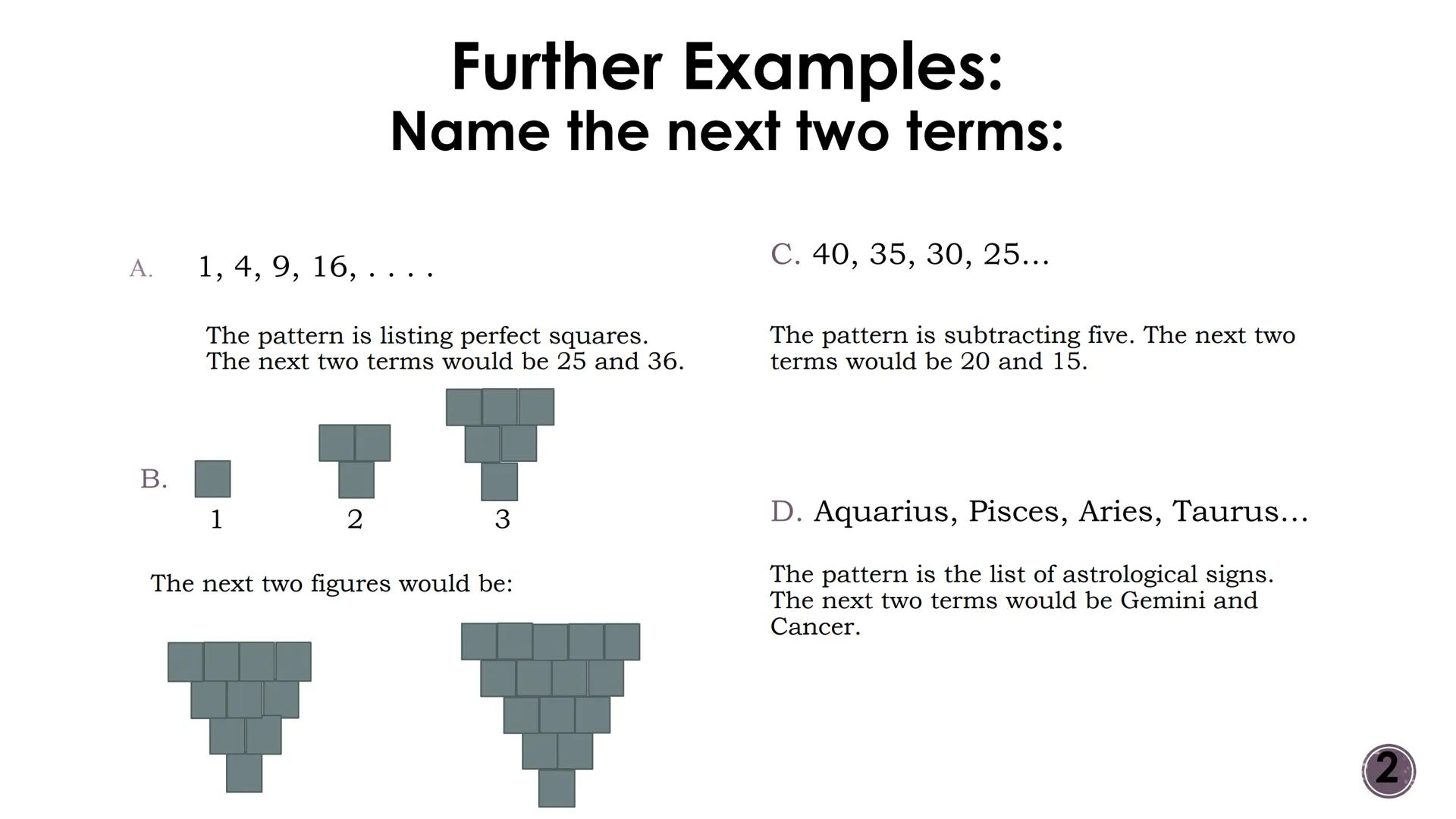
Pattern Recognition Examples
Pattern recognition is something you do every day without realizing it! Here are some different types of patterns you might encounter:
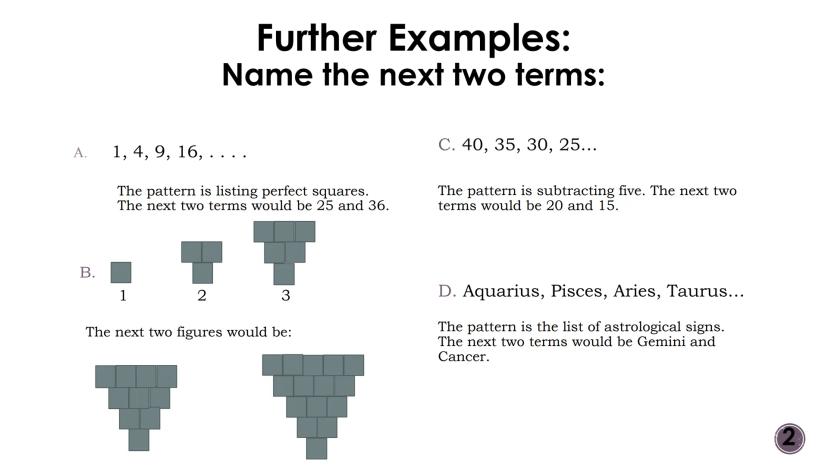
In number sequences like "1, 4, 9, 16, ...", you'd notice these are perfect squares (1², 2², 3², 4²), so the next terms would be 25 and 36.
For a sequence like "40, 35, 30, 25, ...", you can see each number decreases by 5, so the next terms would be 20 and 15.
Patterns can also appear in shapes that follow rules, like a sequence of triangles increasing in size.
Even lists like "Aquarius, Pisces, Aries, Taurus..." follow a pattern (zodiac signs in order), so Gemini and Cancer would come next.
Challenge Yourself: Try creating your own pattern and see if friends can figure out the next terms!
5
of 6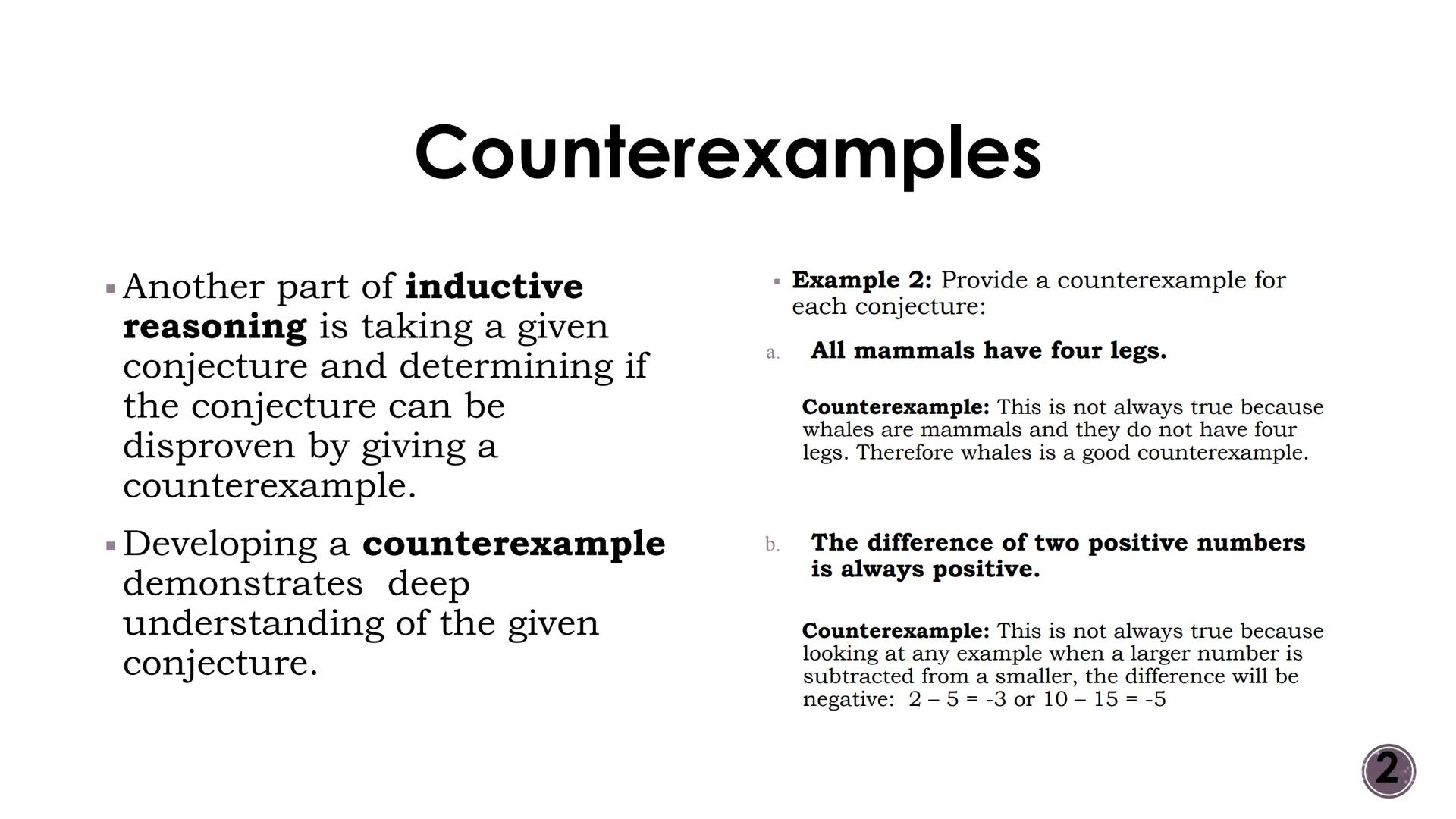
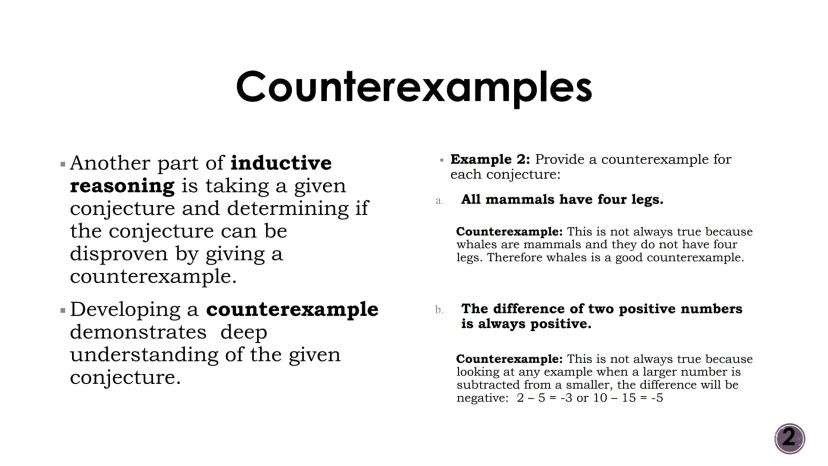
Understanding Counterexamples
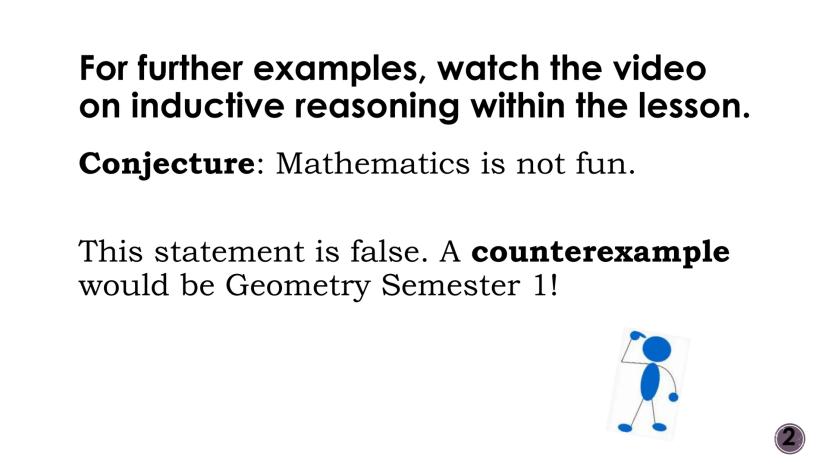
A counterexample is a powerful tool in math - it's a single case that proves a statement isn't always true. Finding good counterexamples shows you truly understand a concept.
For instance, if someone claims "All mammals have four legs," you could provide whales as a counterexample since they're mammals without four legs.
Similarly, for the claim "The difference of two positive numbers is always positive," you could offer the counterexample 2 - 5 = -3. This single calculation proves the statement isn't universally true.
When looking for counterexamples, think about edge cases or exceptions to the rule. Just one valid counterexample is enough to disprove a conjecture!
Power Move: Being able to find counterexamples quickly will help you ace tests and become a stronger logical thinker.
6
of 6
Applying Inductive Reasoning
Inductive reasoning isn't just for math class - it's a skill you'll use throughout your life! Whether you're predicting weather patterns, sports outcomes, or even human behavior, you're using inductive reasoning.
To get better at this skill, practice looking for patterns in everyday situations. Try predicting what will happen next in different scenarios and check if you're right.
Remember that while inductive reasoning is powerful, it doesn't always lead to correct conclusions. That's why we need to remain open to counterexamples and be willing to adjust our conjectures.
Fun Fact: Mathematicians initially use inductive reasoning to develop theories, but then need to prove them with deductive reasoning before they're accepted as mathematical facts.
We thought you’d never ask...
What is the Knowunity AI companion?
Our AI companion is specifically built for the needs of students. Based on the millions of content pieces we have on the platform we can provide truly meaningful and relevant answers to students. But its not only about answers, the companion is even more about guiding students through their daily learning challenges, with personalised study plans, quizzes or content pieces in the chat and 100% personalisation based on the students skills and developments.
Where can I download the Knowunity app?
You can download the app in the Google Play Store and in the Apple App Store.
Is Knowunity really free of charge?
That's right! Enjoy free access to study content, connect with fellow students, and get instant help – all at your fingertips.
Similar Content
Most popular content in Geometry
9Most popular content
9Can't find what you're looking for? Explore other subjects.
Students love us — and so will you.
4.6/5App Store
4.7/5Google Play
The app is very easy to use and well designed. I have found everything I was looking for so far and have been able to learn a lot from the presentations! I will definitely use the app for a class assignment! And of course it also helps a lot as an inspiration.
Stefan SiOS user
This app is really great. There are so many study notes and help [...]. My problem subject is French, for example, and the app has so many options for help. Thanks to this app, I have improved my French. I would recommend it to anyone.
Samantha KlichAndroid user
Wow, I am really amazed. I just tried the app because I've seen it advertised many times and was absolutely stunned. This app is THE HELP you want for school and above all, it offers so many things, such as workouts and fact sheets, which have been VERY helpful to me personally.
AnnaiOS user
Geometry105 views·Updated May 28, 2026·6 pagesExploring Patterns and Inductive Thinking in Logic
C@cnnotes
Patterns are everywhere in math, from sequences of numbers to shapes that follow rules. In this section, we'll explore inductive reasoning - how to spot patterns, make smart predictions, and check if statements are true or false using counterexamples.
1
of 6Sign up to see the content. It's free!
- Access to all documents
- Improve your grades
- Join milions of students
Logic and Reasoning: Patterns and Inductive Reasoning
When you look around, you'll notice that our world is full of patterns. From the changing seasons to the way numbers increase in a sequence, patterns help us make sense of things.
In this section, we'll learn how to recognize these patterns and use them to predict what comes next. This skill is super useful not just in math class, but in everyday life too!
Did You Know? Your brain naturally looks for patterns - it's how we learn language, music, and even predict what might happen next in a story.
2
of 6Sign up to see the content. It's free!
- Access to all documents
- Improve your grades
- Join milions of students
Key Vocabulary
Before diving in, let's understand the important terms we'll be using:
Inductive reasoning happens when we look at examples, spot a pattern, and then make a prediction based on that pattern. It's like figuring out what happens next in a sequence.
A conjecture is the educated guess or conclusion you make after observing a pattern. It's not proven yet, but it's your best prediction based on what you've seen.
A counterexample is just one example that proves a conjecture wrong. Even if your guess works for many cases, a single counterexample shows it isn't always true.
Quick Tip: Think of a conjecture as a hypothesis and a counterexample as evidence that disproves it.
3
of 6Sign up to see the content. It's free!
- Access to all documents
- Improve your grades
- Join milions of students
Inductive Reasoning Process
Inductive reasoning follows three simple steps that you can apply to any pattern:
- Observe the pattern carefully - look for how things are changing or repeating
- Make a conjecture about what will come next based on what you've observed
- Verify that your prediction actually follows the pattern you identified
For example, if given the sequence "Jan, Mar, May...", you'd notice these are months of the year, specifically every other month. Your conjecture would be that July and Sept come next. When you verify by checking the pattern (Jan, Mar, May, July, Sept), you can see it works!
Remember: Good inductive reasoning requires careful observation - don't rush to conclusions before you've fully analyzed the pattern.
4
of 6Sign up to see the content. It's free!
- Access to all documents
- Improve your grades
- Join milions of students
Pattern Recognition Examples
Pattern recognition is something you do every day without realizing it! Here are some different types of patterns you might encounter:
In number sequences like "1, 4, 9, 16, ...", you'd notice these are perfect squares (1², 2², 3², 4²), so the next terms would be 25 and 36.
For a sequence like "40, 35, 30, 25, ...", you can see each number decreases by 5, so the next terms would be 20 and 15.
Patterns can also appear in shapes that follow rules, like a sequence of triangles increasing in size.
Even lists like "Aquarius, Pisces, Aries, Taurus..." follow a pattern (zodiac signs in order), so Gemini and Cancer would come next.
Challenge Yourself: Try creating your own pattern and see if friends can figure out the next terms!
5
of 6Sign up to see the content. It's free!
- Access to all documents
- Improve your grades
- Join milions of students
Understanding Counterexamples
A counterexample is a powerful tool in math - it's a single case that proves a statement isn't always true. Finding good counterexamples shows you truly understand a concept.
For instance, if someone claims "All mammals have four legs," you could provide whales as a counterexample since they're mammals without four legs.
Similarly, for the claim "The difference of two positive numbers is always positive," you could offer the counterexample 2 - 5 = -3. This single calculation proves the statement isn't universally true.
When looking for counterexamples, think about edge cases or exceptions to the rule. Just one valid counterexample is enough to disprove a conjecture!
Power Move: Being able to find counterexamples quickly will help you ace tests and become a stronger logical thinker.
6
of 6Sign up to see the content. It's free!
- Access to all documents
- Improve your grades
- Join milions of students
Applying Inductive Reasoning
Inductive reasoning isn't just for math class - it's a skill you'll use throughout your life! Whether you're predicting weather patterns, sports outcomes, or even human behavior, you're using inductive reasoning.
To get better at this skill, practice looking for patterns in everyday situations. Try predicting what will happen next in different scenarios and check if you're right.
Remember that while inductive reasoning is powerful, it doesn't always lead to correct conclusions. That's why we need to remain open to counterexamples and be willing to adjust our conjectures.
Fun Fact: Mathematicians initially use inductive reasoning to develop theories, but then need to prove them with deductive reasoning before they're accepted as mathematical facts.
We thought you’d never ask...
What is the Knowunity AI companion?
Our AI companion is specifically built for the needs of students. Based on the millions of content pieces we have on the platform we can provide truly meaningful and relevant answers to students. But its not only about answers, the companion is even more about guiding students through their daily learning challenges, with personalised study plans, quizzes or content pieces in the chat and 100% personalisation based on the students skills and developments.
Where can I download the Knowunity app?
You can download the app in the Google Play Store and in the Apple App Store.
Is Knowunity really free of charge?
That's right! Enjoy free access to study content, connect with fellow students, and get instant help – all at your fingertips.
Similar Content
Most popular content in Geometry
9Most popular content
9Can't find what you're looking for? Explore other subjects.
Students love us — and so will you.
4.6/5App Store
4.7/5Google Play
The app is very easy to use and well designed. I have found everything I was looking for so far and have been able to learn a lot from the presentations! I will definitely use the app for a class assignment! And of course it also helps a lot as an inspiration.
Stefan SiOS user
This app is really great. There are so many study notes and help [...]. My problem subject is French, for example, and the app has so many options for help. Thanks to this app, I have improved my French. I would recommend it to anyone.
Samantha KlichAndroid user
Wow, I am really amazed. I just tried the app because I've seen it advertised many times and was absolutely stunned. This app is THE HELP you want for school and above all, it offers so many things, such as workouts and fact sheets, which have been VERY helpful to me personally.
AnnaiOS user