
Ray Bradbury's dystopian masterpiece explores themes of censorship, intellectual freedom,... Show more
 English368 views·Updated May 24, 2026·14 pages
Fahrenheit 451 Story Analysis: Summaries, Quotes, and Insights

°♡✧*𝗠ǻ𝓇ĺ*✧♡°@mari_helping



1 / 10
1
of 10
Understanding Fahrenheit 451's Opening: The Hearth and the Salamander
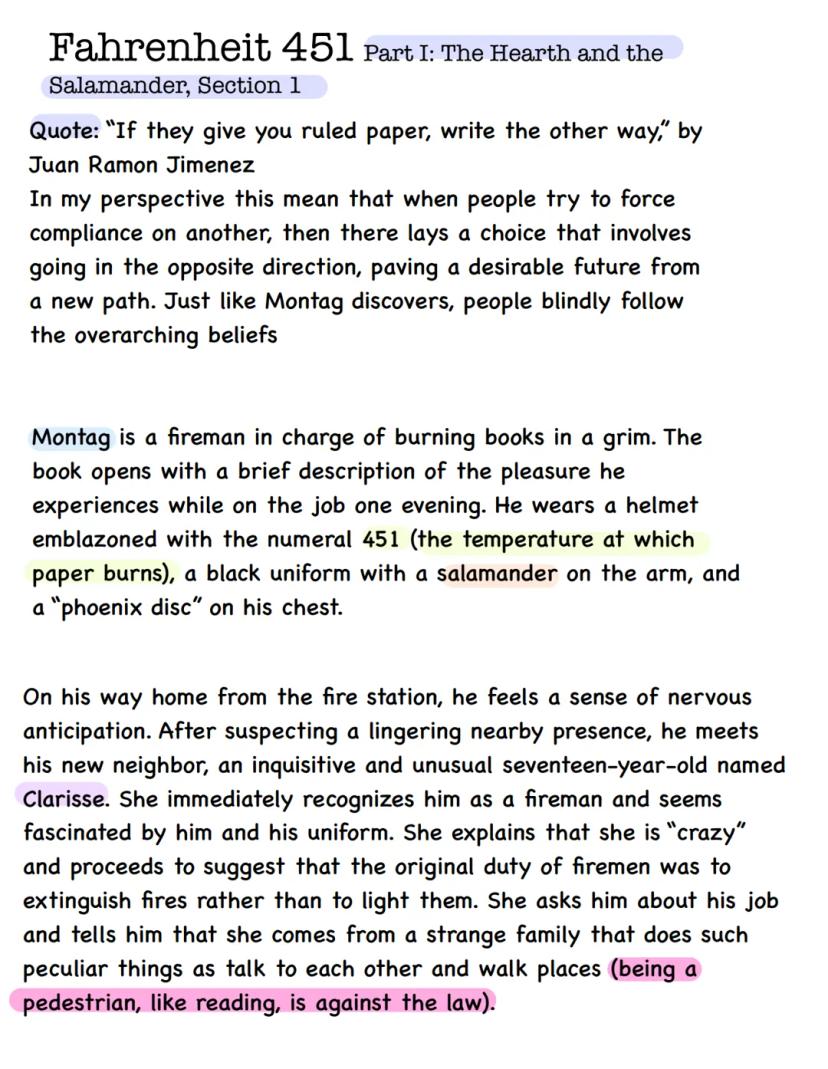
Ray Bradbury's dystopian masterpiece opens with profound symbolism and character introductions that set the stage for a compelling Fahrenheit 451 story analysis. The novel begins with Guy Montag, a fireman whose job involves burning books rather than extinguishing fires. His uniform bears the number 451 - the temperature at which paper burns - along with a salamander emblem and phoenix disc, symbols that foreshadow the transformation to come.
The pivotal Montag's encounter with Clarisse occurs as he walks home from work. This seventeen-year-old neighbor proves instrumental in awakening Montag's dormant consciousness. What surprises Clarisse about the way Montag answers her questions is his mechanical, programmed responses, highlighting the society's suppression of independent thought. Their interaction represents the first crack in Montag's carefully constructed worldview.
Quote: "If they give you ruled paper, write the other way" serves as the section's epigraph, embodying the spirit of rebellion against conformity that will develop throughout the narrative. The significance of ruled paper quote in Fahrenheit 451 lies in its metaphorical representation of societal constraints and the choice to resist them.
2
of 10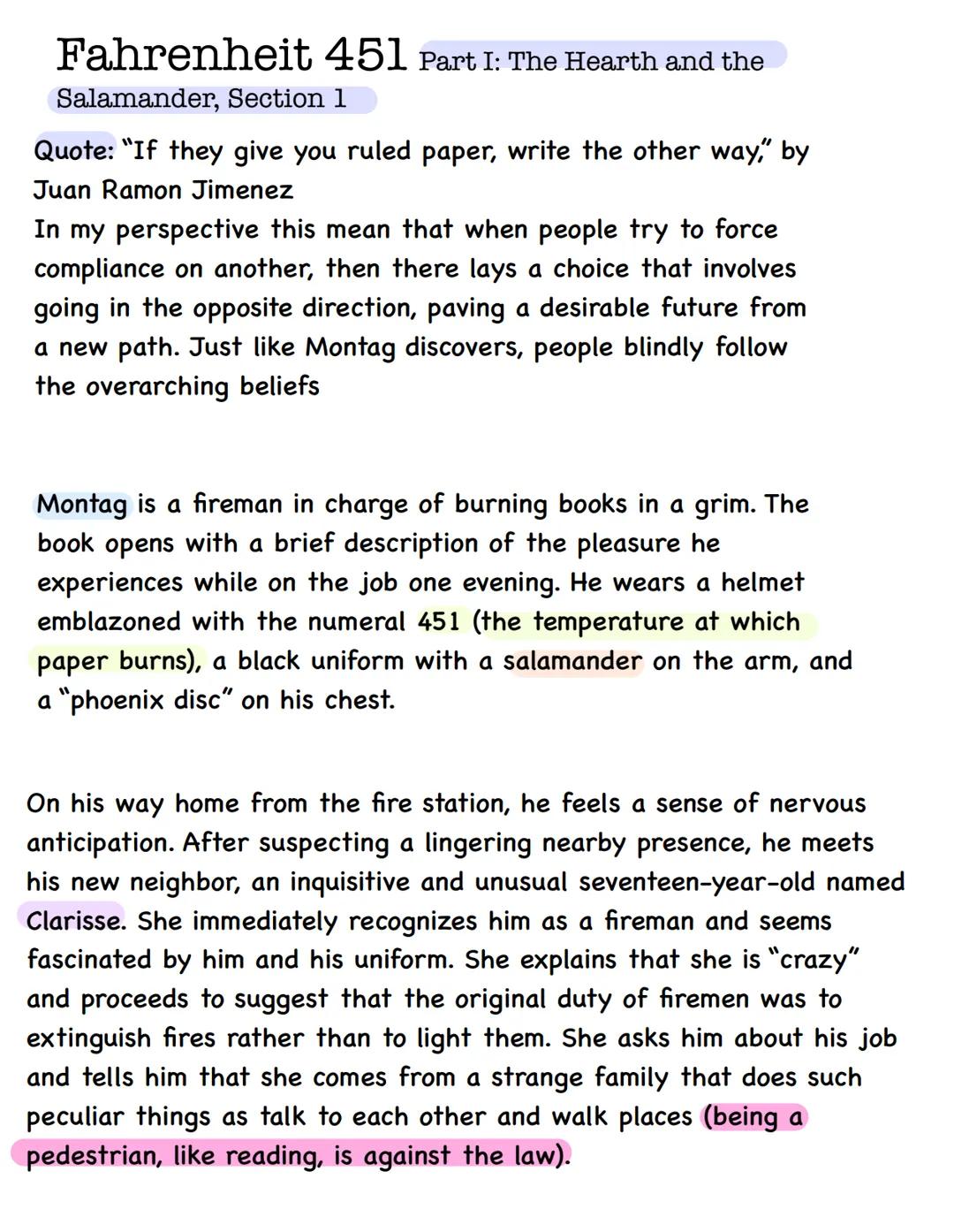
Clarisse's Impact on Montag's Awakening
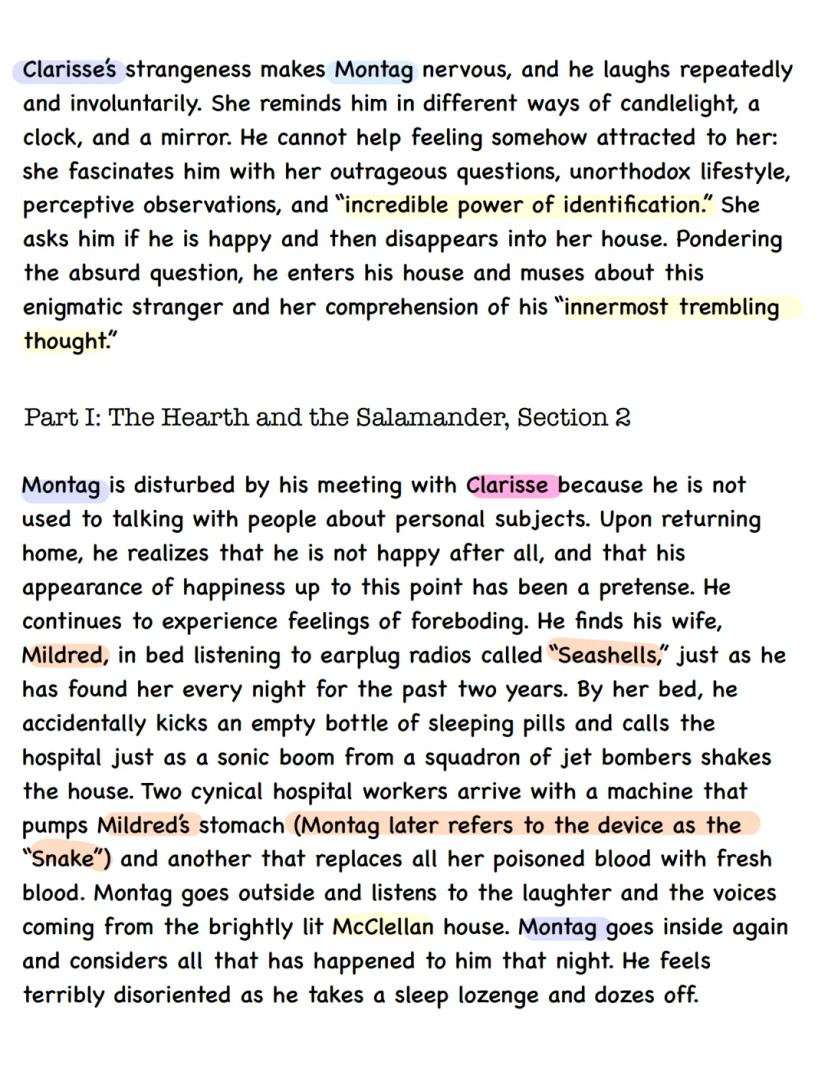
What was Clarisse's first impression of Montag proves transformative - she sees through his professional facade to recognize his underlying humanity. Her observations about his laugh never reaching his eyes and her direct question about his happiness force Montag to confront his own emotional emptiness. Montag starts channeling Clarisse in his thinking as her influence begins to reshape his perspective on the world.
Highlight: Clarisse's character serves as a catalyst for change, representing everything their society rejects: curiosity, nature appreciation, and genuine human connection.
The contrast between Clarisse's vitality and Mildred's emotional death becomes stark in the fahrenheit 451 summary part 1. While Clarisse savors life's simple pleasures, Montag returns home to find his wife overdosed on sleeping pills, highlighting the profound emptiness of their society's prescribed lifestyle.
3
of 10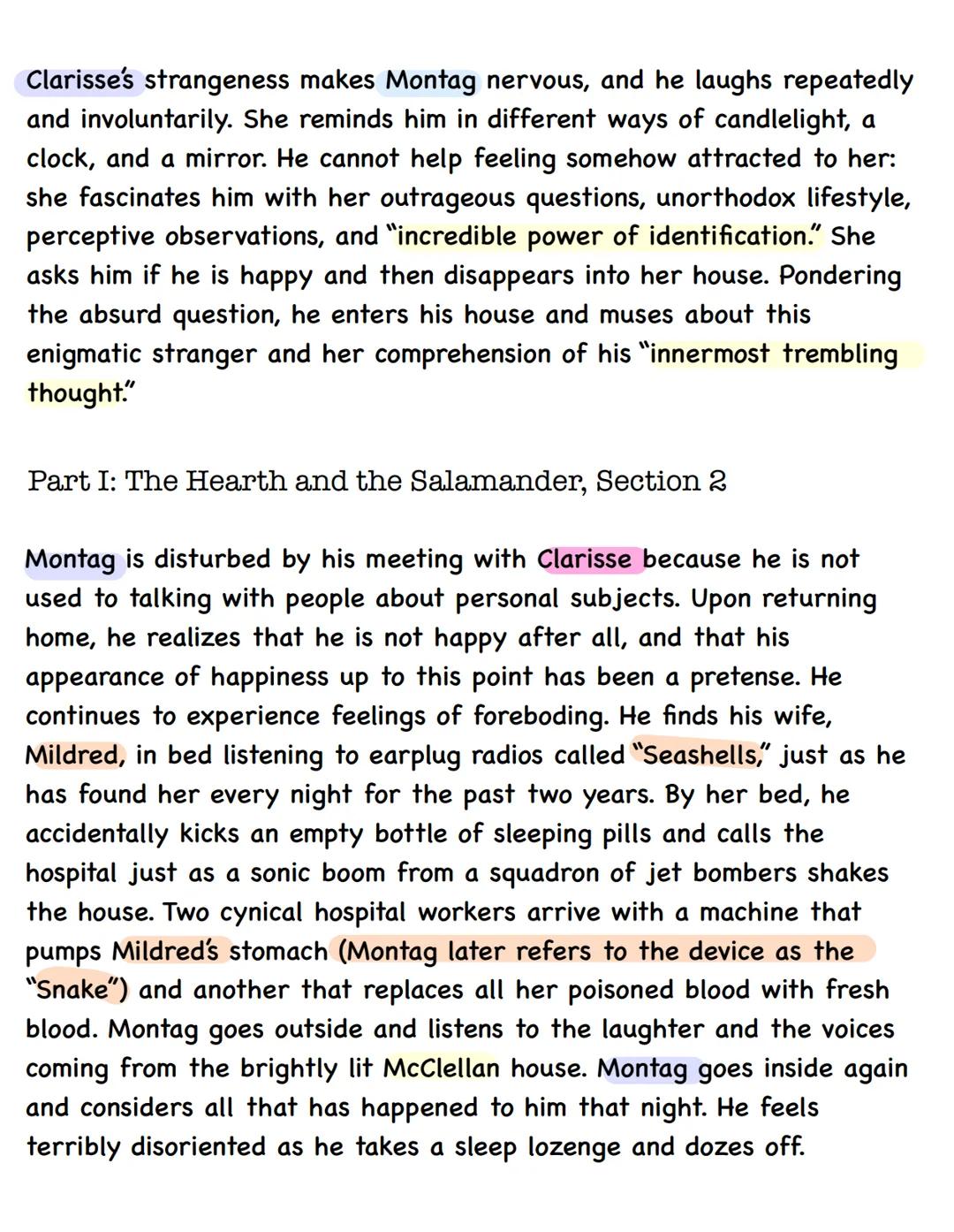
The Mechanical World Versus Human Connection
In this fahrenheit 451 chapter summary, the story juxtaposes mechanical and human elements. The emergency workers who save Mildred operate with industrial efficiency, treating her suicide attempt as routine maintenance. Meanwhile, Clarisse's family represents a dying breed of genuine human interaction.
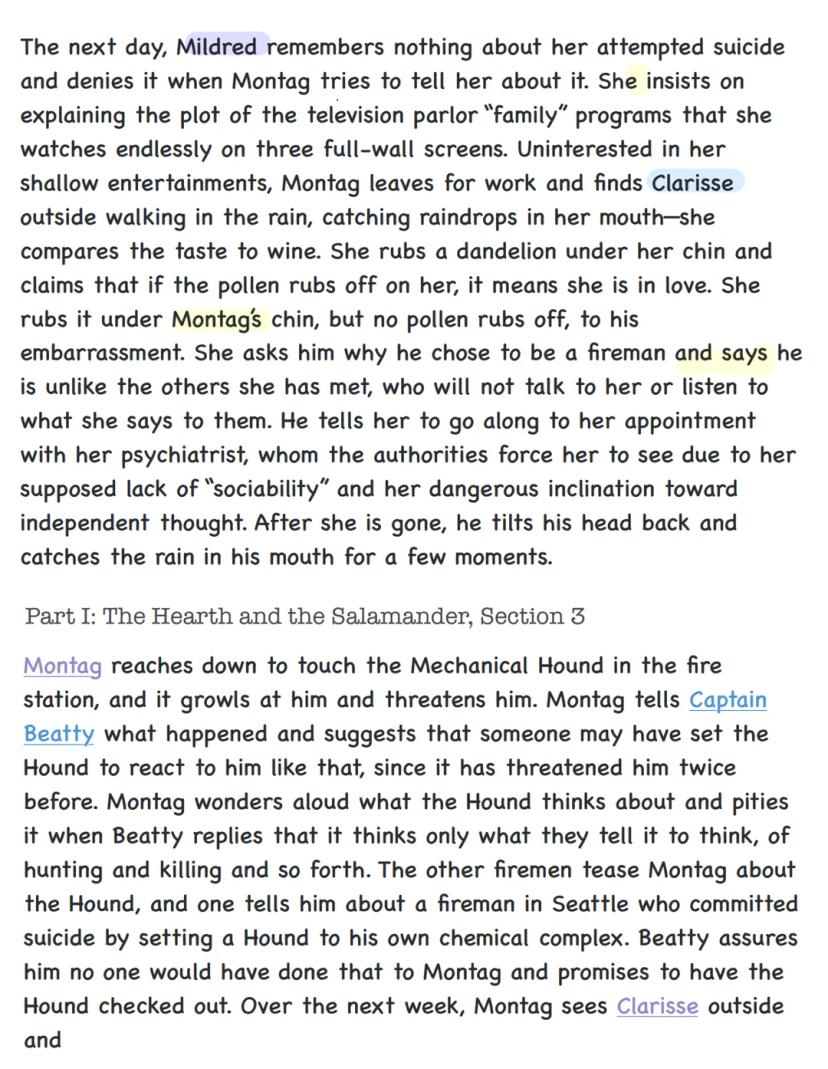
Definition: The Mechanical Hound symbolizes the merciless technological control of their society, programmed to hunt down those who deviate from prescribed norms.
The growing tension between conformity and individuality becomes evident as Montag begins questioning his role in society. His interaction with the Mechanical Hound, which growls at him unprovoked, suggests that even the machines can sense his emerging rebellion against the system.
4
of 10
The Seeds of Revolution in Fahrenheit 451
As shown in the fahrenheit 451 summary part 2, Montag's transformation accelerates through his continued interactions with Clarisse. Her simple act of rubbing a dandelion under his chin becomes a powerful metaphor for authentic human experience versus artificial happiness. The fact that no pollen rubs off on Montag symbolizes his current disconnection from genuine emotion.
Example: Clarisse's rain-tasting scene contrasts sharply with the artificial entertainment of Mildred's wall-screens, highlighting the difference between real and manufactured experiences.
The society's treatment of Clarisse as mentally unstable for her "antisocial" tendencies reveals the systemic fear of independent thought. Her forced psychiatric sessions parallel modern concerns about conformity versus individuality, making the novel's themes remarkably relevant to contemporary readers.
5
of 10
Montag's Transformation Through Encounters with Clarisse and Books
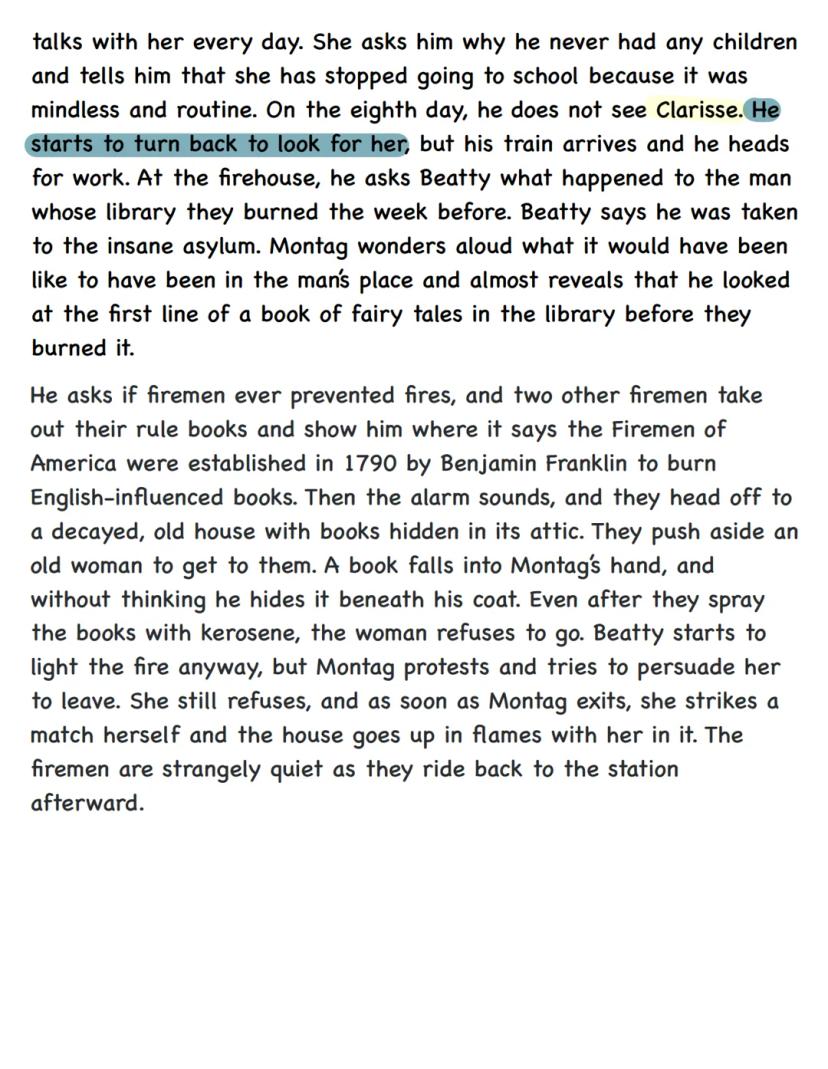
Montag's daily conversations with Clarisse McClellan mark a pivotal shift in his perspective as a fireman. Their interactions reveal her unique worldview - she has rejected the standardized education system, finding it devoid of meaningful thought. When Clarisse suddenly disappears on the eighth day, Montag's concern for her whereabouts demonstrates how deeply she has affected him. This section provides crucial insight into what is clarisse's impression of montag and how their relationship develops.
At the firehouse, Montag's growing internal conflict becomes evident through his questioning of established practices. His interest in the fate of a man whose library they burned and his near-admission of reading a line from a fairy tale book show his emerging doubts. The scene where firemen display their rule books, claiming Benjamin Franklin established their organization to burn English-influenced books in 1790, highlights the dystopian society's historical revisionism.
The turning point comes during a book-burning mission at an elderly woman's house. When Montag instinctively steals a book and witnesses the woman's self-immolation, it profoundly impacts his worldview. This event, combined with Montag's encounter with clarisse summary, sets the stage for his transformation from a loyal fireman to a questioner of his society's values.
Quote: "A book fell into Montag's hand, and without thinking he hides it beneath his coat" - This moment symbolizes the beginning of Montag's rebellion against his society's book-burning mandate.
6
of 10
The Deterioration of Human Connection in a Technology-Dominated World
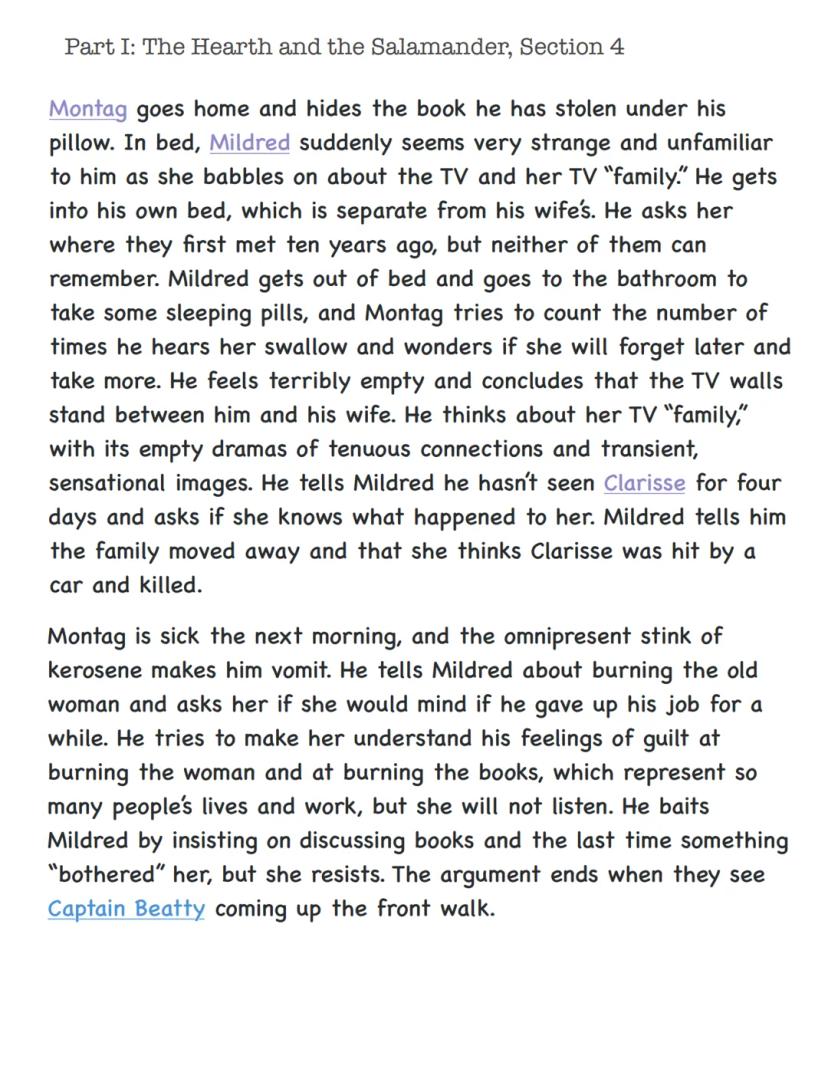
The contrast between Montag's meaningful interactions with Clarisse and his hollow relationship with Mildred becomes stark in this section of fahrenheit 451 summary part 1. The separate beds, their inability to remember their first meeting, and Mildred's addiction to sleeping pills paint a picture of a marriage devoid of genuine connection.
Mildred's casual announcement of Clarisse's death - possibly hit by a car - and her immediate return to her TV "family" emphasizes the society's emotional numbness. This section of fahrenheit 451 chapter summary shows how technology, particularly the TV walls, creates barriers between people rather than connecting them.
Montag's physical reaction to his job - vomiting from the smell of kerosene - symbolizes his growing moral revulsion. His attempt to discuss his feelings about burning books and the elderly woman with Mildred reveals the widening gulf between them, culminating in Captain Beatty's timely arrival.
Highlight: The contrast between Clarisse's thoughtful questions and Mildred's TV-focused existence demonstrates the novel's critique of mass media's impact on human relationships.
7
of 10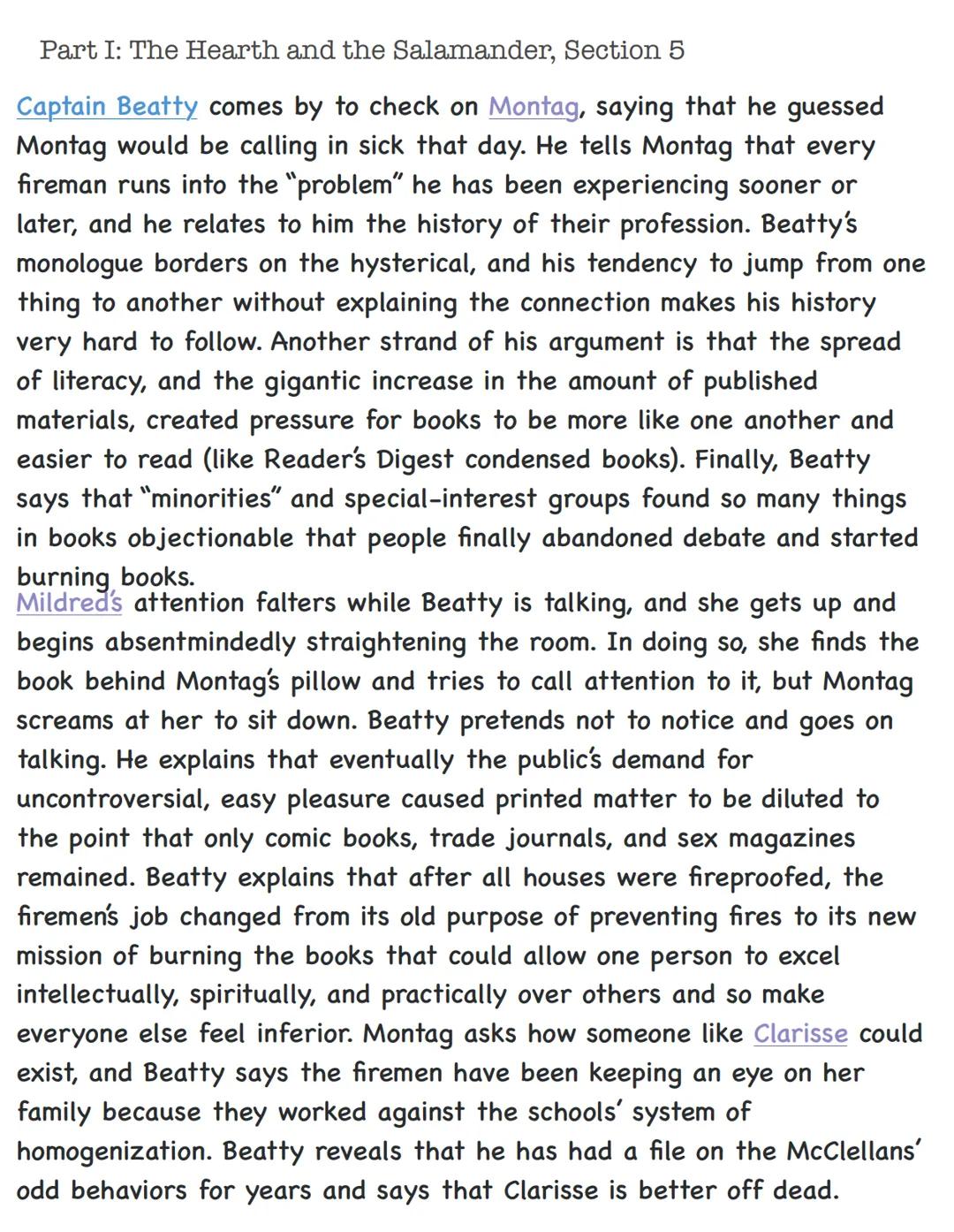
The Historical Context and Justification of Book Burning
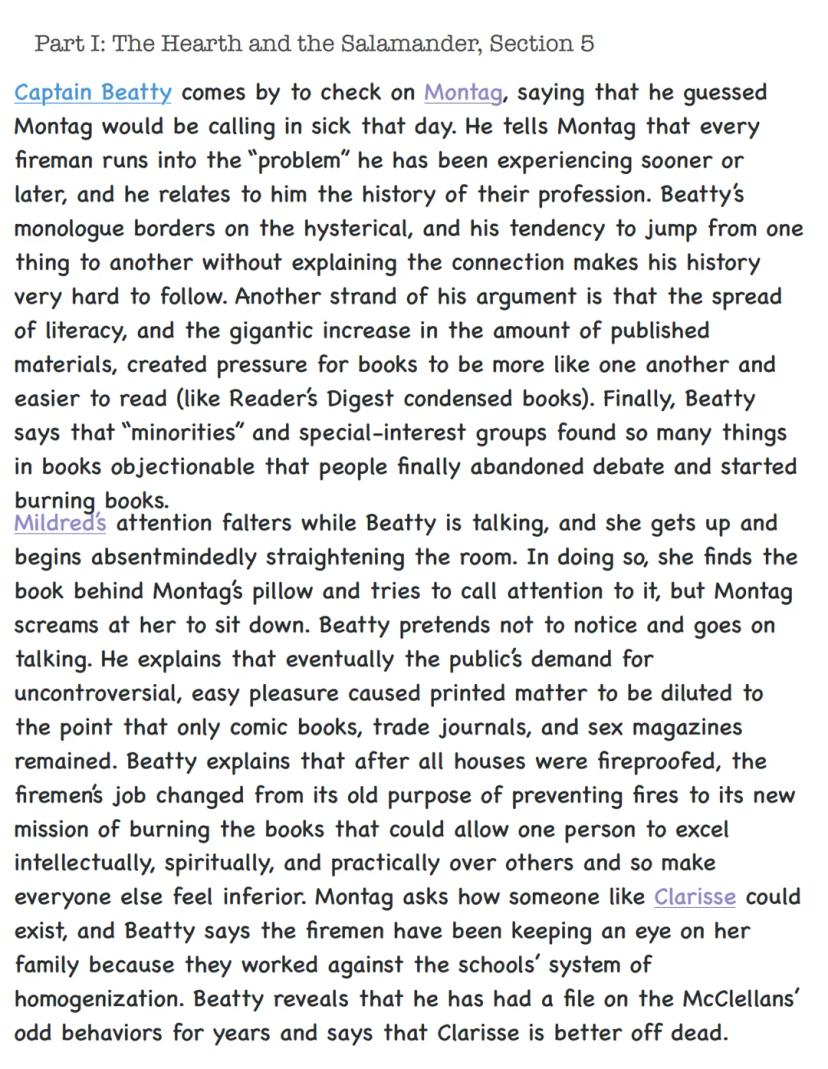
Captain Beatty's visit, as detailed in fahrenheit 451 summary part 2, provides a complex justification for the book-burning society. His erratic monologue explains how the simplification of literature, pressure from minority groups, and the public's demand for unchallenging entertainment led to the current state of censorship.
Beatty's revelation about monitoring Clarisse's family shows the system's intolerance of independent thinking. His statement that "Clarisse is better off dead" reveals the brutal efficiency with which the society eliminates those who question its values. This section provides crucial context for understanding what surprises clarisse about the way montag answers her questions.
The conversation also reveals the system's approach to dealing with wavering firemen, offering them a brief period to satisfy their curiosity about books before forcing conformity. This demonstrates the calculated way the society maintains control over its enforcers.
Definition: The "happiness of the world" in Beatty's context refers to the enforced contentment through censorship and intellectual suppression.
8
of 10
Montag's Rebellion and Search for Meaning
In this crucial section of fahrenheit 451 summary - part 3, Montag's transformation from conformist to rebel culminates in his decision to never return to work. His secret collection of twenty books reveals a long-standing inner conflict, while his determination to understand their content shows his growing resistance to societal control.
The significance of Montag's choice of "Gulliver's Travels" as his first serious reading attempt connects to the novel's themes of societal criticism and individual awakening. His reaching out to Faber, the former English professor, demonstrates his recognition that understanding requires guidance and human connection.
The subway scene, where Montag attempts to memorize Bible verses while being bombarded by commercial jingles, illustrates the struggle between meaningful content and superficial entertainment. This moment powerfully demonstrates how montag starts channeling clarisse in his thinking, questioning the world around him rather than accepting it passively.
Example: The Mechanical Hound's appearance at Montag's door symbolizes the system's growing awareness of his deviation from accepted norms, foreshadowing the conflict to come.
9
of 10
Understanding Fahrenheit 451: Montag's Pivotal Meeting with Faber
In this crucial section of Fahrenheit 451 summary part 2, Montag seeks guidance from Faber, marking a significant turning point in his transformation. When Montag presents Faber with a book, it helps ease the old man's initial suspicions, leading to a profound discussion about the true nature of their society's problems.
Definition: Faber explains that books themselves aren't what society needs, but rather the deep meaning and wisdom they contain. He outlines three essential elements for a functioning society: quality information, time to process it, and the freedom to act on that knowledge.
Faber introduces a powerful metaphor comparing their superficial society to flowers attempting to survive by feeding on other flowers rather than drawing nutrients from soil. This metaphor illustrates how people have become unwilling to confront life's uncomfortable realities, preferring shallow entertainment over substantive knowledge. He emphasizes that quality information should provide detailed insights into human nature and experience - what he calls the "pores" on humanity's face.
The discussion reveals a crucial distinction between books and television. While Faber acknowledges television's apparent realism, he criticizes its invasive nature and how it controls viewers' thoughts. Books, in contrast, allow readers to pause, reflect, and engage critically with the material. This comparison becomes central to understanding the broader themes of intellectual freedom and critical thinking in the novel.
10
of 10
The Deeper Implications of Fahrenheit 451's Social Commentary
The second half of this Fahrenheit 451 story analysis delves into the root causes of society's decline. When Montag proposes planting books in firemen's homes to discredit their profession, Faber reveals a darker truth: the firemen aren't the real problem. Society had already abandoned reading before the book-burning began, highlighting how cultural decay often precedes institutional oppression.
Highlight: A key revelation is that the public's voluntary abandonment of books preceded the government's book-burning campaign, suggesting that societal apathy, not just censorship, leads to intellectual decline.
Faber's perspective on the coming war adds another layer to the novel's social commentary. He sees the potential destruction of "TV families" as an opportunity for cultural renewal, though this view reveals a certain fatalism in his thinking. This conversation demonstrates how the novel explores themes of societal collapse and potential rebirth through crisis.
The dialogue between Montag and Faber serves as a crucial analysis of how societies lose their intellectual freedom. Through their discussion, readers understand that the path to cultural degradation isn't always through direct oppression, but often through the gradual surrender of intellectual curiosity and critical thinking. This section provides essential context for understanding the novel's broader themes about the relationship between knowledge, freedom, and social responsibility.
We thought you’d never ask...
What is the Knowunity AI companion?
Our AI companion is specifically built for the needs of students. Based on the millions of content pieces we have on the platform we can provide truly meaningful and relevant answers to students. But its not only about answers, the companion is even more about guiding students through their daily learning challenges, with personalised study plans, quizzes or content pieces in the chat and 100% personalisation based on the students skills and developments.
Where can I download the Knowunity app?
You can download the app in the Google Play Store and in the Apple App Store.
Is Knowunity really free of charge?
That's right! Enjoy free access to study content, connect with fellow students, and get instant help – all at your fingertips.
Most popular content: Fahrenheit 451
1Most popular content in English
9Most popular content
9Can't find what you're looking for? Explore other subjects.
Students love us — and so will you.
4.6/5App Store
4.7/5Google Play
The app is very easy to use and well designed. I have found everything I was looking for so far and have been able to learn a lot from the presentations! I will definitely use the app for a class assignment! And of course it also helps a lot as an inspiration.
Stefan SiOS user
This app is really great. There are so many study notes and help [...]. My problem subject is French, for example, and the app has so many options for help. Thanks to this app, I have improved my French. I would recommend it to anyone.
Samantha KlichAndroid user
Wow, I am really amazed. I just tried the app because I've seen it advertised many times and was absolutely stunned. This app is THE HELP you want for school and above all, it offers so many things, such as workouts and fact sheets, which have been VERY helpful to me personally.
AnnaiOS user
English368 views·Updated May 24, 2026·14 pagesFahrenheit 451 Story Analysis: Summaries, Quotes, and Insights
°♡✧*𝗠ǻ𝓇ĺ*✧♡°@mari_helping
Ray Bradbury's dystopian masterpiece explores themes of censorship, intellectual freedom, and human connection through the transformation of its protagonist.
In Fahrenheit 451 summary part 1, we meet Guy Montag, a fireman who burns books instead of extinguishing fires. His... Show more
1
of 10Sign up to see the content. It's free!
- Access to all documents
- Improve your grades
- Join milions of students
Understanding Fahrenheit 451's Opening: The Hearth and the Salamander
Ray Bradbury's dystopian masterpiece opens with profound symbolism and character introductions that set the stage for a compelling Fahrenheit 451 story analysis. The novel begins with Guy Montag, a fireman whose job involves burning books rather than extinguishing fires. His uniform bears the number 451 - the temperature at which paper burns - along with a salamander emblem and phoenix disc, symbols that foreshadow the transformation to come.
The pivotal Montag's encounter with Clarisse occurs as he walks home from work. This seventeen-year-old neighbor proves instrumental in awakening Montag's dormant consciousness. What surprises Clarisse about the way Montag answers her questions is his mechanical, programmed responses, highlighting the society's suppression of independent thought. Their interaction represents the first crack in Montag's carefully constructed worldview.
Quote: "If they give you ruled paper, write the other way" serves as the section's epigraph, embodying the spirit of rebellion against conformity that will develop throughout the narrative. The significance of ruled paper quote in Fahrenheit 451 lies in its metaphorical representation of societal constraints and the choice to resist them.
2
of 10Sign up to see the content. It's free!
- Access to all documents
- Improve your grades
- Join milions of students
Clarisse's Impact on Montag's Awakening
What was Clarisse's first impression of Montag proves transformative - she sees through his professional facade to recognize his underlying humanity. Her observations about his laugh never reaching his eyes and her direct question about his happiness force Montag to confront his own emotional emptiness. Montag starts channeling Clarisse in his thinking as her influence begins to reshape his perspective on the world.
Highlight: Clarisse's character serves as a catalyst for change, representing everything their society rejects: curiosity, nature appreciation, and genuine human connection.
The contrast between Clarisse's vitality and Mildred's emotional death becomes stark in the fahrenheit 451 summary part 1. While Clarisse savors life's simple pleasures, Montag returns home to find his wife overdosed on sleeping pills, highlighting the profound emptiness of their society's prescribed lifestyle.
3
of 10Sign up to see the content. It's free!
- Access to all documents
- Improve your grades
- Join milions of students
The Mechanical World Versus Human Connection
In this fahrenheit 451 chapter summary, the story juxtaposes mechanical and human elements. The emergency workers who save Mildred operate with industrial efficiency, treating her suicide attempt as routine maintenance. Meanwhile, Clarisse's family represents a dying breed of genuine human interaction.
Definition: The Mechanical Hound symbolizes the merciless technological control of their society, programmed to hunt down those who deviate from prescribed norms.
The growing tension between conformity and individuality becomes evident as Montag begins questioning his role in society. His interaction with the Mechanical Hound, which growls at him unprovoked, suggests that even the machines can sense his emerging rebellion against the system.
4
of 10Sign up to see the content. It's free!
- Access to all documents
- Improve your grades
- Join milions of students
The Seeds of Revolution in Fahrenheit 451
As shown in the fahrenheit 451 summary part 2, Montag's transformation accelerates through his continued interactions with Clarisse. Her simple act of rubbing a dandelion under his chin becomes a powerful metaphor for authentic human experience versus artificial happiness. The fact that no pollen rubs off on Montag symbolizes his current disconnection from genuine emotion.
Example: Clarisse's rain-tasting scene contrasts sharply with the artificial entertainment of Mildred's wall-screens, highlighting the difference between real and manufactured experiences.
The society's treatment of Clarisse as mentally unstable for her "antisocial" tendencies reveals the systemic fear of independent thought. Her forced psychiatric sessions parallel modern concerns about conformity versus individuality, making the novel's themes remarkably relevant to contemporary readers.
5
of 10Sign up to see the content. It's free!
- Access to all documents
- Improve your grades
- Join milions of students
Montag's Transformation Through Encounters with Clarisse and Books
Montag's daily conversations with Clarisse McClellan mark a pivotal shift in his perspective as a fireman. Their interactions reveal her unique worldview - she has rejected the standardized education system, finding it devoid of meaningful thought. When Clarisse suddenly disappears on the eighth day, Montag's concern for her whereabouts demonstrates how deeply she has affected him. This section provides crucial insight into what is clarisse's impression of montag and how their relationship develops.
At the firehouse, Montag's growing internal conflict becomes evident through his questioning of established practices. His interest in the fate of a man whose library they burned and his near-admission of reading a line from a fairy tale book show his emerging doubts. The scene where firemen display their rule books, claiming Benjamin Franklin established their organization to burn English-influenced books in 1790, highlights the dystopian society's historical revisionism.
The turning point comes during a book-burning mission at an elderly woman's house. When Montag instinctively steals a book and witnesses the woman's self-immolation, it profoundly impacts his worldview. This event, combined with Montag's encounter with clarisse summary, sets the stage for his transformation from a loyal fireman to a questioner of his society's values.
Quote: "A book fell into Montag's hand, and without thinking he hides it beneath his coat" - This moment symbolizes the beginning of Montag's rebellion against his society's book-burning mandate.
6
of 10Sign up to see the content. It's free!
- Access to all documents
- Improve your grades
- Join milions of students
The Deterioration of Human Connection in a Technology-Dominated World
The contrast between Montag's meaningful interactions with Clarisse and his hollow relationship with Mildred becomes stark in this section of fahrenheit 451 summary part 1. The separate beds, their inability to remember their first meeting, and Mildred's addiction to sleeping pills paint a picture of a marriage devoid of genuine connection.
Mildred's casual announcement of Clarisse's death - possibly hit by a car - and her immediate return to her TV "family" emphasizes the society's emotional numbness. This section of fahrenheit 451 chapter summary shows how technology, particularly the TV walls, creates barriers between people rather than connecting them.
Montag's physical reaction to his job - vomiting from the smell of kerosene - symbolizes his growing moral revulsion. His attempt to discuss his feelings about burning books and the elderly woman with Mildred reveals the widening gulf between them, culminating in Captain Beatty's timely arrival.
Highlight: The contrast between Clarisse's thoughtful questions and Mildred's TV-focused existence demonstrates the novel's critique of mass media's impact on human relationships.
7
of 10Sign up to see the content. It's free!
- Access to all documents
- Improve your grades
- Join milions of students
The Historical Context and Justification of Book Burning
Captain Beatty's visit, as detailed in fahrenheit 451 summary part 2, provides a complex justification for the book-burning society. His erratic monologue explains how the simplification of literature, pressure from minority groups, and the public's demand for unchallenging entertainment led to the current state of censorship.
Beatty's revelation about monitoring Clarisse's family shows the system's intolerance of independent thinking. His statement that "Clarisse is better off dead" reveals the brutal efficiency with which the society eliminates those who question its values. This section provides crucial context for understanding what surprises clarisse about the way montag answers her questions.
The conversation also reveals the system's approach to dealing with wavering firemen, offering them a brief period to satisfy their curiosity about books before forcing conformity. This demonstrates the calculated way the society maintains control over its enforcers.
Definition: The "happiness of the world" in Beatty's context refers to the enforced contentment through censorship and intellectual suppression.
8
of 10Sign up to see the content. It's free!
- Access to all documents
- Improve your grades
- Join milions of students
Montag's Rebellion and Search for Meaning
In this crucial section of fahrenheit 451 summary - part 3, Montag's transformation from conformist to rebel culminates in his decision to never return to work. His secret collection of twenty books reveals a long-standing inner conflict, while his determination to understand their content shows his growing resistance to societal control.
The significance of Montag's choice of "Gulliver's Travels" as his first serious reading attempt connects to the novel's themes of societal criticism and individual awakening. His reaching out to Faber, the former English professor, demonstrates his recognition that understanding requires guidance and human connection.
The subway scene, where Montag attempts to memorize Bible verses while being bombarded by commercial jingles, illustrates the struggle between meaningful content and superficial entertainment. This moment powerfully demonstrates how montag starts channeling clarisse in his thinking, questioning the world around him rather than accepting it passively.
Example: The Mechanical Hound's appearance at Montag's door symbolizes the system's growing awareness of his deviation from accepted norms, foreshadowing the conflict to come.
9
of 10Sign up to see the content. It's free!
- Access to all documents
- Improve your grades
- Join milions of students
Understanding Fahrenheit 451: Montag's Pivotal Meeting with Faber
In this crucial section of Fahrenheit 451 summary part 2, Montag seeks guidance from Faber, marking a significant turning point in his transformation. When Montag presents Faber with a book, it helps ease the old man's initial suspicions, leading to a profound discussion about the true nature of their society's problems.
Definition: Faber explains that books themselves aren't what society needs, but rather the deep meaning and wisdom they contain. He outlines three essential elements for a functioning society: quality information, time to process it, and the freedom to act on that knowledge.
Faber introduces a powerful metaphor comparing their superficial society to flowers attempting to survive by feeding on other flowers rather than drawing nutrients from soil. This metaphor illustrates how people have become unwilling to confront life's uncomfortable realities, preferring shallow entertainment over substantive knowledge. He emphasizes that quality information should provide detailed insights into human nature and experience - what he calls the "pores" on humanity's face.
The discussion reveals a crucial distinction between books and television. While Faber acknowledges television's apparent realism, he criticizes its invasive nature and how it controls viewers' thoughts. Books, in contrast, allow readers to pause, reflect, and engage critically with the material. This comparison becomes central to understanding the broader themes of intellectual freedom and critical thinking in the novel.
10
of 10Sign up to see the content. It's free!
- Access to all documents
- Improve your grades
- Join milions of students
The Deeper Implications of Fahrenheit 451's Social Commentary
The second half of this Fahrenheit 451 story analysis delves into the root causes of society's decline. When Montag proposes planting books in firemen's homes to discredit their profession, Faber reveals a darker truth: the firemen aren't the real problem. Society had already abandoned reading before the book-burning began, highlighting how cultural decay often precedes institutional oppression.
Highlight: A key revelation is that the public's voluntary abandonment of books preceded the government's book-burning campaign, suggesting that societal apathy, not just censorship, leads to intellectual decline.
Faber's perspective on the coming war adds another layer to the novel's social commentary. He sees the potential destruction of "TV families" as an opportunity for cultural renewal, though this view reveals a certain fatalism in his thinking. This conversation demonstrates how the novel explores themes of societal collapse and potential rebirth through crisis.
The dialogue between Montag and Faber serves as a crucial analysis of how societies lose their intellectual freedom. Through their discussion, readers understand that the path to cultural degradation isn't always through direct oppression, but often through the gradual surrender of intellectual curiosity and critical thinking. This section provides essential context for understanding the novel's broader themes about the relationship between knowledge, freedom, and social responsibility.
We thought you’d never ask...
What is the Knowunity AI companion?
Our AI companion is specifically built for the needs of students. Based on the millions of content pieces we have on the platform we can provide truly meaningful and relevant answers to students. But its not only about answers, the companion is even more about guiding students through their daily learning challenges, with personalised study plans, quizzes or content pieces in the chat and 100% personalisation based on the students skills and developments.
Where can I download the Knowunity app?
You can download the app in the Google Play Store and in the Apple App Store.
Is Knowunity really free of charge?
That's right! Enjoy free access to study content, connect with fellow students, and get instant help – all at your fingertips.
Most popular content: Fahrenheit 451
1Most popular content in English
9Most popular content
9Can't find what you're looking for? Explore other subjects.
Students love us — and so will you.
4.6/5App Store
4.7/5Google Play
The app is very easy to use and well designed. I have found everything I was looking for so far and have been able to learn a lot from the presentations! I will definitely use the app for a class assignment! And of course it also helps a lot as an inspiration.
Stefan SiOS user
This app is really great. There are so many study notes and help [...]. My problem subject is French, for example, and the app has so many options for help. Thanks to this app, I have improved my French. I would recommend it to anyone.
Samantha KlichAndroid user
Wow, I am really amazed. I just tried the app because I've seen it advertised many times and was absolutely stunned. This app is THE HELP you want for school and above all, it offers so many things, such as workouts and fact sheets, which have been VERY helpful to me personally.
AnnaiOS user