

A comprehensive guide to Thermodynamics boiler cycle computationfocusing on... Show more
 Chemistry21 views·Updated May 24, 2026·6 pages
Fun with Thermodynamics: Easy Boiler and Rankine Cycle Tricks!
1 / 6
1
of 6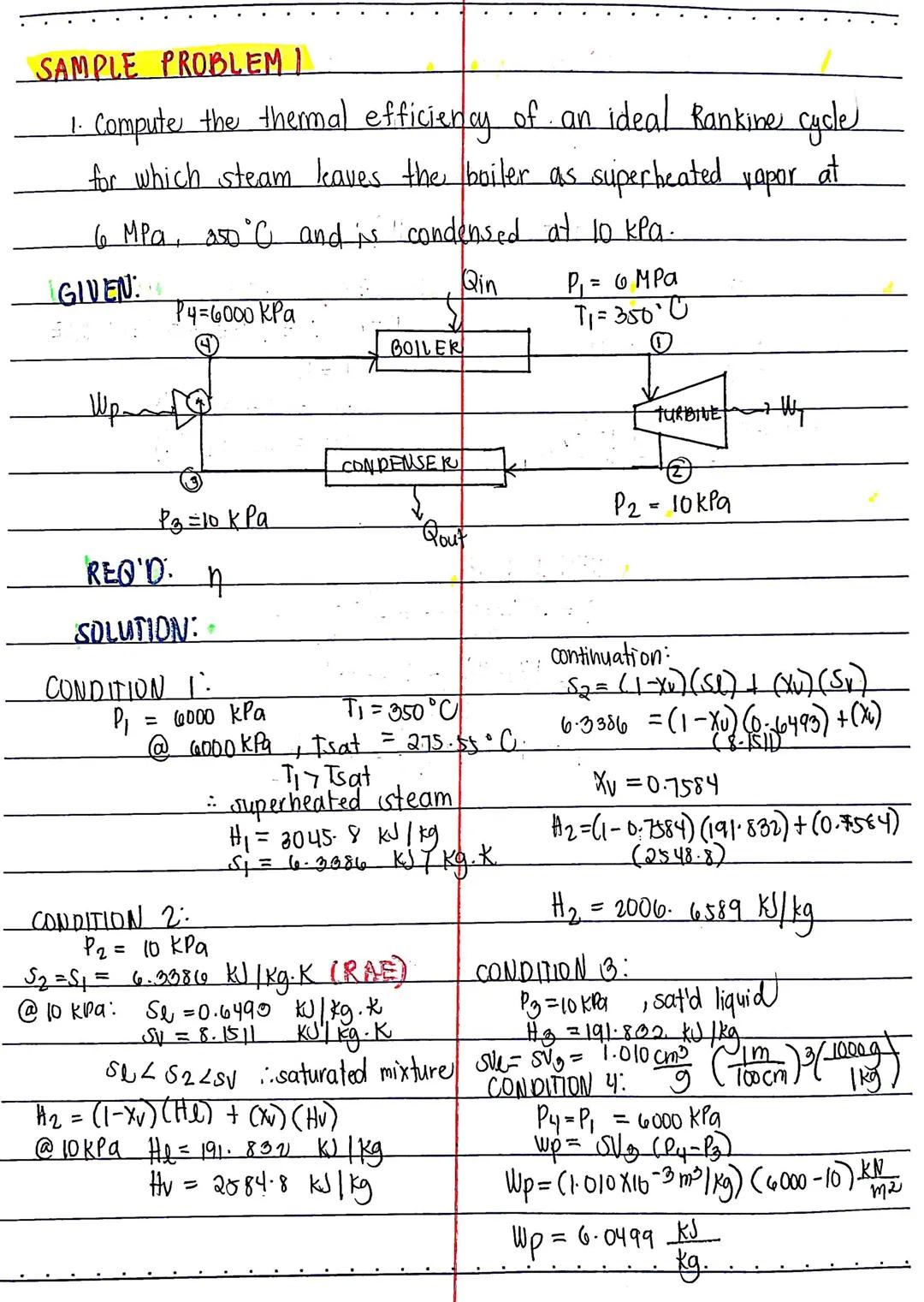
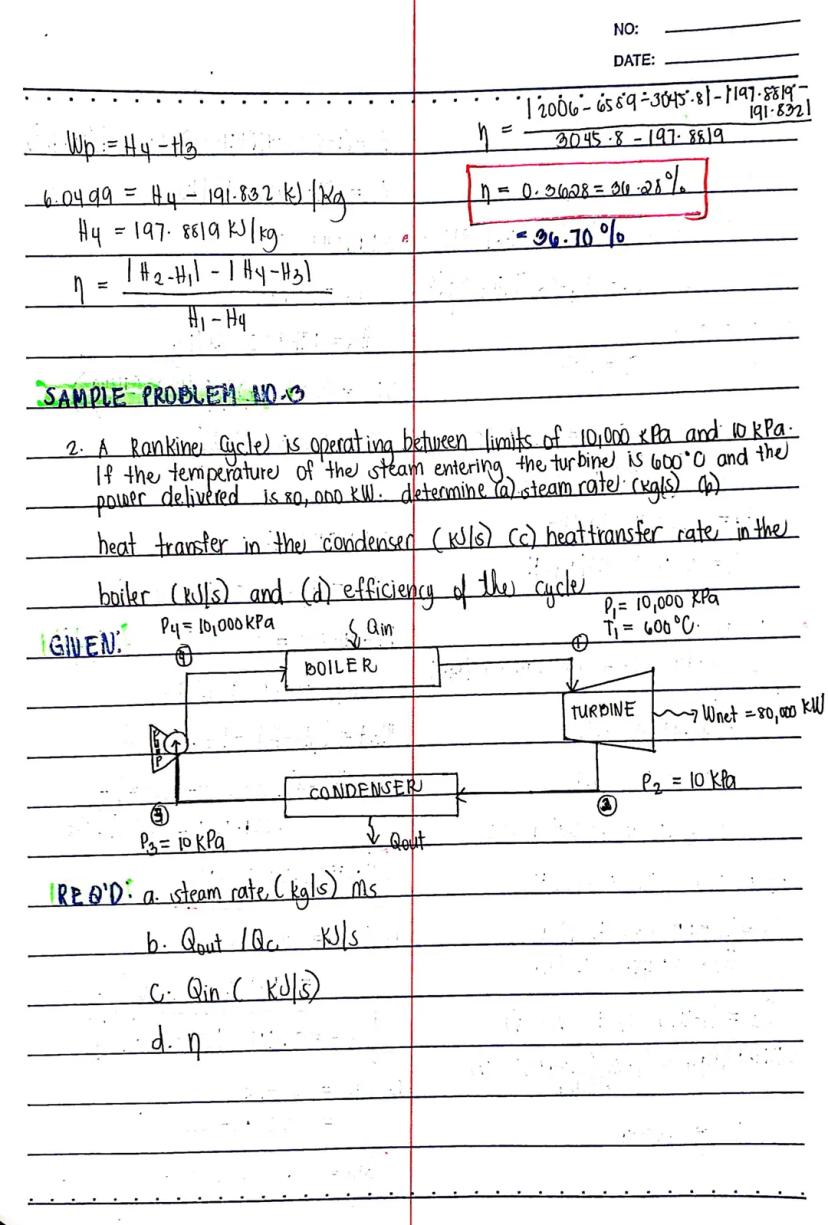
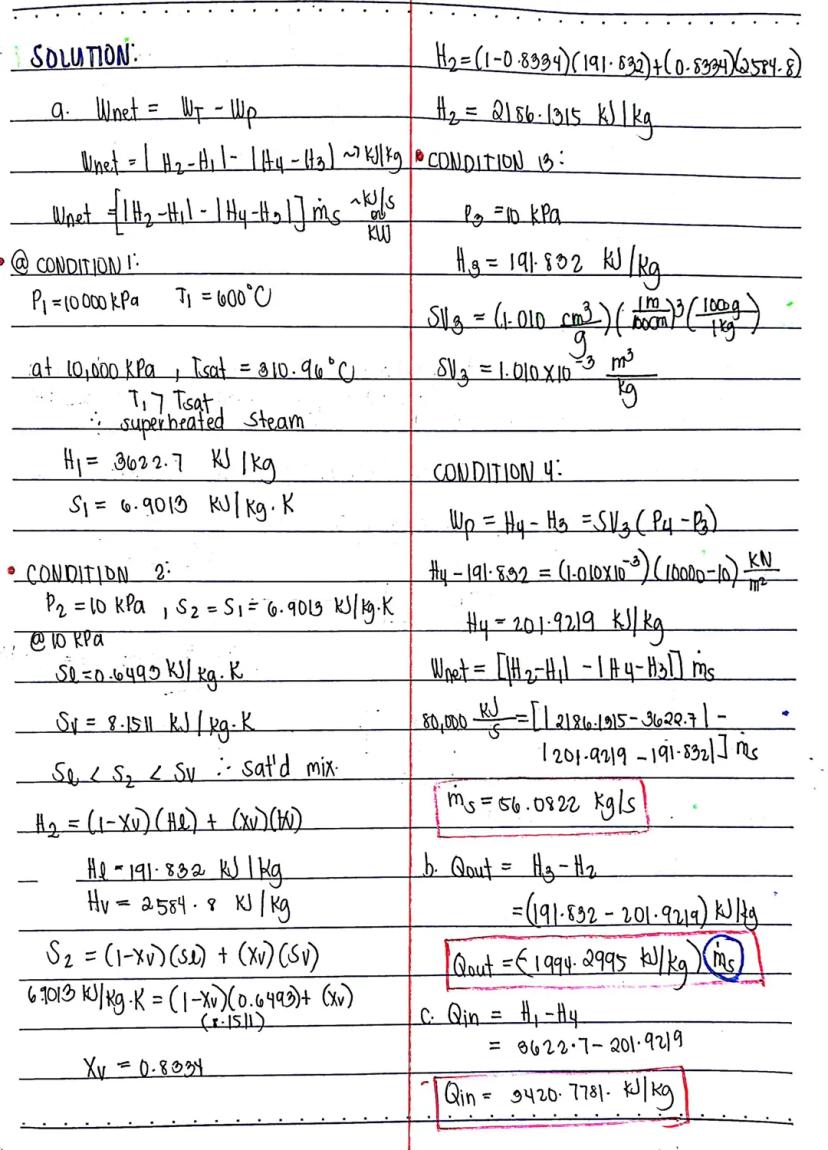
Rankine Cycle Analysis with Given Power Output
This page presents a more complex Rankine cycle problem, where the cycle operates between 10,000 kPa and 10 kPa, with steam entering the turbine at 600°C and delivering 80,000 kW of power.
The problem requires calculating:
- Steam rate
- Heat transfer in the condenser
- Heat transfer rate in the boiler
- Cycle efficiency
Definition: Steam rate - The mass flow rate of steam through the cycle, typically measured in kilograms per second.
The solution process involves:
- Determining thermodynamic properties at each state point
- Calculating the work done by the turbine and pump
- Computing the steam rate based on the given power output
- Determining heat transfer rates in the boiler and condenser
Highlight: The calculated steam rate is 56.0822 kg/s, demonstrating the application of boiler capacity kg/hr calculations in a practical scenario.
This problem showcases the application of Rankine cycle efficiency of steam power plant calculations in a real-world context.
2
of 6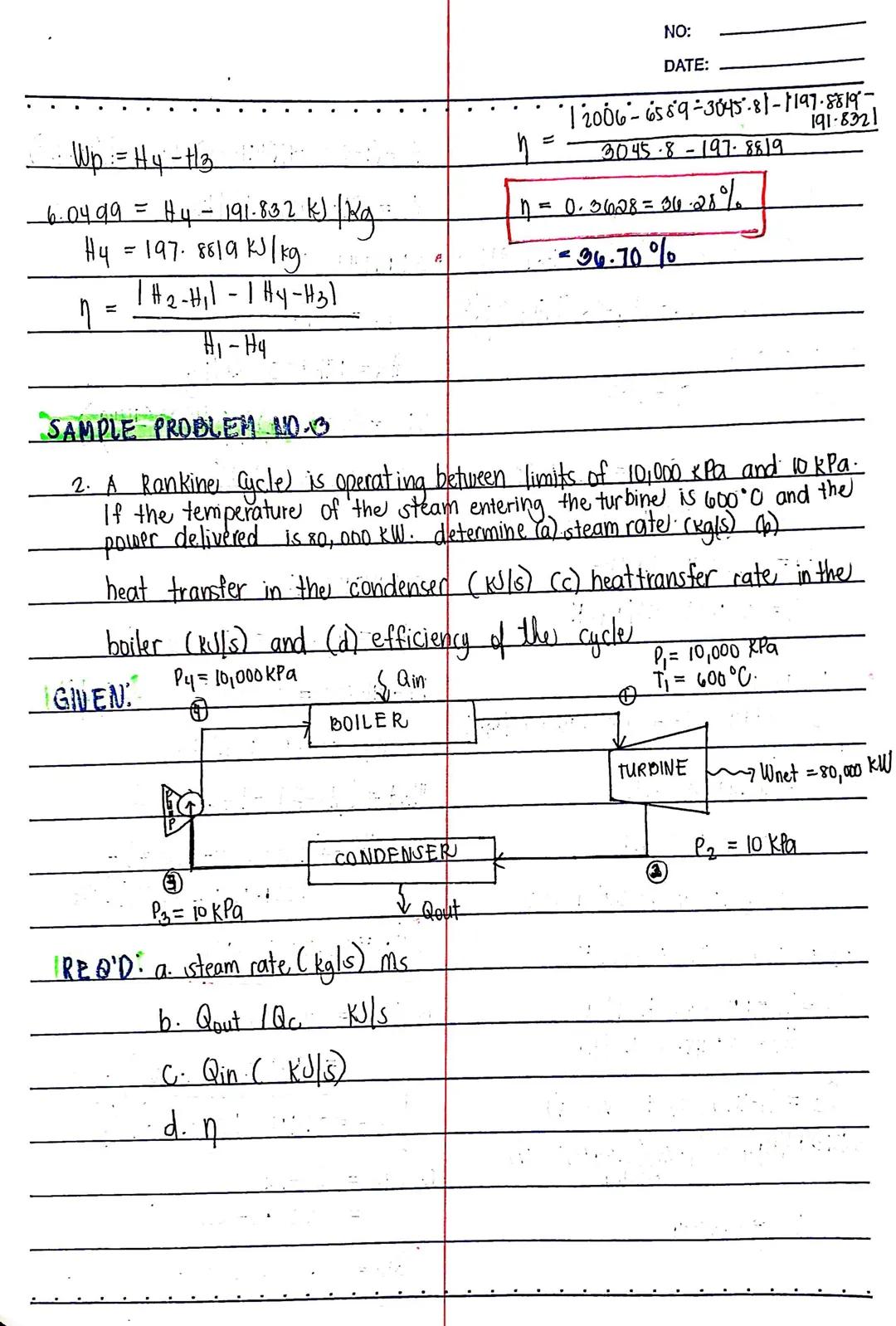
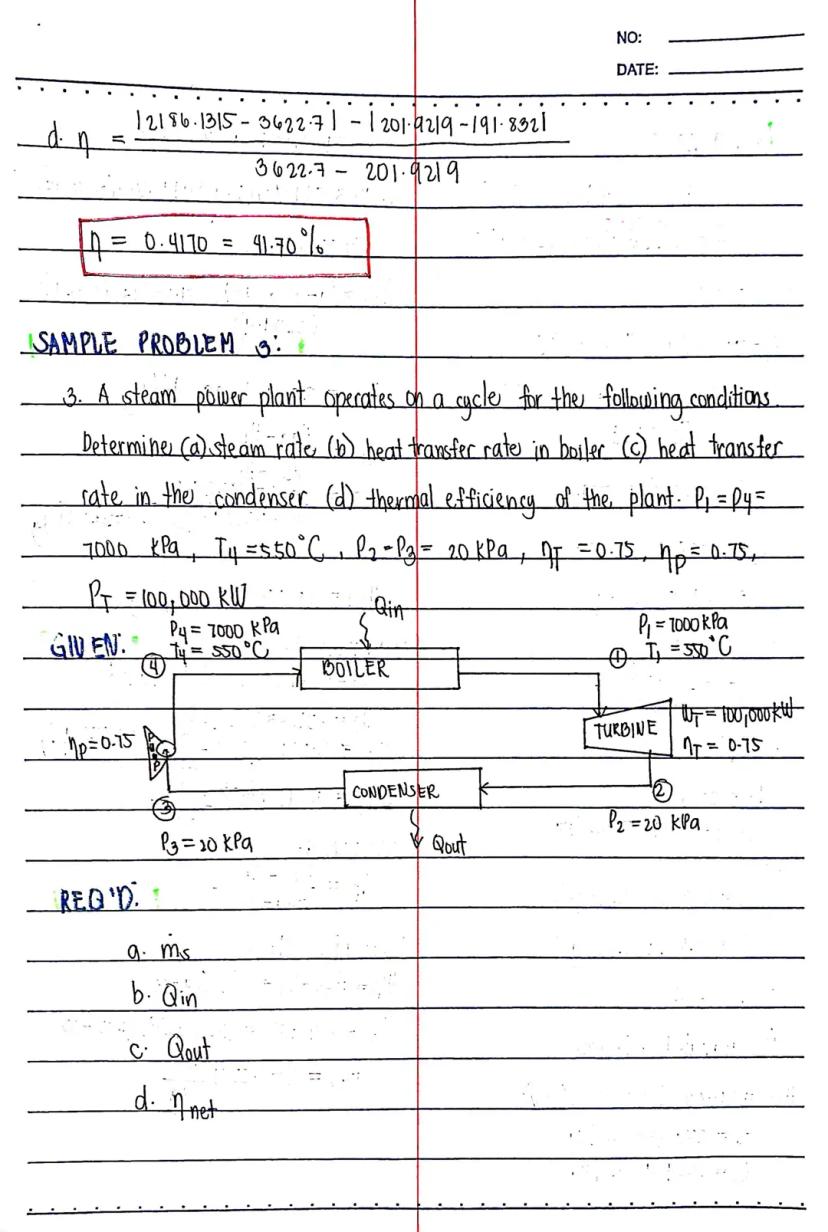
Steam Power Plant Cycle Analysis
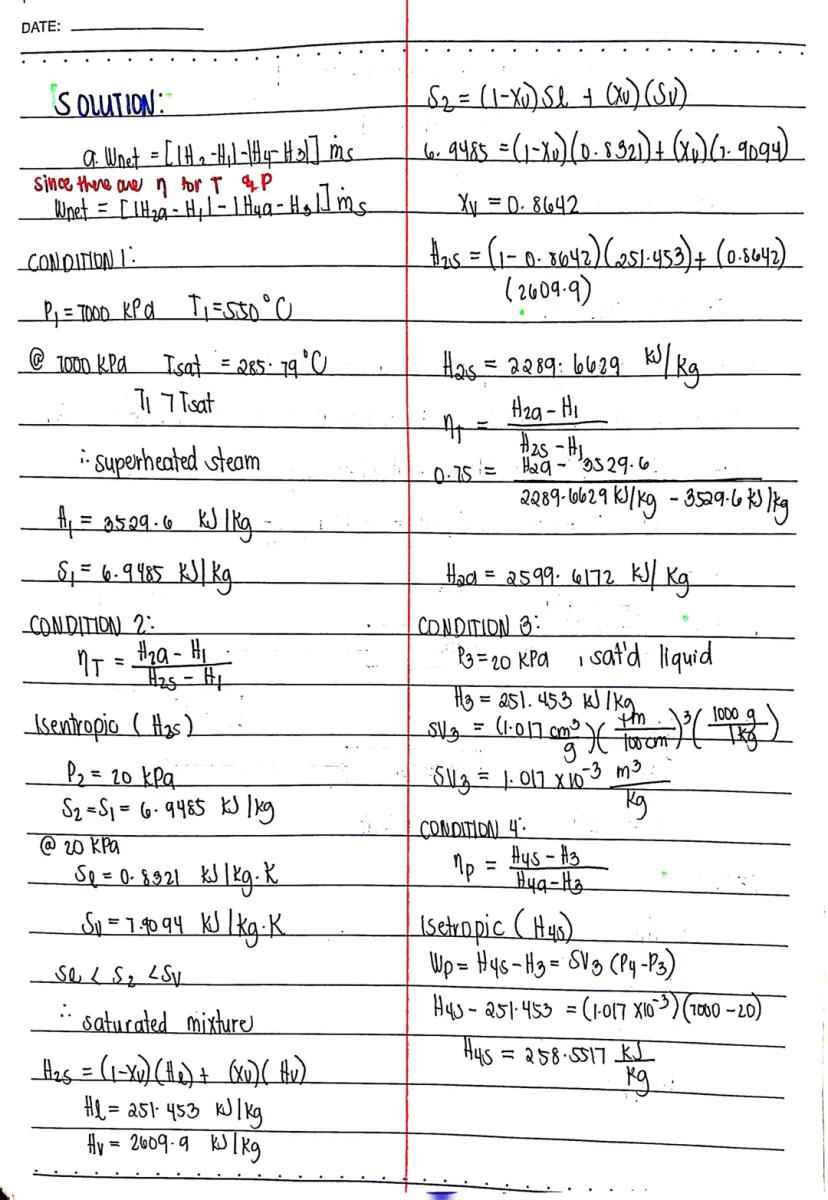
This page presents a comprehensive problem involving a steam power plant operating on a Rankine cycle. The problem provides specific conditions for the cycle and requires the calculation of various parameters.
Given conditions:
- P₁ = P₄ = 7000 kPa
- T₁ = 550°C
- P₂ = P₃ = 20 kPa
- Turbine efficiency (ηₜ) = 0.75
- Pump efficiency (ηₚ) = 0.75
- Power output = 100,000 kW
The problem requires calculating: a. Steam rate b. Heat transfer rate in the boiler c. Heat transfer rate in the condenser d. Thermal efficiency of the plant
Example: The solution demonstrates the use of isentropic efficiencies for both the turbine and pump, showing how real processes deviate from ideal conditions.
The solution process involves:
- Analyzing each state point in the cycle
- Calculating actual enthalpy values using isentropic efficiencies
- Determining the steam rate based on the given power output
- Computing heat transfer rates and overall thermal efficiency
Highlight: This problem illustrates the application of boiler steam problems rankine cycle efficiency calculations in a complex power plant scenario.
The detailed solution provides insights into power plant boiler steam problems rankine cycle efficiency and demonstrates the use of thermodynamic tables and equations.
3
of 6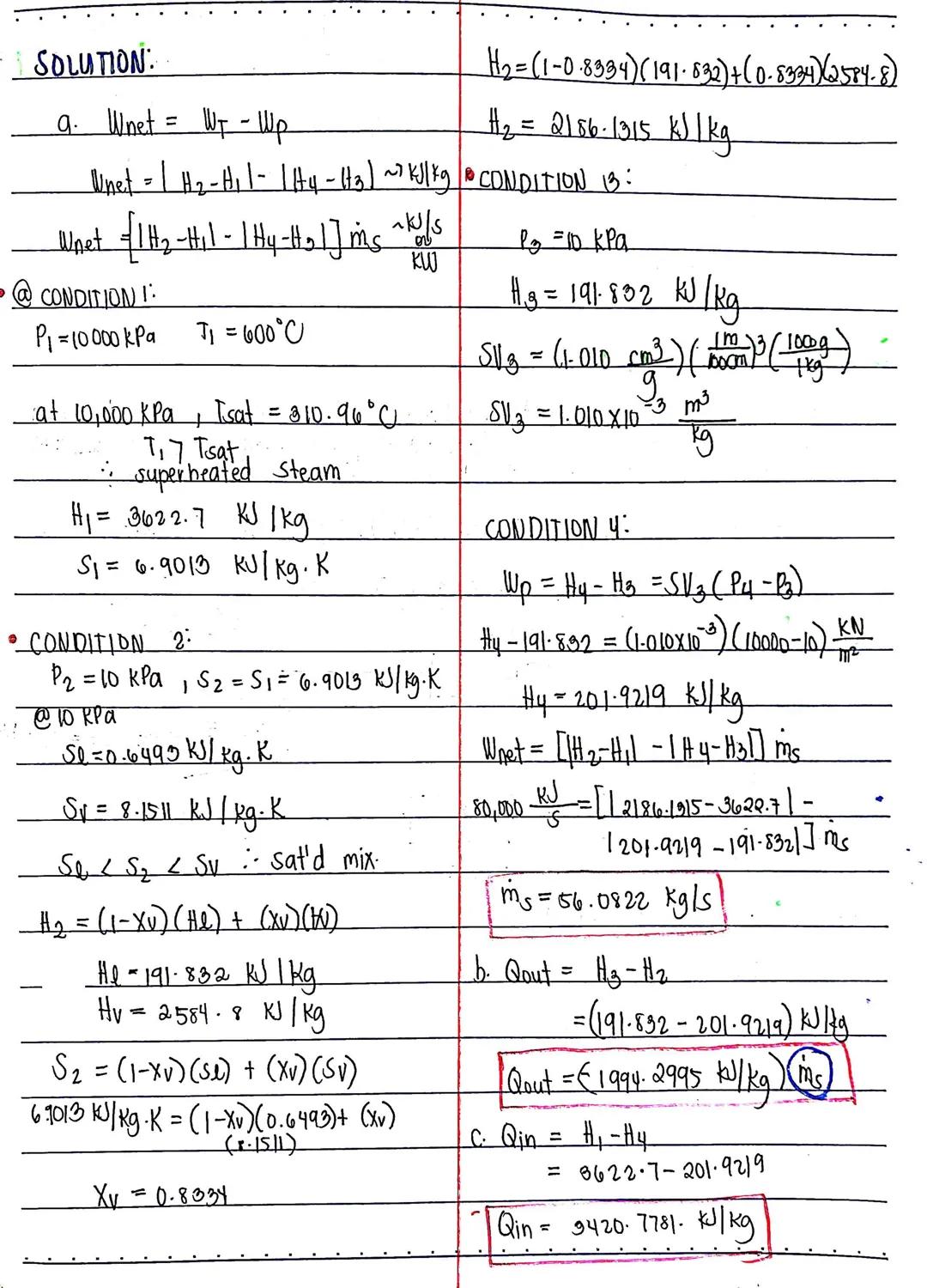
Ideal Rankine Cycle with Reheat
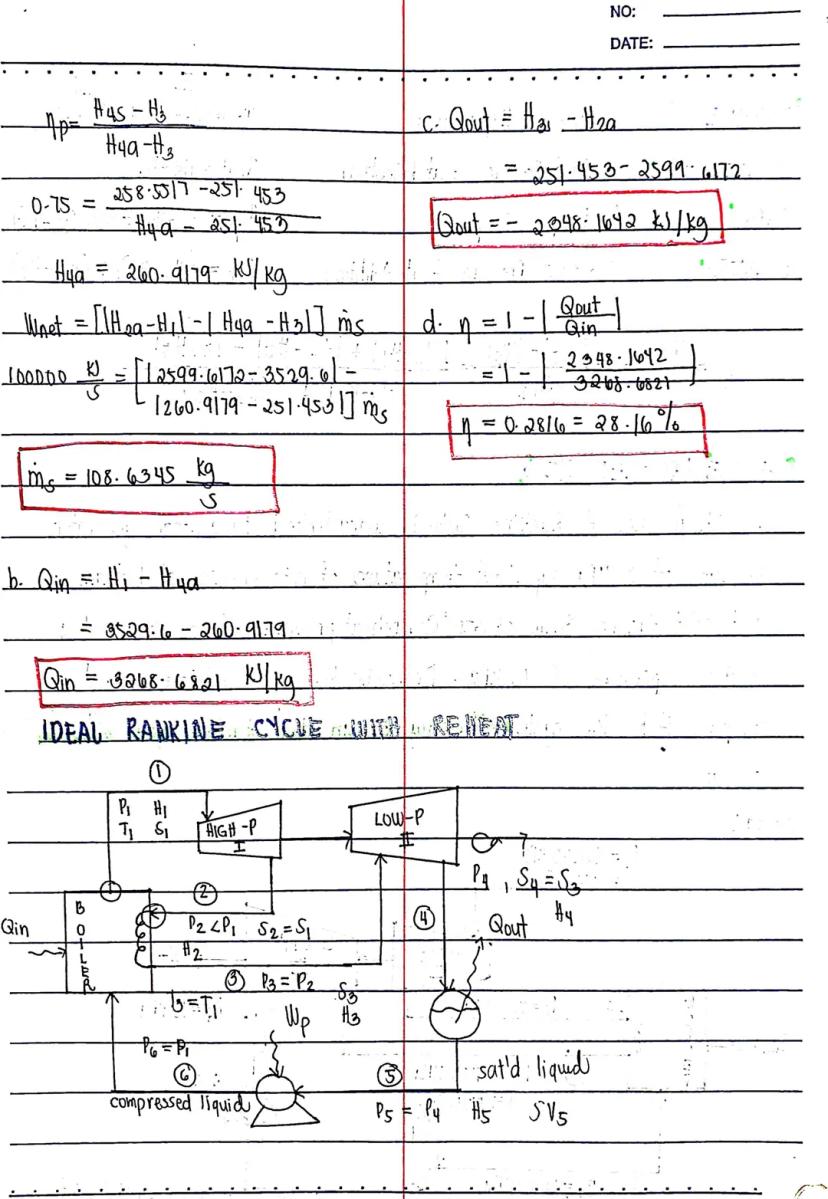
This page introduces the concept of an ideal Rankine cycle with reheat, presenting a P-v diagram to illustrate the process.
Key points:
- The cycle includes two turbine stages: high-pressure and low-pressure
- Steam is reheated between the two turbine stages
- The process aims to improve overall cycle efficiency
Definition: Reheat - A process in steam power cycles where steam is returned to the boiler for additional heating after partial expansion in the high-pressure turbine.
The P-v diagram shows:
- Compression in the pump (3-4)
- Heat addition in the boiler (4-1)
- Expansion in the high-pressure turbine (1-2)
- Reheat process (2-5)
- Expansion in the low-pressure turbine (5-6)
- Condensation (6-3)
Highlight: The reheat process in the Rankine cycle can significantly improve the overall thermal efficiency of the power plant.
This page provides a visual representation of the Rankine cycle P-v diagram, helping to understand the thermodynamic processes involved in steam power generation with reheat.
4
of 6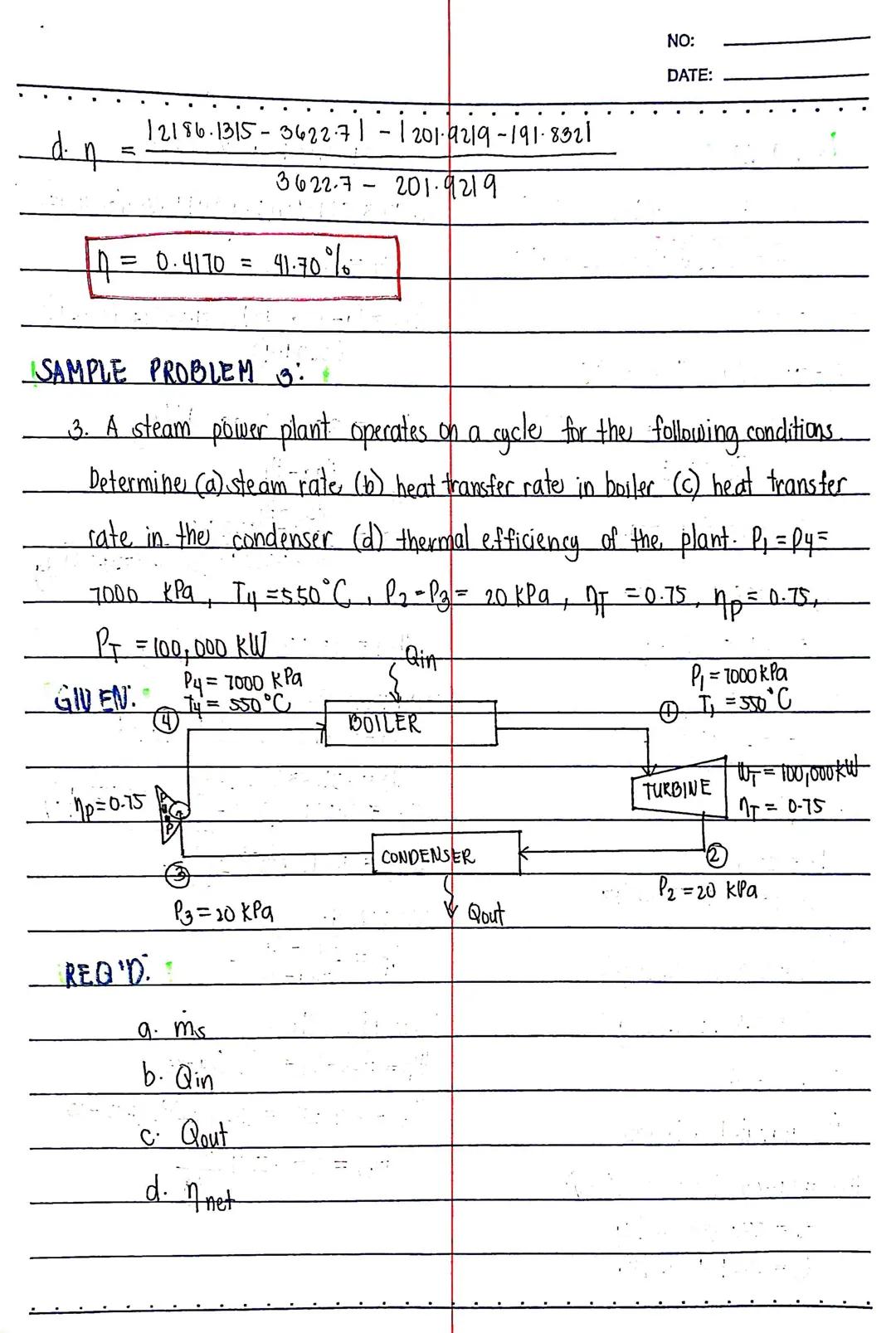
Continuation of Steam Power Plant Analysis
This page continues the solution of the steam power plant problem from the previous page, focusing on the final calculations and results.
Key calculations:
- Determination of actual enthalpy at turbine exit (H₂ₐ)
- Calculation of actual enthalpy at pump exit (H₄ₐ)
- Computation of steam rate (mṡ)
- Determination of heat input in the boiler (Qᵢₙ)
- Calculation of heat output in the condenser (Qₒᵤₜ)
- Computation of overall thermal efficiency (η)
Results:
- Steam rate: 108.6345 kg/s
- Heat input: 3268.6821 kJ/kg
- Heat output: 2348.1642 kJ/kg
- Thermal efficiency: 28.16%
Example: The thermal efficiency calculation demonstrates the application of the formula η = 1 - , which is a fundamental Rankine cycle efficiency formula.
Highlight: This problem solution provides a comprehensive example of boiler fuel consumption calculation and boiler efficiency calculation in the context of a steam power plant.
The page concludes with a brief mention of the ideal Rankine cycle with reheat, setting the stage for more advanced cycle analyses.
5
of 6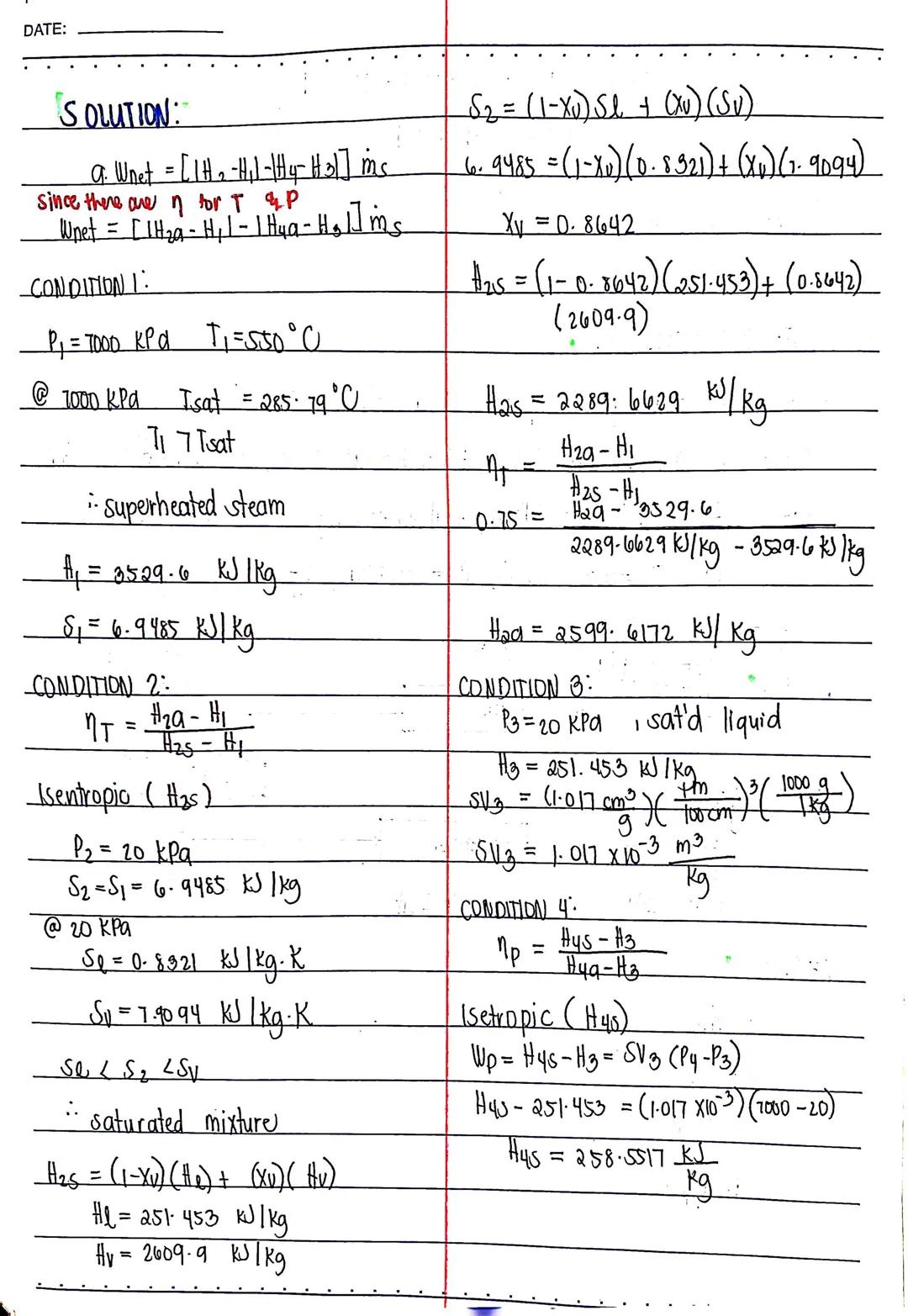
Rankine Cycle Variations and Applications
The final section covers variations of the basic Rankine cycle.
Definition: Reheat cycles involve reheating steam after partial expansion to improve efficiency.
Example: The ideal Rankine cycle with reheat shows how multiple pressure stages can enhance overall performance.
6
of 6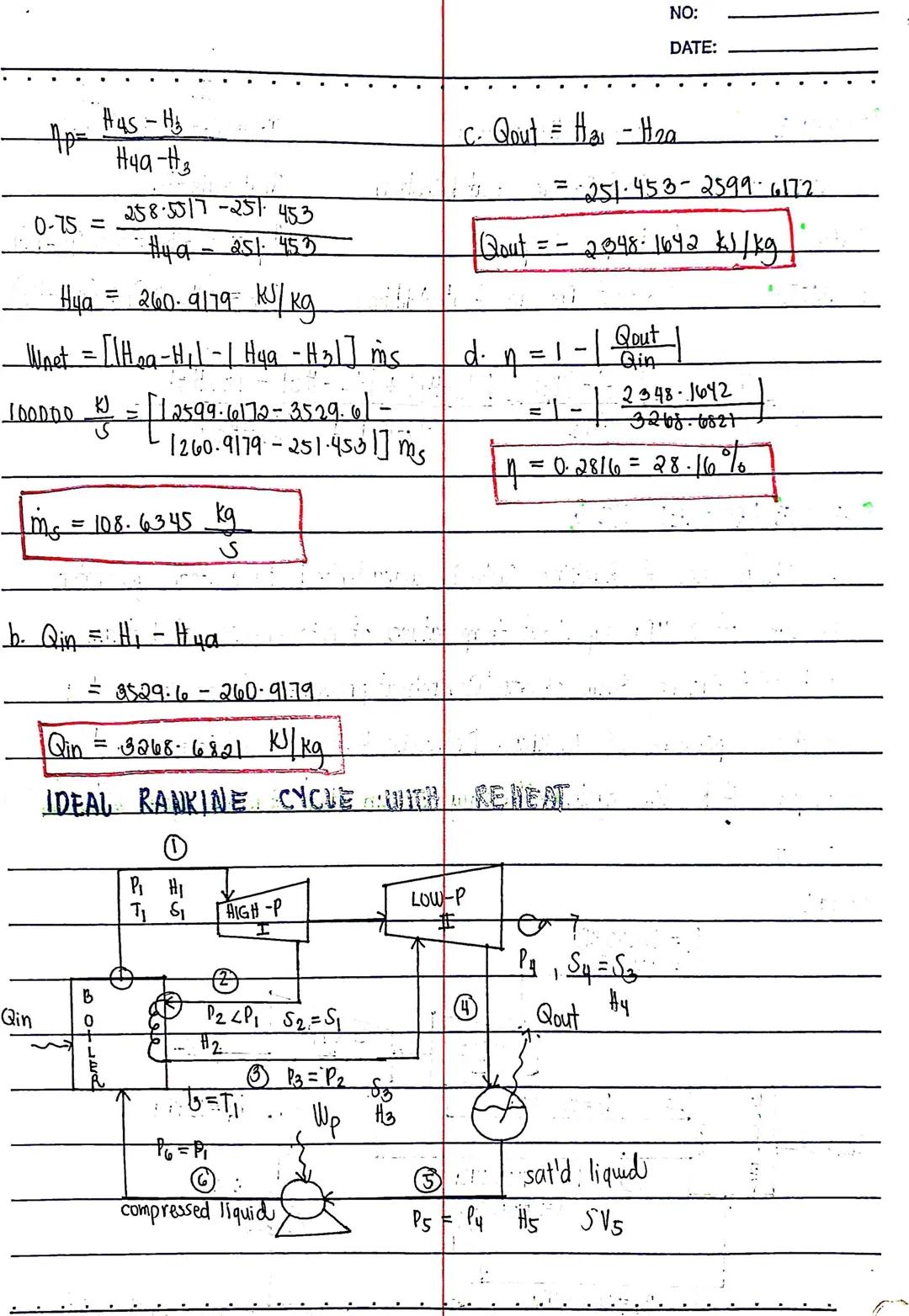
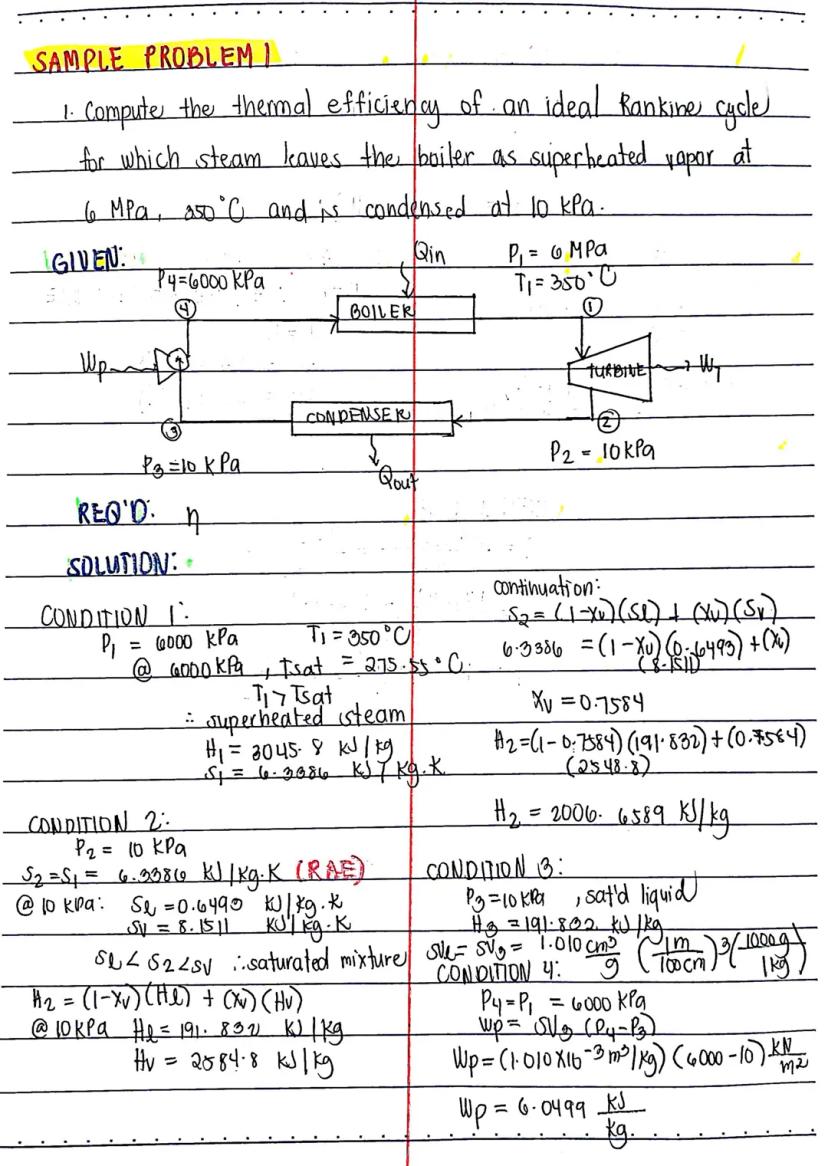
Thermal Efficiency Calculation of Ideal Rankine Cycle
This page presents a sample problem demonstrating the calculation of thermal efficiency for an ideal Rankine cycle. The problem involves steam leaving the boiler as superheated vapor at 6 MPa and 250°C, with the condenser pressure at 10 kPa.
The solution process involves:
- Determining the thermodynamic properties at each state point
- Calculating the work done by the turbine and pump
- Computing the heat input and output
- Applying the thermal efficiency formula
Vocabulary: Rankine cycle - A thermodynamic cycle that converts thermal energy into mechanical work, commonly used in steam power plants.
Example: The thermal efficiency calculation considers the enthalpy values at different points in the cycle, such as H₁ = 3045.8 kJ/kg at the boiler exit and H₂ = 2006.6589 kJ/kg at the turbine exit.
Highlight: The thermal efficiency of this ideal Rankine cycle is calculated to be 36.28%.
The page also includes detailed calculations for each state point, demonstrating the application of boiler efficiency formulas and thermodynamic principles.
We thought you’d never ask...
What is the Knowunity AI companion?
Our AI companion is specifically built for the needs of students. Based on the millions of content pieces we have on the platform we can provide truly meaningful and relevant answers to students. But its not only about answers, the companion is even more about guiding students through their daily learning challenges, with personalised study plans, quizzes or content pieces in the chat and 100% personalisation based on the students skills and developments.
Where can I download the Knowunity app?
You can download the app in the Google Play Store and in the Apple App Store.
Is Knowunity really free of charge?
That's right! Enjoy free access to study content, connect with fellow students, and get instant help – all at your fingertips.
Similar Content
Most popular content in Chemistry
9Most popular content
9Can't find what you're looking for? Explore other subjects.
Students love us — and so will you.
4.6/5App Store
4.7/5Google Play
The app is very easy to use and well designed. I have found everything I was looking for so far and have been able to learn a lot from the presentations! I will definitely use the app for a class assignment! And of course it also helps a lot as an inspiration.
Stefan SiOS user
This app is really great. There are so many study notes and help [...]. My problem subject is French, for example, and the app has so many options for help. Thanks to this app, I have improved my French. I would recommend it to anyone.
Samantha KlichAndroid user
Wow, I am really amazed. I just tried the app because I've seen it advertised many times and was absolutely stunned. This app is THE HELP you want for school and above all, it offers so many things, such as workouts and fact sheets, which have been VERY helpful to me personally.
AnnaiOS user
Chemistry21 views·Updated May 24, 2026·6 pagesFun with Thermodynamics: Easy Boiler and Rankine Cycle Tricks!
A comprehensive guide to Thermodynamics boiler cycle computation focusing on Rankine cycle efficiency calculations and problem-solving methods.
• The document presents three detailed sample problems demonstrating Ideal Rankine cycle thermal efficiency calculation methods and solutions.
• Key calculations include thermal... Show more
1
of 6Sign up to see the content. It's free!
- Access to all documents
- Improve your grades
- Join milions of students
Rankine Cycle Analysis with Given Power Output
This page presents a more complex Rankine cycle problem, where the cycle operates between 10,000 kPa and 10 kPa, with steam entering the turbine at 600°C and delivering 80,000 kW of power.
The problem requires calculating:
- Steam rate
- Heat transfer in the condenser
- Heat transfer rate in the boiler
- Cycle efficiency
Definition: Steam rate - The mass flow rate of steam through the cycle, typically measured in kilograms per second.
The solution process involves:
- Determining thermodynamic properties at each state point
- Calculating the work done by the turbine and pump
- Computing the steam rate based on the given power output
- Determining heat transfer rates in the boiler and condenser
Highlight: The calculated steam rate is 56.0822 kg/s, demonstrating the application of boiler capacity kg/hr calculations in a practical scenario.
This problem showcases the application of Rankine cycle efficiency of steam power plant calculations in a real-world context.
2
of 6Sign up to see the content. It's free!
- Access to all documents
- Improve your grades
- Join milions of students
Steam Power Plant Cycle Analysis
This page presents a comprehensive problem involving a steam power plant operating on a Rankine cycle. The problem provides specific conditions for the cycle and requires the calculation of various parameters.
Given conditions:
- P₁ = P₄ = 7000 kPa
- T₁ = 550°C
- P₂ = P₃ = 20 kPa
- Turbine efficiency (ηₜ) = 0.75
- Pump efficiency (ηₚ) = 0.75
- Power output = 100,000 kW
The problem requires calculating: a. Steam rate b. Heat transfer rate in the boiler c. Heat transfer rate in the condenser d. Thermal efficiency of the plant
Example: The solution demonstrates the use of isentropic efficiencies for both the turbine and pump, showing how real processes deviate from ideal conditions.
The solution process involves:
- Analyzing each state point in the cycle
- Calculating actual enthalpy values using isentropic efficiencies
- Determining the steam rate based on the given power output
- Computing heat transfer rates and overall thermal efficiency
Highlight: This problem illustrates the application of boiler steam problems rankine cycle efficiency calculations in a complex power plant scenario.
The detailed solution provides insights into power plant boiler steam problems rankine cycle efficiency and demonstrates the use of thermodynamic tables and equations.
3
of 6Sign up to see the content. It's free!
- Access to all documents
- Improve your grades
- Join milions of students
Ideal Rankine Cycle with Reheat
This page introduces the concept of an ideal Rankine cycle with reheat, presenting a P-v diagram to illustrate the process.
Key points:
- The cycle includes two turbine stages: high-pressure and low-pressure
- Steam is reheated between the two turbine stages
- The process aims to improve overall cycle efficiency
Definition: Reheat - A process in steam power cycles where steam is returned to the boiler for additional heating after partial expansion in the high-pressure turbine.
The P-v diagram shows:
- Compression in the pump (3-4)
- Heat addition in the boiler (4-1)
- Expansion in the high-pressure turbine (1-2)
- Reheat process (2-5)
- Expansion in the low-pressure turbine (5-6)
- Condensation (6-3)
Highlight: The reheat process in the Rankine cycle can significantly improve the overall thermal efficiency of the power plant.
This page provides a visual representation of the Rankine cycle P-v diagram, helping to understand the thermodynamic processes involved in steam power generation with reheat.
4
of 6Sign up to see the content. It's free!
- Access to all documents
- Improve your grades
- Join milions of students
Continuation of Steam Power Plant Analysis
This page continues the solution of the steam power plant problem from the previous page, focusing on the final calculations and results.
Key calculations:
- Determination of actual enthalpy at turbine exit (H₂ₐ)
- Calculation of actual enthalpy at pump exit (H₄ₐ)
- Computation of steam rate (mṡ)
- Determination of heat input in the boiler (Qᵢₙ)
- Calculation of heat output in the condenser (Qₒᵤₜ)
- Computation of overall thermal efficiency (η)
Results:
- Steam rate: 108.6345 kg/s
- Heat input: 3268.6821 kJ/kg
- Heat output: 2348.1642 kJ/kg
- Thermal efficiency: 28.16%
Example: The thermal efficiency calculation demonstrates the application of the formula η = 1 - , which is a fundamental Rankine cycle efficiency formula.
Highlight: This problem solution provides a comprehensive example of boiler fuel consumption calculation and boiler efficiency calculation in the context of a steam power plant.
The page concludes with a brief mention of the ideal Rankine cycle with reheat, setting the stage for more advanced cycle analyses.
5
of 6Sign up to see the content. It's free!
- Access to all documents
- Improve your grades
- Join milions of students
Rankine Cycle Variations and Applications
The final section covers variations of the basic Rankine cycle.
Definition: Reheat cycles involve reheating steam after partial expansion to improve efficiency.
Example: The ideal Rankine cycle with reheat shows how multiple pressure stages can enhance overall performance.
6
of 6Sign up to see the content. It's free!
- Access to all documents
- Improve your grades
- Join milions of students
Thermal Efficiency Calculation of Ideal Rankine Cycle
This page presents a sample problem demonstrating the calculation of thermal efficiency for an ideal Rankine cycle. The problem involves steam leaving the boiler as superheated vapor at 6 MPa and 250°C, with the condenser pressure at 10 kPa.
The solution process involves:
- Determining the thermodynamic properties at each state point
- Calculating the work done by the turbine and pump
- Computing the heat input and output
- Applying the thermal efficiency formula
Vocabulary: Rankine cycle - A thermodynamic cycle that converts thermal energy into mechanical work, commonly used in steam power plants.
Example: The thermal efficiency calculation considers the enthalpy values at different points in the cycle, such as H₁ = 3045.8 kJ/kg at the boiler exit and H₂ = 2006.6589 kJ/kg at the turbine exit.
Highlight: The thermal efficiency of this ideal Rankine cycle is calculated to be 36.28%.
The page also includes detailed calculations for each state point, demonstrating the application of boiler efficiency formulas and thermodynamic principles.
We thought you’d never ask...
What is the Knowunity AI companion?
Our AI companion is specifically built for the needs of students. Based on the millions of content pieces we have on the platform we can provide truly meaningful and relevant answers to students. But its not only about answers, the companion is even more about guiding students through their daily learning challenges, with personalised study plans, quizzes or content pieces in the chat and 100% personalisation based on the students skills and developments.
Where can I download the Knowunity app?
You can download the app in the Google Play Store and in the Apple App Store.
Is Knowunity really free of charge?
That's right! Enjoy free access to study content, connect with fellow students, and get instant help – all at your fingertips.
Similar Content
Most popular content in Chemistry
9Most popular content
9Can't find what you're looking for? Explore other subjects.
Students love us — and so will you.
4.6/5App Store
4.7/5Google Play
The app is very easy to use and well designed. I have found everything I was looking for so far and have been able to learn a lot from the presentations! I will definitely use the app for a class assignment! And of course it also helps a lot as an inspiration.
Stefan SiOS user
This app is really great. There are so many study notes and help [...]. My problem subject is French, for example, and the app has so many options for help. Thanks to this app, I have improved my French. I would recommend it to anyone.
Samantha KlichAndroid user
Wow, I am really amazed. I just tried the app because I've seen it advertised many times and was absolutely stunned. This app is THE HELP you want for school and above all, it offers so many things, such as workouts and fact sheets, which have been VERY helpful to me personally.
AnnaiOS user