
Nuclear chemistry explores the fascinating world of atomic nuclei and... Show more
 Chemistry112 views·Updated May 29, 2026·2 pages
An Introduction to Nuclear Chemistry

thatweebudontknow @thatweebudontknow
1
of 2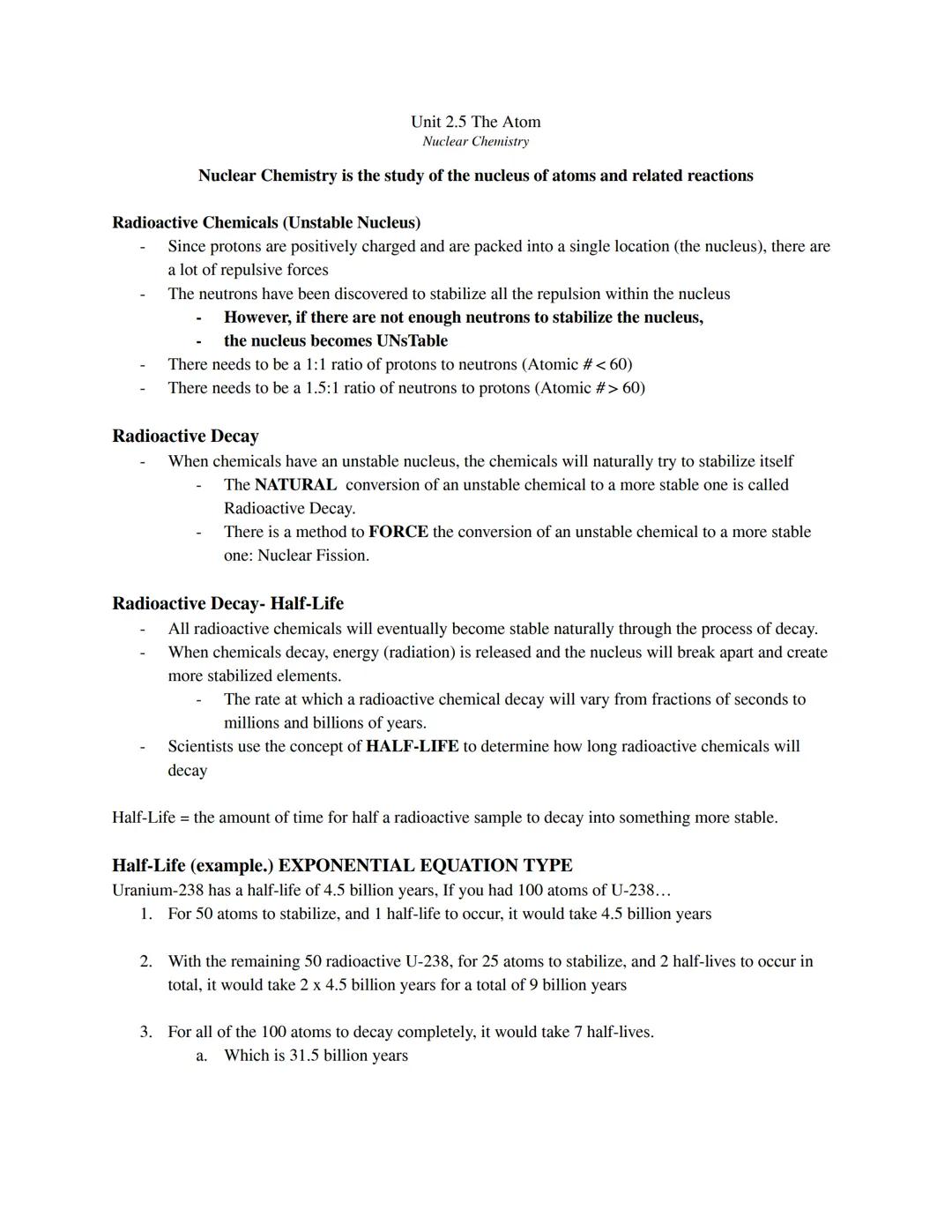
Nuclear Chemistry Fundamentals
Ever wonder what makes some atoms unstable? It all comes down to balance in the nucleus. When protons crowd together, their positive charges create strong repulsive forces that need neutrons to stabilize them. For atoms with atomic numbers below 60, a 1:1 ratio of protons to neutrons works well. Larger atoms (atomic number >60) need more help—about 1.5 neutrons for every proton.
When atoms don't have the right neutron balance, they become radioactive and undergo radioactive decay to reach stability. During this process, the unstable nucleus releases energy as radiation while transforming into more stable elements. This happens naturally, unlike nuclear fission, which is a forced conversion process.
Scientists measure radioactive decay using half-life—the time it takes for half of a radioactive sample to decay. Half-lives vary dramatically from fractions of seconds to billions of years! Take Uranium-238 with its 4.5-billion-year half-life: if you started with 100 atoms, after 4.5 billion years, you'd have 50 atoms left. After another 4.5 billion years (9 billion total), you'd have 25 atoms remaining. Complete decay would take about 7 half-lives or 31.5 billion years!
💡 Think of half-life like eating half a pizza repeatedly: first you eat half, then half of what remains, and so on. You never quite finish the whole pizza, but you get very close after several rounds!
2
of 2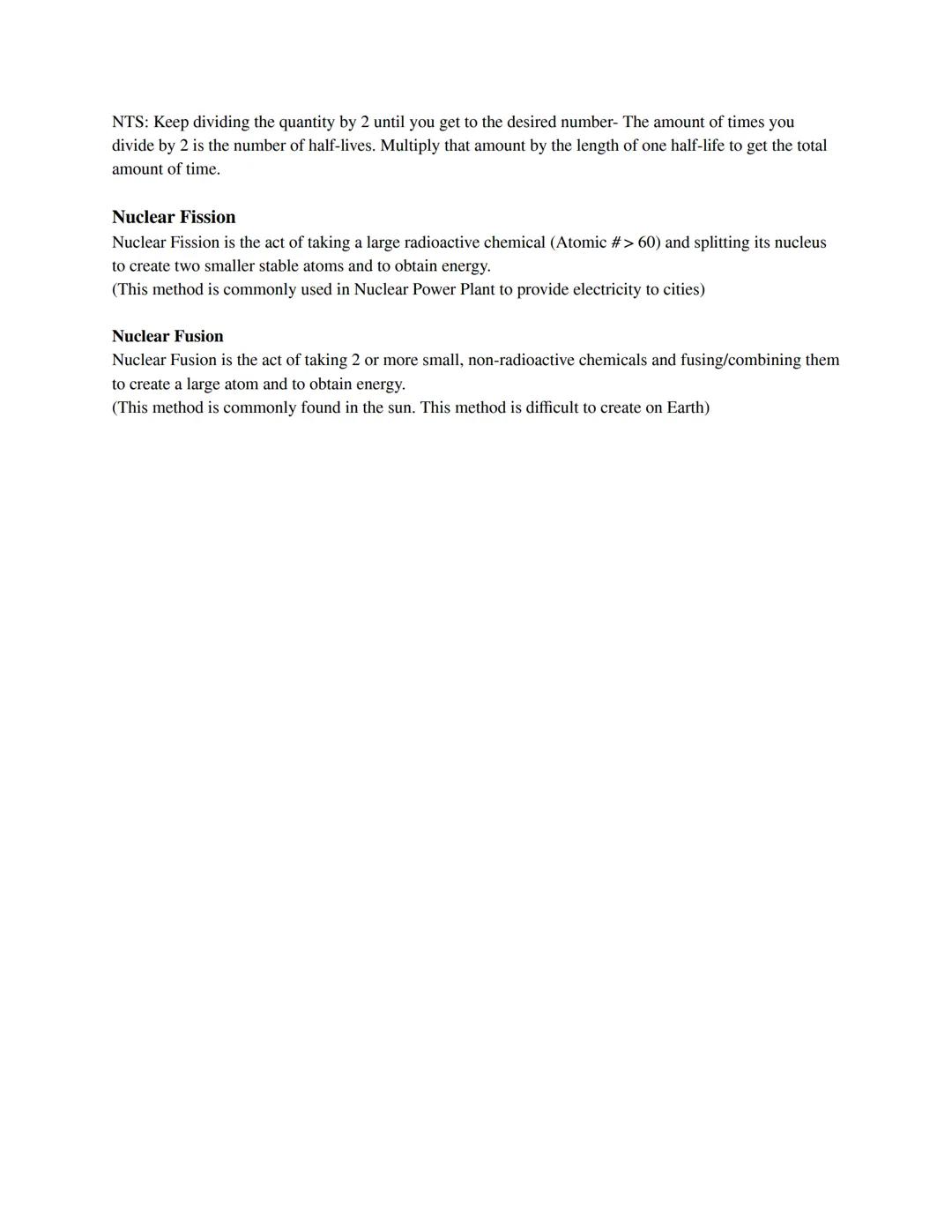
Nuclear Reactions and Energy
When calculating decay time, just keep dividing your starting quantity by 2 until you reach your target amount. The number of divisions equals the number of half-lives. Multiply this by the length of one half-life to find the total time.
Nuclear fission splits large, unstable atoms (atomic number >60) into smaller, more stable ones while releasing enormous energy. This process powers nuclear plants that generate electricity for entire cities. The controlled splitting of uranium atoms creates heat that ultimately drives turbines to produce power.
On the flip side, nuclear fusion combines small, non-radioactive atoms to form larger ones, also releasing energy. This is the sun's power source—hydrogen atoms fusing to create helium. While fusion produces clean energy without radioactive waste, scientists still struggle to create sustainable fusion reactions on Earth due to the extreme temperatures and pressures required.
🔍 Fascinating fact: The energy from nuclear fusion powers our sun, releasing more energy from a small amount of material than any chemical reaction could produce!
We thought you’d never ask...
What is the Knowunity AI companion?
Our AI companion is specifically built for the needs of students. Based on the millions of content pieces we have on the platform we can provide truly meaningful and relevant answers to students. But its not only about answers, the companion is even more about guiding students through their daily learning challenges, with personalised study plans, quizzes or content pieces in the chat and 100% personalisation based on the students skills and developments.
Where can I download the Knowunity app?
You can download the app in the Google Play Store and in the Apple App Store.
Is Knowunity really free of charge?
That's right! Enjoy free access to study content, connect with fellow students, and get instant help – all at your fingertips.
Similar Content
Most popular content in Chemistry
9Most popular content
9Can't find what you're looking for? Explore other subjects.
Students love us — and so will you.
4.6/5App Store
4.7/5Google Play
The app is very easy to use and well designed. I have found everything I was looking for so far and have been able to learn a lot from the presentations! I will definitely use the app for a class assignment! And of course it also helps a lot as an inspiration.
Stefan SiOS user
This app is really great. There are so many study notes and help [...]. My problem subject is French, for example, and the app has so many options for help. Thanks to this app, I have improved my French. I would recommend it to anyone.
Samantha KlichAndroid user
Wow, I am really amazed. I just tried the app because I've seen it advertised many times and was absolutely stunned. This app is THE HELP you want for school and above all, it offers so many things, such as workouts and fact sheets, which have been VERY helpful to me personally.
AnnaiOS user
Chemistry112 views·Updated May 29, 2026·2 pagesAn Introduction to Nuclear Chemistry
thatweebudontknow @thatweebudontknow
Nuclear chemistry explores the fascinating world of atomic nuclei and their reactions. This branch of chemistry helps us understand how unstable atoms transform naturally and how humans harness nuclear processes for energy production.
1
of 2Sign up to see the content. It's free!
- Access to all documents
- Improve your grades
- Join milions of students
Nuclear Chemistry Fundamentals
Ever wonder what makes some atoms unstable? It all comes down to balance in the nucleus. When protons crowd together, their positive charges create strong repulsive forces that need neutrons to stabilize them. For atoms with atomic numbers below 60, a 1:1 ratio of protons to neutrons works well. Larger atoms (atomic number >60) need more help—about 1.5 neutrons for every proton.
When atoms don't have the right neutron balance, they become radioactive and undergo radioactive decay to reach stability. During this process, the unstable nucleus releases energy as radiation while transforming into more stable elements. This happens naturally, unlike nuclear fission, which is a forced conversion process.
Scientists measure radioactive decay using half-life—the time it takes for half of a radioactive sample to decay. Half-lives vary dramatically from fractions of seconds to billions of years! Take Uranium-238 with its 4.5-billion-year half-life: if you started with 100 atoms, after 4.5 billion years, you'd have 50 atoms left. After another 4.5 billion years (9 billion total), you'd have 25 atoms remaining. Complete decay would take about 7 half-lives or 31.5 billion years!
💡 Think of half-life like eating half a pizza repeatedly: first you eat half, then half of what remains, and so on. You never quite finish the whole pizza, but you get very close after several rounds!
2
of 2Sign up to see the content. It's free!
- Access to all documents
- Improve your grades
- Join milions of students
Nuclear Reactions and Energy
When calculating decay time, just keep dividing your starting quantity by 2 until you reach your target amount. The number of divisions equals the number of half-lives. Multiply this by the length of one half-life to find the total time.
Nuclear fission splits large, unstable atoms (atomic number >60) into smaller, more stable ones while releasing enormous energy. This process powers nuclear plants that generate electricity for entire cities. The controlled splitting of uranium atoms creates heat that ultimately drives turbines to produce power.
On the flip side, nuclear fusion combines small, non-radioactive atoms to form larger ones, also releasing energy. This is the sun's power source—hydrogen atoms fusing to create helium. While fusion produces clean energy without radioactive waste, scientists still struggle to create sustainable fusion reactions on Earth due to the extreme temperatures and pressures required.
🔍 Fascinating fact: The energy from nuclear fusion powers our sun, releasing more energy from a small amount of material than any chemical reaction could produce!
We thought you’d never ask...
What is the Knowunity AI companion?
Our AI companion is specifically built for the needs of students. Based on the millions of content pieces we have on the platform we can provide truly meaningful and relevant answers to students. But its not only about answers, the companion is even more about guiding students through their daily learning challenges, with personalised study plans, quizzes or content pieces in the chat and 100% personalisation based on the students skills and developments.
Where can I download the Knowunity app?
You can download the app in the Google Play Store and in the Apple App Store.
Is Knowunity really free of charge?
That's right! Enjoy free access to study content, connect with fellow students, and get instant help – all at your fingertips.
Similar Content
Most popular content in Chemistry
9Most popular content
9Can't find what you're looking for? Explore other subjects.
Students love us — and so will you.
4.6/5App Store
4.7/5Google Play
The app is very easy to use and well designed. I have found everything I was looking for so far and have been able to learn a lot from the presentations! I will definitely use the app for a class assignment! And of course it also helps a lot as an inspiration.
Stefan SiOS user
This app is really great. There are so many study notes and help [...]. My problem subject is French, for example, and the app has so many options for help. Thanks to this app, I have improved my French. I would recommend it to anyone.
Samantha KlichAndroid user
Wow, I am really amazed. I just tried the app because I've seen it advertised many times and was absolutely stunned. This app is THE HELP you want for school and above all, it offers so many things, such as workouts and fact sheets, which have been VERY helpful to me personally.
AnnaiOS user