
Chemistry is the study of everything around us, often called... Show more
 Chemistry51 views·Updated Jun 2, 2026·2 pages
Basics of Chemistry: A Beginner's Guide

Evana Labban@evanalabban_ltlg
1
of 2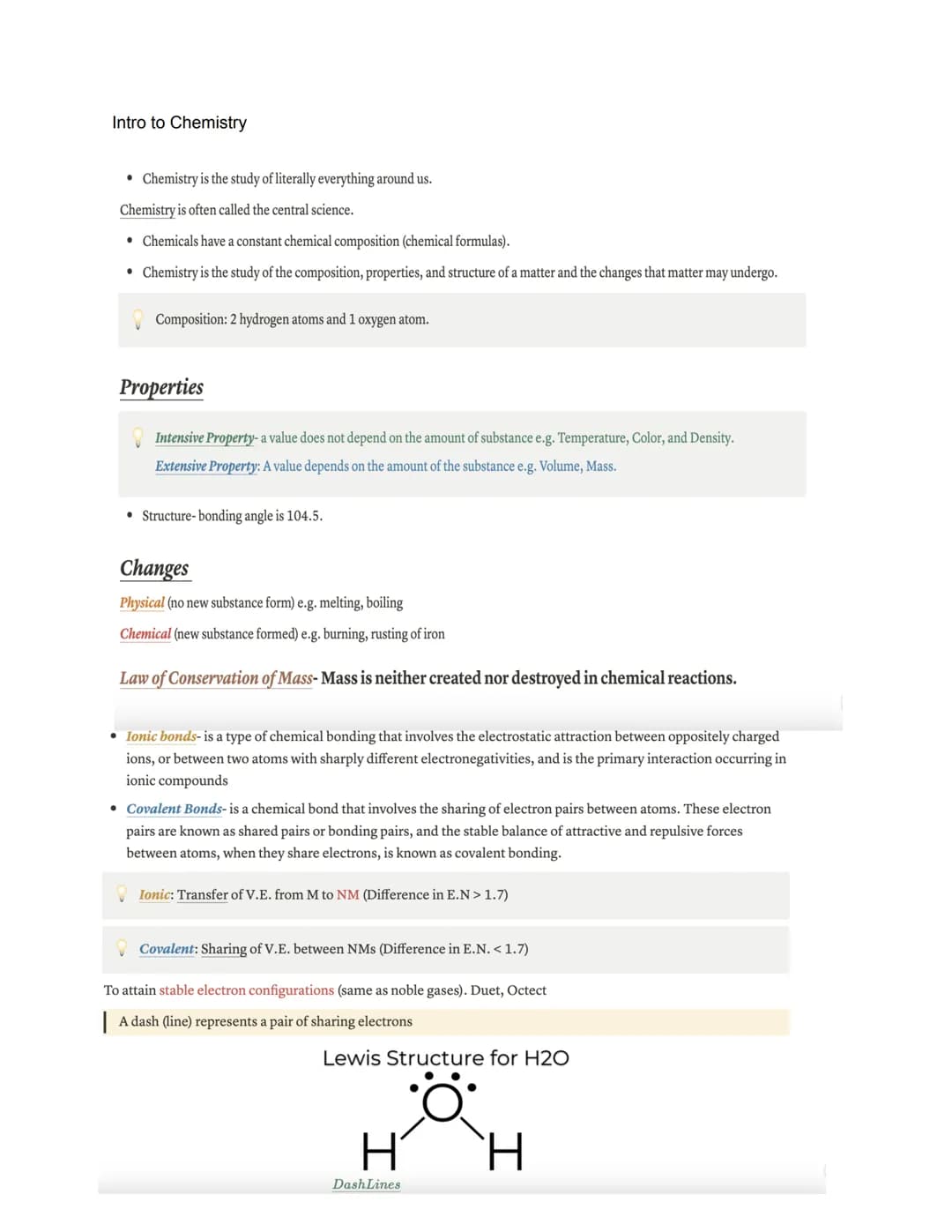
Introduction to Chemistry
Chemistry investigates the building blocks of our universe! It focuses on chemicals which have constant compositions represented by chemical formulas. When studying any substance, chemists look at three main aspects: composition (what it's made of), properties (how it behaves), and structure (how it's arranged).
Properties come in two types: intensive properties don't depend on the amount of substance (like temperature or color), while extensive properties change with the amount (like volume or mass). Matter can undergo changes too - physical changes like ice melting don't create new substances, but chemical changes like iron rusting produce completely new materials.
One fundamental principle in chemistry is the Law of Conservation of Mass - mass cannot be created or destroyed in chemical reactions, it just changes form. Chemical bonds hold atoms together, with ionic bonds forming through electrostatic attraction between oppositely charged ions, and covalent bonds forming when atoms share electron pairs.
Try This! Draw the Lewis structure for water (H₂O) on your own. Remember that oxygen needs 8 electrons to be stable, while each hydrogen needs 2. How many shared electron pairs (bonds) will form?
2
of 2
Chemical Bonding Basics
Chemical bonds form because atoms want to achieve stable electron configurations like those of noble gases. This stability typically means having 8 electrons in the outer shell (the octet rule) or 2 electrons for smaller atoms (the duet rule). When atoms bond, they either share or transfer electrons to reach this stability.
In ionic bonding, electrons transfer completely from metals to non-metals when their electronegativity difference is greater than 1.7. For example, calcium (Ca) gives up two electrons to become Ca²⁺, while chlorine atoms (Cl) each gain one electron to become Cl⁻ ions. The resulting formula is CaCl₂, with the subscript 2 indicating two chlorine atoms.
Covalent bonding occurs when the electronegativity difference between atoms is less than 1.7. These bonds involve non-metals sharing electron pairs, represented in Lewis structures as dash lines between atoms. Each dash represents two shared electrons that count toward both atoms' stable configurations.
Remember: Metals form positive ions (cations), while non-metals form negative ions (anions). The strong electrostatic attraction between these oppositely charged ions creates ionic bonds.
We thought you’d never ask...
What is the Knowunity AI companion?
Our AI companion is specifically built for the needs of students. Based on the millions of content pieces we have on the platform we can provide truly meaningful and relevant answers to students. But its not only about answers, the companion is even more about guiding students through their daily learning challenges, with personalised study plans, quizzes or content pieces in the chat and 100% personalisation based on the students skills and developments.
Where can I download the Knowunity app?
You can download the app in the Google Play Store and in the Apple App Store.
Is Knowunity really free of charge?
That's right! Enjoy free access to study content, connect with fellow students, and get instant help – all at your fingertips.
Similar Content
Most popular content in Chemistry
9Most popular content
9Can't find what you're looking for? Explore other subjects.
Students love us — and so will you.
4.6/5App Store
4.7/5Google Play
The app is very easy to use and well designed. I have found everything I was looking for so far and have been able to learn a lot from the presentations! I will definitely use the app for a class assignment! And of course it also helps a lot as an inspiration.
Stefan SiOS user
This app is really great. There are so many study notes and help [...]. My problem subject is French, for example, and the app has so many options for help. Thanks to this app, I have improved my French. I would recommend it to anyone.
Samantha KlichAndroid user
Wow, I am really amazed. I just tried the app because I've seen it advertised many times and was absolutely stunned. This app is THE HELP you want for school and above all, it offers so many things, such as workouts and fact sheets, which have been VERY helpful to me personally.
AnnaiOS user
Chemistry51 views·Updated Jun 2, 2026·2 pagesBasics of Chemistry: A Beginner's Guide
Evana Labban@evanalabban_ltlg
Chemistry is the study of everything around us, often called the central science because it connects to all other sciences. It explores the composition, properties, and structure of matter, along with the changes matter undergoes. Understanding chemistry helps explain why... Show more
1
of 2Sign up to see the content. It's free!
- Access to all documents
- Improve your grades
- Join milions of students
Introduction to Chemistry
Chemistry investigates the building blocks of our universe! It focuses on chemicals which have constant compositions represented by chemical formulas. When studying any substance, chemists look at three main aspects: composition (what it's made of), properties (how it behaves), and structure (how it's arranged).
Properties come in two types: intensive properties don't depend on the amount of substance (like temperature or color), while extensive properties change with the amount (like volume or mass). Matter can undergo changes too - physical changes like ice melting don't create new substances, but chemical changes like iron rusting produce completely new materials.
One fundamental principle in chemistry is the Law of Conservation of Mass - mass cannot be created or destroyed in chemical reactions, it just changes form. Chemical bonds hold atoms together, with ionic bonds forming through electrostatic attraction between oppositely charged ions, and covalent bonds forming when atoms share electron pairs.
Try This! Draw the Lewis structure for water (H₂O) on your own. Remember that oxygen needs 8 electrons to be stable, while each hydrogen needs 2. How many shared electron pairs (bonds) will form?
2
of 2Sign up to see the content. It's free!
- Access to all documents
- Improve your grades
- Join milions of students
Chemical Bonding Basics
Chemical bonds form because atoms want to achieve stable electron configurations like those of noble gases. This stability typically means having 8 electrons in the outer shell (the octet rule) or 2 electrons for smaller atoms (the duet rule). When atoms bond, they either share or transfer electrons to reach this stability.
In ionic bonding, electrons transfer completely from metals to non-metals when their electronegativity difference is greater than 1.7. For example, calcium (Ca) gives up two electrons to become Ca²⁺, while chlorine atoms (Cl) each gain one electron to become Cl⁻ ions. The resulting formula is CaCl₂, with the subscript 2 indicating two chlorine atoms.
Covalent bonding occurs when the electronegativity difference between atoms is less than 1.7. These bonds involve non-metals sharing electron pairs, represented in Lewis structures as dash lines between atoms. Each dash represents two shared electrons that count toward both atoms' stable configurations.
Remember: Metals form positive ions (cations), while non-metals form negative ions (anions). The strong electrostatic attraction between these oppositely charged ions creates ionic bonds.
We thought you’d never ask...
What is the Knowunity AI companion?
Our AI companion is specifically built for the needs of students. Based on the millions of content pieces we have on the platform we can provide truly meaningful and relevant answers to students. But its not only about answers, the companion is even more about guiding students through their daily learning challenges, with personalised study plans, quizzes or content pieces in the chat and 100% personalisation based on the students skills and developments.
Where can I download the Knowunity app?
You can download the app in the Google Play Store and in the Apple App Store.
Is Knowunity really free of charge?
That's right! Enjoy free access to study content, connect with fellow students, and get instant help – all at your fingertips.
Similar Content
Most popular content in Chemistry
9Most popular content
9Can't find what you're looking for? Explore other subjects.
Students love us — and so will you.
4.6/5App Store
4.7/5Google Play
The app is very easy to use and well designed. I have found everything I was looking for so far and have been able to learn a lot from the presentations! I will definitely use the app for a class assignment! And of course it also helps a lot as an inspiration.
Stefan SiOS user
This app is really great. There are so many study notes and help [...]. My problem subject is French, for example, and the app has so many options for help. Thanks to this app, I have improved my French. I would recommend it to anyone.
Samantha KlichAndroid user
Wow, I am really amazed. I just tried the app because I've seen it advertised many times and was absolutely stunned. This app is THE HELP you want for school and above all, it offers so many things, such as workouts and fact sheets, which have been VERY helpful to me personally.
AnnaiOS user