
John Dalton's atomic theoryrevolutionized our understanding of matter at... Show more
 Chemistry214 views·Updated May 24, 2026·3 pages
Discover Atoms, Isotopes, and John Dalton's Atomic Theory for Class 9 & 11

Keara Fish@kearafish4


1 / 3
1
of 3
Properties of Subatomic Particles and Isotopes
This page delves deeper into the properties and structure of subatomic particles, providing a detailed table comparing their relative masses and charges. It also introduces the concept of isotopes and explains the structure of the nucleus and electron orbitals.
Isotopes are defined as species of an element with the same atomic number and chemical behavior but different atomic masses due to varying numbers of neutrons. The page emphasizes the importance of the nucleus as the tiny central core of an atom composed of protons and neutrons.
The atomic number and mass number are introduced as key concepts for distinguishing between atoms:
- Atomic number: The number of protons in the nucleus of an atom
- Mass number: The total number of protons and neutrons in an atom
Example: The atomic symbol for hydrogen (¹H) shows its atomic number (1) and mass number (1).
Definition: Isotopes are atoms of the same element with different numbers of neutrons but the same number of protons.
Highlight: The number of neutrons in an atom can be calculated by subtracting the atomic number from the mass number.
2
of 3
Atoms of the First 10 Elements and Natural Abundance
This page provides a comprehensive table of the first 10 elements in the periodic table, listing their names, symbols, atomic numbers, and the number of protons, neutrons, and electrons in their most common isotopes. This information is crucial for understanding the properties and structure of subatomic particles in different elements.
The concept of natural abundance and isotopes of elements is introduced with a table showing the relative abundance of stable isotopes for common elements like hydrogen, carbon, nitrogen, and oxygen. This information is vital for understanding isotopic composition in nature and its applications in various scientific fields.
Example: Carbon has two main stable isotopes: Carbon-12 (98.89% abundance) and Carbon-13 (1.11% abundance).
Highlight: The natural abundance of isotopes can vary slightly in different environments, which is useful for tracing the origin of materials in geology and environmental science.
Vocabulary: Natural abundance refers to the relative proportion of different isotopes of an element as they occur in nature.
3
of 3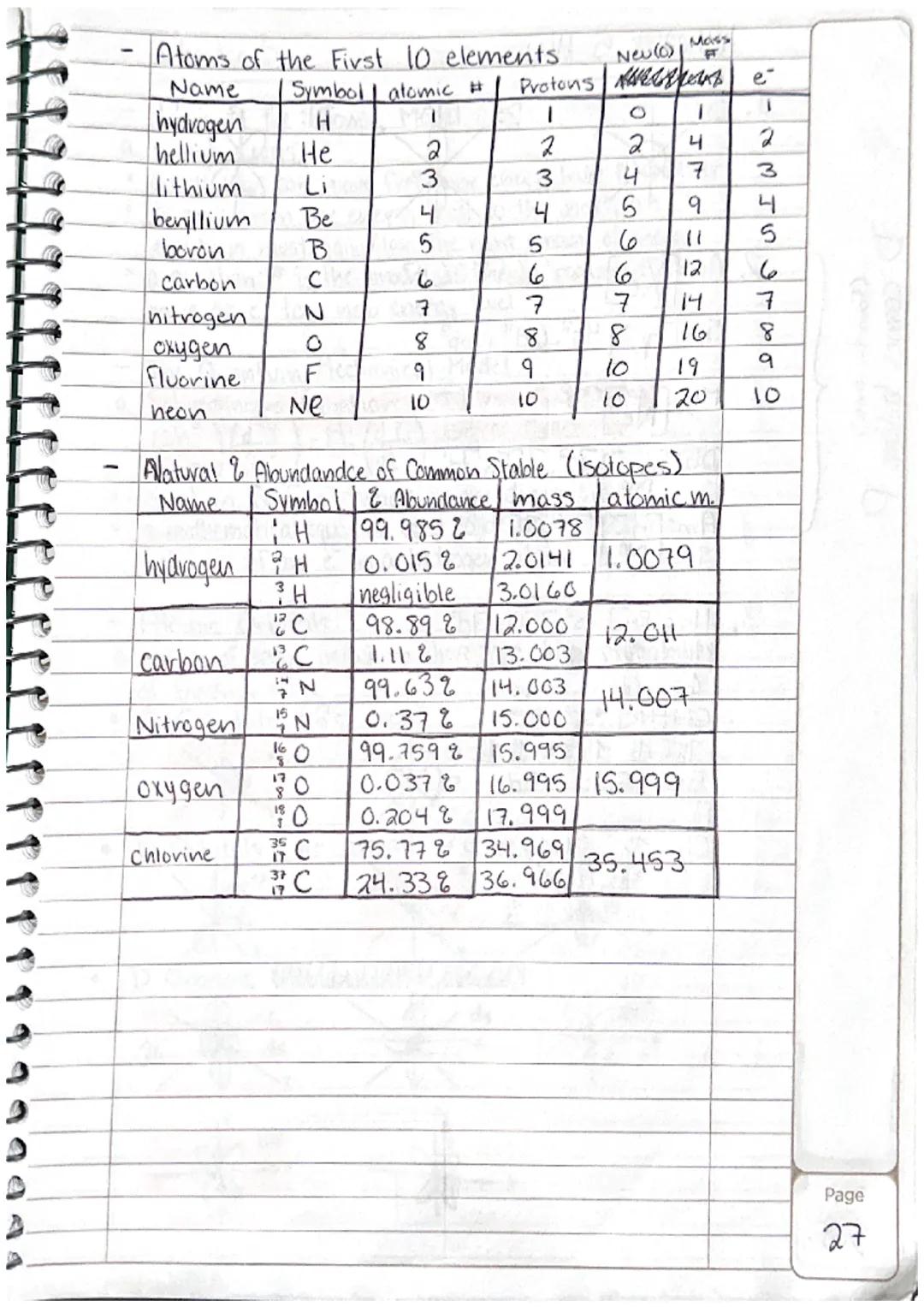
Dalton's Atomic Theory and Atomic Structure
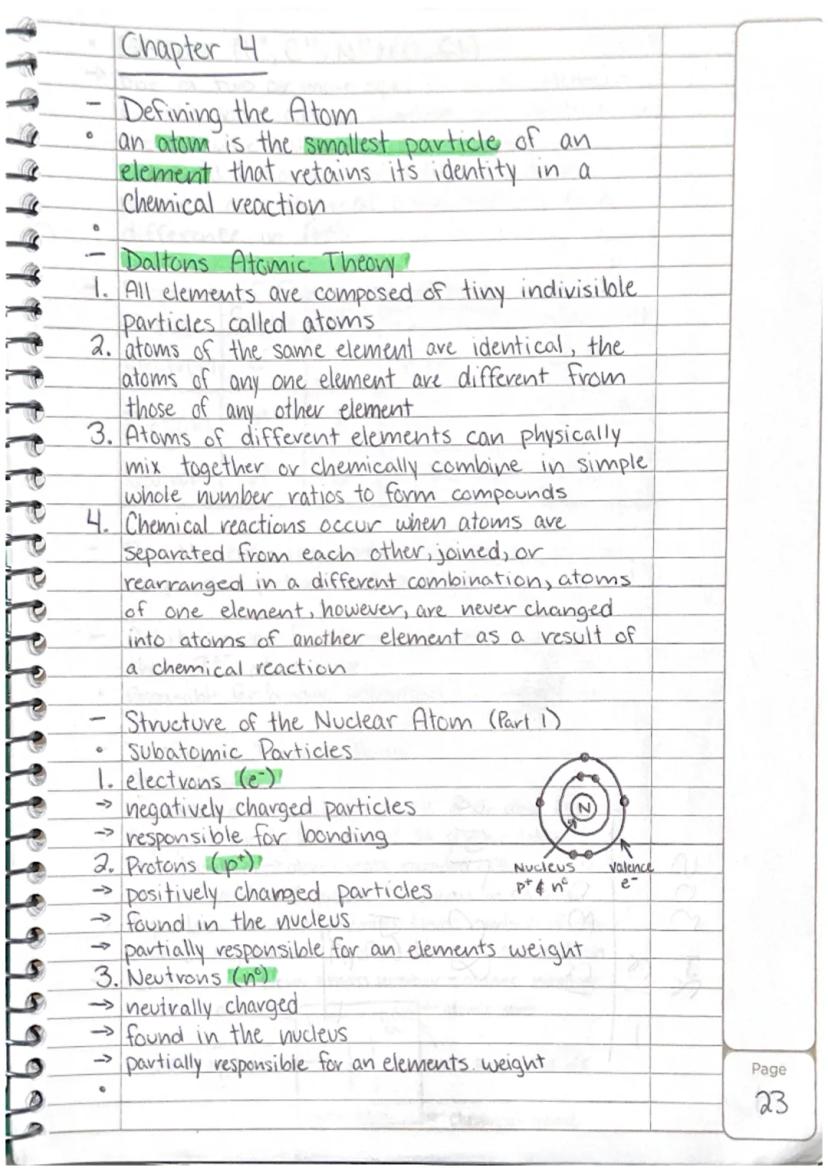
This page introduces John Dalton's atomic theory and the basic structure of atoms. Dalton proposed that all elements are composed of tiny, indivisible particles called atoms. He stated that atoms of the same element are identical, while atoms of different elements have distinct properties. According to Dalton, chemical reactions occur when atoms are separated, joined, or rearranged, but atoms themselves are not changed into other elements during reactions.
The modern definition of an atom is provided as the smallest particle of an element that retains its identity in a chemical reaction. The page then describes the structure of the nuclear atom, introducing the three main subatomic particles:
- Electrons: Negatively charged particles responsible for bonding
- Protons: Positively charged particles found in the nucleus
- Neutrons: Neutrally charged particles found in the nucleus
Definition: An atom is the smallest particle of an element that retains its identity in a chemical reaction.
Highlight: The nucleus contains protons and neutrons, while electrons orbit around it in energy levels called shells.
Vocabulary: Valence electrons are the outermost electrons of an atom, which are involved in chemical bonding.
We thought you’d never ask...
What is the Knowunity AI companion?
Our AI companion is specifically built for the needs of students. Based on the millions of content pieces we have on the platform we can provide truly meaningful and relevant answers to students. But its not only about answers, the companion is even more about guiding students through their daily learning challenges, with personalised study plans, quizzes or content pieces in the chat and 100% personalisation based on the students skills and developments.
Where can I download the Knowunity app?
You can download the app in the Google Play Store and in the Apple App Store.
Is Knowunity really free of charge?
That's right! Enjoy free access to study content, connect with fellow students, and get instant help – all at your fingertips.
Similar Content
Most popular content in Chemistry
9Most popular content
9Can't find what you're looking for? Explore other subjects.
Students love us — and so will you.
4.6/5App Store
4.7/5Google Play
The app is very easy to use and well designed. I have found everything I was looking for so far and have been able to learn a lot from the presentations! I will definitely use the app for a class assignment! And of course it also helps a lot as an inspiration.
Stefan SiOS user
This app is really great. There are so many study notes and help [...]. My problem subject is French, for example, and the app has so many options for help. Thanks to this app, I have improved my French. I would recommend it to anyone.
Samantha KlichAndroid user
Wow, I am really amazed. I just tried the app because I've seen it advertised many times and was absolutely stunned. This app is THE HELP you want for school and above all, it offers so many things, such as workouts and fact sheets, which have been VERY helpful to me personally.
AnnaiOS user
Chemistry214 views·Updated May 24, 2026·3 pagesDiscover Atoms, Isotopes, and John Dalton's Atomic Theory for Class 9 & 11
Keara Fish@kearafish4
John Dalton's atomic theory revolutionized our understanding of matter at the atomic level. This summary explores key concepts including the structure of atoms, subatomic particles, isotopes, and natural abundance.
- Dalton proposed that all elements are made of indivisible atoms
- Atoms... Show more
1
of 3Sign up to see the content. It's free!
- Access to all documents
- Improve your grades
- Join milions of students
Properties of Subatomic Particles and Isotopes
This page delves deeper into the properties and structure of subatomic particles, providing a detailed table comparing their relative masses and charges. It also introduces the concept of isotopes and explains the structure of the nucleus and electron orbitals.
Isotopes are defined as species of an element with the same atomic number and chemical behavior but different atomic masses due to varying numbers of neutrons. The page emphasizes the importance of the nucleus as the tiny central core of an atom composed of protons and neutrons.
The atomic number and mass number are introduced as key concepts for distinguishing between atoms:
- Atomic number: The number of protons in the nucleus of an atom
- Mass number: The total number of protons and neutrons in an atom
Example: The atomic symbol for hydrogen (¹H) shows its atomic number (1) and mass number (1).
Definition: Isotopes are atoms of the same element with different numbers of neutrons but the same number of protons.
Highlight: The number of neutrons in an atom can be calculated by subtracting the atomic number from the mass number.
2
of 3Sign up to see the content. It's free!
- Access to all documents
- Improve your grades
- Join milions of students
Atoms of the First 10 Elements and Natural Abundance
This page provides a comprehensive table of the first 10 elements in the periodic table, listing their names, symbols, atomic numbers, and the number of protons, neutrons, and electrons in their most common isotopes. This information is crucial for understanding the properties and structure of subatomic particles in different elements.
The concept of natural abundance and isotopes of elements is introduced with a table showing the relative abundance of stable isotopes for common elements like hydrogen, carbon, nitrogen, and oxygen. This information is vital for understanding isotopic composition in nature and its applications in various scientific fields.
Example: Carbon has two main stable isotopes: Carbon-12 (98.89% abundance) and Carbon-13 (1.11% abundance).
Highlight: The natural abundance of isotopes can vary slightly in different environments, which is useful for tracing the origin of materials in geology and environmental science.
Vocabulary: Natural abundance refers to the relative proportion of different isotopes of an element as they occur in nature.
3
of 3Sign up to see the content. It's free!
- Access to all documents
- Improve your grades
- Join milions of students
Dalton's Atomic Theory and Atomic Structure
This page introduces John Dalton's atomic theory and the basic structure of atoms. Dalton proposed that all elements are composed of tiny, indivisible particles called atoms. He stated that atoms of the same element are identical, while atoms of different elements have distinct properties. According to Dalton, chemical reactions occur when atoms are separated, joined, or rearranged, but atoms themselves are not changed into other elements during reactions.
The modern definition of an atom is provided as the smallest particle of an element that retains its identity in a chemical reaction. The page then describes the structure of the nuclear atom, introducing the three main subatomic particles:
- Electrons: Negatively charged particles responsible for bonding
- Protons: Positively charged particles found in the nucleus
- Neutrons: Neutrally charged particles found in the nucleus
Definition: An atom is the smallest particle of an element that retains its identity in a chemical reaction.
Highlight: The nucleus contains protons and neutrons, while electrons orbit around it in energy levels called shells.
Vocabulary: Valence electrons are the outermost electrons of an atom, which are involved in chemical bonding.
We thought you’d never ask...
What is the Knowunity AI companion?
Our AI companion is specifically built for the needs of students. Based on the millions of content pieces we have on the platform we can provide truly meaningful and relevant answers to students. But its not only about answers, the companion is even more about guiding students through their daily learning challenges, with personalised study plans, quizzes or content pieces in the chat and 100% personalisation based on the students skills and developments.
Where can I download the Knowunity app?
You can download the app in the Google Play Store and in the Apple App Store.
Is Knowunity really free of charge?
That's right! Enjoy free access to study content, connect with fellow students, and get instant help – all at your fingertips.
Similar Content
Most popular content in Chemistry
9Most popular content
9Can't find what you're looking for? Explore other subjects.
Students love us — and so will you.
4.6/5App Store
4.7/5Google Play
The app is very easy to use and well designed. I have found everything I was looking for so far and have been able to learn a lot from the presentations! I will definitely use the app for a class assignment! And of course it also helps a lot as an inspiration.
Stefan SiOS user
This app is really great. There are so many study notes and help [...]. My problem subject is French, for example, and the app has so many options for help. Thanks to this app, I have improved my French. I would recommend it to anyone.
Samantha KlichAndroid user
Wow, I am really amazed. I just tried the app because I've seen it advertised many times and was absolutely stunned. This app is THE HELP you want for school and above all, it offers so many things, such as workouts and fact sheets, which have been VERY helpful to me personally.
AnnaiOS user