
Aromatic compounds are a fascinating group of organic molecules that... Show more
 Chemistry36 views·Updated May 27, 2026·40 pages
Understanding Aromatic Compounds: Structures, Rules, and Examples

Benjamin Arguelles@benjaminarguelles_ysur
1 / 10
1
of 10
Aromatic Compounds
Aromatic compounds are a special class of organic molecules with unique stability and reactivity patterns. They're called "aromatic" because many of these compounds have pleasant smells, though this name was given before their structure was fully understood.
These compounds contain rings with delocalized electrons that give them unusual chemical properties. Unlike typical hydrocarbons, aromatic compounds resist certain reactions that would normally disrupt carbon-carbon double bonds.
You'll find aromatic compounds everywhere in your daily life - from medicines and plastics to natural products and fuels. Their unique structure makes them essential building blocks in chemistry.
2
of 10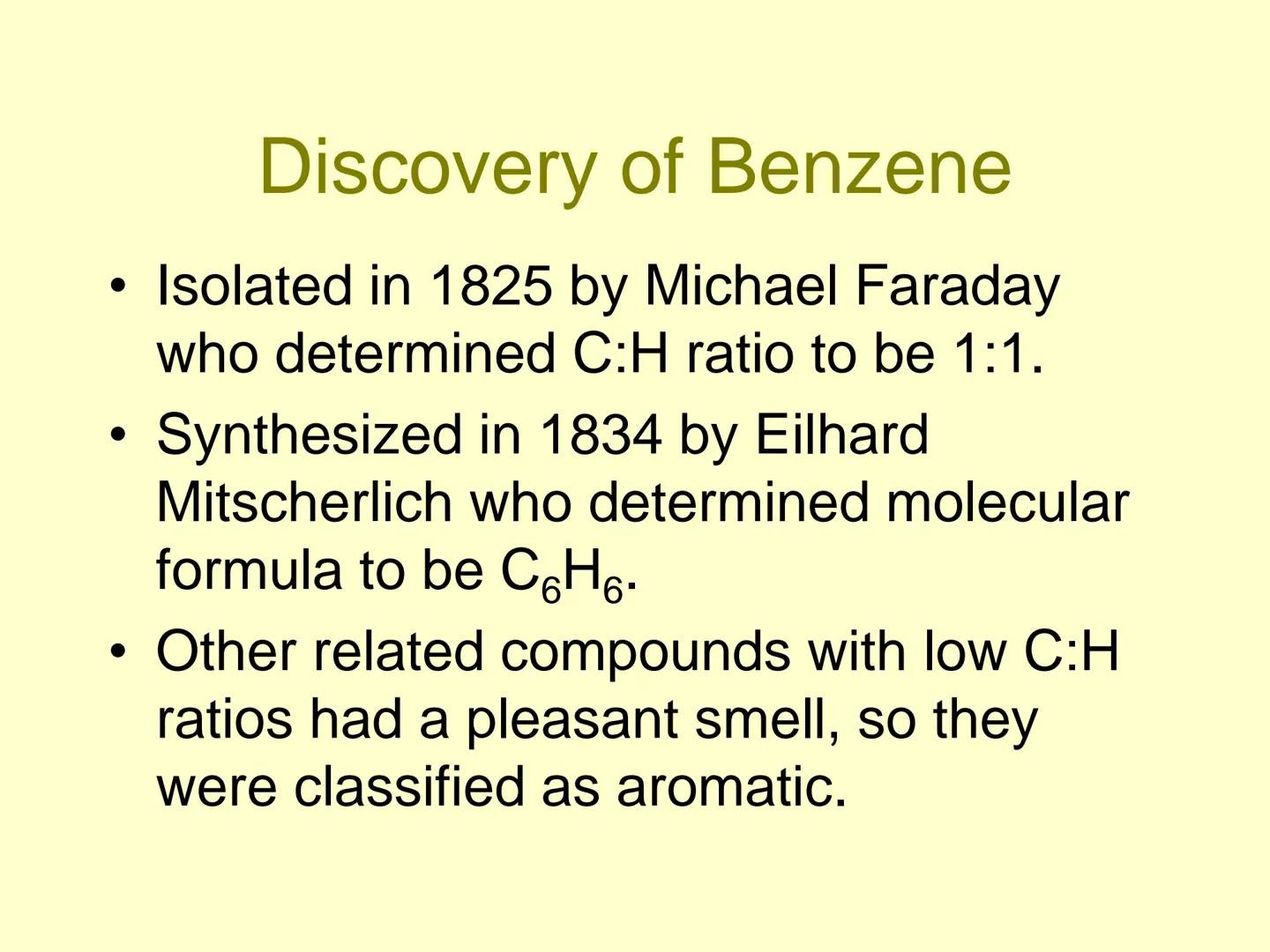
Discovery of Benzene
Benzene, the simplest aromatic compound, was first isolated in 1825 by Michael Faraday who determined it had a carbon-to-hydrogen ratio of 1:1. This was unusual compared to other known hydrocarbons at the time.
In 1834, scientist Eilhard Mitscherlich took things further by synthesizing benzene and determining its molecular formula to be C₆H₆. This formula suggested something strange - benzene had far fewer hydrogen atoms than expected for a compound with six carbon atoms.
Scientists noticed that benzene and related compounds with similar low C:H ratios often had pleasant smells. This observation led to the classification of these compounds as "aromatic," a term that stuck even after we learned more about their true structure.
Did you know? The term "aromatic" has nothing to do with the actual structure of these compounds - it was based solely on their pleasant smell, but today it describes a specific chemical arrangement!
3
of 10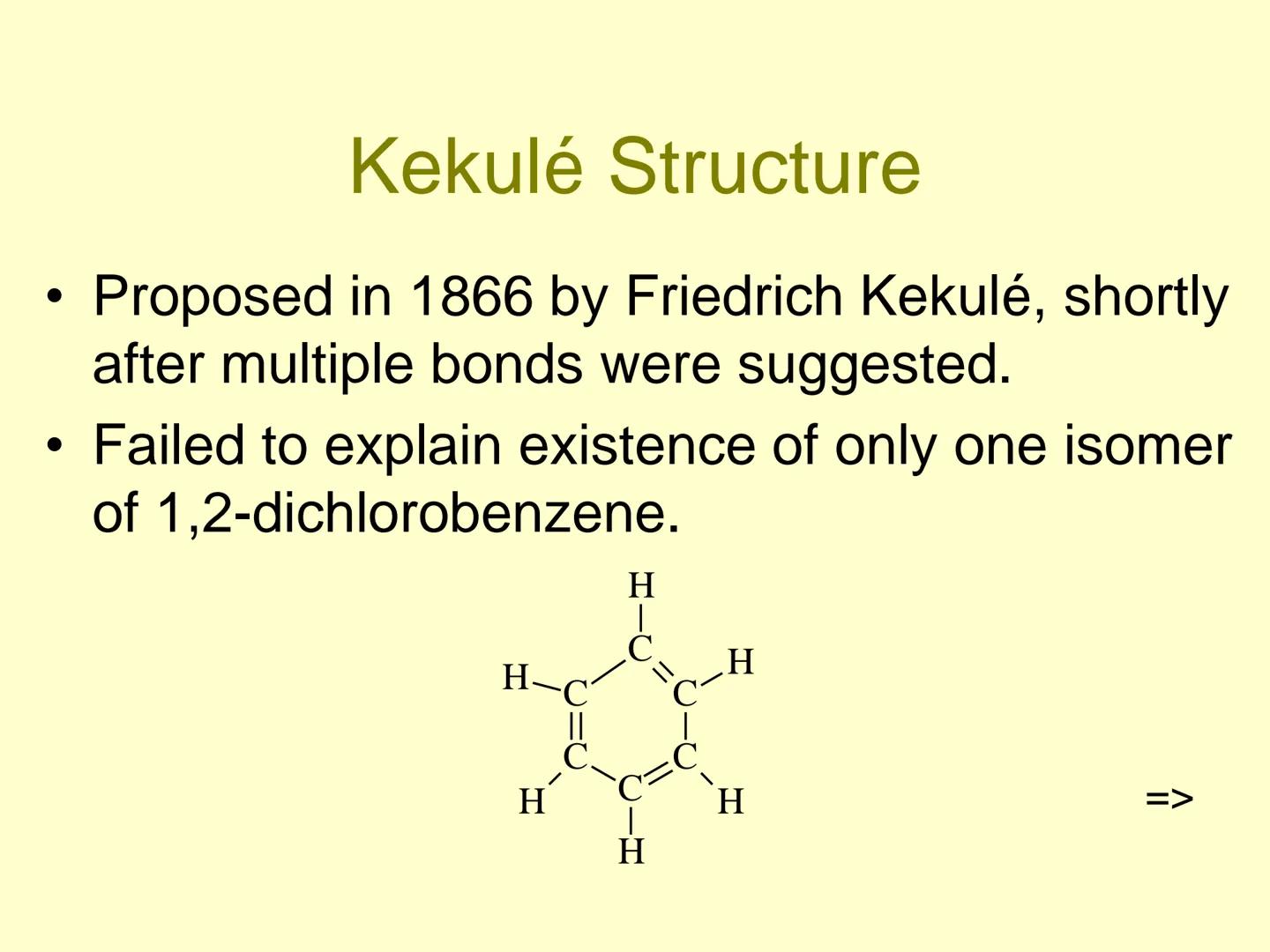
Kekulé Structure
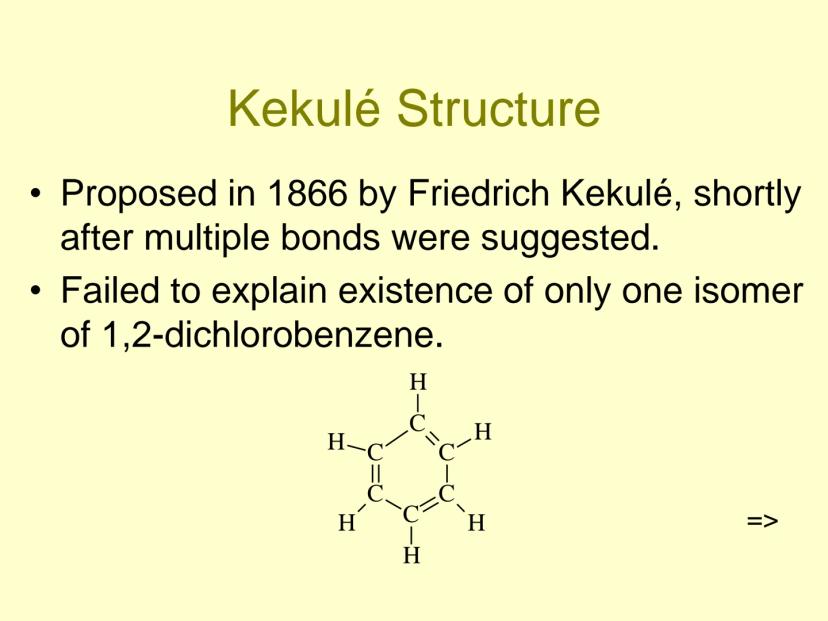
In 1866, Friedrich Kekulé proposed a groundbreaking structure for benzene shortly after the concept of multiple bonds was introduced to chemistry. His model showed benzene as a six-carbon ring with alternating single and double bonds.
Kekulé's structure was revolutionary but had problems. Most importantly, it failed to explain why there's only one isomer of 1,2-dichlorobenzene. If benzene truly had three distinct double bonds, we should see different isomers depending on which double bond the chlorine atoms attached to.
The Kekulé structure represented an important step in understanding aromatic compounds, but chemists would soon discover that benzene's true nature was even more fascinating.
4
of 10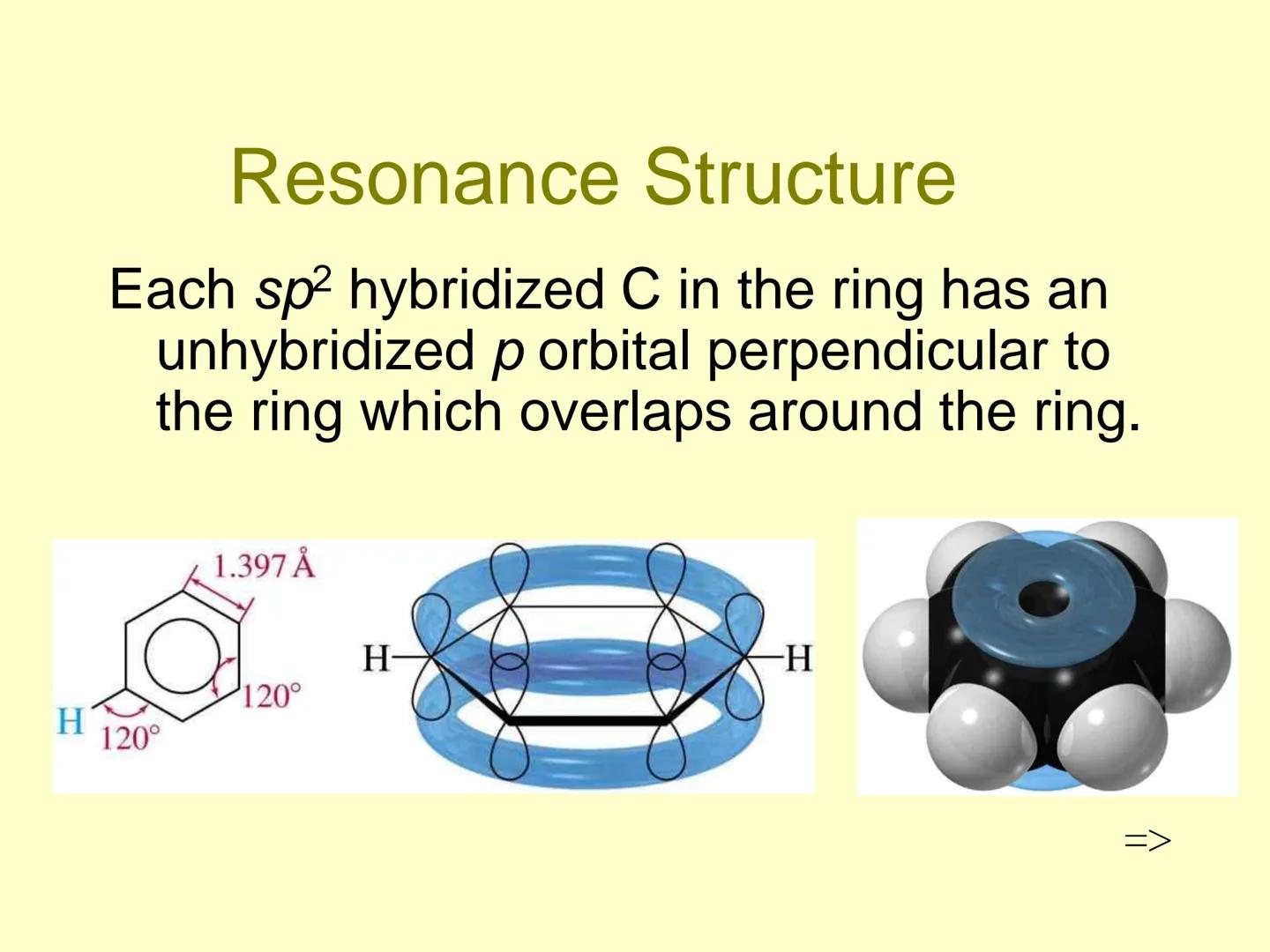
Resonance Structure
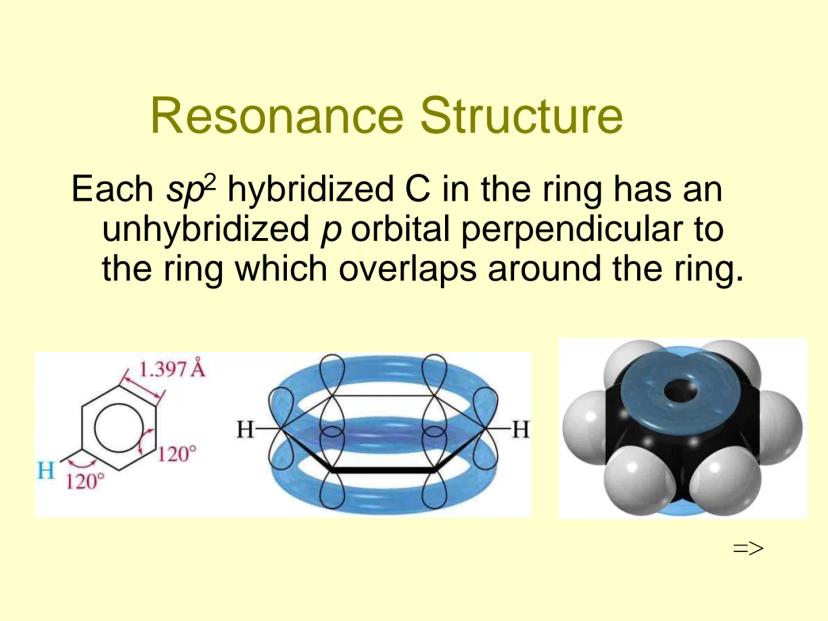
Benzene's true structure involves a concept called resonance, which explains its unusual stability and reactivity. Each carbon atom in the benzene ring is sp² hybridized and has an unhybridized p orbital perpendicular to the ring.
These p orbitals overlap continuously around the ring, creating a donut-shaped cloud of electrons above and below the plane of the molecule. This electron delocalization is what gives benzene its special properties.
In the benzene ring, all carbon-carbon bonds have the same length (1.397 Å), and all bond angles are 120°. This uniformity wouldn't exist if benzene had alternating single and double bonds as Kekulé proposed.
Chemistry Insight: Think of benzene's electrons like kids on a circular playground - they don't stay in one place but move freely around the entire structure, making the whole molecule more stable!
5
of 10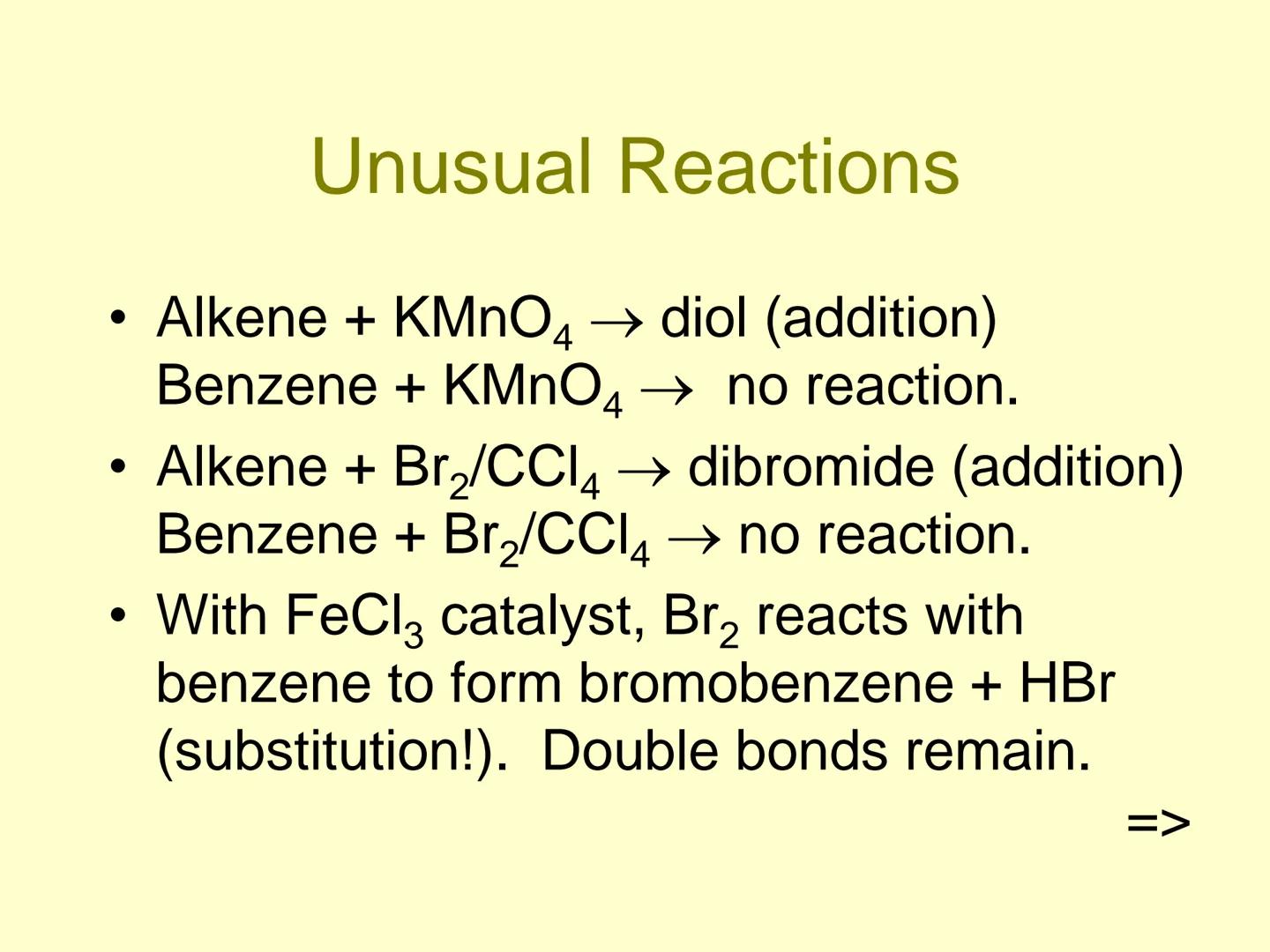
Unusual Reactions
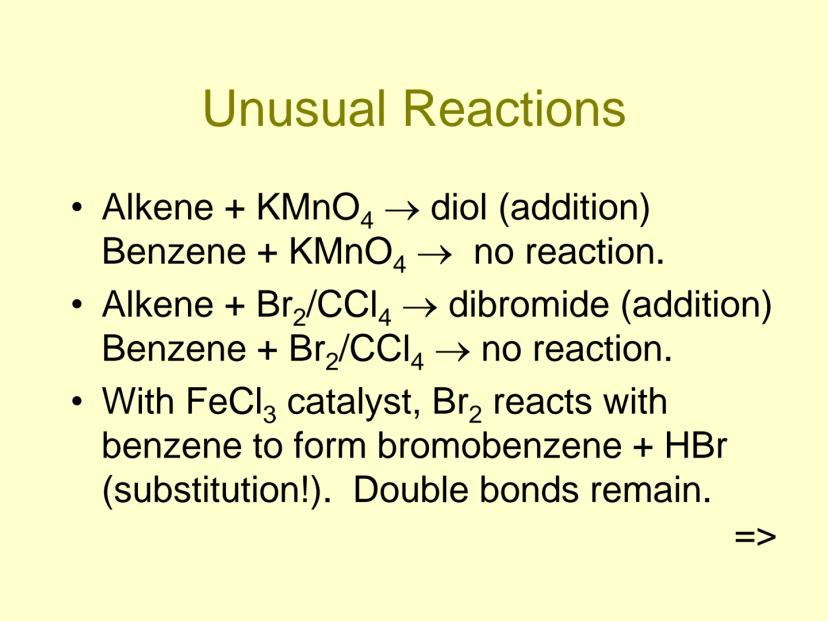
Aromatic compounds don't react like typical alkenes, which helps us identify them. When alkenes react with potassium permanganate (KMnO₄), they form diols through addition reactions - but benzene shows no reaction with KMnO₄.
Similarly, alkenes readily react with bromine (Br₂) in carbon tetrachloride (CCl₄) to form dibromides through addition reactions. Benzene, however, shows no reaction under these conditions.
Benzene does react with bromine, but only when iron(III) chloride (FeCl₃) catalyst is present. Instead of addition, benzene undergoes substitution to form bromobenzene plus hydrogen bromide, while keeping its double bonds intact. This substitution (rather than addition) reaction is a telltale sign of aromatic character.
6
of 10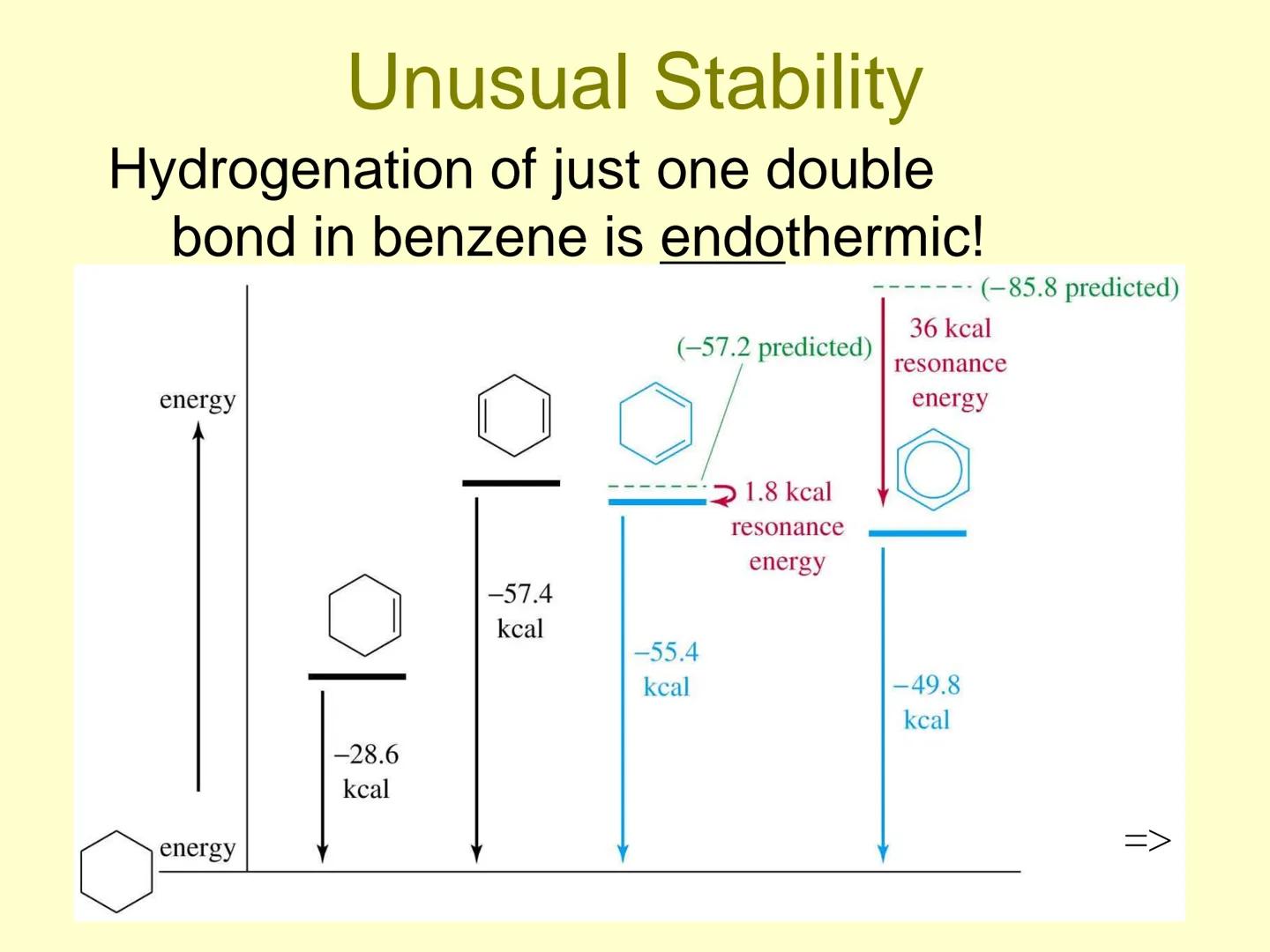
Unusual Stability
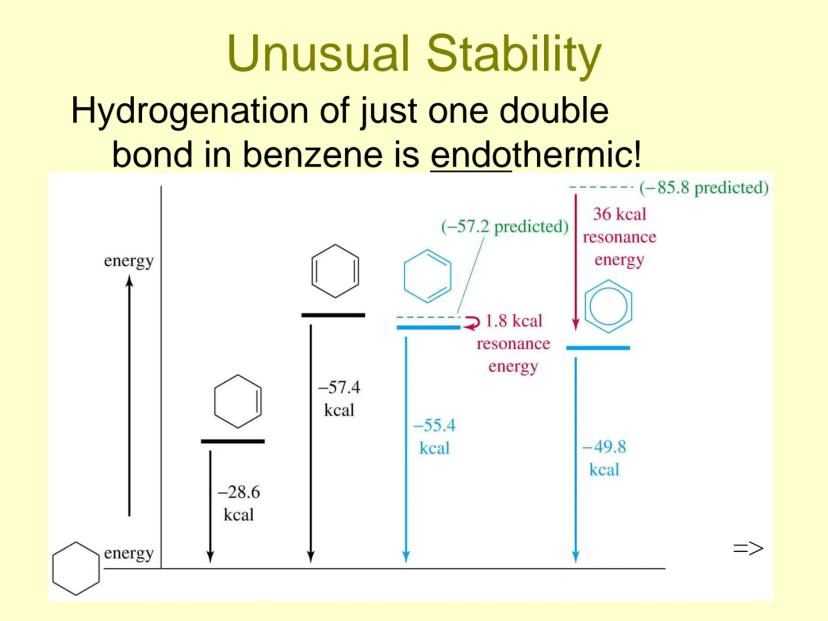
Benzene is remarkably more stable than you'd expect based on its structure alone. This extra stability, called resonance energy, can be measured through heat experiments.
When we fully hydrogenate benzene (adding 3 H₂ molecules), we release 49.8 kcal of energy. But if benzene were just a typical cyclic molecule with three double bonds, we'd expect to release 85.8 kcal based on similar compounds. The difference (36 kcal) represents benzene's special resonance stabilization.
Even more striking, trying to hydrogenate just one double bond in benzene would actually require adding energy (it's endothermic)! This is completely opposite to normal alkenes, which readily give up energy when hydrogenated.
Test Tip: Remember that aromatic compounds are unusually stable - they have lower energy than we'd predict based on their structures. This stability makes them less reactive than similar non-aromatic compounds.
7
of 10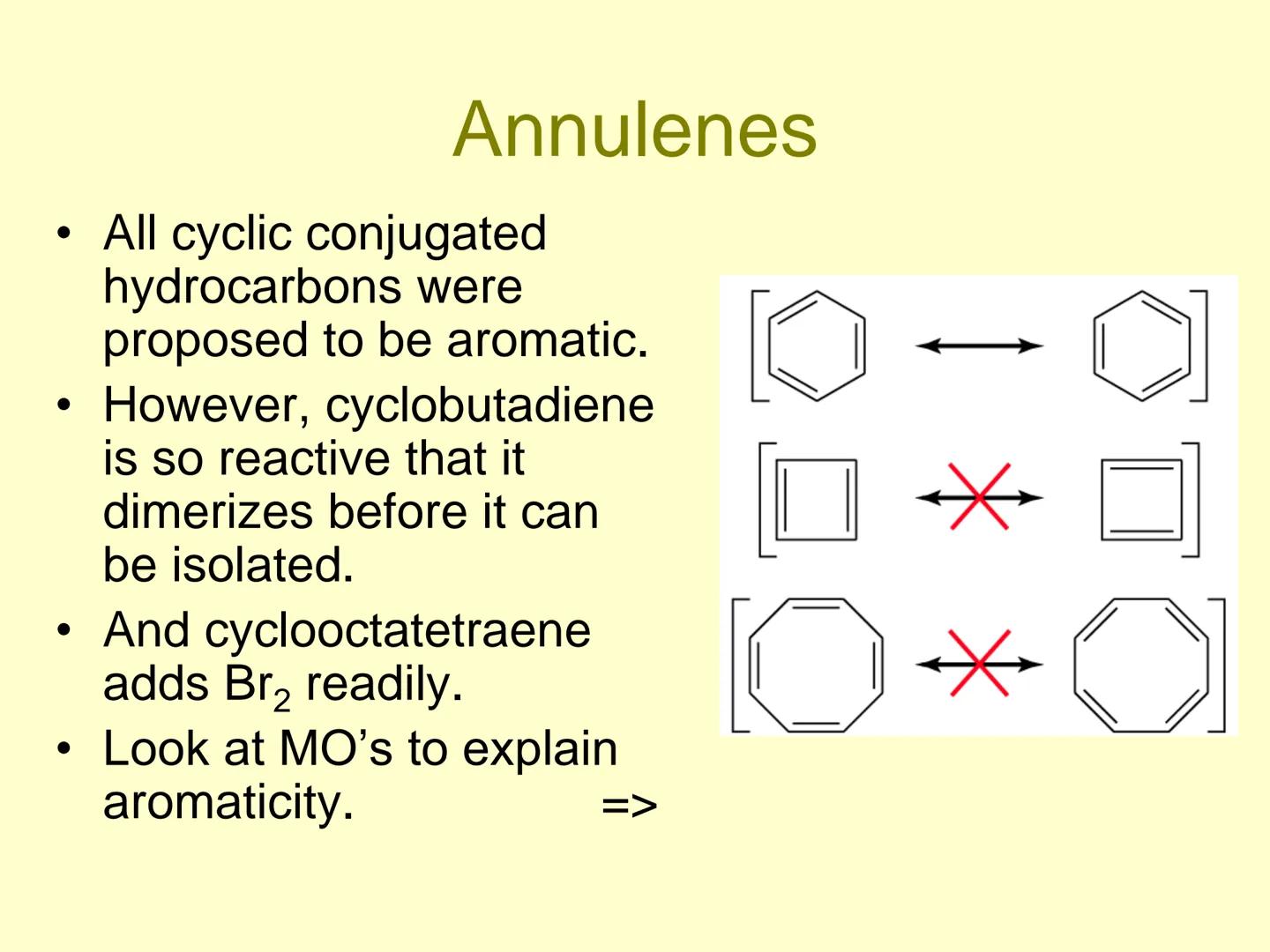
Annulenes
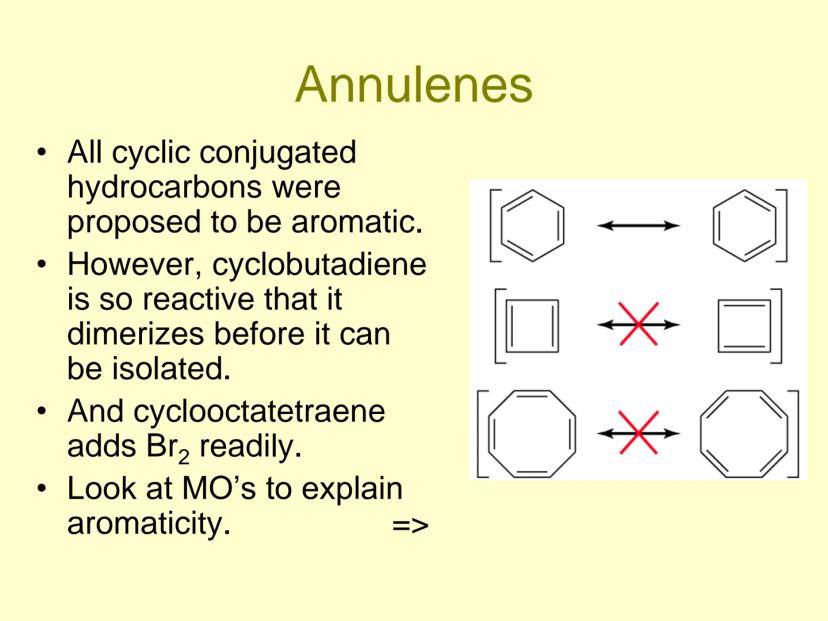
Chemists originally thought all cyclic conjugated hydrocarbons (called annulenes) would be aromatic like benzene. However, experiments quickly disproved this theory.
Cyclobutadiene, a four-carbon ring with alternating double bonds, is so incredibly reactive that it dimerizes (combines with another cyclobutadiene molecule) before chemists can even isolate it. This extreme reactivity is the opposite of aromatic stability.
Cyclooctatetraene, with eight carbons and four double bonds, readily adds bromine (Br₂) just like normal alkenes do. This behavior shows it's not aromatic either.
To explain why some cyclic compounds are aromatic while others aren't, chemists needed to examine molecular orbitals (MOs) - the mathematical models that describe where electrons exist in molecules.
8
of 10
MO Rules for Benzene
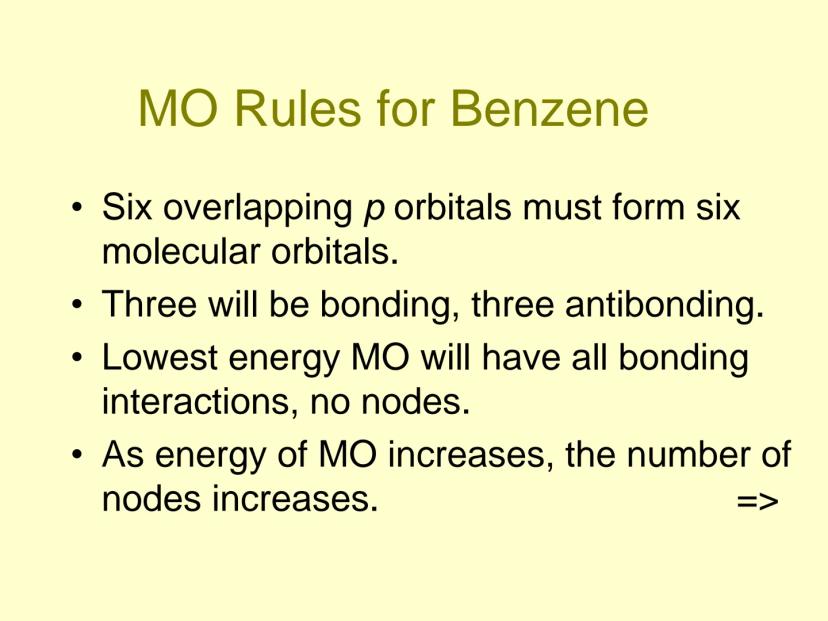
Molecular orbital (MO) theory helps explain benzene's unusual stability. In benzene, six overlapping p orbitals must form six molecular orbitals - three bonding (lower energy) and three antibonding (higher energy).
The lowest energy MO has all bonding interactions with no nodes (points where electron density is zero). This is the most stable orbital and the first to fill with electrons.
As the energy of molecular orbitals increases, the number of nodes increases too. Electrons naturally fill the lowest energy orbitals first, which gives benzene its exceptional stability.
Visualization Tip: Think of molecular orbitals like standing waves - the simplest wave has no nodes and is lowest energy, while more complex waves have more nodes and higher energy.
9
of 10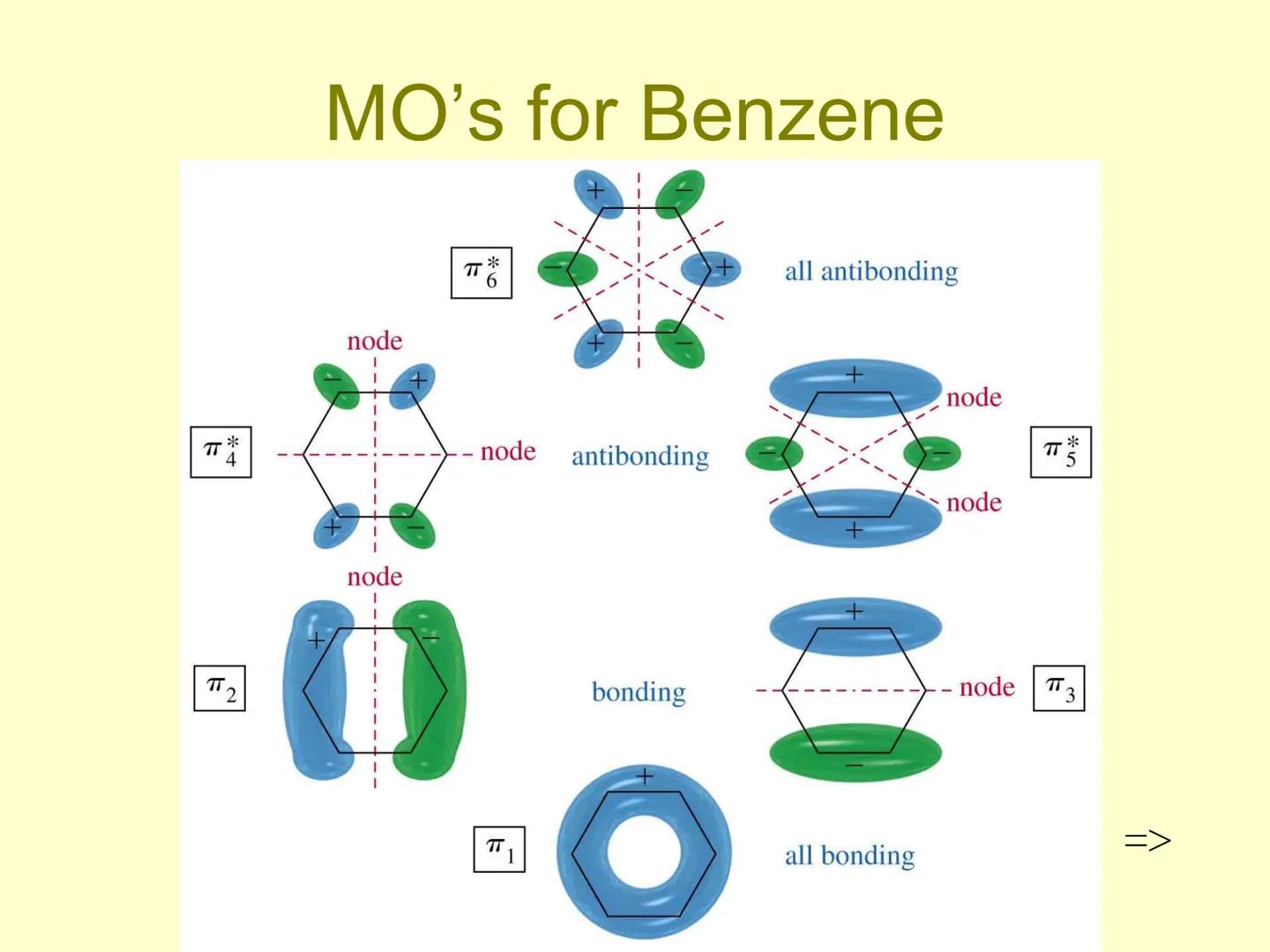
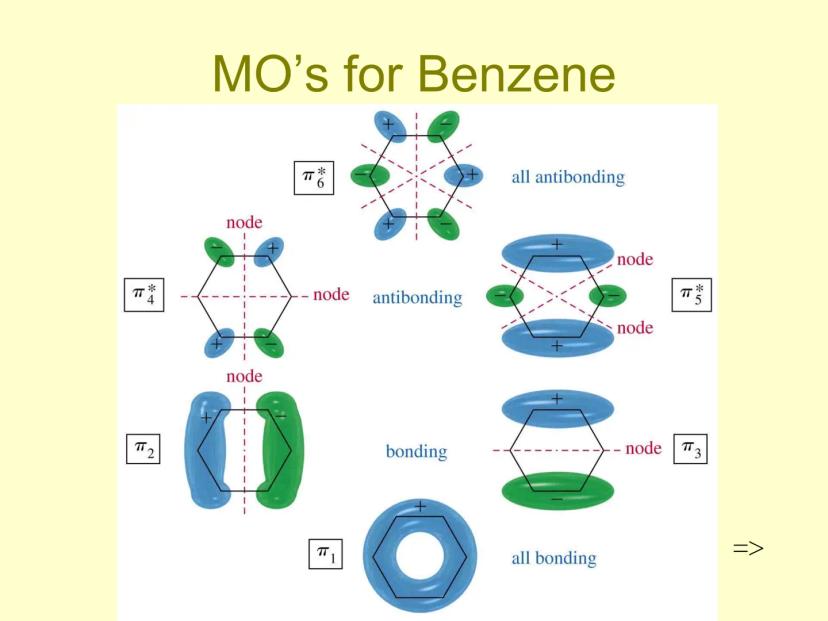
MO's for Benzene
Benzene's molecular orbitals (MOs) come in different shapes and energies based on how the p orbitals interact. Each MO is either bonding (strengthens the ring) or antibonding (weakens it).
The lowest energy orbital (π₁) has all bonding interactions with no nodes, making it extremely stable. As you move up in energy to π₂ and π₃, you add nodes where electron density drops to zero.
The antibonding orbitals (π₄, π₅, and π*₆) have multiple nodes and represent higher energy states. These orbitals remain empty in benzene's ground state.
The pattern of nodes in these orbitals determines whether electrons will stabilize or destabilize the molecule, which ultimately explains why some cyclic compounds are aromatic while others aren't.
10
of 10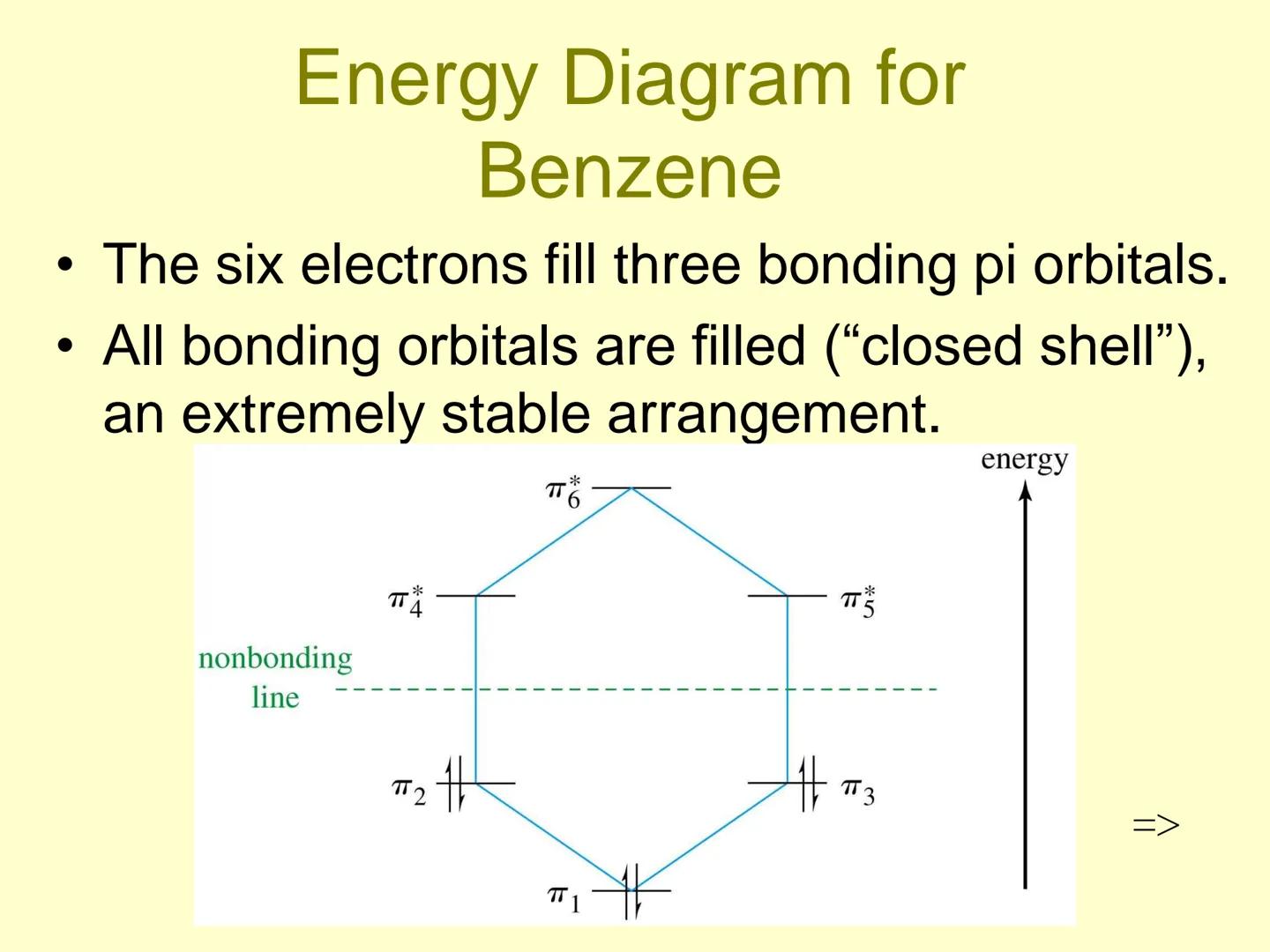
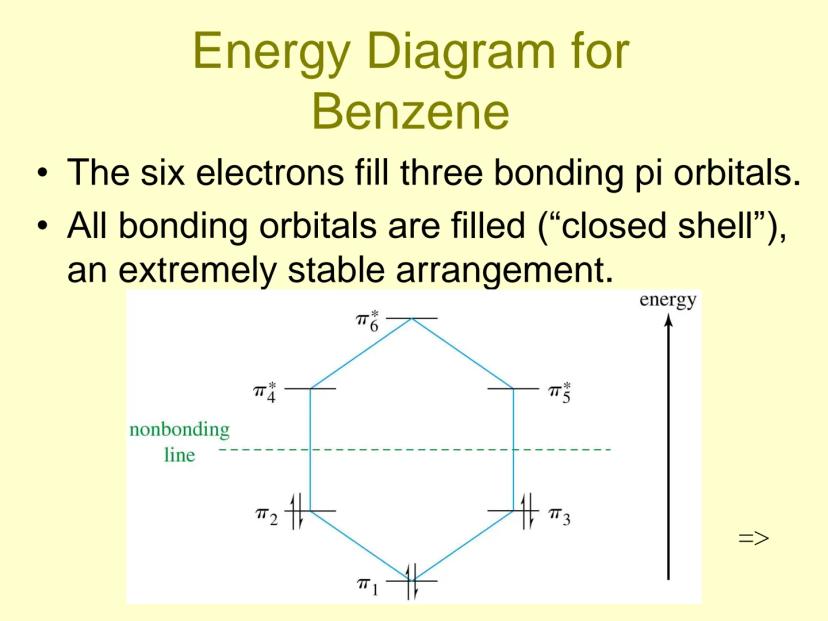
Energy Diagram for Benzene
Looking at benzene's energy diagram explains its exceptional stability. The six π electrons in benzene perfectly fill the three bonding molecular orbitals (π₁, π₂, and π₃), while all antibonding orbitals remain empty.
This arrangement creates what chemists call a "closed shell" - a completely filled set of bonding orbitals. Closed shells are extremely stable configurations in chemistry, similar to how noble gases have stable electron arrangements.
The large energy gap between the highest occupied molecular orbital (HOMO) and the lowest unoccupied molecular orbital (LUMO) further contributes to benzene's stability. This gap makes it energetically difficult to add or remove electrons.
Think of it like this: Benzene's electrons are arranged like a perfectly packed box - every space is efficiently filled with no room for movement, creating an extremely stable situation.
We thought you’d never ask...
What is the Knowunity AI companion?
Our AI companion is specifically built for the needs of students. Based on the millions of content pieces we have on the platform we can provide truly meaningful and relevant answers to students. But its not only about answers, the companion is even more about guiding students through their daily learning challenges, with personalised study plans, quizzes or content pieces in the chat and 100% personalisation based on the students skills and developments.
Where can I download the Knowunity app?
You can download the app in the Google Play Store and in the Apple App Store.
Is Knowunity really free of charge?
That's right! Enjoy free access to study content, connect with fellow students, and get instant help – all at your fingertips.
Similar Content
Most popular content in Chemistry
9Most popular content
9Can't find what you're looking for? Explore other subjects.
Students love us — and so will you.
4.6/5App Store
4.7/5Google Play
The app is very easy to use and well designed. I have found everything I was looking for so far and have been able to learn a lot from the presentations! I will definitely use the app for a class assignment! And of course it also helps a lot as an inspiration.
Stefan SiOS user
This app is really great. There are so many study notes and help [...]. My problem subject is French, for example, and the app has so many options for help. Thanks to this app, I have improved my French. I would recommend it to anyone.
Samantha KlichAndroid user
Wow, I am really amazed. I just tried the app because I've seen it advertised many times and was absolutely stunned. This app is THE HELP you want for school and above all, it offers so many things, such as workouts and fact sheets, which have been VERY helpful to me personally.
AnnaiOS user
Chemistry36 views·Updated May 27, 2026·40 pagesUnderstanding Aromatic Compounds: Structures, Rules, and Examples
Benjamin Arguelles@benjaminarguelles_ysur
Aromatic compounds are a fascinating group of organic molecules that don't behave like typical hydrocarbons. They have special stability due to their ring structure and electron arrangement. Understanding these compounds helps you make sense of everything from common chemicals to... Show more
1
of 10Sign up to see the content. It's free!
- Access to all documents
- Improve your grades
- Join milions of students
Aromatic Compounds
Aromatic compounds are a special class of organic molecules with unique stability and reactivity patterns. They're called "aromatic" because many of these compounds have pleasant smells, though this name was given before their structure was fully understood.
These compounds contain rings with delocalized electrons that give them unusual chemical properties. Unlike typical hydrocarbons, aromatic compounds resist certain reactions that would normally disrupt carbon-carbon double bonds.
You'll find aromatic compounds everywhere in your daily life - from medicines and plastics to natural products and fuels. Their unique structure makes them essential building blocks in chemistry.
2
of 10Sign up to see the content. It's free!
- Access to all documents
- Improve your grades
- Join milions of students
Discovery of Benzene
Benzene, the simplest aromatic compound, was first isolated in 1825 by Michael Faraday who determined it had a carbon-to-hydrogen ratio of 1:1. This was unusual compared to other known hydrocarbons at the time.
In 1834, scientist Eilhard Mitscherlich took things further by synthesizing benzene and determining its molecular formula to be C₆H₆. This formula suggested something strange - benzene had far fewer hydrogen atoms than expected for a compound with six carbon atoms.
Scientists noticed that benzene and related compounds with similar low C:H ratios often had pleasant smells. This observation led to the classification of these compounds as "aromatic," a term that stuck even after we learned more about their true structure.
Did you know? The term "aromatic" has nothing to do with the actual structure of these compounds - it was based solely on their pleasant smell, but today it describes a specific chemical arrangement!
3
of 10Sign up to see the content. It's free!
- Access to all documents
- Improve your grades
- Join milions of students
Kekulé Structure
In 1866, Friedrich Kekulé proposed a groundbreaking structure for benzene shortly after the concept of multiple bonds was introduced to chemistry. His model showed benzene as a six-carbon ring with alternating single and double bonds.
Kekulé's structure was revolutionary but had problems. Most importantly, it failed to explain why there's only one isomer of 1,2-dichlorobenzene. If benzene truly had three distinct double bonds, we should see different isomers depending on which double bond the chlorine atoms attached to.
The Kekulé structure represented an important step in understanding aromatic compounds, but chemists would soon discover that benzene's true nature was even more fascinating.
4
of 10Sign up to see the content. It's free!
- Access to all documents
- Improve your grades
- Join milions of students
Resonance Structure
Benzene's true structure involves a concept called resonance, which explains its unusual stability and reactivity. Each carbon atom in the benzene ring is sp² hybridized and has an unhybridized p orbital perpendicular to the ring.
These p orbitals overlap continuously around the ring, creating a donut-shaped cloud of electrons above and below the plane of the molecule. This electron delocalization is what gives benzene its special properties.
In the benzene ring, all carbon-carbon bonds have the same length (1.397 Å), and all bond angles are 120°. This uniformity wouldn't exist if benzene had alternating single and double bonds as Kekulé proposed.
Chemistry Insight: Think of benzene's electrons like kids on a circular playground - they don't stay in one place but move freely around the entire structure, making the whole molecule more stable!
5
of 10Sign up to see the content. It's free!
- Access to all documents
- Improve your grades
- Join milions of students
Unusual Reactions
Aromatic compounds don't react like typical alkenes, which helps us identify them. When alkenes react with potassium permanganate (KMnO₄), they form diols through addition reactions - but benzene shows no reaction with KMnO₄.
Similarly, alkenes readily react with bromine (Br₂) in carbon tetrachloride (CCl₄) to form dibromides through addition reactions. Benzene, however, shows no reaction under these conditions.
Benzene does react with bromine, but only when iron(III) chloride (FeCl₃) catalyst is present. Instead of addition, benzene undergoes substitution to form bromobenzene plus hydrogen bromide, while keeping its double bonds intact. This substitution (rather than addition) reaction is a telltale sign of aromatic character.
6
of 10Sign up to see the content. It's free!
- Access to all documents
- Improve your grades
- Join milions of students
Unusual Stability
Benzene is remarkably more stable than you'd expect based on its structure alone. This extra stability, called resonance energy, can be measured through heat experiments.
When we fully hydrogenate benzene (adding 3 H₂ molecules), we release 49.8 kcal of energy. But if benzene were just a typical cyclic molecule with three double bonds, we'd expect to release 85.8 kcal based on similar compounds. The difference (36 kcal) represents benzene's special resonance stabilization.
Even more striking, trying to hydrogenate just one double bond in benzene would actually require adding energy (it's endothermic)! This is completely opposite to normal alkenes, which readily give up energy when hydrogenated.
Test Tip: Remember that aromatic compounds are unusually stable - they have lower energy than we'd predict based on their structures. This stability makes them less reactive than similar non-aromatic compounds.
7
of 10Sign up to see the content. It's free!
- Access to all documents
- Improve your grades
- Join milions of students
Annulenes
Chemists originally thought all cyclic conjugated hydrocarbons (called annulenes) would be aromatic like benzene. However, experiments quickly disproved this theory.
Cyclobutadiene, a four-carbon ring with alternating double bonds, is so incredibly reactive that it dimerizes (combines with another cyclobutadiene molecule) before chemists can even isolate it. This extreme reactivity is the opposite of aromatic stability.
Cyclooctatetraene, with eight carbons and four double bonds, readily adds bromine (Br₂) just like normal alkenes do. This behavior shows it's not aromatic either.
To explain why some cyclic compounds are aromatic while others aren't, chemists needed to examine molecular orbitals (MOs) - the mathematical models that describe where electrons exist in molecules.
8
of 10Sign up to see the content. It's free!
- Access to all documents
- Improve your grades
- Join milions of students
MO Rules for Benzene
Molecular orbital (MO) theory helps explain benzene's unusual stability. In benzene, six overlapping p orbitals must form six molecular orbitals - three bonding (lower energy) and three antibonding (higher energy).
The lowest energy MO has all bonding interactions with no nodes (points where electron density is zero). This is the most stable orbital and the first to fill with electrons.
As the energy of molecular orbitals increases, the number of nodes increases too. Electrons naturally fill the lowest energy orbitals first, which gives benzene its exceptional stability.
Visualization Tip: Think of molecular orbitals like standing waves - the simplest wave has no nodes and is lowest energy, while more complex waves have more nodes and higher energy.
9
of 10Sign up to see the content. It's free!
- Access to all documents
- Improve your grades
- Join milions of students
MO's for Benzene
Benzene's molecular orbitals (MOs) come in different shapes and energies based on how the p orbitals interact. Each MO is either bonding (strengthens the ring) or antibonding (weakens it).
The lowest energy orbital (π₁) has all bonding interactions with no nodes, making it extremely stable. As you move up in energy to π₂ and π₃, you add nodes where electron density drops to zero.
The antibonding orbitals (π₄, π₅, and π*₆) have multiple nodes and represent higher energy states. These orbitals remain empty in benzene's ground state.
The pattern of nodes in these orbitals determines whether electrons will stabilize or destabilize the molecule, which ultimately explains why some cyclic compounds are aromatic while others aren't.
10
of 10Sign up to see the content. It's free!
- Access to all documents
- Improve your grades
- Join milions of students
Energy Diagram for Benzene
Looking at benzene's energy diagram explains its exceptional stability. The six π electrons in benzene perfectly fill the three bonding molecular orbitals (π₁, π₂, and π₃), while all antibonding orbitals remain empty.
This arrangement creates what chemists call a "closed shell" - a completely filled set of bonding orbitals. Closed shells are extremely stable configurations in chemistry, similar to how noble gases have stable electron arrangements.
The large energy gap between the highest occupied molecular orbital (HOMO) and the lowest unoccupied molecular orbital (LUMO) further contributes to benzene's stability. This gap makes it energetically difficult to add or remove electrons.
Think of it like this: Benzene's electrons are arranged like a perfectly packed box - every space is efficiently filled with no room for movement, creating an extremely stable situation.
We thought you’d never ask...
What is the Knowunity AI companion?
Our AI companion is specifically built for the needs of students. Based on the millions of content pieces we have on the platform we can provide truly meaningful and relevant answers to students. But its not only about answers, the companion is even more about guiding students through their daily learning challenges, with personalised study plans, quizzes or content pieces in the chat and 100% personalisation based on the students skills and developments.
Where can I download the Knowunity app?
You can download the app in the Google Play Store and in the Apple App Store.
Is Knowunity really free of charge?
That's right! Enjoy free access to study content, connect with fellow students, and get instant help – all at your fingertips.
Similar Content
Most popular content in Chemistry
9Most popular content
9Can't find what you're looking for? Explore other subjects.
Students love us — and so will you.
4.6/5App Store
4.7/5Google Play
The app is very easy to use and well designed. I have found everything I was looking for so far and have been able to learn a lot from the presentations! I will definitely use the app for a class assignment! And of course it also helps a lot as an inspiration.
Stefan SiOS user
This app is really great. There are so many study notes and help [...]. My problem subject is French, for example, and the app has so many options for help. Thanks to this app, I have improved my French. I would recommend it to anyone.
Samantha KlichAndroid user
Wow, I am really amazed. I just tried the app because I've seen it advertised many times and was absolutely stunned. This app is THE HELP you want for school and above all, it offers so many things, such as workouts and fact sheets, which have been VERY helpful to me personally.
AnnaiOS user