
Neurons and synapses form the communication network of your nervous... Show more
 Biology56 views·Updated May 27, 2026·2 pages
IB Biology Chapter 6.5: Understanding Neurons and Synapses

Val@val.vasqc
1
of 2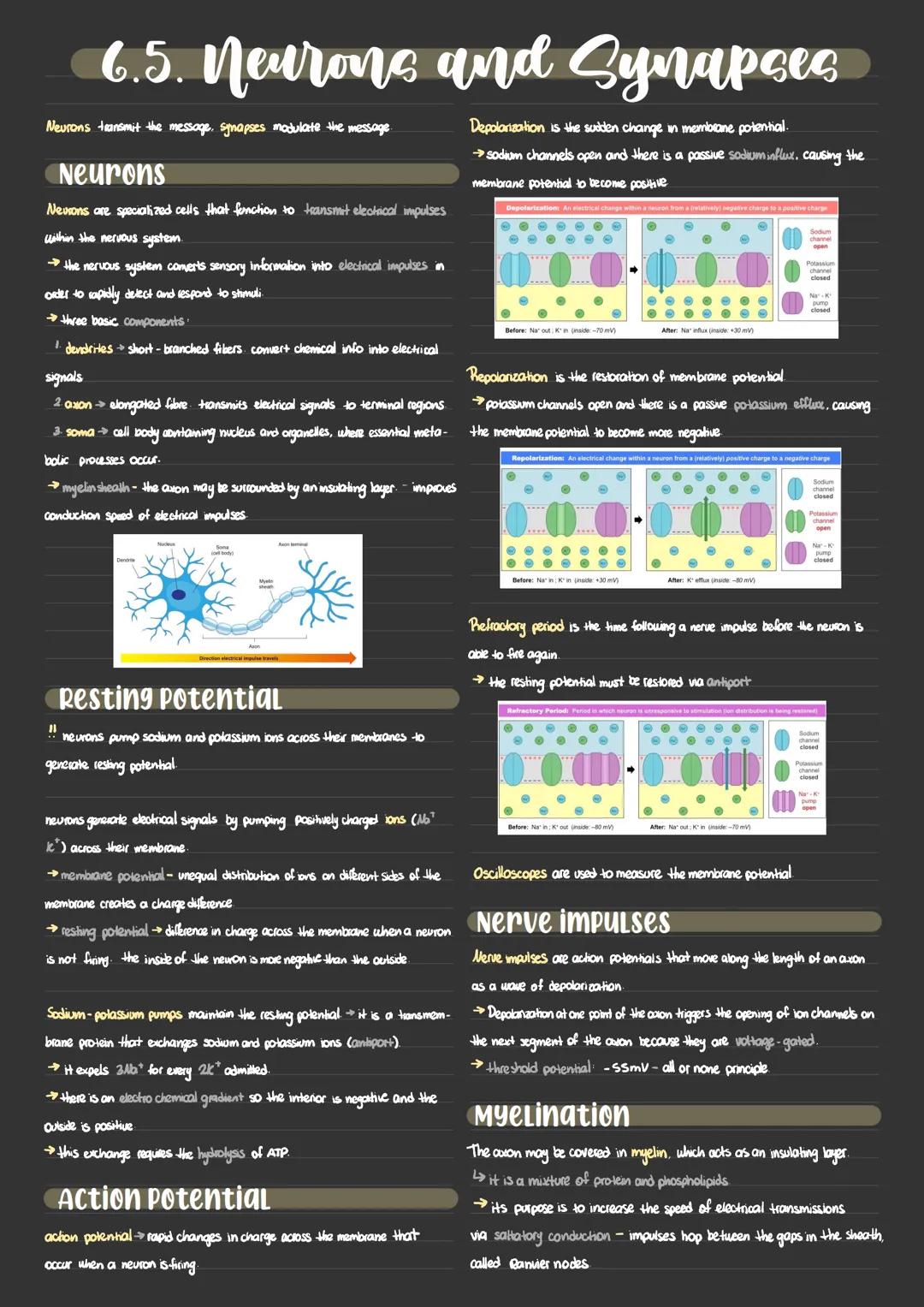
Neurons: The Messaging System
Ever wonder how you can react so quickly when you touch something hot? Neurons make this possible! These specialized cells have three main parts: dendrites that receive signals, a soma (cell body) that processes information, and an axon that sends signals to other cells. Many axons are wrapped in a myelin sheath that speeds up signal transmission like insulation on electrical wires.
Neurons work by changing their electrical charge in a process called depolarization. At rest, neurons maintain a negative charge inside , but when stimulated, sodium channels open, letting positive sodium ions rush in and temporarily making the inside positive . This dramatic shift triggers the neuron to fire. After firing, repolarization occurs as potassium flows out, restoring the negative charge.
The neuron's resting state is maintained by sodium-potassium pumps that use energy (ATP) to push out three sodium ions for every two potassium ions they bring in. This creates an electrical gradient across the cell membrane. When a neuron fires, this electrical signal (called an action potential) travels down the axon like a wave, following the "all-or-none principle" - neurons either fire completely or not at all.
Real-World Connection: Neurons with myelin work like an express train that only stops at stations (gaps called Ranvier nodes). This "saltatory conduction" makes signals travel much faster - crucial for everything from quick reflexes to coordinated movements!
2
of 2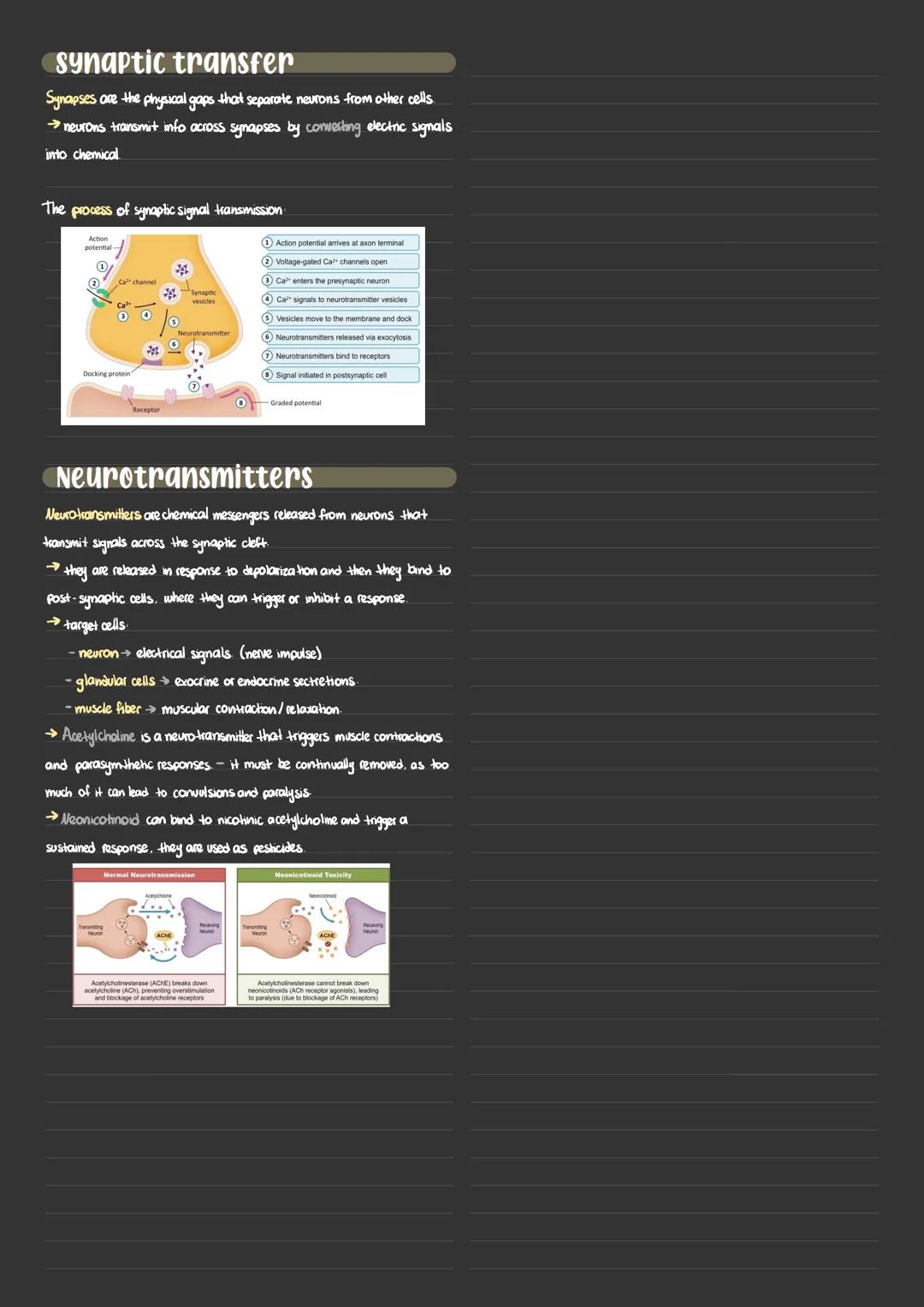
Synapses: The Communication Junctions
Think of synapses as tiny messaging stations between cells. When a signal reaches the end of a neuron, something amazing happens - the electrical signal transforms into a chemical one! This occurs at the synaptic cleft, the microscopic gap between cells where information transfers.
When an action potential arrives at the axon terminal, it triggers voltage-gated calcium channels to open. Calcium ions rush in, signaling tiny sacs called synaptic vesicles to move to the cell membrane. Through exocytosis, these vesicles release chemical messengers called neurotransmitters into the synaptic cleft. These chemicals then bind to receptors on the receiving cell, potentially starting a new electrical signal.
Acetylcholine is an important neurotransmitter that triggers muscle contractions. Your body must constantly remove excess acetylcholine with an enzyme called acetylcholinesterase - otherwise, muscles would remain contracted, leading to convulsions or paralysis. This system is so precise that disrupting it can have serious consequences. For example, neonicotinoids (used in pesticides) mimic acetylcholine but can't be broken down normally, which can cause paralysis in insects.
Fascinating Fact: Your brain contains approximately 100 billion neurons making trillions of synaptic connections! Every thought, memory, and movement depends on these microscopic chemical handshakes between cells.
We thought you’d never ask...
What is the Knowunity AI companion?
Our AI companion is specifically built for the needs of students. Based on the millions of content pieces we have on the platform we can provide truly meaningful and relevant answers to students. But its not only about answers, the companion is even more about guiding students through their daily learning challenges, with personalised study plans, quizzes or content pieces in the chat and 100% personalisation based on the students skills and developments.
Where can I download the Knowunity app?
You can download the app in the Google Play Store and in the Apple App Store.
Is Knowunity really free of charge?
That's right! Enjoy free access to study content, connect with fellow students, and get instant help – all at your fingertips.
Similar Content
Most popular content in Biology
9Most popular content
9Can't find what you're looking for? Explore other subjects.
Students love us — and so will you.
4.6/5App Store
4.7/5Google Play
The app is very easy to use and well designed. I have found everything I was looking for so far and have been able to learn a lot from the presentations! I will definitely use the app for a class assignment! And of course it also helps a lot as an inspiration.
Stefan SiOS user
This app is really great. There are so many study notes and help [...]. My problem subject is French, for example, and the app has so many options for help. Thanks to this app, I have improved my French. I would recommend it to anyone.
Samantha KlichAndroid user
Wow, I am really amazed. I just tried the app because I've seen it advertised many times and was absolutely stunned. This app is THE HELP you want for school and above all, it offers so many things, such as workouts and fact sheets, which have been VERY helpful to me personally.
AnnaiOS user
Biology56 views·Updated May 27, 2026·2 pagesIB Biology Chapter 6.5: Understanding Neurons and Synapses
Val@val.vasqc
Neurons and synapses form the communication network of your nervous system. These specialized cells transmit electrical impulses that allow you to sense the world around you and respond quickly. Understanding how neurons work helps explain everything from how you think... Show more
1
of 2Sign up to see the content. It's free!
- Access to all documents
- Improve your grades
- Join milions of students
Neurons: The Messaging System
Ever wonder how you can react so quickly when you touch something hot? Neurons make this possible! These specialized cells have three main parts: dendrites that receive signals, a soma (cell body) that processes information, and an axon that sends signals to other cells. Many axons are wrapped in a myelin sheath that speeds up signal transmission like insulation on electrical wires.
Neurons work by changing their electrical charge in a process called depolarization. At rest, neurons maintain a negative charge inside , but when stimulated, sodium channels open, letting positive sodium ions rush in and temporarily making the inside positive . This dramatic shift triggers the neuron to fire. After firing, repolarization occurs as potassium flows out, restoring the negative charge.
The neuron's resting state is maintained by sodium-potassium pumps that use energy (ATP) to push out three sodium ions for every two potassium ions they bring in. This creates an electrical gradient across the cell membrane. When a neuron fires, this electrical signal (called an action potential) travels down the axon like a wave, following the "all-or-none principle" - neurons either fire completely or not at all.
Real-World Connection: Neurons with myelin work like an express train that only stops at stations (gaps called Ranvier nodes). This "saltatory conduction" makes signals travel much faster - crucial for everything from quick reflexes to coordinated movements!
2
of 2Sign up to see the content. It's free!
- Access to all documents
- Improve your grades
- Join milions of students
Synapses: The Communication Junctions
Think of synapses as tiny messaging stations between cells. When a signal reaches the end of a neuron, something amazing happens - the electrical signal transforms into a chemical one! This occurs at the synaptic cleft, the microscopic gap between cells where information transfers.
When an action potential arrives at the axon terminal, it triggers voltage-gated calcium channels to open. Calcium ions rush in, signaling tiny sacs called synaptic vesicles to move to the cell membrane. Through exocytosis, these vesicles release chemical messengers called neurotransmitters into the synaptic cleft. These chemicals then bind to receptors on the receiving cell, potentially starting a new electrical signal.
Acetylcholine is an important neurotransmitter that triggers muscle contractions. Your body must constantly remove excess acetylcholine with an enzyme called acetylcholinesterase - otherwise, muscles would remain contracted, leading to convulsions or paralysis. This system is so precise that disrupting it can have serious consequences. For example, neonicotinoids (used in pesticides) mimic acetylcholine but can't be broken down normally, which can cause paralysis in insects.
Fascinating Fact: Your brain contains approximately 100 billion neurons making trillions of synaptic connections! Every thought, memory, and movement depends on these microscopic chemical handshakes between cells.
We thought you’d never ask...
What is the Knowunity AI companion?
Our AI companion is specifically built for the needs of students. Based on the millions of content pieces we have on the platform we can provide truly meaningful and relevant answers to students. But its not only about answers, the companion is even more about guiding students through their daily learning challenges, with personalised study plans, quizzes or content pieces in the chat and 100% personalisation based on the students skills and developments.
Where can I download the Knowunity app?
You can download the app in the Google Play Store and in the Apple App Store.
Is Knowunity really free of charge?
That's right! Enjoy free access to study content, connect with fellow students, and get instant help – all at your fingertips.
Similar Content
Most popular content in Biology
9Most popular content
9Can't find what you're looking for? Explore other subjects.
Students love us — and so will you.
4.6/5App Store
4.7/5Google Play
The app is very easy to use and well designed. I have found everything I was looking for so far and have been able to learn a lot from the presentations! I will definitely use the app for a class assignment! And of course it also helps a lot as an inspiration.
Stefan SiOS user
This app is really great. There are so many study notes and help [...]. My problem subject is French, for example, and the app has so many options for help. Thanks to this app, I have improved my French. I would recommend it to anyone.
Samantha KlichAndroid user
Wow, I am really amazed. I just tried the app because I've seen it advertised many times and was absolutely stunned. This app is THE HELP you want for school and above all, it offers so many things, such as workouts and fact sheets, which have been VERY helpful to me personally.
AnnaiOS user