
Forensic science isn't just cool TV drama—it's real-world detective work...
 Biology42 views·Updated Jul 6, 2026·2 pages
Forensics Unit 2.2: Crime Scene Procedures Notes

Zu@zuliana1787
1
of 2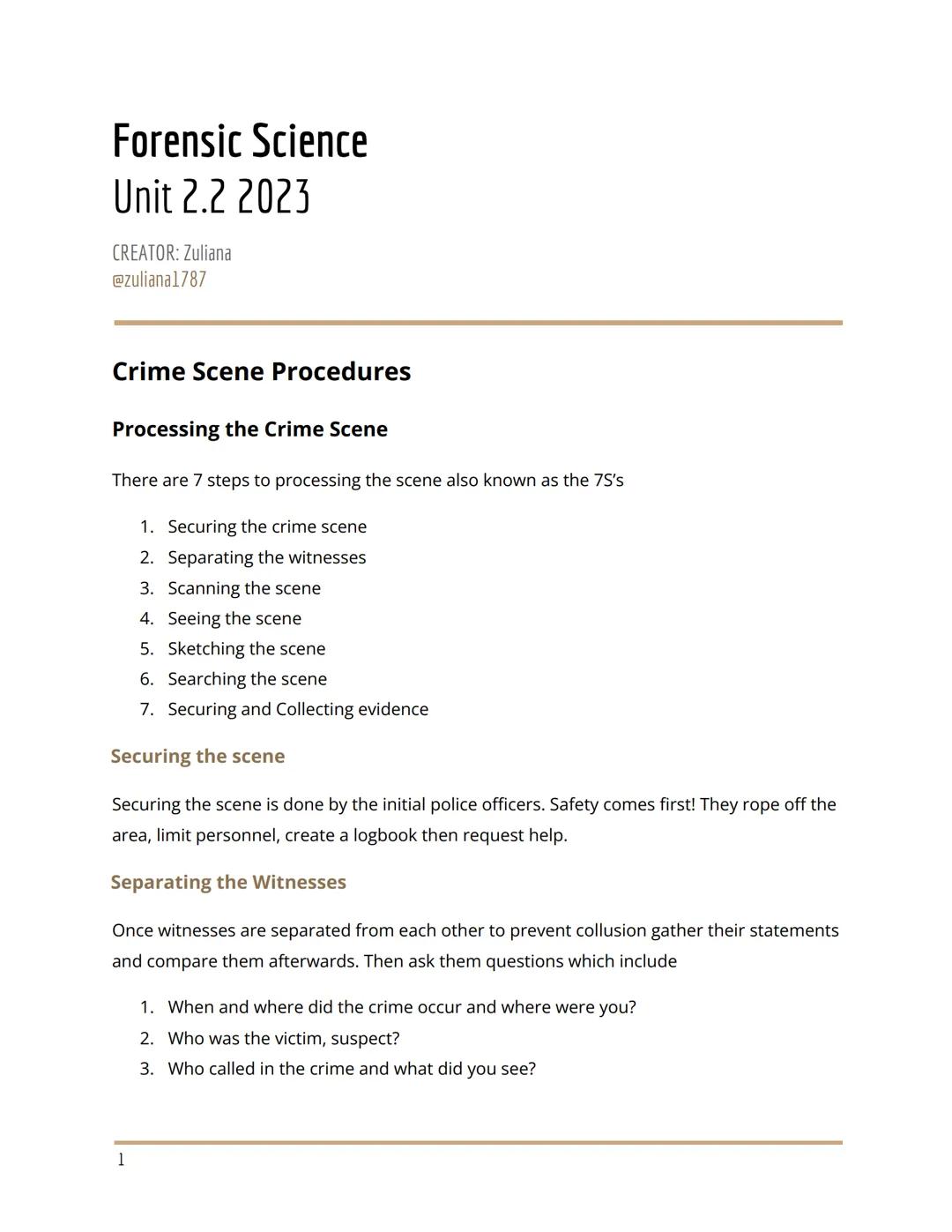
Crime Scene Procedures: The 7 S's
When investigators arrive at a crime scene, they follow seven critical steps known as the 7 S's. These steps ensure nothing is overlooked and evidence remains uncontaminated.
The process begins with securing the crime scene, where initial police officers rope off the area and prioritize safety. They limit who can enter, create a detailed logbook of everyone present, and call for specialized help when needed. This critical first step prevents evidence contamination.
Next comes separating the witnesses, which prevents people from influencing each other's accounts. Investigators ask key questions: When and where did the crime occur? Where were you when it happened? Who was the victim or suspect? Who reported the crime? This information provides multiple perspectives on what happened.
Real-World Tip: Think about why police immediately put up yellow tape at crime scenes. It's not just for show—it's the first crucial step in preserving evidence that might solve the case!
2
of 2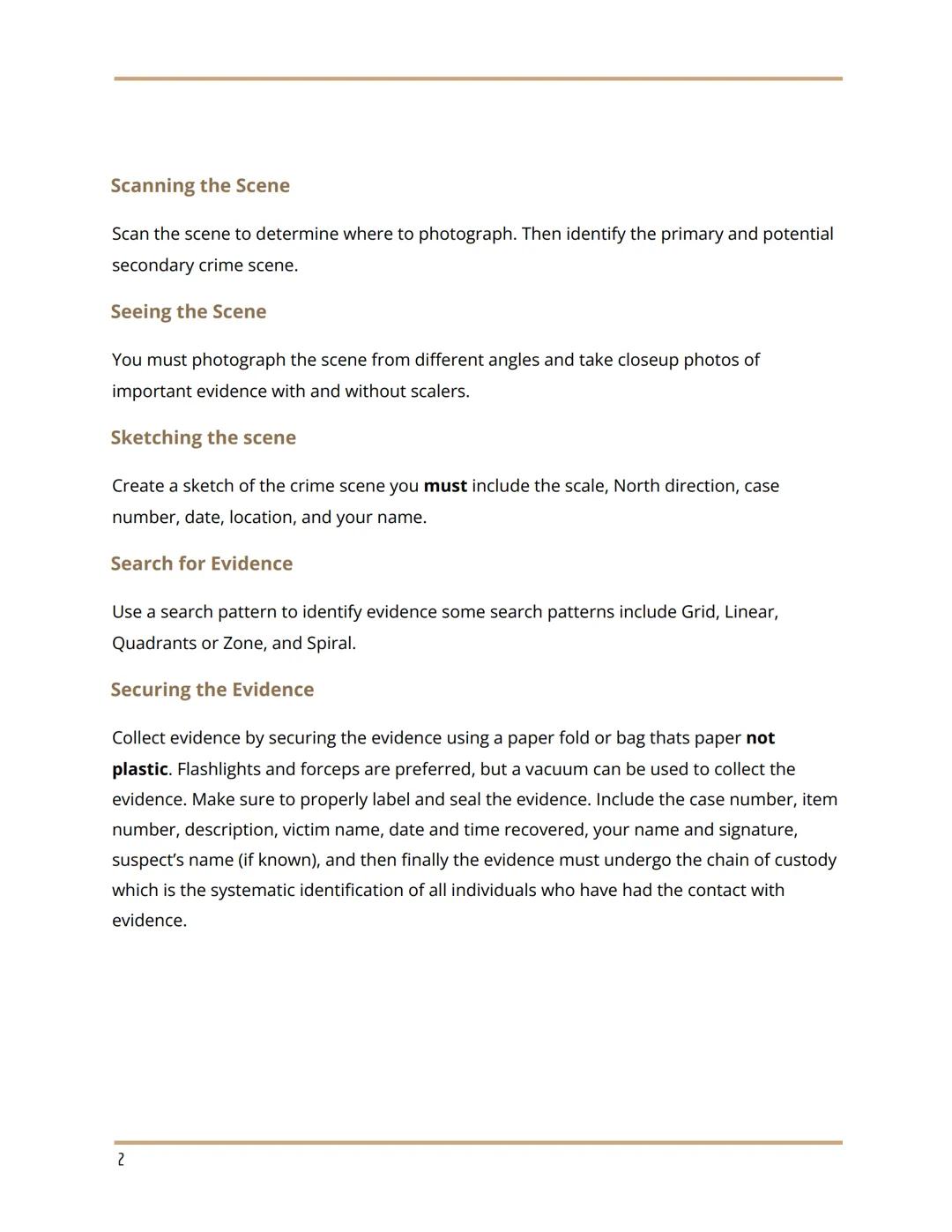
Processing the Scene: From Scanning to Collection
After securing the scene and separating witnesses, investigators scan the scene to get an overview and identify both primary and secondary crime scenes. This helps them determine where to focus their photography efforts.
Seeing the scene comes next through detailed photography. Investigators take wide-angle shots from multiple perspectives and close-ups of key evidence. Some photos include measurement tools (scalers) to document size accurately.
Investigators then create detailed sketches with important elements: scale, north direction, case number, date, location, and the sketcher's name. For finding evidence, they use systematic search patterns like grid, linear, quadrant/zone, or spiral methods to ensure nothing is missed.
Finally, securing and collecting evidence requires precise handling. Evidence goes into paper (never plastic) containers using tools like flashlights and forceps to avoid contamination. Each item receives detailed labeling with the case number, description, recovery information, and names of those involved. The chain of custody documentation tracks everyone who handles the evidence afterward—a crucial step for court proceedings.
Test Prep Alert: The specific labeling requirements for evidence are frequently tested! Make sure you can list all the required elements: case number, item number, description, victim name, collection date/time, collector's name, and suspect's name (if known).
We thought you’d never ask...
Our AI companion is specifically built for the needs of students. Based on the millions of content pieces we have on the platform we can provide truly meaningful and relevant answers to students. But its not only about answers, the companion is even more about guiding students through their daily learning challenges, with personalised study plans, quizzes or content pieces in the chat and 100% personalisation based on the students skills and developments.
You can download the app in the Google Play Store and in the Apple App Store.
That's right! Enjoy free access to study content, connect with fellow students, and get instant help – all at your fingertips.
Similar Content
 Health & Medicine
Most popular content in Biology
9C
BiologyCell Organelles
This Quiz Is To Test Your Knowledge Of Cell Organelles And Their Functions Inside The Cell. It Can Also Be A Study Guide To Remember Them Better.
6th6830
B
Biologybiology cell organelles and functions
Do you know the cell organelles and their functions?
9th4730
M
BiologyMitosis and Cell Division Flashcards
These flashcards cover the basics of mitosis and why cell division occurs in the first place.
9th3440
A
BiologyAnimal and plant cell structure
Quiz on animal and plant cell structures
9th3490
D
BiologyDiscover the Fascinating World of Living Organisms
Uncover the secrets of biology and explore the diverse and amazing life forms that inhabit our planet with this captivating flashcard set.
7th4510
D
BiologyDiscover Punnet Squares
Uncover the secrets of life with this comprehensive Biology flashcard set. Perfect for grade 10 students studying Living Environment.
10th3991
D
BiologyDNA
Parts of DNA
9th3030
S
BiologySteps of Cellular Respiration
3 basic steps and Molecule Vocab
9th2660
D
BiologyDNA and RNA
Uncover the secrets of life with this comprehensive Biology flashcard set. Perfect for grade 10 students studying Living Environment.
10th1,0882
Most popular content
9O
 AP US History
Origins and Dynamics of the Columbian Exchange
Analyze the ecological and economic motivations behind the initial transfer of goods, people, and diseases between the Old and New Worlds.
9th3,1280
I
AP US HistoryIntroduction to Early Cultural Interactions
Analyze the initial social and religious encounters between Europeans, Africans, and Indigenous peoples in the colonial Americas.
9th2,7730
O
 AP World History
Origins of Ancient River Civilizations
Analyze the environmental factors and technological innovations that led to the rise of early states in Mesopotamia, Egypt, and the Indus Valley.
9th3,1870
M
AP US HistoryMotivations for European Exploration
Analyze the economic, religious, and political factors that drove European powers to the Americas during the 15th and 16th centuries.
9th1,7780
F
 AP Psychology
Foundations of Ethical Guidelines in Research
Practice the core principles of the APA ethical code including informed consent, debriefing, and the role of Institutional Review Boards.
9th1,3360
I
AP US HistoryIntroduction to Native American Societies
Examine the diverse social, political, and economic structures of North American indigenous groups prior to European contact.
9th1,1100
I
AP US HistoryIntroduction to the Spanish Encomienda System
Explore the fundamental economic and social structures of the Spanish colonial system, focusing on the encomienda and the casta social hierarchy.
9th8890
I
AP BiologyIntroduction to Biological Elements of Life
Practice identifying the essential elements including carbon, nitrogen, phosphorus, and sulfur that compose biological macromolecules.
9th1,7410
O
AP US Government & PoliticsOrigins of the Articles of Confederation
Practice identifying the motivations for a weak central government and the specific powers granted to the states under the first U.S. constitution.
9th9370
Students love us — and so will you.
4.6/5App Store
4.7/5Google Play
The app is very easy to use and well designed. I have found everything I was looking for so far and have been able to learn a lot from the presentations! I will definitely use the app for a class assignment! And of course it also helps a lot as an inspiration.
Stefan SiOS user
This app is really great. There are so many study notes and help [...]. My problem subject is French, for example, and the app has so many options for help. Thanks to this app, I have improved my French. I would recommend it to anyone.
Samantha KlichAndroid user
Wow, I am really amazed. I just tried the app because I've seen it advertised many times and was absolutely stunned. This app is THE HELP you want for school and above all, it offers so many things, such as workouts and fact sheets, which have been VERY helpful to me personally.
AnnaiOS user
Biology42 views·Updated Jul 6, 2026·2 pagesForensics Unit 2.2: Crime Scene Procedures Notes
Zu@zuliana1787
Forensic science isn't just cool TV drama—it's real-world detective work with strict procedures. Crime scene processing follows a methodical approach that preserves evidence integrity and helps solve crimes. Let's explore how professionals handle crime scenes step by step.
1
of 2
Sign up to see the content. It's free!
- Access to all documents
- Improve your grades
- Join milions of students
Crime Scene Procedures: The 7 S's
When investigators arrive at a crime scene, they follow seven critical steps known as the 7 S's. These steps ensure nothing is overlooked and evidence remains uncontaminated.
The process begins with securing the crime scene, where initial police officers rope off the area and prioritize safety. They limit who can enter, create a detailed logbook of everyone present, and call for specialized help when needed. This critical first step prevents evidence contamination.
Next comes separating the witnesses, which prevents people from influencing each other's accounts. Investigators ask key questions: When and where did the crime occur? Where were you when it happened? Who was the victim or suspect? Who reported the crime? This information provides multiple perspectives on what happened.
Real-World Tip: Think about why police immediately put up yellow tape at crime scenes. It's not just for show—it's the first crucial step in preserving evidence that might solve the case!
2
of 2Sign up to see the content. It's free!
- Access to all documents
- Improve your grades
- Join milions of students
Processing the Scene: From Scanning to Collection
After securing the scene and separating witnesses, investigators scan the scene to get an overview and identify both primary and secondary crime scenes. This helps them determine where to focus their photography efforts.
Seeing the scene comes next through detailed photography. Investigators take wide-angle shots from multiple perspectives and close-ups of key evidence. Some photos include measurement tools (scalers) to document size accurately.
Investigators then create detailed sketches with important elements: scale, north direction, case number, date, location, and the sketcher's name. For finding evidence, they use systematic search patterns like grid, linear, quadrant/zone, or spiral methods to ensure nothing is missed.
Finally, securing and collecting evidence requires precise handling. Evidence goes into paper (never plastic) containers using tools like flashlights and forceps to avoid contamination. Each item receives detailed labeling with the case number, description, recovery information, and names of those involved. The chain of custody documentation tracks everyone who handles the evidence afterward—a crucial step for court proceedings.
Test Prep Alert: The specific labeling requirements for evidence are frequently tested! Make sure you can list all the required elements: case number, item number, description, victim name, collection date/time, collector's name, and suspect's name (if known).
We thought you’d never ask...
Our AI companion is specifically built for the needs of students. Based on the millions of content pieces we have on the platform we can provide truly meaningful and relevant answers to students. But its not only about answers, the companion is even more about guiding students through their daily learning challenges, with personalised study plans, quizzes or content pieces in the chat and 100% personalisation based on the students skills and developments.
You can download the app in the Google Play Store and in the Apple App Store.
That's right! Enjoy free access to study content, connect with fellow students, and get instant help – all at your fingertips.
Similar Content
Most popular content in Biology
9C
BiologyCell Organelles
This Quiz Is To Test Your Knowledge Of Cell Organelles And Their Functions Inside The Cell. It Can Also Be A Study Guide To Remember Them Better.
6th6830
B
Biologybiology cell organelles and functions
Do you know the cell organelles and their functions?
9th4730
M
BiologyMitosis and Cell Division Flashcards
These flashcards cover the basics of mitosis and why cell division occurs in the first place.
9th3440
A
BiologyAnimal and plant cell structure
Quiz on animal and plant cell structures
9th3490
D
BiologyDiscover the Fascinating World of Living Organisms
Uncover the secrets of biology and explore the diverse and amazing life forms that inhabit our planet with this captivating flashcard set.
7th4510
D
BiologyDiscover Punnet Squares
Uncover the secrets of life with this comprehensive Biology flashcard set. Perfect for grade 10 students studying Living Environment.
10th3991
D
BiologyDNA
Parts of DNA
9th3030
S
BiologySteps of Cellular Respiration
3 basic steps and Molecule Vocab
9th2660
D
BiologyDNA and RNA
Uncover the secrets of life with this comprehensive Biology flashcard set. Perfect for grade 10 students studying Living Environment.
10th1,0882
Most popular content
9O
AP US HistoryOrigins and Dynamics of the Columbian Exchange
Analyze the ecological and economic motivations behind the initial transfer of goods, people, and diseases between the Old and New Worlds.
9th3,1280
I
AP US HistoryIntroduction to Early Cultural Interactions
Analyze the initial social and religious encounters between Europeans, Africans, and Indigenous peoples in the colonial Americas.
9th2,7730
O
AP World HistoryOrigins of Ancient River Civilizations
Analyze the environmental factors and technological innovations that led to the rise of early states in Mesopotamia, Egypt, and the Indus Valley.
9th3,1870
M
AP US HistoryMotivations for European Exploration
Analyze the economic, religious, and political factors that drove European powers to the Americas during the 15th and 16th centuries.
9th1,7780
F
AP PsychologyFoundations of Ethical Guidelines in Research
Practice the core principles of the APA ethical code including informed consent, debriefing, and the role of Institutional Review Boards.
9th1,3360
I
AP US HistoryIntroduction to Native American Societies
Examine the diverse social, political, and economic structures of North American indigenous groups prior to European contact.
9th1,1100
I
AP US HistoryIntroduction to the Spanish Encomienda System
Explore the fundamental economic and social structures of the Spanish colonial system, focusing on the encomienda and the casta social hierarchy.
9th8890
I
AP BiologyIntroduction to Biological Elements of Life
Practice identifying the essential elements including carbon, nitrogen, phosphorus, and sulfur that compose biological macromolecules.
9th1,7410
O
AP US Government & PoliticsOrigins of the Articles of Confederation
Practice identifying the motivations for a weak central government and the specific powers granted to the states under the first U.S. constitution.
9th9370
Students love us — and so will you.
4.6/5App Store
4.7/5Google Play
The app is very easy to use and well designed. I have found everything I was looking for so far and have been able to learn a lot from the presentations! I will definitely use the app for a class assignment! And of course it also helps a lot as an inspiration.
Stefan SiOS user
This app is really great. There are so many study notes and help [...]. My problem subject is French, for example, and the app has so many options for help. Thanks to this app, I have improved my French. I would recommend it to anyone.
Samantha KlichAndroid user
Wow, I am really amazed. I just tried the app because I've seen it advertised many times and was absolutely stunned. This app is THE HELP you want for school and above all, it offers so many things, such as workouts and fact sheets, which have been VERY helpful to me personally.
AnnaiOS user