
Forensic science combines legal expertise with scientific analysis to solve... Show more
 Biology107 views·Updated May 31, 2026·2 pages
Forensics Chapter 1: Introduction to Law
C
Cindy Lin@indyin_zgzy
1
of 2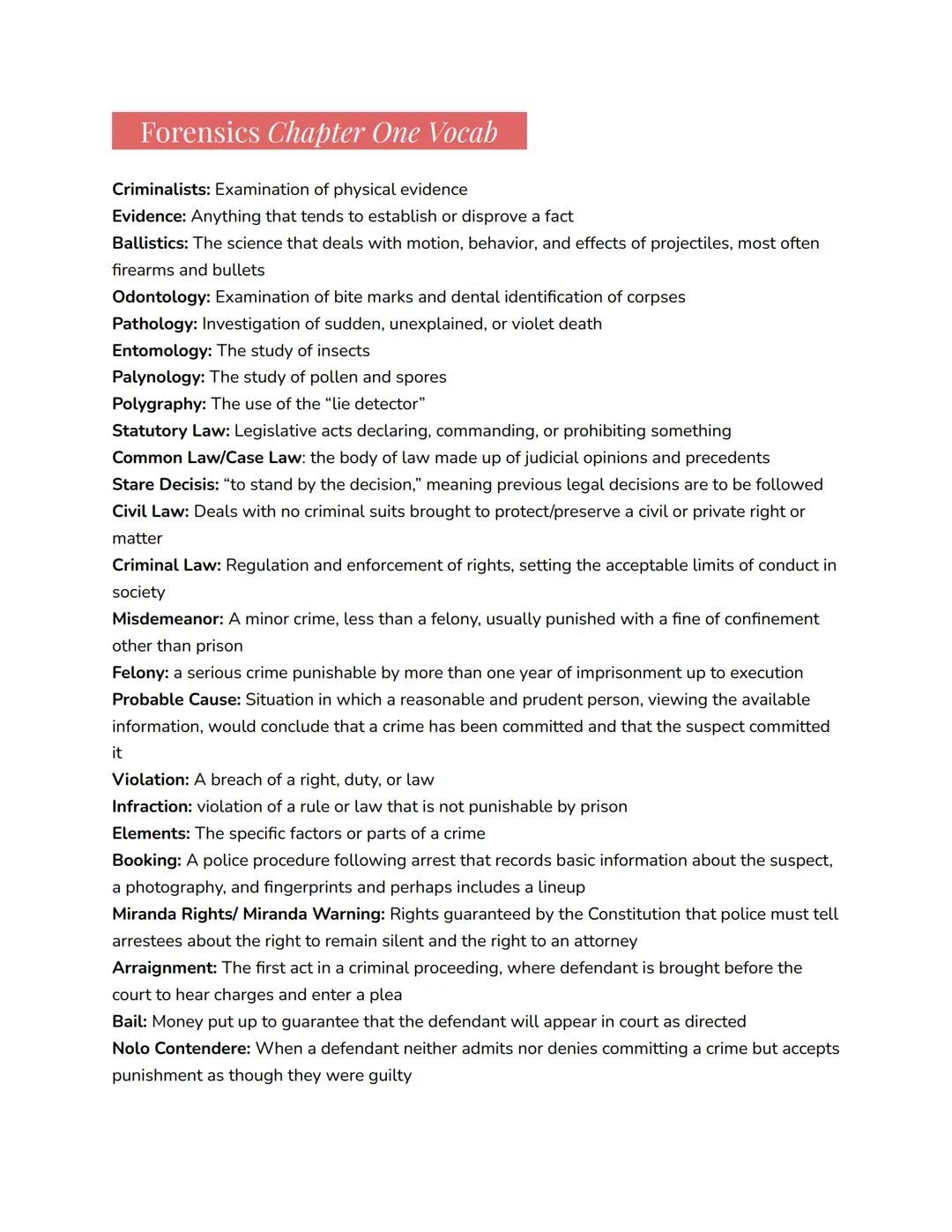
Forensic Investigation Terms
Forensic investigations rely on specialized fields to analyze evidence. Criminalists examine physical evidence that might establish facts about a crime. When investigating deaths, pathology determines causes of unexplained or violent deaths, while odontology examines bite marks and identifies corpses through dental records. Other specialized fields include entomology (study of insects), palynology (study of pollen), and ballistics (examining firearms and projectile behavior).
Understanding legal frameworks is crucial in forensics. Criminal law sets acceptable conduct limits in society, while civil law deals with non-criminal matters protecting private rights. Legal violations range from infractions (minor law violations not punishable by prison) to misdemeanors (minor crimes usually punished by fines) and felonies (serious crimes punishable by more than a year in prison).
Legal proceedings follow specific steps after a crime. After arrest, suspects undergo booking, where their information, photo, and fingerprints are recorded. Police must read suspects their Miranda rights, informing them of their right to remain silent and have an attorney. During arraignment, defendants hear charges and enter pleas, possibly paying bail to guarantee court appearance or entering a nolo contendere plea (neither admitting nor denying the crime).
💡 Real-world application: When you watch crime shows, notice how they follow these legal procedures—from booking suspects to reading Miranda rights—which are constitutional protections that apply in actual criminal cases.
2
of 2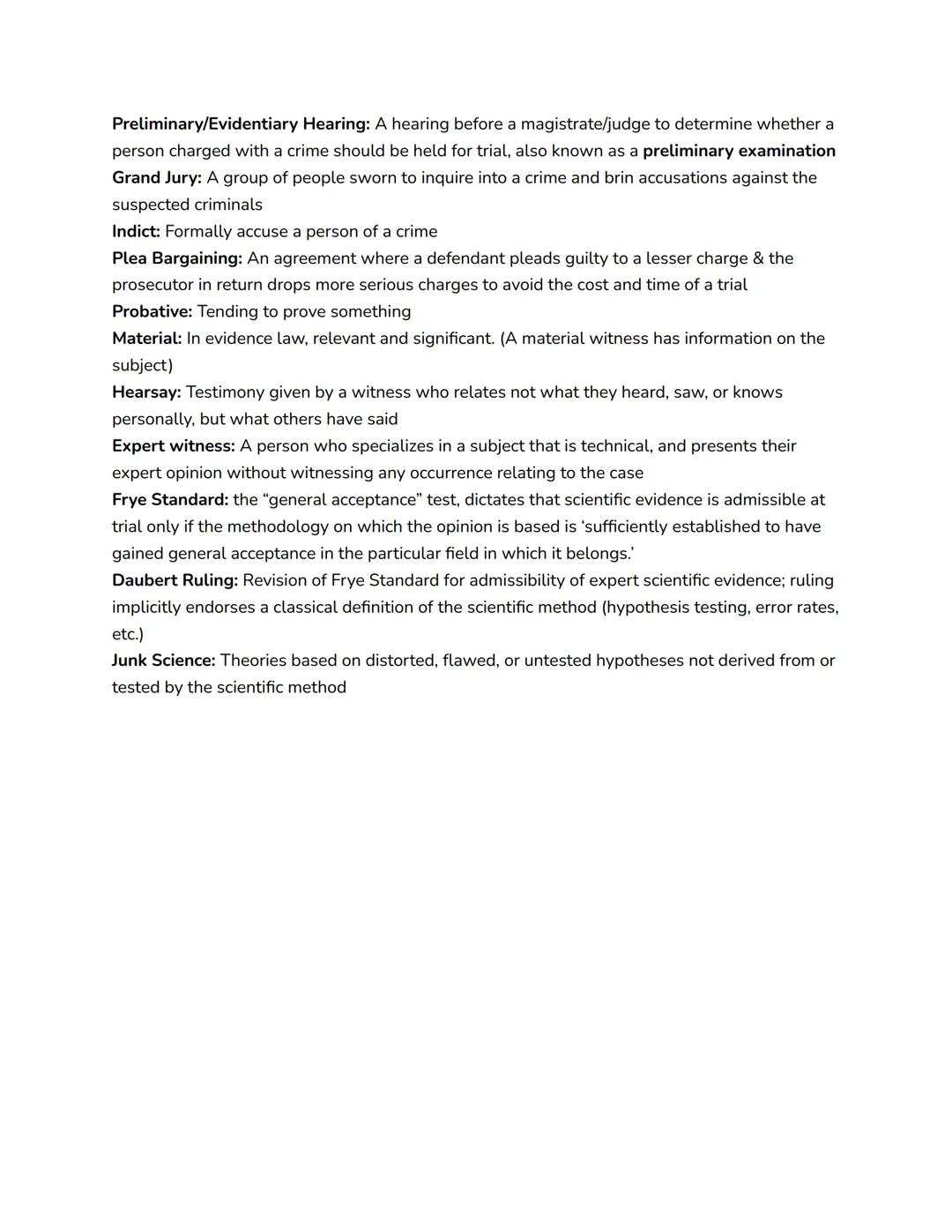
Legal Proceedings and Evidence
After arrest, cases move through several court phases. The preliminary hearing (also called evidentiary hearing) determines if enough evidence exists to hold a trial. In some jurisdictions, a grand jury may review evidence and formally indict a suspect. Many cases never reach trial due to plea bargaining, where defendants plead guilty to lesser charges in exchange for prosecutors dropping more serious ones.
Evidence presented in court must meet specific standards. It must be material (relevant to the case) and probative (tending to prove something). Courts distinguish between regular witnesses and expert witnesses who provide specialized opinions without directly witnessing the crime. Hearsay evidence—information from secondhand sources rather than personal knowledge—faces strict admissibility rules.
Scientific evidence faces particularly rigorous standards. The Frye Standard traditionally required scientific methods to have "general acceptance" in their field. The newer Daubert Ruling revised these requirements, emphasizing hypothesis testing and error rates that follow the scientific method. These standards help courts reject junk science—theories based on flawed or untested hypotheses that don't follow proper scientific methodology.
🔍 Critical thinking tip: When evaluating scientific claims in forensics (or anywhere!), ask if the methods have been properly tested and accepted by scientific communities—the same standards courts use to keep junk science out of trials.
We thought you’d never ask...
What is the Knowunity AI companion?
Our AI companion is specifically built for the needs of students. Based on the millions of content pieces we have on the platform we can provide truly meaningful and relevant answers to students. But its not only about answers, the companion is even more about guiding students through their daily learning challenges, with personalised study plans, quizzes or content pieces in the chat and 100% personalisation based on the students skills and developments.
Where can I download the Knowunity app?
You can download the app in the Google Play Store and in the Apple App Store.
Is Knowunity really free of charge?
That's right! Enjoy free access to study content, connect with fellow students, and get instant help – all at your fingertips.
Similar Content
Most popular content in Biology
9Most popular content
9Can't find what you're looking for? Explore other subjects.
Students love us — and so will you.
4.6/5App Store
4.7/5Google Play
The app is very easy to use and well designed. I have found everything I was looking for so far and have been able to learn a lot from the presentations! I will definitely use the app for a class assignment! And of course it also helps a lot as an inspiration.
Stefan SiOS user
This app is really great. There are so many study notes and help [...]. My problem subject is French, for example, and the app has so many options for help. Thanks to this app, I have improved my French. I would recommend it to anyone.
Samantha KlichAndroid user
Wow, I am really amazed. I just tried the app because I've seen it advertised many times and was absolutely stunned. This app is THE HELP you want for school and above all, it offers so many things, such as workouts and fact sheets, which have been VERY helpful to me personally.
AnnaiOS user
Biology107 views·Updated May 31, 2026·2 pagesForensics Chapter 1: Introduction to Law
C
Cindy Lin@indyin_zgzy
Forensic science combines legal expertise with scientific analysis to solve crimes. This study guide covers key vocabulary from criminalist techniques to legal proceedings, providing the essential terminology you need to understand forensic investigations and criminal justice.
1
of 2Sign up to see the content. It's free!
- Access to all documents
- Improve your grades
- Join milions of students
Forensic Investigation Terms
Forensic investigations rely on specialized fields to analyze evidence. Criminalists examine physical evidence that might establish facts about a crime. When investigating deaths, pathology determines causes of unexplained or violent deaths, while odontology examines bite marks and identifies corpses through dental records. Other specialized fields include entomology (study of insects), palynology (study of pollen), and ballistics (examining firearms and projectile behavior).
Understanding legal frameworks is crucial in forensics. Criminal law sets acceptable conduct limits in society, while civil law deals with non-criminal matters protecting private rights. Legal violations range from infractions (minor law violations not punishable by prison) to misdemeanors (minor crimes usually punished by fines) and felonies (serious crimes punishable by more than a year in prison).
Legal proceedings follow specific steps after a crime. After arrest, suspects undergo booking, where their information, photo, and fingerprints are recorded. Police must read suspects their Miranda rights, informing them of their right to remain silent and have an attorney. During arraignment, defendants hear charges and enter pleas, possibly paying bail to guarantee court appearance or entering a nolo contendere plea (neither admitting nor denying the crime).
💡 Real-world application: When you watch crime shows, notice how they follow these legal procedures—from booking suspects to reading Miranda rights—which are constitutional protections that apply in actual criminal cases.
2
of 2Sign up to see the content. It's free!
- Access to all documents
- Improve your grades
- Join milions of students
Legal Proceedings and Evidence
After arrest, cases move through several court phases. The preliminary hearing (also called evidentiary hearing) determines if enough evidence exists to hold a trial. In some jurisdictions, a grand jury may review evidence and formally indict a suspect. Many cases never reach trial due to plea bargaining, where defendants plead guilty to lesser charges in exchange for prosecutors dropping more serious ones.
Evidence presented in court must meet specific standards. It must be material (relevant to the case) and probative (tending to prove something). Courts distinguish between regular witnesses and expert witnesses who provide specialized opinions without directly witnessing the crime. Hearsay evidence—information from secondhand sources rather than personal knowledge—faces strict admissibility rules.
Scientific evidence faces particularly rigorous standards. The Frye Standard traditionally required scientific methods to have "general acceptance" in their field. The newer Daubert Ruling revised these requirements, emphasizing hypothesis testing and error rates that follow the scientific method. These standards help courts reject junk science—theories based on flawed or untested hypotheses that don't follow proper scientific methodology.
🔍 Critical thinking tip: When evaluating scientific claims in forensics (or anywhere!), ask if the methods have been properly tested and accepted by scientific communities—the same standards courts use to keep junk science out of trials.
We thought you’d never ask...
What is the Knowunity AI companion?
Our AI companion is specifically built for the needs of students. Based on the millions of content pieces we have on the platform we can provide truly meaningful and relevant answers to students. But its not only about answers, the companion is even more about guiding students through their daily learning challenges, with personalised study plans, quizzes or content pieces in the chat and 100% personalisation based on the students skills and developments.
Where can I download the Knowunity app?
You can download the app in the Google Play Store and in the Apple App Store.
Is Knowunity really free of charge?
That's right! Enjoy free access to study content, connect with fellow students, and get instant help – all at your fingertips.
Similar Content
Most popular content in Biology
9Most popular content
9Can't find what you're looking for? Explore other subjects.
Students love us — and so will you.
4.6/5App Store
4.7/5Google Play
The app is very easy to use and well designed. I have found everything I was looking for so far and have been able to learn a lot from the presentations! I will definitely use the app for a class assignment! And of course it also helps a lot as an inspiration.
Stefan SiOS user
This app is really great. There are so many study notes and help [...]. My problem subject is French, for example, and the app has so many options for help. Thanks to this app, I have improved my French. I would recommend it to anyone.
Samantha KlichAndroid user
Wow, I am really amazed. I just tried the app because I've seen it advertised many times and was absolutely stunned. This app is THE HELP you want for school and above all, it offers so many things, such as workouts and fact sheets, which have been VERY helpful to me personally.
AnnaiOS user