
Epithelial tissues are specialized cell layers that cover body surfaces,... Show more
 Biology59 views·Updated May 21, 2026·6 pages
Epithelial Tissue Types and Functions

johanna@notj.l11
1 / 6
1
of 6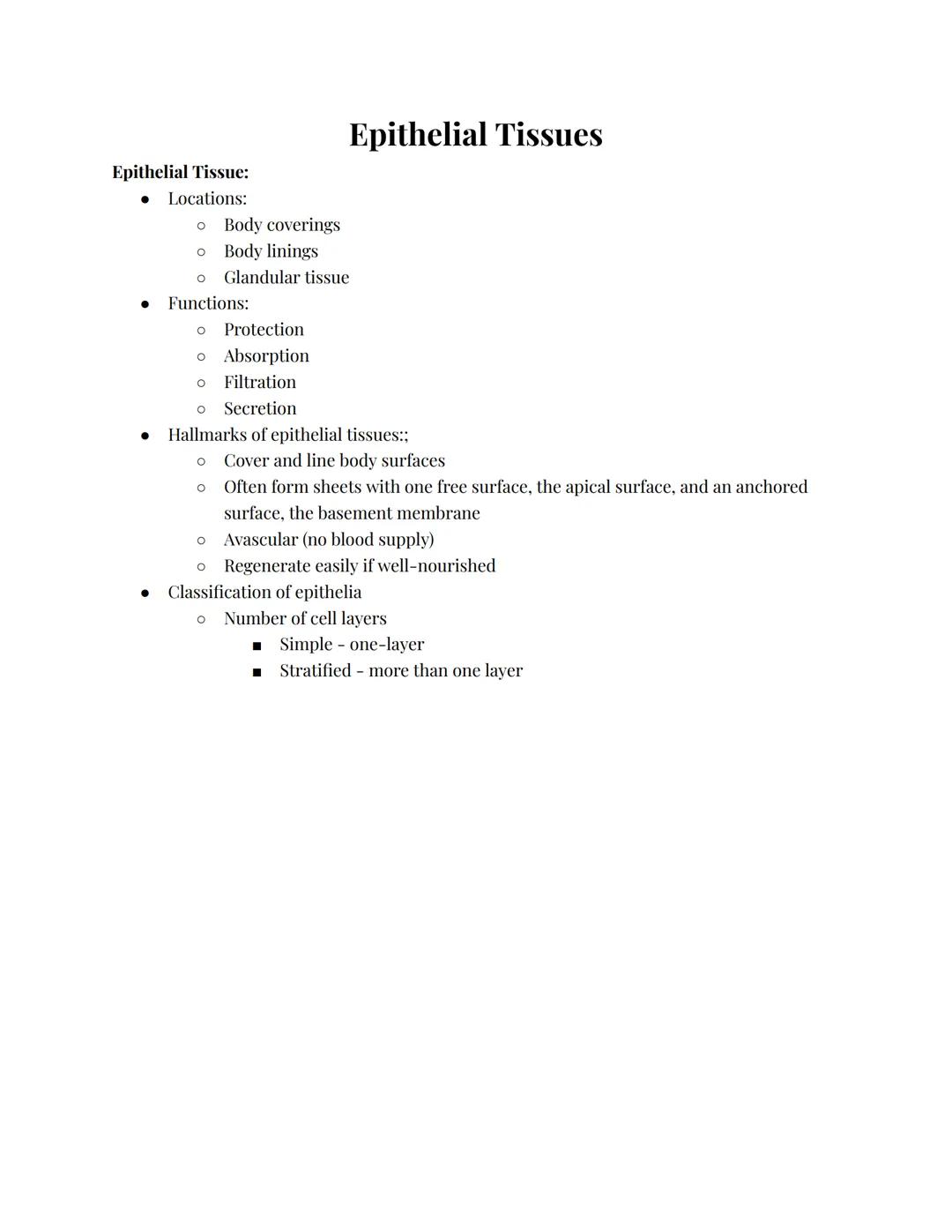
Epithelial Tissue Basics
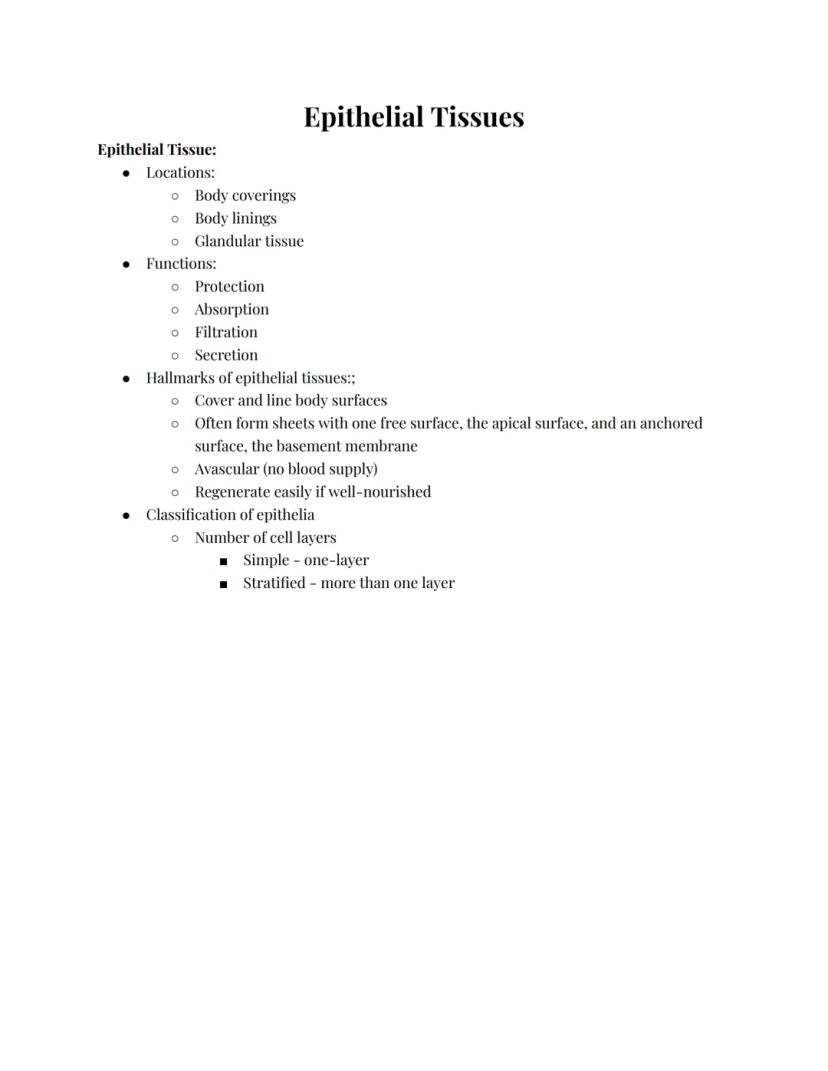
Epithelial tissues are the body's protective coverings and linings. You'll find them covering your skin, lining your digestive tract, and forming your glands.
These tissues have distinct hallmarks that set them apart. They typically form sheets with an apical surface and a basement membrane (attached side). Interestingly, epithelial tissues have no direct blood supply (they're avascular) but can regenerate easily when properly nourished.
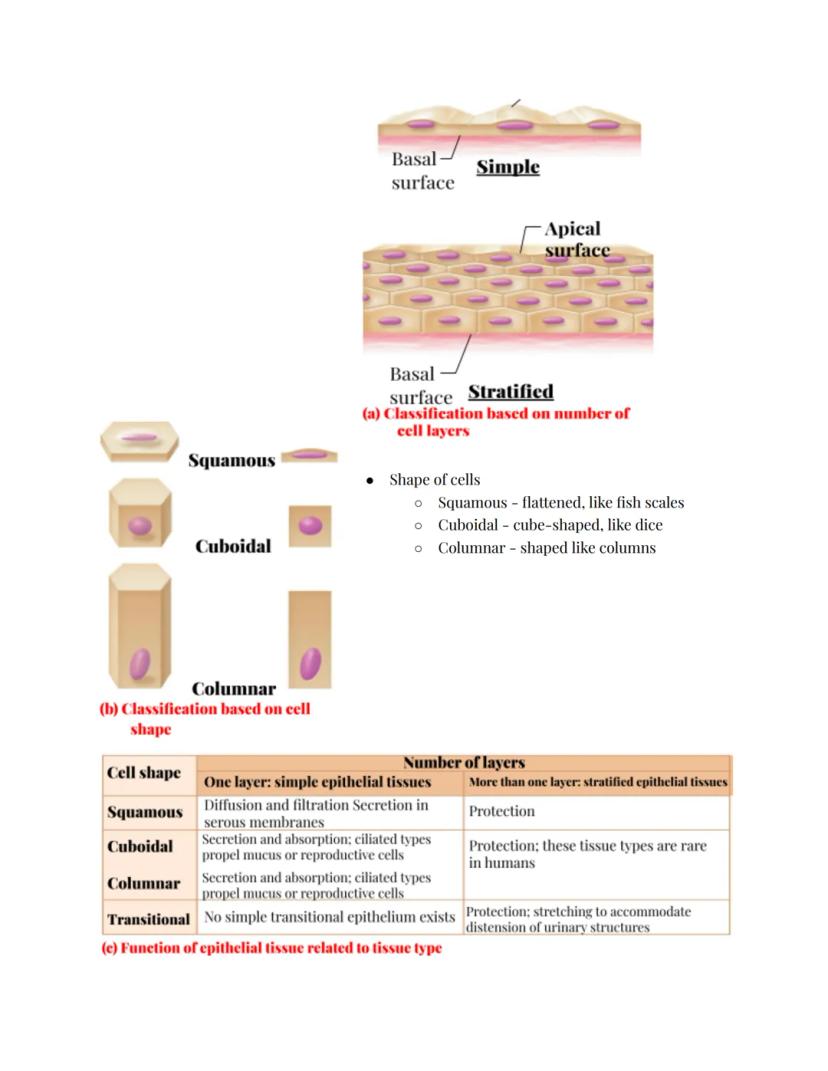
Epithelial tissues are classified in two main ways. First, by the number of cell layers - either simple (one layer) or stratified (multiple layers). Second, by cell shape - squamous (flat like fish scales), cuboidal , or columnar .
💡 Think of epithelial tissues as the body's "boundary specialists" - they control what gets in and out at nearly every surface of your body!
2
of 6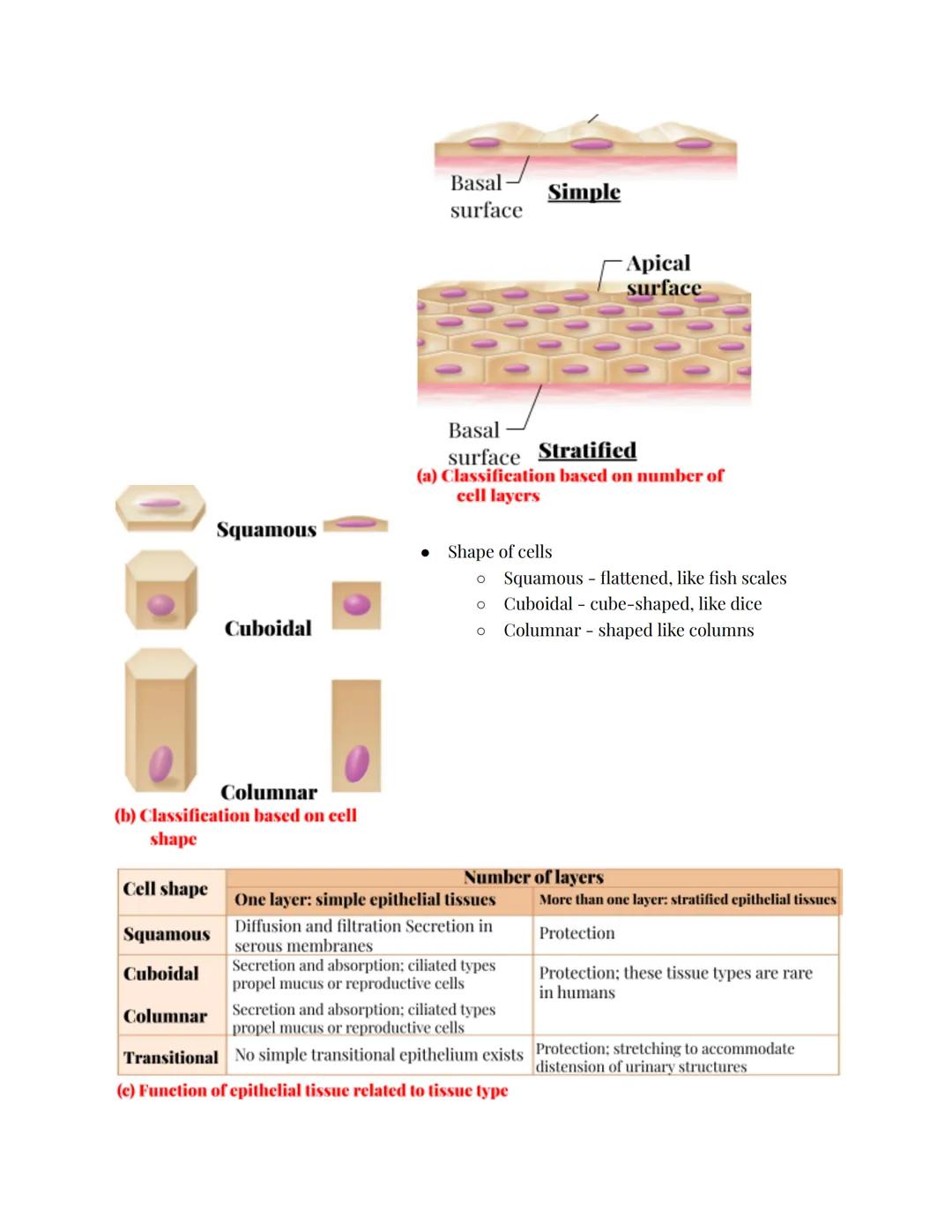
Epithelial Classification and Function
The function of epithelial tissue directly relates to its structure. Simple epithelia are thin and perfect for absorption, secretion, and filtration, while stratified epithelia provide protection against wear and tear.
Squamous epithelial cells excel at allowing diffusion and filtration. You'll find them in places like your lungs where gases need to pass quickly. Cuboidal and columnar cells are better for secretion and absorption - they have more space inside to contain the cellular machinery needed for these functions.
When viewing epithelia under a microscope, you can identify them by both their cell layers and shapes. For example, a layer of flat cells would be simple squamous, while stacked cube-shaped cells would be stratified cuboidal.
A special type called transitional epithelium exists only in stratified form and has a unique ability to stretch and return to its original shape - perfect for organs like your bladder that need to expand and contract.
3
of 6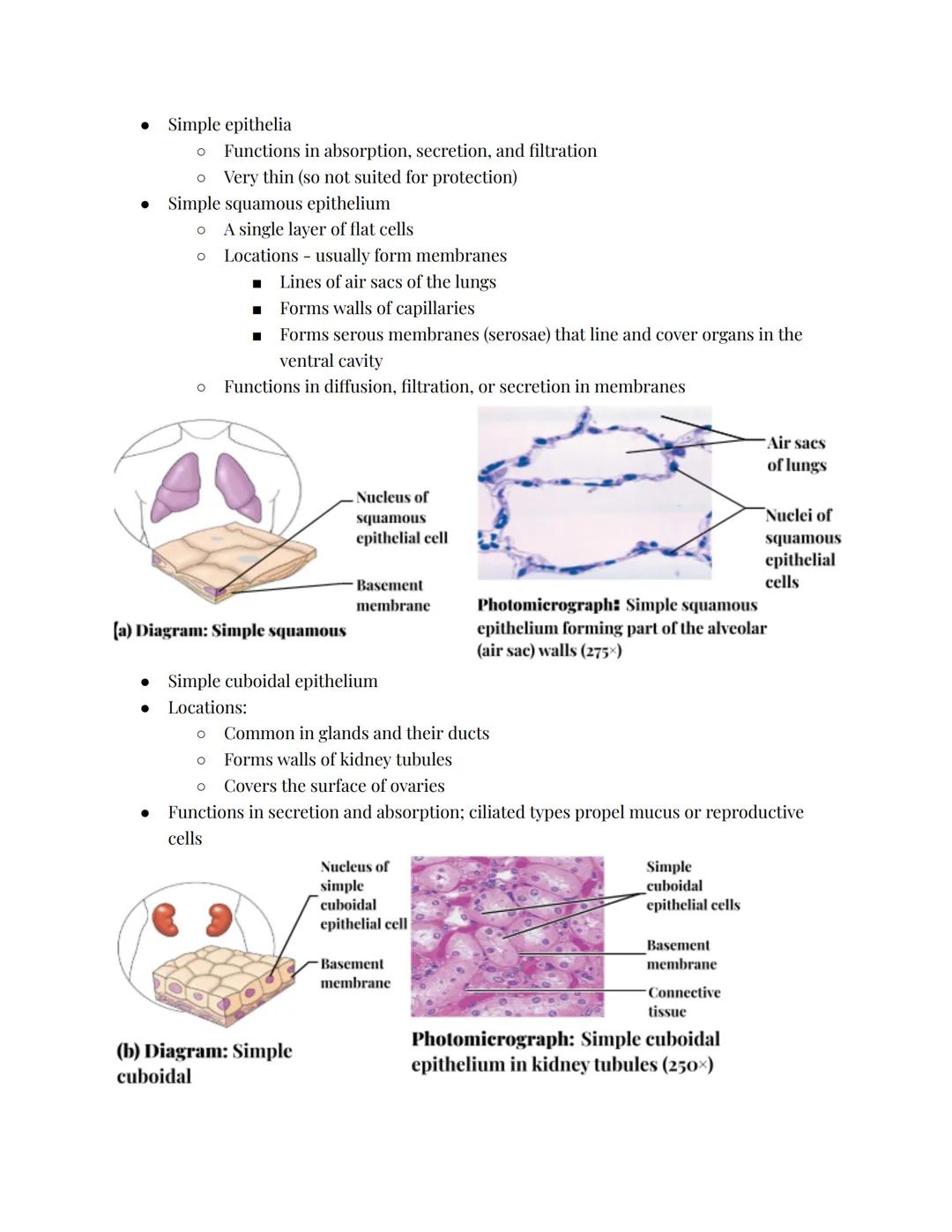
Simple Epithelia
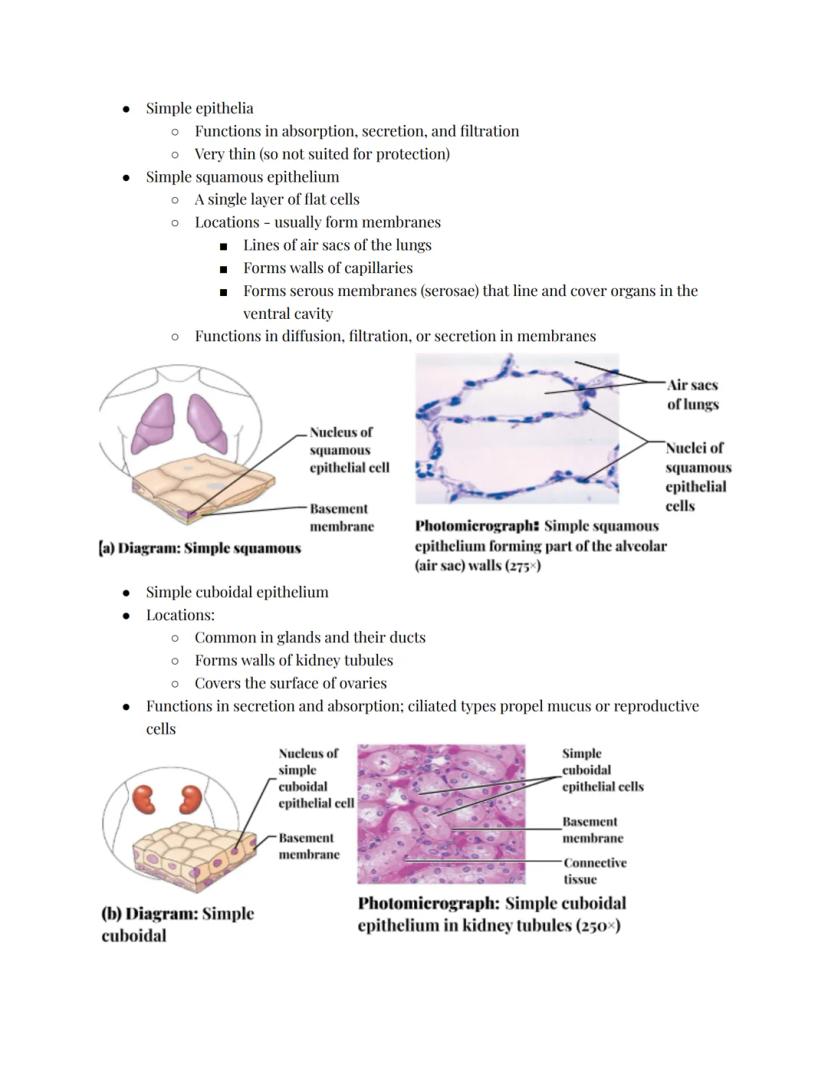
Simple epithelia consist of a single layer of cells that excel at absorption, secretion, and filtration functions. Since they're very thin, they don't provide much protection.
Simple squamous epithelium forms some of the thinnest tissues in your body. These flat cells create important membranes in the air sacs of your lungs (allowing oxygen to pass through easily), the walls of your capillaries, and the serous membranes that line your body cavities. Their flattened shape makes them perfect for allowing substances to pass through quickly.
Simple cuboidal epithelium looks like a layer of tiny blocks when viewed from the side. You'll find these cube-shaped cells in your kidney tubules, covering your ovaries, and in many glands and their ducts. Their shape gives them more volume than squamous cells, making them better suited for secretion and absorption.
🔍 When you breathe, oxygen passes through simple squamous epithelium in your lungs - if these cells were thicker, you wouldn't be able to get oxygen efficiently!
4
of 6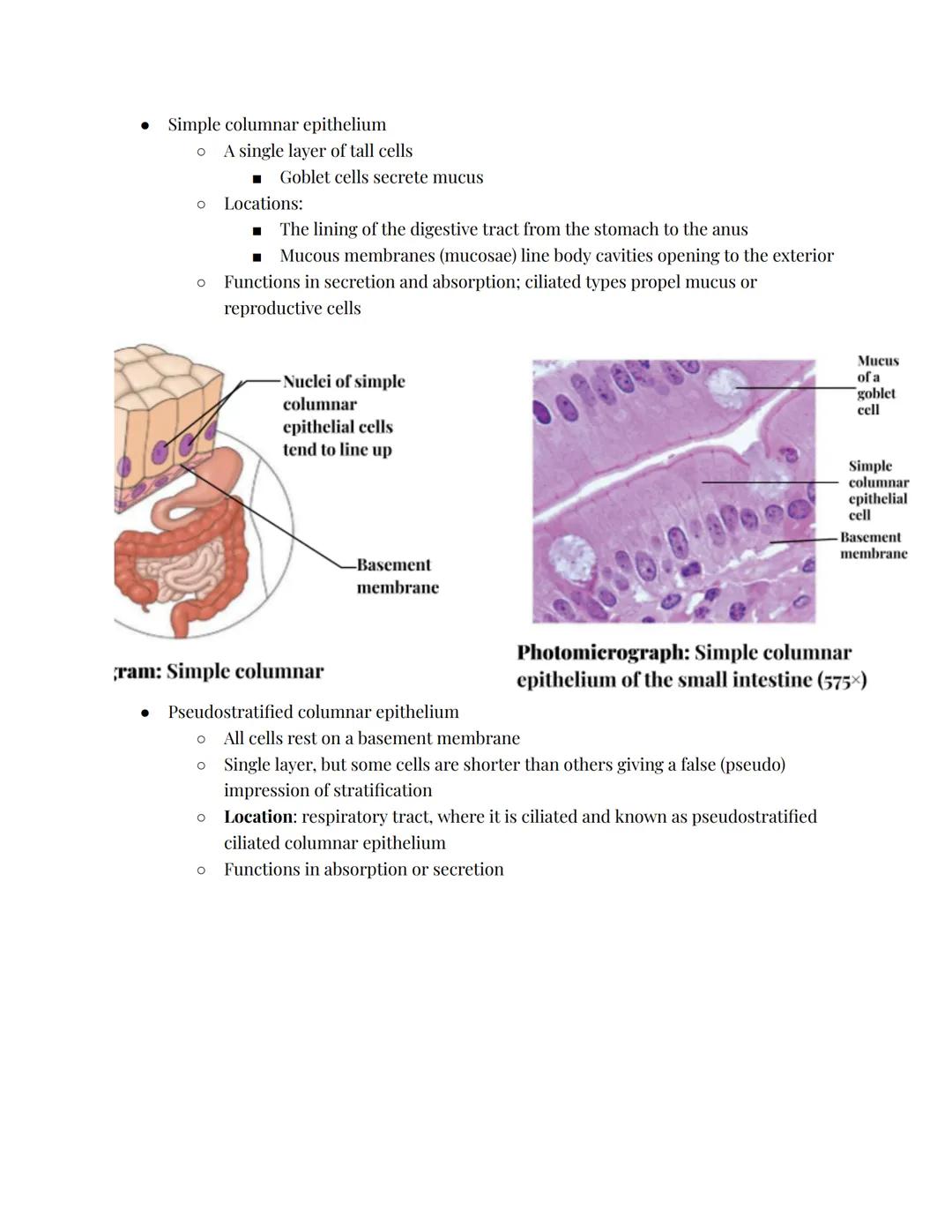
More Simple Epithelia Types
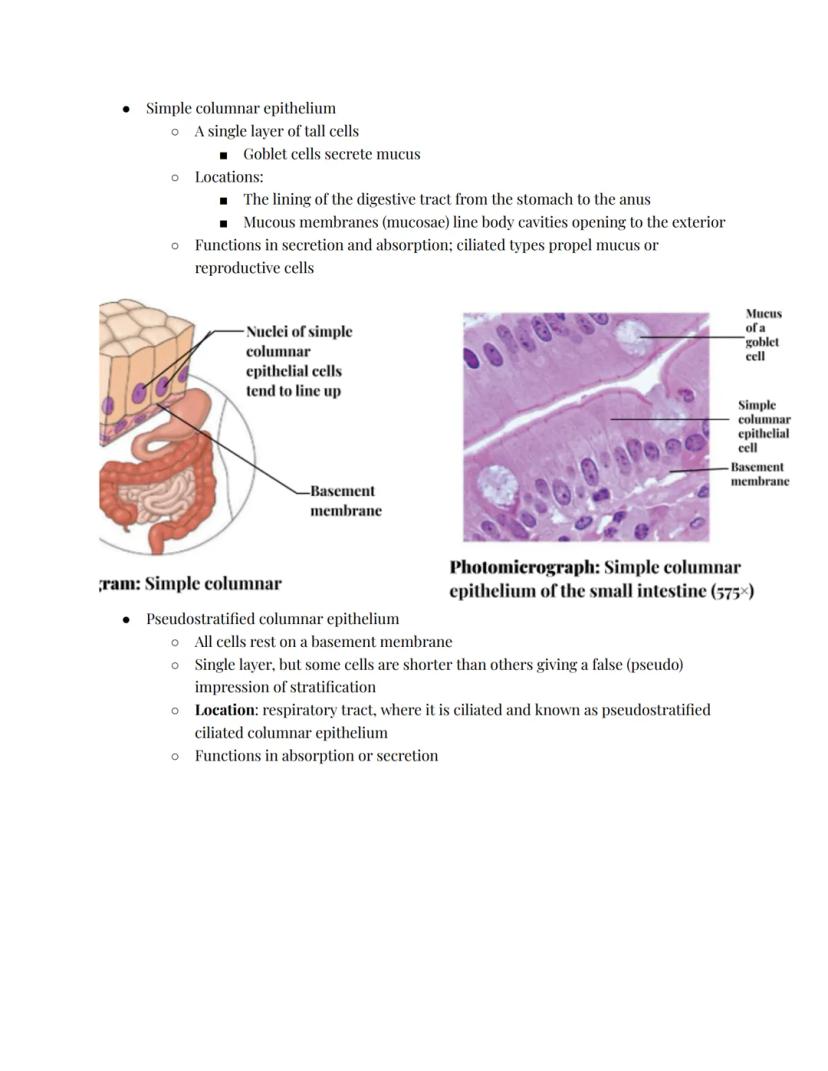
Simple columnar epithelium consists of tall, column-like cells arranged in a single layer. These cells line your digestive tract from stomach to anus, where they absorb nutrients and secrete digestive substances. Many contain special goblet cells that secrete mucus to protect and lubricate surfaces.
The columnar shape gives these cells more interior space to house the machinery needed for absorption and secretion. When these cells have hair-like projections called cilia on their surface, they can move substances across their surface – think of tiny cellular brooms sweeping along mucus.
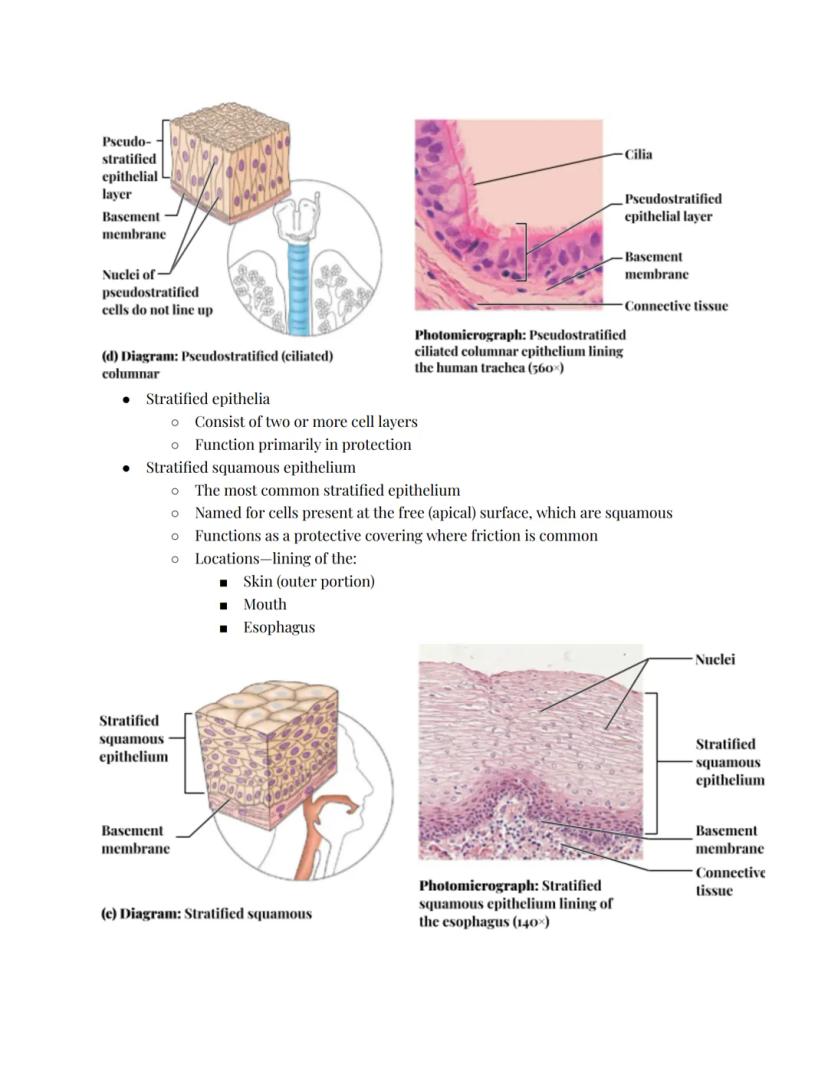
Pseudostratified columnar epithelium looks like it has multiple layers, but it's actually a single layer where some cells don't reach the surface. The "pseudo" in the name means "false" – referring to this illusion of stratification. You'll find this type lining your respiratory tract, where its ciliated cells move mucus and trapped particles up and out of your airways.
Although all cells in pseudostratified epithelium contact the basement membrane, their nuclei appear at different heights, creating a misleading multi-layered appearance when viewed under a microscope.
5
of 6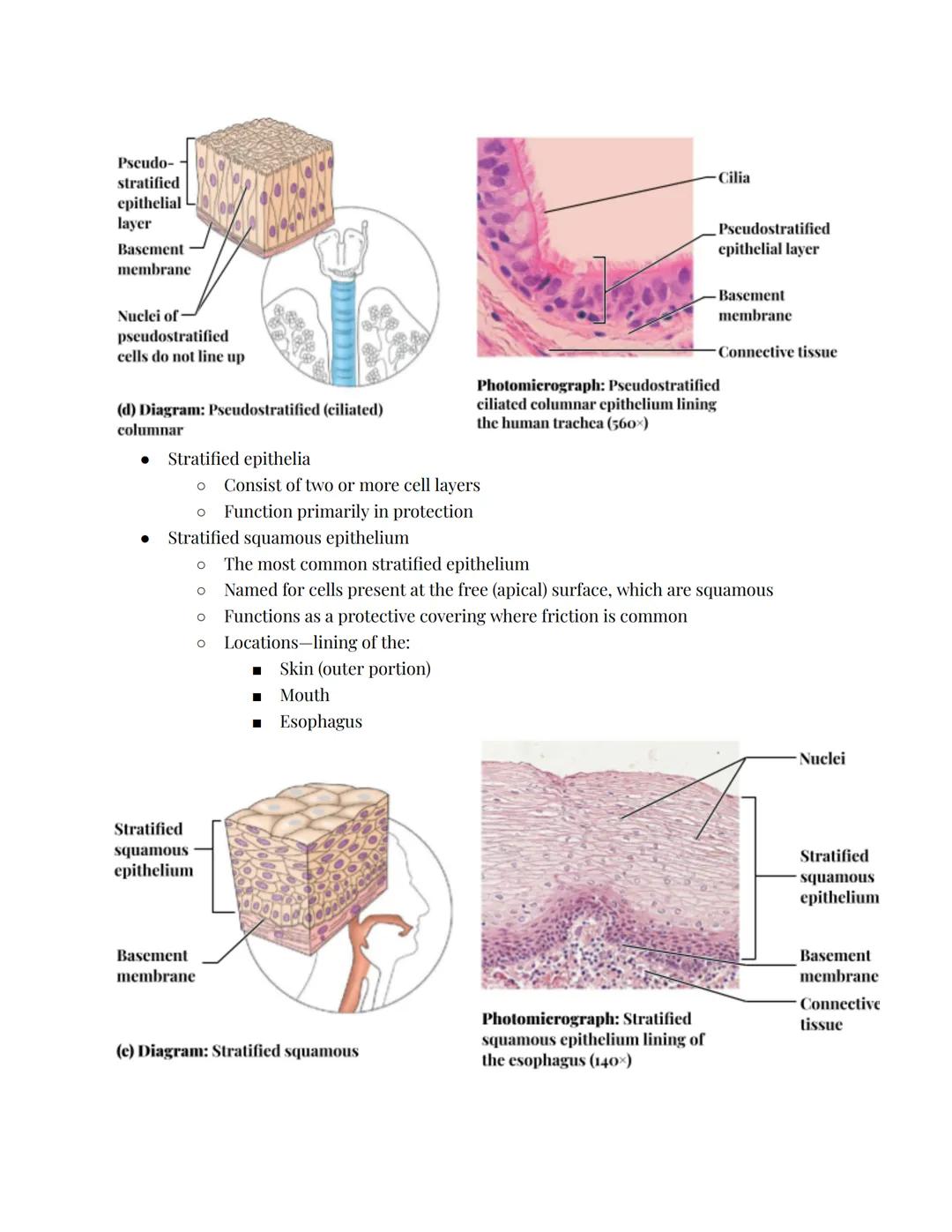
Stratified Epithelia
Stratified epithelia have two or more layers of cells stacked on top of each other. This multi-layered structure makes them tough and durable, perfect for areas that face a lot of wear and tear.
Stratified squamous epithelium is the most common type of stratified tissue in your body. The surface cells are flat (squamous), while deeper layers may have different shapes. You'll find this tough tissue in high-friction areas like your skin's outer layer, the lining of your mouth, and your esophagus. These multiple layers provide excellent protection against physical damage and harmful substances.
The cells in stratified epithelia continuously regenerate. New cells are produced in the deeper layers and gradually move toward the surface, replacing older cells that are worn away. This constant renewal explains why a scraped knee or paper cut heals relatively quickly.
💡 Your skin replaces itself completely every 27 days! This rapid regeneration is possible because of the stratified squamous epithelium that makes up your epidermis.
6
of 6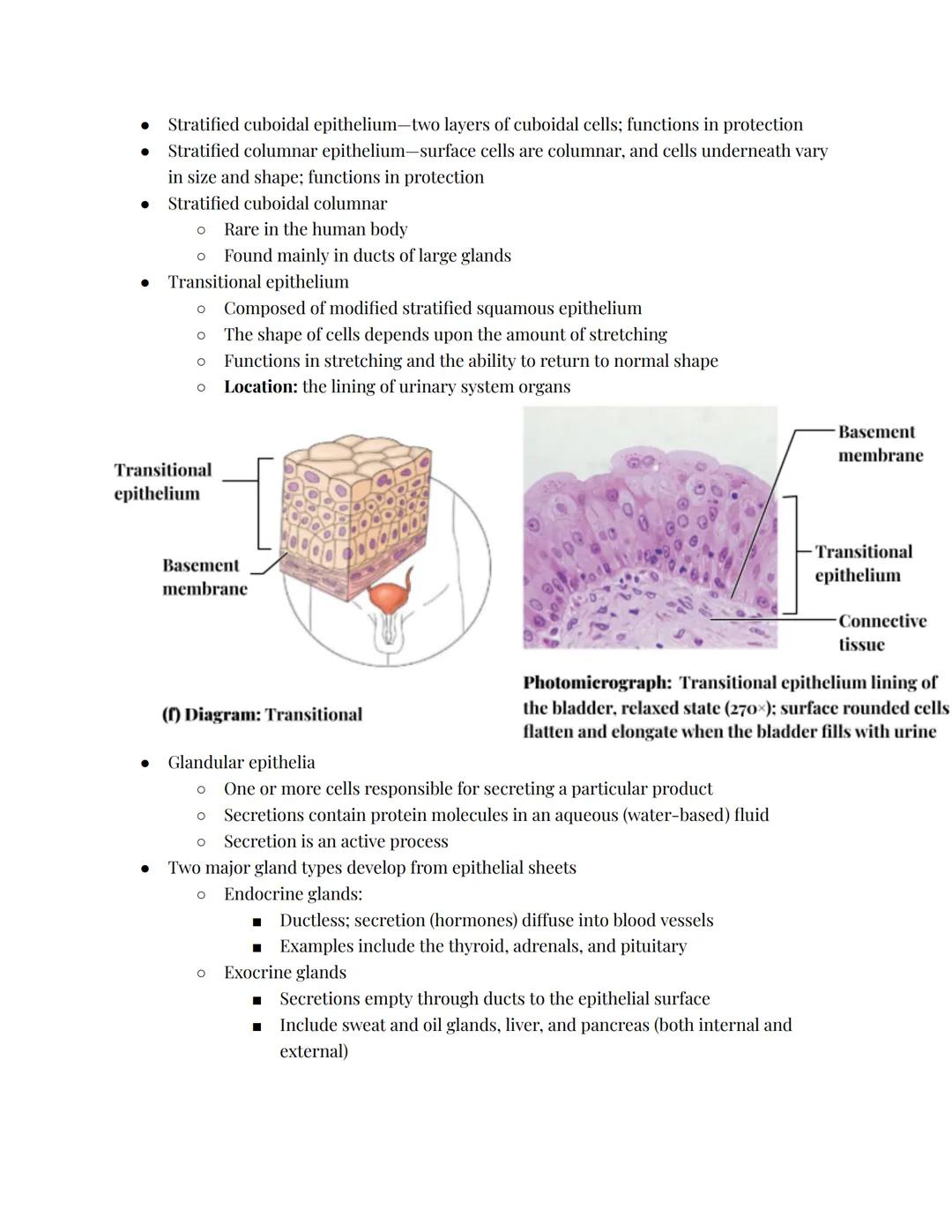
Specialized Epithelia and Glands
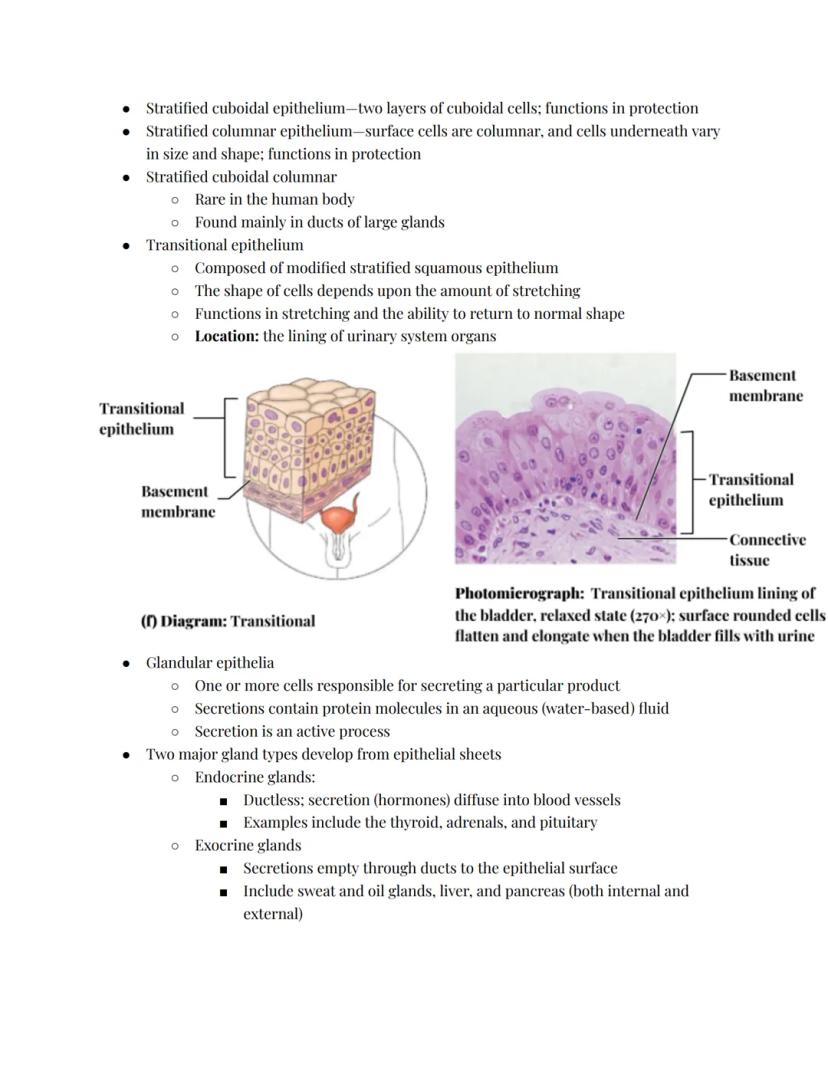
While stratified cuboidal and stratified columnar epithelia exist, they're relatively rare in your body. Stratified cuboidal epithelium appears mainly in large gland ducts, with two layers of cube-shaped cells. Stratified columnar has column-shaped cells at the surface with variably shaped cells underneath.
Transitional epithelium is a special type of stratified tissue designed to stretch. Found in your urinary system, it appears dome-shaped when relaxed but flattens and stretches when organs like your bladder fill with urine. This remarkable ability to change shape allows organs to expand without tearing the epithelial lining.
Glandular epithelia are specialized for secretion. These tissues fold inward from an epithelial sheet to form glands that produce substances your body needs. Endocrine glands (like your thyroid and adrenals) release hormones directly into your bloodstream, while exocrine glands (like sweat glands and the pancreas) release their secretions through ducts to specific locations.
The difference between endocrine and exocrine glands is straightforward: endocrine glands are ductless and release hormones directly into your blood, while exocrine glands have ducts that carry their secretions to specific destinations.
We thought you’d never ask...
What is the Knowunity AI companion?
Our AI companion is specifically built for the needs of students. Based on the millions of content pieces we have on the platform we can provide truly meaningful and relevant answers to students. But its not only about answers, the companion is even more about guiding students through their daily learning challenges, with personalised study plans, quizzes or content pieces in the chat and 100% personalisation based on the students skills and developments.
Where can I download the Knowunity app?
You can download the app in the Google Play Store and in the Apple App Store.
Is Knowunity really free of charge?
That's right! Enjoy free access to study content, connect with fellow students, and get instant help – all at your fingertips.
Most popular content in Biology
9Most popular content
9Can't find what you're looking for? Explore other subjects.
Students love us — and so will you.
4.6/5App Store
4.7/5Google Play
The app is very easy to use and well designed. I have found everything I was looking for so far and have been able to learn a lot from the presentations! I will definitely use the app for a class assignment! And of course it also helps a lot as an inspiration.
Stefan SiOS user
This app is really great. There are so many study notes and help [...]. My problem subject is French, for example, and the app has so many options for help. Thanks to this app, I have improved my French. I would recommend it to anyone.
Samantha KlichAndroid user
Wow, I am really amazed. I just tried the app because I've seen it advertised many times and was absolutely stunned. This app is THE HELP you want for school and above all, it offers so many things, such as workouts and fact sheets, which have been VERY helpful to me personally.
AnnaiOS user
Biology59 views·Updated May 21, 2026·6 pagesEpithelial Tissue Types and Functions
johanna@notj.l11
Epithelial tissues are specialized cell layers that cover body surfaces, line internal cavities, and form glands. These tissues perform essential functions like protection, absorption, secretion, and filtration throughout your body. Understanding how epithelial tissues are structured and classified helps you... Show more
1
of 6Sign up to see the content. It's free!
- Access to all documents
- Improve your grades
- Join milions of students
Epithelial Tissue Basics
Epithelial tissues are the body's protective coverings and linings. You'll find them covering your skin, lining your digestive tract, and forming your glands.
These tissues have distinct hallmarks that set them apart. They typically form sheets with an apical surface and a basement membrane (attached side). Interestingly, epithelial tissues have no direct blood supply (they're avascular) but can regenerate easily when properly nourished.
Epithelial tissues are classified in two main ways. First, by the number of cell layers - either simple (one layer) or stratified (multiple layers). Second, by cell shape - squamous (flat like fish scales), cuboidal , or columnar .
💡 Think of epithelial tissues as the body's "boundary specialists" - they control what gets in and out at nearly every surface of your body!
2
of 6Sign up to see the content. It's free!
- Access to all documents
- Improve your grades
- Join milions of students
Epithelial Classification and Function
The function of epithelial tissue directly relates to its structure. Simple epithelia are thin and perfect for absorption, secretion, and filtration, while stratified epithelia provide protection against wear and tear.
Squamous epithelial cells excel at allowing diffusion and filtration. You'll find them in places like your lungs where gases need to pass quickly. Cuboidal and columnar cells are better for secretion and absorption - they have more space inside to contain the cellular machinery needed for these functions.
When viewing epithelia under a microscope, you can identify them by both their cell layers and shapes. For example, a layer of flat cells would be simple squamous, while stacked cube-shaped cells would be stratified cuboidal.
A special type called transitional epithelium exists only in stratified form and has a unique ability to stretch and return to its original shape - perfect for organs like your bladder that need to expand and contract.
3
of 6Sign up to see the content. It's free!
- Access to all documents
- Improve your grades
- Join milions of students
Simple Epithelia
Simple epithelia consist of a single layer of cells that excel at absorption, secretion, and filtration functions. Since they're very thin, they don't provide much protection.
Simple squamous epithelium forms some of the thinnest tissues in your body. These flat cells create important membranes in the air sacs of your lungs (allowing oxygen to pass through easily), the walls of your capillaries, and the serous membranes that line your body cavities. Their flattened shape makes them perfect for allowing substances to pass through quickly.
Simple cuboidal epithelium looks like a layer of tiny blocks when viewed from the side. You'll find these cube-shaped cells in your kidney tubules, covering your ovaries, and in many glands and their ducts. Their shape gives them more volume than squamous cells, making them better suited for secretion and absorption.
🔍 When you breathe, oxygen passes through simple squamous epithelium in your lungs - if these cells were thicker, you wouldn't be able to get oxygen efficiently!
4
of 6Sign up to see the content. It's free!
- Access to all documents
- Improve your grades
- Join milions of students
More Simple Epithelia Types
Simple columnar epithelium consists of tall, column-like cells arranged in a single layer. These cells line your digestive tract from stomach to anus, where they absorb nutrients and secrete digestive substances. Many contain special goblet cells that secrete mucus to protect and lubricate surfaces.
The columnar shape gives these cells more interior space to house the machinery needed for absorption and secretion. When these cells have hair-like projections called cilia on their surface, they can move substances across their surface – think of tiny cellular brooms sweeping along mucus.
Pseudostratified columnar epithelium looks like it has multiple layers, but it's actually a single layer where some cells don't reach the surface. The "pseudo" in the name means "false" – referring to this illusion of stratification. You'll find this type lining your respiratory tract, where its ciliated cells move mucus and trapped particles up and out of your airways.
Although all cells in pseudostratified epithelium contact the basement membrane, their nuclei appear at different heights, creating a misleading multi-layered appearance when viewed under a microscope.
5
of 6Sign up to see the content. It's free!
- Access to all documents
- Improve your grades
- Join milions of students
Stratified Epithelia
Stratified epithelia have two or more layers of cells stacked on top of each other. This multi-layered structure makes them tough and durable, perfect for areas that face a lot of wear and tear.
Stratified squamous epithelium is the most common type of stratified tissue in your body. The surface cells are flat (squamous), while deeper layers may have different shapes. You'll find this tough tissue in high-friction areas like your skin's outer layer, the lining of your mouth, and your esophagus. These multiple layers provide excellent protection against physical damage and harmful substances.
The cells in stratified epithelia continuously regenerate. New cells are produced in the deeper layers and gradually move toward the surface, replacing older cells that are worn away. This constant renewal explains why a scraped knee or paper cut heals relatively quickly.
💡 Your skin replaces itself completely every 27 days! This rapid regeneration is possible because of the stratified squamous epithelium that makes up your epidermis.
6
of 6Sign up to see the content. It's free!
- Access to all documents
- Improve your grades
- Join milions of students
Specialized Epithelia and Glands
While stratified cuboidal and stratified columnar epithelia exist, they're relatively rare in your body. Stratified cuboidal epithelium appears mainly in large gland ducts, with two layers of cube-shaped cells. Stratified columnar has column-shaped cells at the surface with variably shaped cells underneath.
Transitional epithelium is a special type of stratified tissue designed to stretch. Found in your urinary system, it appears dome-shaped when relaxed but flattens and stretches when organs like your bladder fill with urine. This remarkable ability to change shape allows organs to expand without tearing the epithelial lining.
Glandular epithelia are specialized for secretion. These tissues fold inward from an epithelial sheet to form glands that produce substances your body needs. Endocrine glands (like your thyroid and adrenals) release hormones directly into your bloodstream, while exocrine glands (like sweat glands and the pancreas) release their secretions through ducts to specific locations.
The difference between endocrine and exocrine glands is straightforward: endocrine glands are ductless and release hormones directly into your blood, while exocrine glands have ducts that carry their secretions to specific destinations.
We thought you’d never ask...
What is the Knowunity AI companion?
Our AI companion is specifically built for the needs of students. Based on the millions of content pieces we have on the platform we can provide truly meaningful and relevant answers to students. But its not only about answers, the companion is even more about guiding students through their daily learning challenges, with personalised study plans, quizzes or content pieces in the chat and 100% personalisation based on the students skills and developments.
Where can I download the Knowunity app?
You can download the app in the Google Play Store and in the Apple App Store.
Is Knowunity really free of charge?
That's right! Enjoy free access to study content, connect with fellow students, and get instant help – all at your fingertips.
Most popular content in Biology
9Most popular content
9Can't find what you're looking for? Explore other subjects.
Students love us — and so will you.
4.6/5App Store
4.7/5Google Play
The app is very easy to use and well designed. I have found everything I was looking for so far and have been able to learn a lot from the presentations! I will definitely use the app for a class assignment! And of course it also helps a lot as an inspiration.
Stefan SiOS user
This app is really great. There are so many study notes and help [...]. My problem subject is French, for example, and the app has so many options for help. Thanks to this app, I have improved my French. I would recommend it to anyone.
Samantha KlichAndroid user
Wow, I am really amazed. I just tried the app because I've seen it advertised many times and was absolutely stunned. This app is THE HELP you want for school and above all, it offers so many things, such as workouts and fact sheets, which have been VERY helpful to me personally.
AnnaiOS user