
Ecosystems are fascinating webs of life where energy flows from... Show more
 Biology113 views·Updated May 30, 2026·4 pages
Understanding the Energy Flow in Ecosystems

1 / 4
1
of 4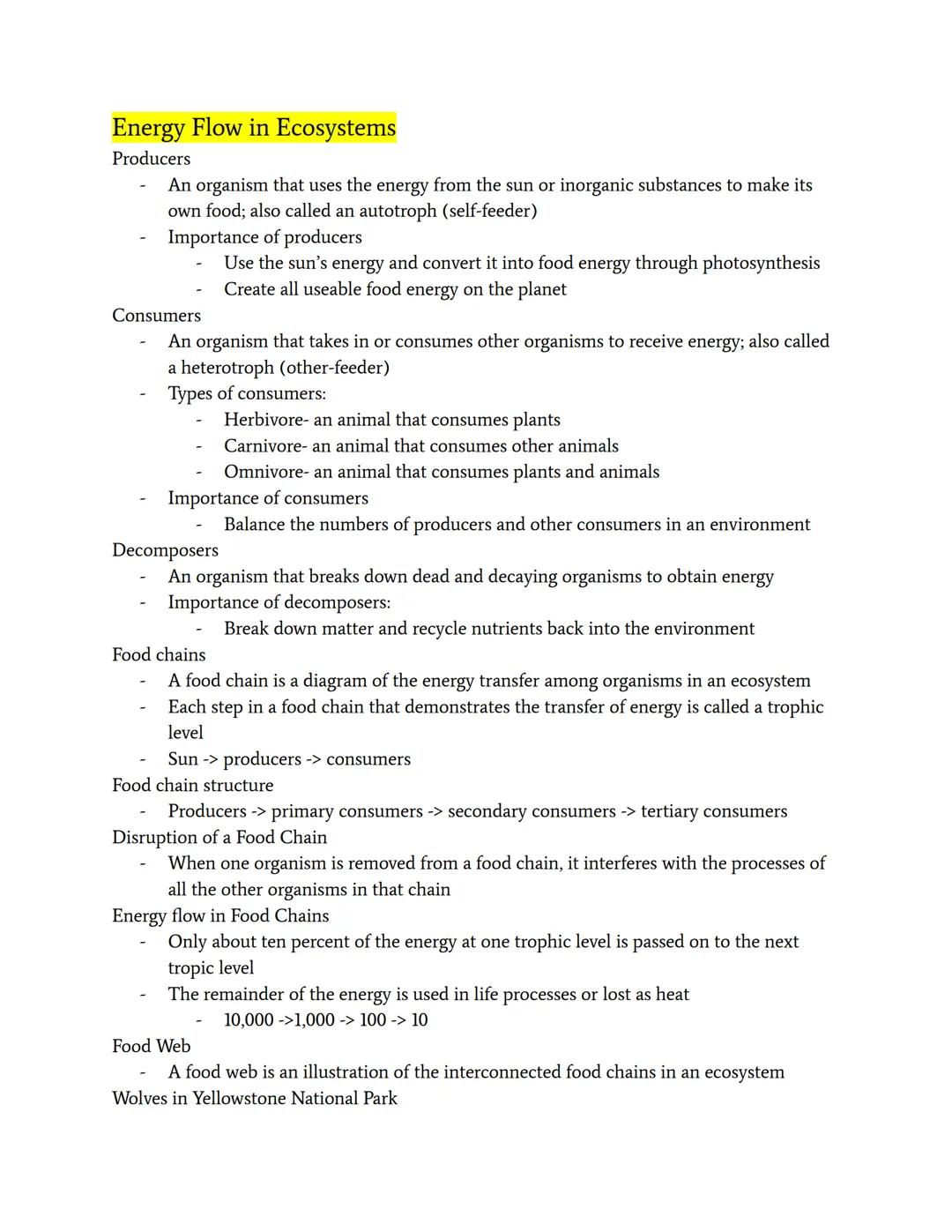
Energy Flow in Ecosystems
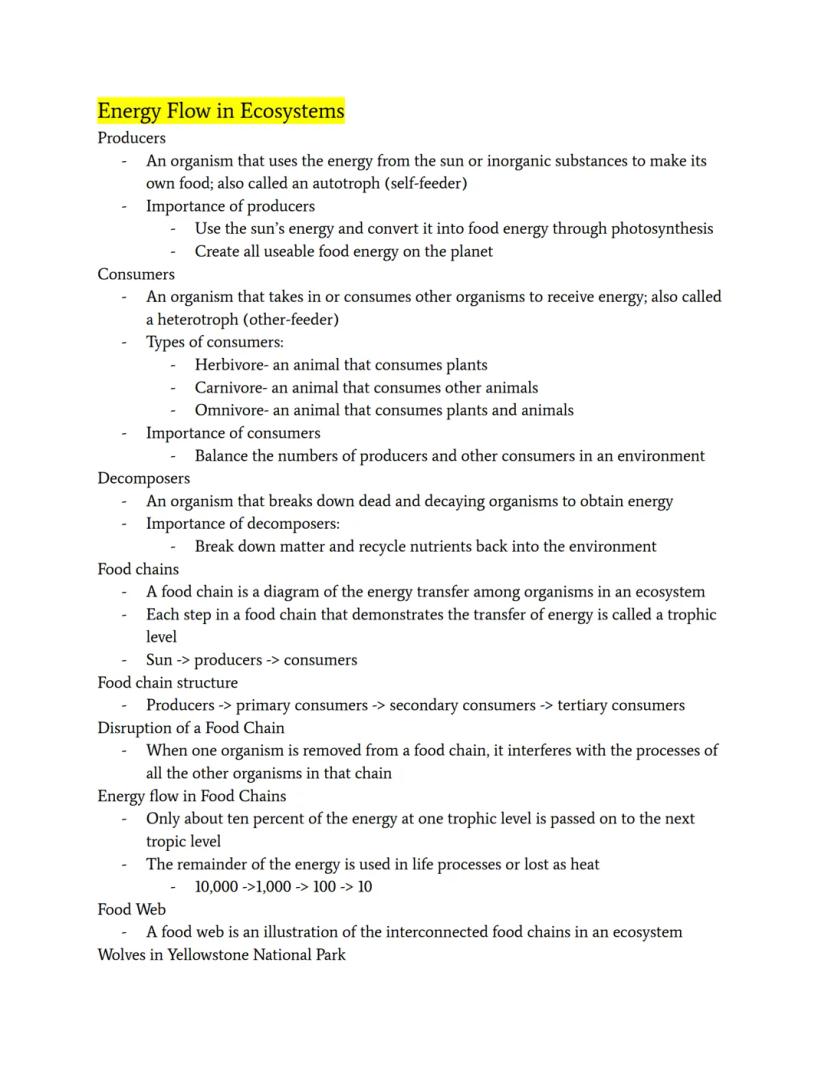
Everything in an ecosystem revolves around energy transfer. Producers (also called autotrophs) are organisms that create their own food using sunlight through photosynthesis. They're the foundation of all food energy on Earth, converting solar energy into usable food energy for other organisms.
Consumers (heterotrophs) obtain energy by eating other organisms. They come in three main types: herbivores , carnivores , and omnivores (eat both plants and animals). Consumers help balance populations of producers and other consumers in the environment.
Decomposers break down dead organisms, recycling nutrients back into the ecosystem. Food chains and food webs illustrate how energy transfers through trophic levels - from producers to primary consumers, then to secondary and tertiary consumers. Each transfer is inefficient, with only about 10% of energy passing to the next level (the "10% rule").
💡 When one organism disappears from a food chain, it affects every other organism connected to it. This ripple effect shows why even seemingly "unimportant" species matter to ecosystem health!
2
of 4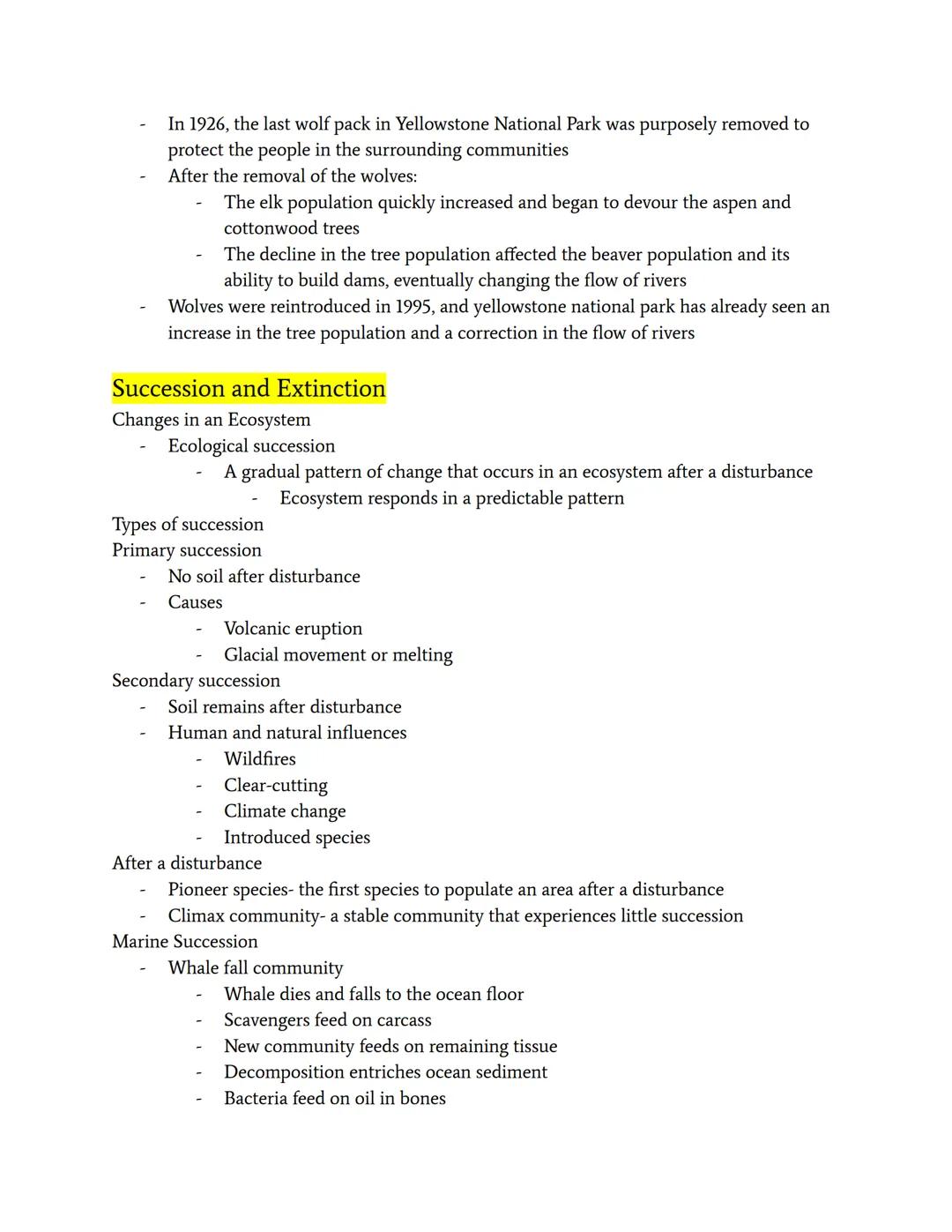
Ecosystem Changes and Succession
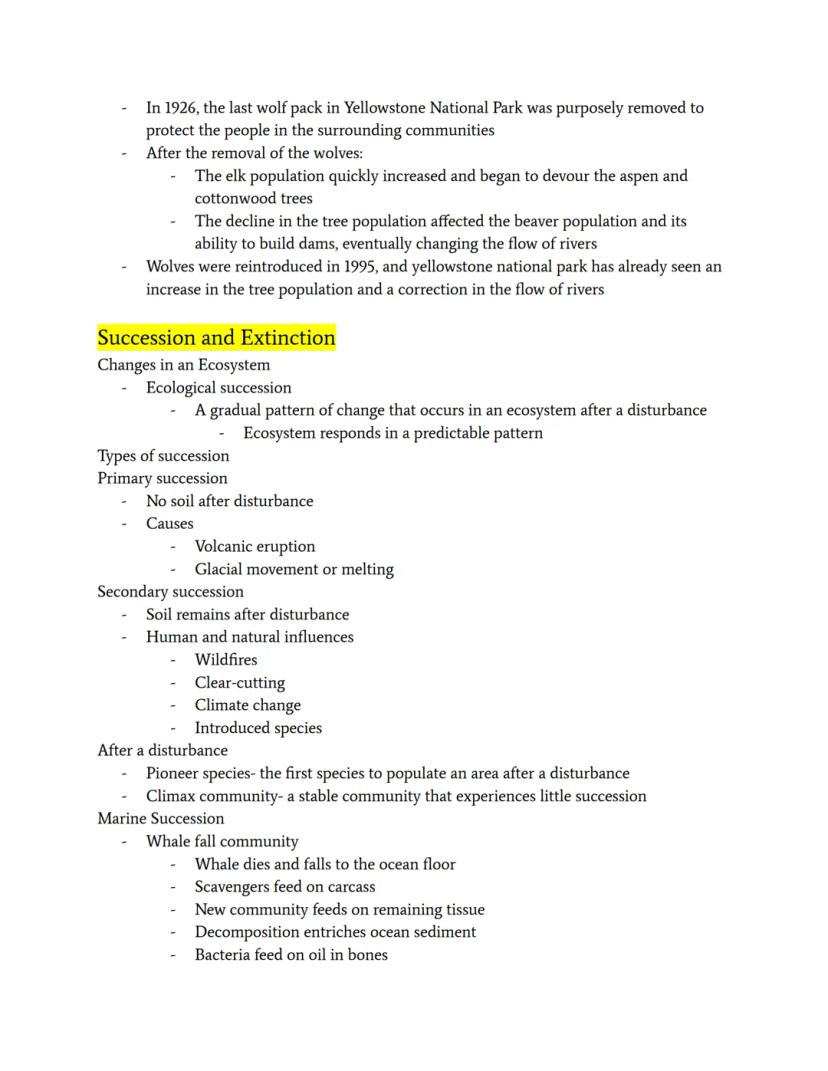
Ever wonder what happens when nature gets disrupted? Yellowstone National Park provides a fascinating example. When wolves were removed in 1926, elk populations exploded and devastated tree populations, which in turn affected beaver populations and even changed river flows! When wolves were reintroduced in 1995, the ecosystem began to recover, showing how interconnected species truly are.
Ecological succession describes how ecosystems recover after disturbances in predictable patterns. Primary succession occurs when no soil remains (like after volcanic eruptions or glacier movements), while secondary succession happens when soil remains intact . The first species to arrive are called pioneer species, eventually leading to a stable climax community.
Marine ecosystems experience succession too. When a whale dies and sinks to the ocean floor, it creates a "whale fall community" where scavengers feed on the carcass, followed by other organisms that feed on remaining tissue, while bacteria feed on oils in the bones - creating an entire ecosystem from a single dead animal!
🌊 Ocean succession is like nature's recycling system - a single whale carcass can support a thriving community of marine life for decades as different species take turns utilizing every part of the remains.
3
of 4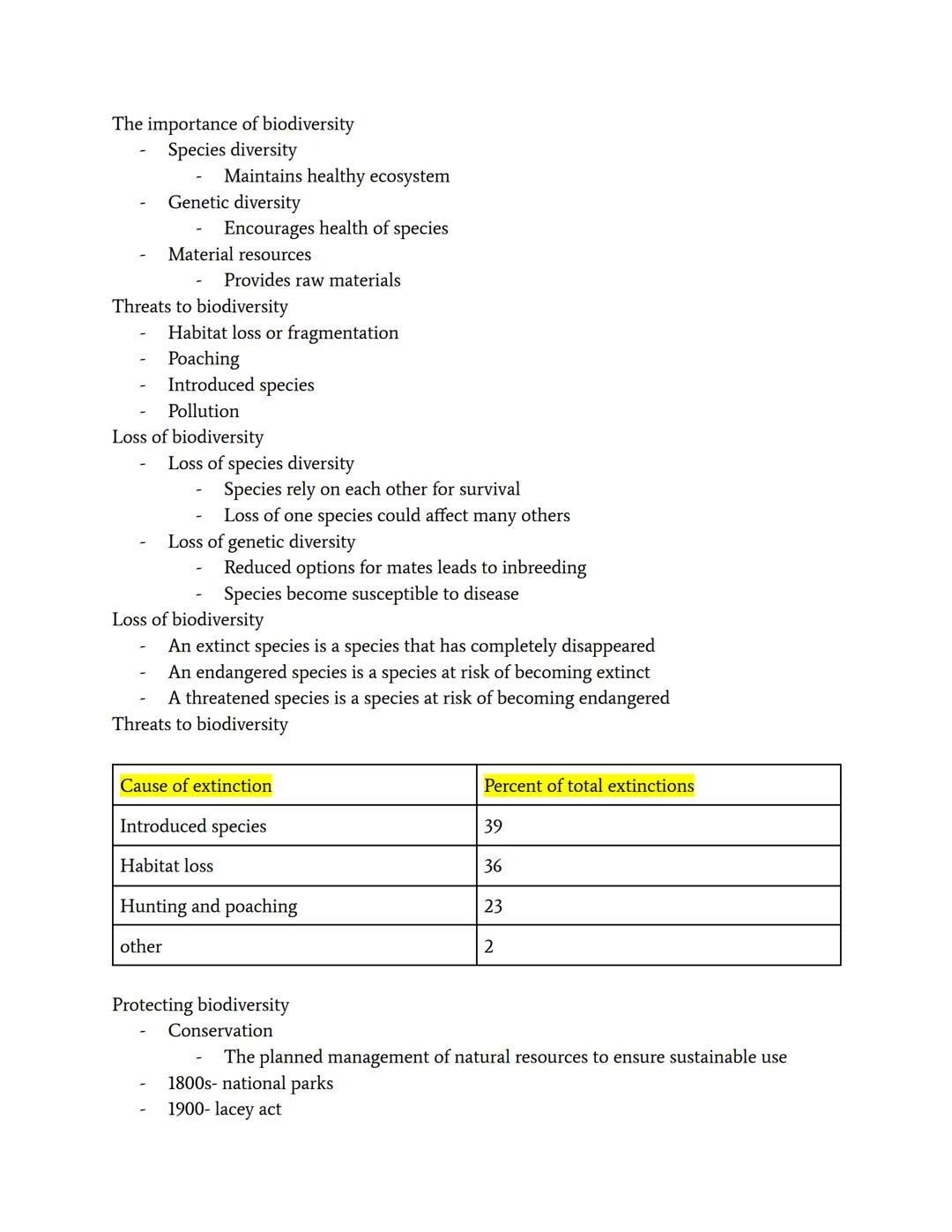
The Importance of Biodiversity
Biodiversity is crucial for healthy ecosystems. Species diversity maintains ecosystem balance, while genetic diversity ensures species health and resilience. Biodiversity also provides valuable material resources that humans rely on daily.
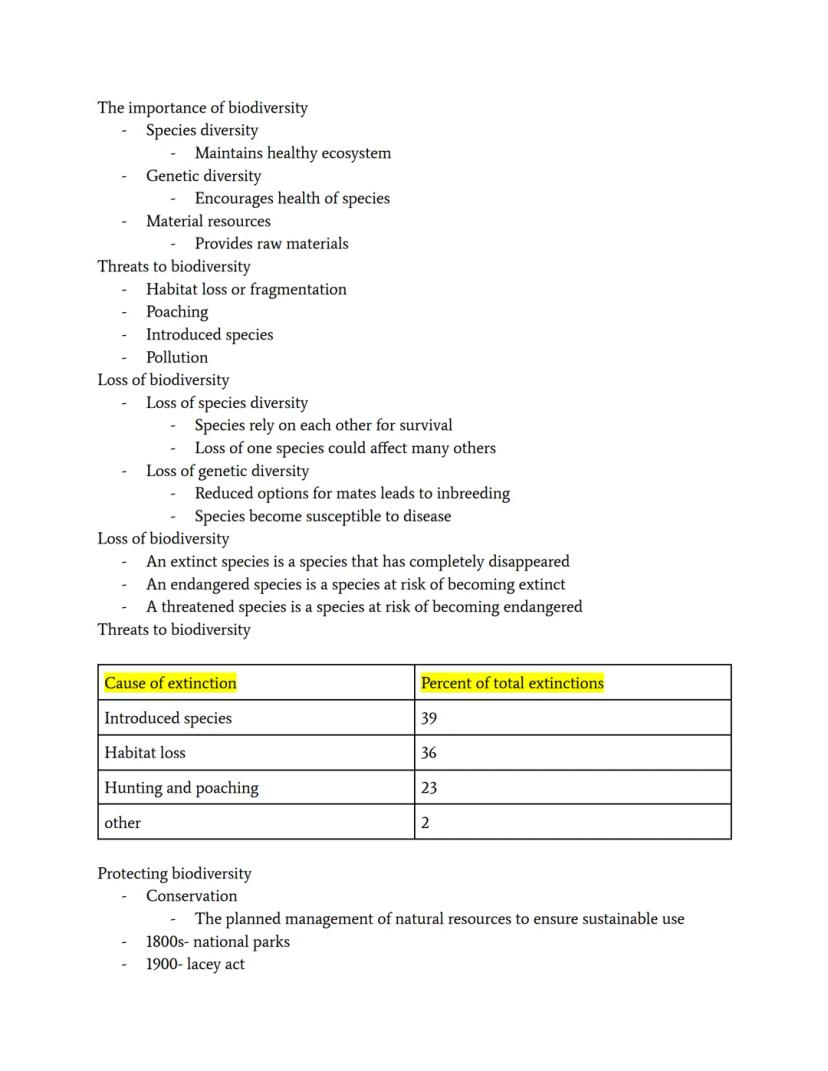
Unfortunately, biodiversity faces serious threats. Habitat loss, poaching, introduced species, and pollution all endanger the delicate balance of ecosystems. When biodiversity decreases, the effects cascade throughout the ecosystem. The loss of even one species can affect many others that depend on it. Similarly, reduced genetic diversity leads to inbreeding and makes species more vulnerable to diseases.
Species can be classified based on their extinction risk: extinct species have completely disappeared, endangered species are at high risk of extinction, and threatened species are likely to become endangered. According to research, introduced species cause 39% of extinctions, habitat loss causes 36%, and hunting/poaching causes 23%.
🌿 Think of biodiversity as Earth's insurance policy - the more diverse our ecosystems, the better they can adapt to changes and challenges. Every species you help protect strengthens our planet's resilience!
4
of 4
Protecting Biodiversity
Conservation efforts aim to manage natural resources sustainably to protect biodiversity. The establishment of national parks in the 1800s marked one of the first major conservation efforts in the United States.
Later protections came through legislation like the Lacey Act (1900), which prohibits trade in wildlife taken illegally. The Endangered Species Act of 1973 provided comprehensive protection for endangered species, while CITES (Convention on International Trade in Endangered Species) established in 1975 regulates international wildlife trade.
These conservation milestones represent our growing understanding of biodiversity's importance and our responsibility to protect it for future generations.
🦅 Conservation isn't just about saving individual species - it's about preserving the complex relationships between all living things. You can make a difference through everyday choices that support biodiversity!
We thought you’d never ask...
What is the Knowunity AI companion?
Our AI companion is specifically built for the needs of students. Based on the millions of content pieces we have on the platform we can provide truly meaningful and relevant answers to students. But its not only about answers, the companion is even more about guiding students through their daily learning challenges, with personalised study plans, quizzes or content pieces in the chat and 100% personalisation based on the students skills and developments.
Where can I download the Knowunity app?
You can download the app in the Google Play Store and in the Apple App Store.
Is Knowunity really free of charge?
That's right! Enjoy free access to study content, connect with fellow students, and get instant help – all at your fingertips.
Similar Content
Most popular content in Biology
9Most popular content
9Can't find what you're looking for? Explore other subjects.
Students love us — and so will you.
4.6/5App Store
4.7/5Google Play
The app is very easy to use and well designed. I have found everything I was looking for so far and have been able to learn a lot from the presentations! I will definitely use the app for a class assignment! And of course it also helps a lot as an inspiration.
Stefan SiOS user
This app is really great. There are so many study notes and help [...]. My problem subject is French, for example, and the app has so many options for help. Thanks to this app, I have improved my French. I would recommend it to anyone.
Samantha KlichAndroid user
Wow, I am really amazed. I just tried the app because I've seen it advertised many times and was absolutely stunned. This app is THE HELP you want for school and above all, it offers so many things, such as workouts and fact sheets, which have been VERY helpful to me personally.
AnnaiOS user
Biology113 views·Updated May 30, 2026·4 pagesUnderstanding the Energy Flow in Ecosystems
Ecosystems are fascinating webs of life where energy flows from one organism to another. Understanding how these interconnected systems work helps us see why each plant, animal, and microorganism plays a vital role in maintaining balance on our planet. This... Show more
1
of 4Sign up to see the content. It's free!
- Access to all documents
- Improve your grades
- Join milions of students
Energy Flow in Ecosystems
Everything in an ecosystem revolves around energy transfer. Producers (also called autotrophs) are organisms that create their own food using sunlight through photosynthesis. They're the foundation of all food energy on Earth, converting solar energy into usable food energy for other organisms.
Consumers (heterotrophs) obtain energy by eating other organisms. They come in three main types: herbivores , carnivores , and omnivores (eat both plants and animals). Consumers help balance populations of producers and other consumers in the environment.
Decomposers break down dead organisms, recycling nutrients back into the ecosystem. Food chains and food webs illustrate how energy transfers through trophic levels - from producers to primary consumers, then to secondary and tertiary consumers. Each transfer is inefficient, with only about 10% of energy passing to the next level (the "10% rule").
💡 When one organism disappears from a food chain, it affects every other organism connected to it. This ripple effect shows why even seemingly "unimportant" species matter to ecosystem health!
2
of 4Sign up to see the content. It's free!
- Access to all documents
- Improve your grades
- Join milions of students
Ecosystem Changes and Succession
Ever wonder what happens when nature gets disrupted? Yellowstone National Park provides a fascinating example. When wolves were removed in 1926, elk populations exploded and devastated tree populations, which in turn affected beaver populations and even changed river flows! When wolves were reintroduced in 1995, the ecosystem began to recover, showing how interconnected species truly are.
Ecological succession describes how ecosystems recover after disturbances in predictable patterns. Primary succession occurs when no soil remains (like after volcanic eruptions or glacier movements), while secondary succession happens when soil remains intact . The first species to arrive are called pioneer species, eventually leading to a stable climax community.
Marine ecosystems experience succession too. When a whale dies and sinks to the ocean floor, it creates a "whale fall community" where scavengers feed on the carcass, followed by other organisms that feed on remaining tissue, while bacteria feed on oils in the bones - creating an entire ecosystem from a single dead animal!
🌊 Ocean succession is like nature's recycling system - a single whale carcass can support a thriving community of marine life for decades as different species take turns utilizing every part of the remains.
3
of 4Sign up to see the content. It's free!
- Access to all documents
- Improve your grades
- Join milions of students
The Importance of Biodiversity
Biodiversity is crucial for healthy ecosystems. Species diversity maintains ecosystem balance, while genetic diversity ensures species health and resilience. Biodiversity also provides valuable material resources that humans rely on daily.
Unfortunately, biodiversity faces serious threats. Habitat loss, poaching, introduced species, and pollution all endanger the delicate balance of ecosystems. When biodiversity decreases, the effects cascade throughout the ecosystem. The loss of even one species can affect many others that depend on it. Similarly, reduced genetic diversity leads to inbreeding and makes species more vulnerable to diseases.
Species can be classified based on their extinction risk: extinct species have completely disappeared, endangered species are at high risk of extinction, and threatened species are likely to become endangered. According to research, introduced species cause 39% of extinctions, habitat loss causes 36%, and hunting/poaching causes 23%.
🌿 Think of biodiversity as Earth's insurance policy - the more diverse our ecosystems, the better they can adapt to changes and challenges. Every species you help protect strengthens our planet's resilience!
4
of 4Sign up to see the content. It's free!
- Access to all documents
- Improve your grades
- Join milions of students
Protecting Biodiversity
Conservation efforts aim to manage natural resources sustainably to protect biodiversity. The establishment of national parks in the 1800s marked one of the first major conservation efforts in the United States.
Later protections came through legislation like the Lacey Act (1900), which prohibits trade in wildlife taken illegally. The Endangered Species Act of 1973 provided comprehensive protection for endangered species, while CITES (Convention on International Trade in Endangered Species) established in 1975 regulates international wildlife trade.
These conservation milestones represent our growing understanding of biodiversity's importance and our responsibility to protect it for future generations.
🦅 Conservation isn't just about saving individual species - it's about preserving the complex relationships between all living things. You can make a difference through everyday choices that support biodiversity!
We thought you’d never ask...
What is the Knowunity AI companion?
Our AI companion is specifically built for the needs of students. Based on the millions of content pieces we have on the platform we can provide truly meaningful and relevant answers to students. But its not only about answers, the companion is even more about guiding students through their daily learning challenges, with personalised study plans, quizzes or content pieces in the chat and 100% personalisation based on the students skills and developments.
Where can I download the Knowunity app?
You can download the app in the Google Play Store and in the Apple App Store.
Is Knowunity really free of charge?
That's right! Enjoy free access to study content, connect with fellow students, and get instant help – all at your fingertips.
Similar Content
Most popular content in Biology
9Most popular content
9Can't find what you're looking for? Explore other subjects.
Students love us — and so will you.
4.6/5App Store
4.7/5Google Play
The app is very easy to use and well designed. I have found everything I was looking for so far and have been able to learn a lot from the presentations! I will definitely use the app for a class assignment! And of course it also helps a lot as an inspiration.
Stefan SiOS user
This app is really great. There are so many study notes and help [...]. My problem subject is French, for example, and the app has so many options for help. Thanks to this app, I have improved my French. I would recommend it to anyone.
Samantha KlichAndroid user
Wow, I am really amazed. I just tried the app because I've seen it advertised many times and was absolutely stunned. This app is THE HELP you want for school and above all, it offers so many things, such as workouts and fact sheets, which have been VERY helpful to me personally.
AnnaiOS user