
The nervous system is your body's command center, controlling everything...
 AP Psychology95 views·Updated Jul 6, 2026·4 pages
UNIT 2 (2.3) - Understanding the Nervous System Functions

Kylie Williams@kyliewilliams_8
1 / 4
1
of 4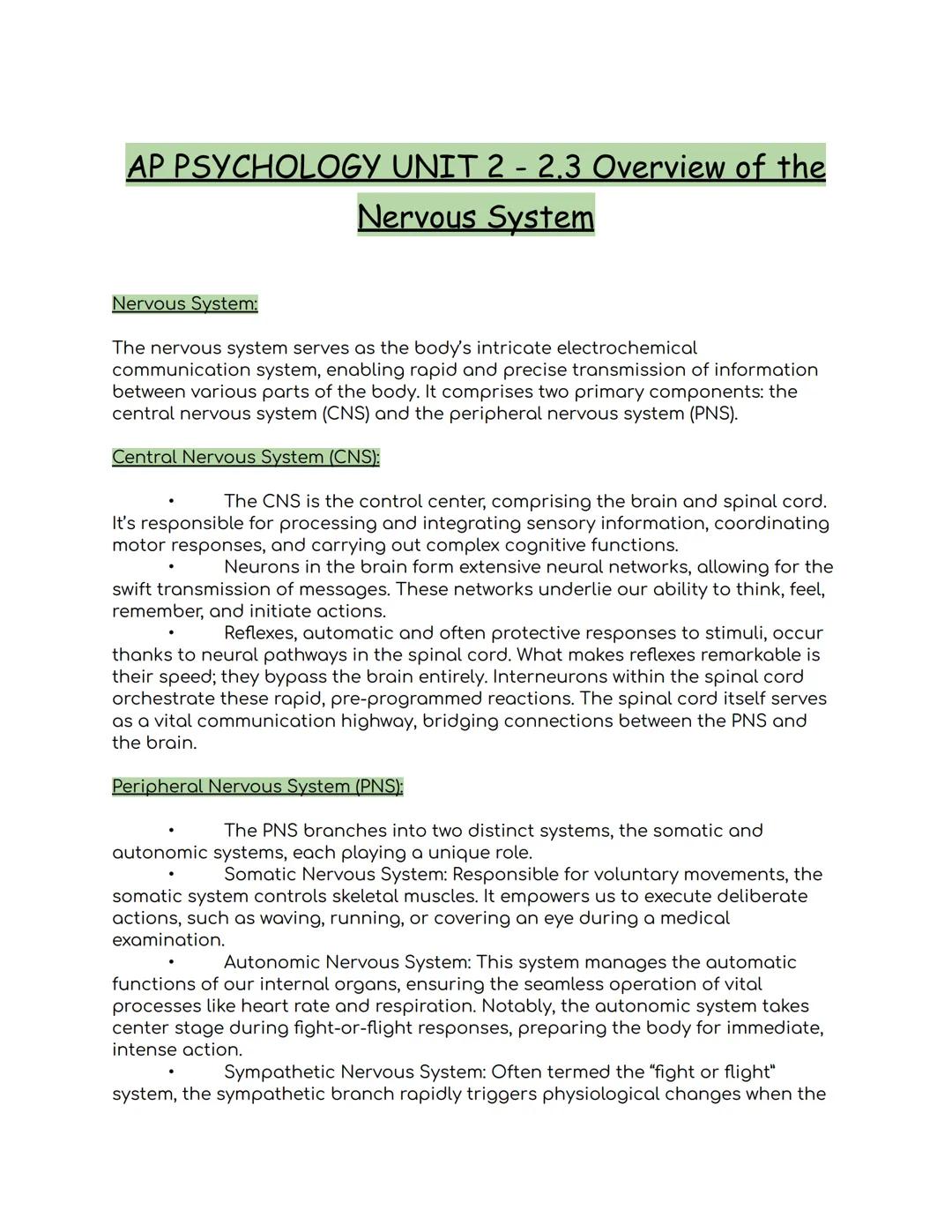
Overview of the Nervous System
Your nervous system is like an incredibly complex electrical wiring system that transmits information throughout your body. It has two main parts: the central nervous system (CNS) - your brain and spinal cord - and the peripheral nervous system (PNS), which connects the CNS to the rest of your body.
The brain is your body's control center, where neural networks enable you to think, feel, remember, and act. These networks process massive amounts of information in milliseconds! Meanwhile, your spinal cord serves as the communication highway between your brain and body.
Reflexes are one of the coolest features of your nervous system - they're automatic responses that bypass your brain completely. When you touch something hot, your hand pulls away before you even feel pain because interneurons in your spinal cord create this lightning-fast reaction.
Did You Know? Your nervous system transmits information at speeds up to 268 miles per hour - faster than Formula 1 race cars! This incredible speed is why you can react so quickly to sudden dangers.
2
of 4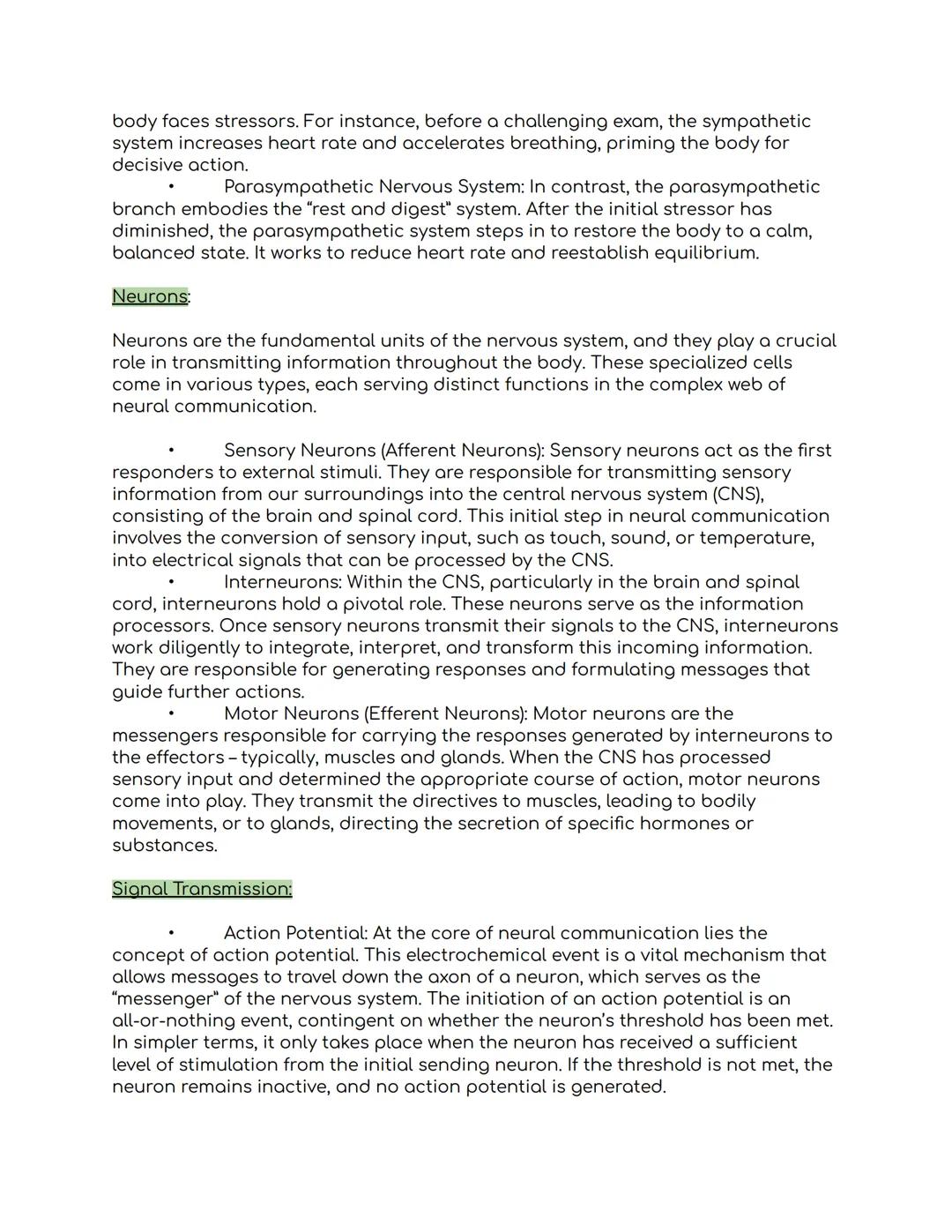
Neural Communication
Think of neurons as the messengers of your body - they're specialized cells that transmit information from one part of your body to another. There are three main types that work together to create a communication network.
Sensory neurons are like scouts, constantly collecting information about your environment. They detect everything from the temperature outside to the pressure of your shoes against your feet. Interneurons are the processors - they take this information and decide what to do with it. Finally, motor neurons carry commands to your muscles and glands, telling them how to respond.
Communication between neurons happens through action potentials - electrical signals that travel down the axon like a wave. This works on an all-or-nothing principle - if a signal reaches the threshold, an action potential fires; if not, nothing happens. This system ensures clear, reliable messaging throughout your body.
When an action potential reaches the end of a neuron, it triggers the release of neurotransmitters - chemical messengers that cross the tiny gap between neurons called a synapse. These chemicals are picked up by the next neuron, continuing the signal chain. Synapses can be electrical (fast and direct) or chemical (slower but more flexible).
Brain Boost: When you're learning something new, your brain is literally creating and strengthening connections between neurons. The more you practice, the stronger these connections become!
3
of 4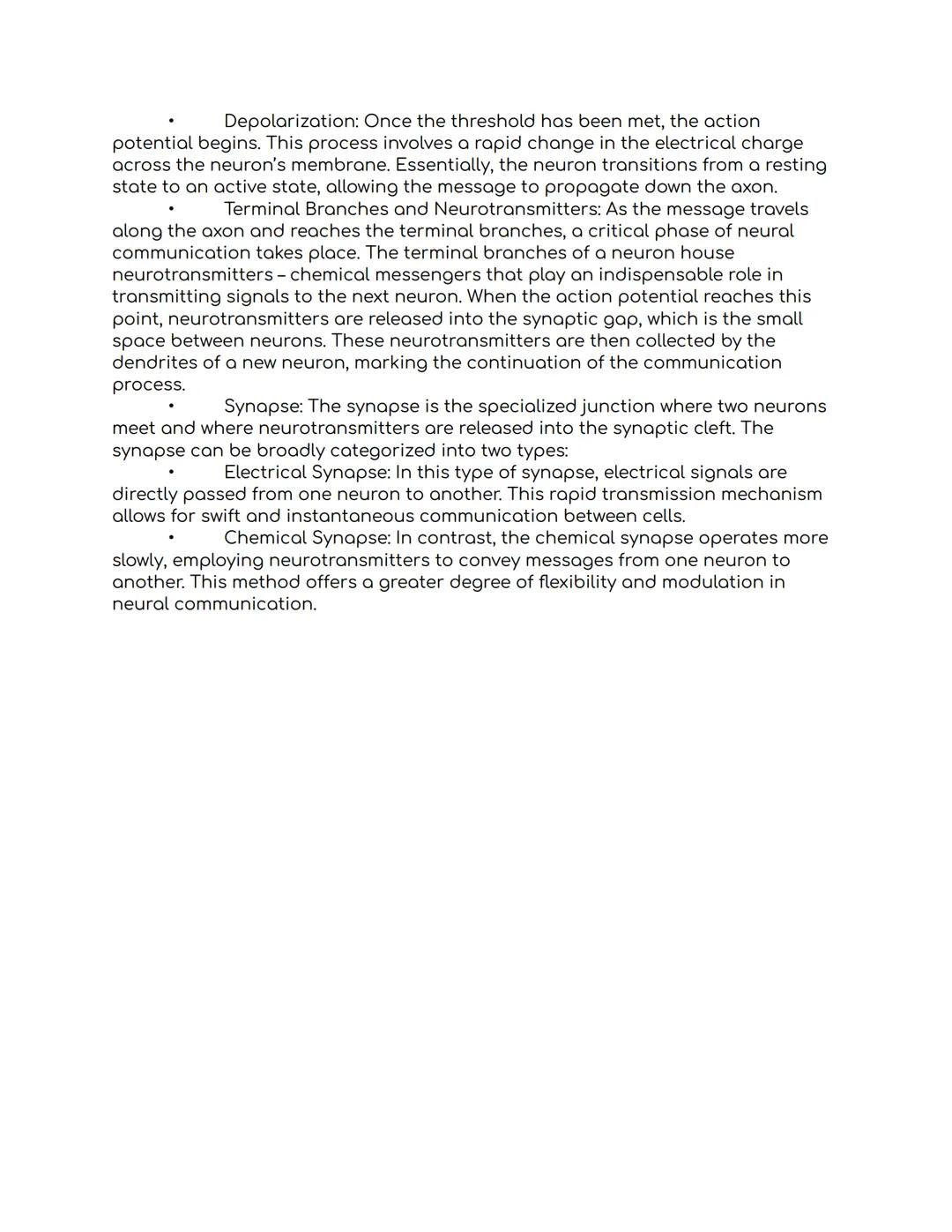
The Autonomic Nervous System
Your body operates many functions automatically without you having to think about them. Your heart beats, you breathe, and your digestive system works all on their own thanks to the autonomic nervous system, a division of your peripheral nervous system.
The autonomic system has two branches that work as opposing forces: the sympathetic nervous system and the parasympathetic nervous system. Think of them as your body's gas pedal and brake. The sympathetic system (the "fight-or-flight" response) kicks in during stressful situations - before a big test, it increases your heart rate and breathing, preparing you to face the challenge.
The parasympathetic system (the "rest and digest" response) does the opposite. After the stress passes, it helps your body return to a calm state, slowing your heart rate and allowing you to relax. This balance between the two systems helps maintain your body's equilibrium.
Test Tip: When you feel nervous before an exam, that's your sympathetic nervous system activating! Try taking slow, deep breaths to engage your parasympathetic system and calm yourself down.
4
of 4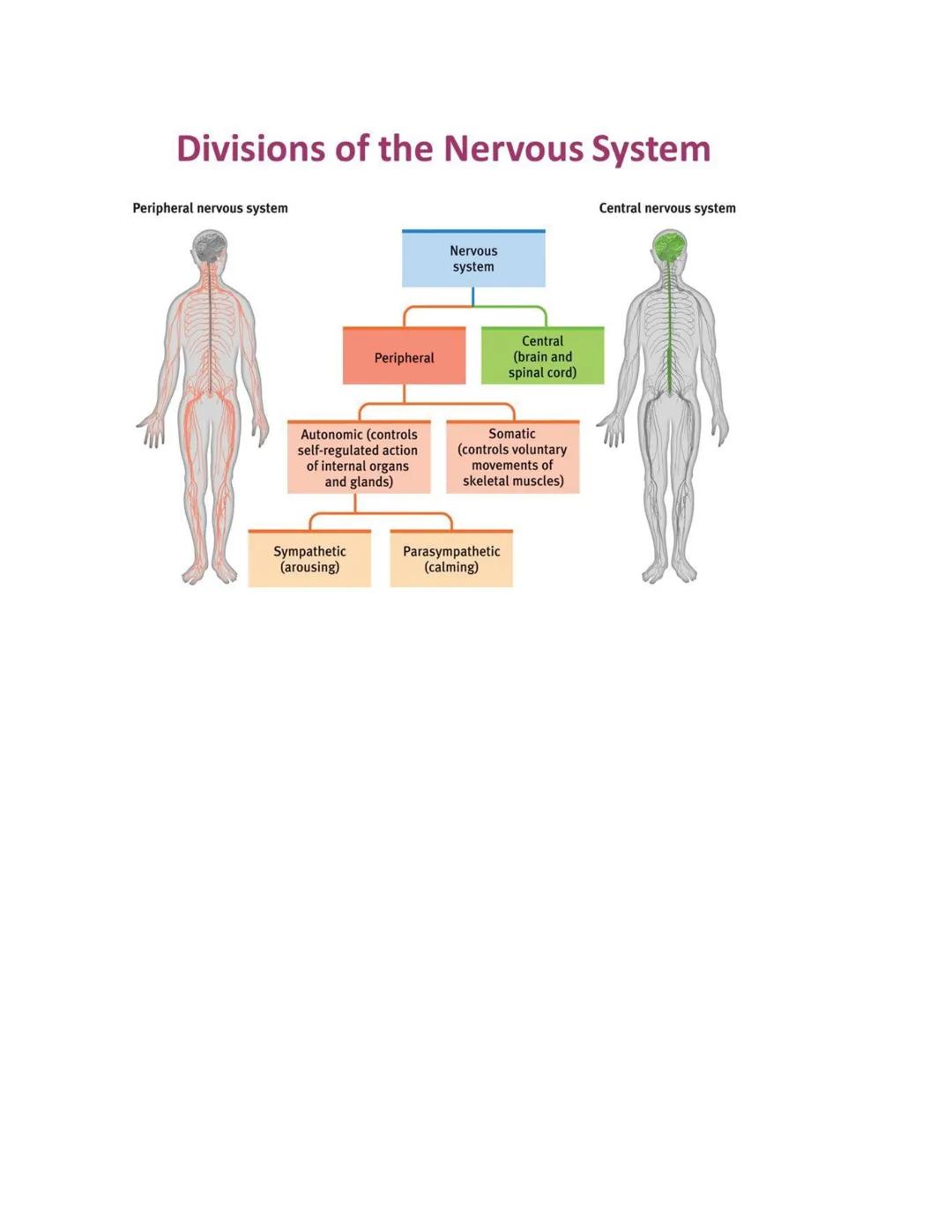
Divisions of the Nervous System
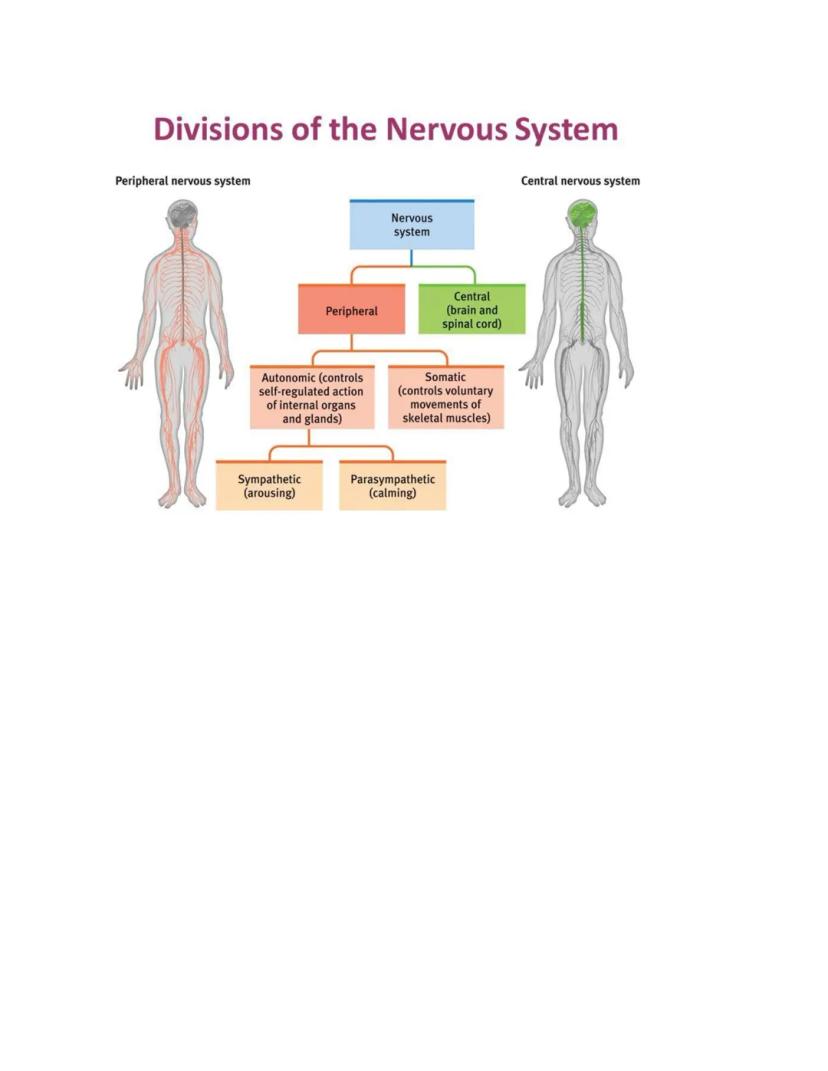
Your entire nervous system is organized into a logical hierarchy that helps coordinate all your bodily functions. At the top level, it divides into the central nervous system (brain and spinal cord) and the peripheral nervous system (everything else).
The peripheral nervous system further splits into two branches: the somatic system controls all your voluntary movements, like raising your hand in class or kicking a soccer ball. The autonomic system handles all the automatic functions you don't consciously control.
Within the autonomic system, the sympathetic division activates your body in moments of stress or excitement, while the parasympathetic division promotes relaxation and normal functioning. These systems constantly work together, adjusting your body's responses to meet your changing needs throughout the day.
Connection Point: Think about the last time you were startled - your heart raced, you breathed faster, and you felt suddenly alert. That's your sympathetic nervous system instantly preparing you to respond to potential danger!
We thought you’d never ask...
Our AI companion is specifically built for the needs of students. Based on the millions of content pieces we have on the platform we can provide truly meaningful and relevant answers to students. But its not only about answers, the companion is even more about guiding students through their daily learning challenges, with personalised study plans, quizzes or content pieces in the chat and 100% personalisation based on the students skills and developments.
You can download the app in the Google Play Store and in the Apple App Store.
That's right! Enjoy free access to study content, connect with fellow students, and get instant help – all at your fingertips.
Similar Content
Most popular content in AP Psychology
9F
AP PsychologyFoundations of Ethical Guidelines in Research
Practice the core principles of the APA ethical code including informed consent, debriefing, and the role of Institutional Review Boards.
9th1,3360
F
AP PsychologyFoundations of Research Design and Methodology
Practice distinguishing between different research methods including experiments, correlations, and case studies while identifying key variables.
9th6670
H
AP PsychologyHistorical Foundations of Psychology
Practice distinguishing between structuralism, functionalism, and the early philosophical roots of psychological science.
9th1,0940
I
AP PsychologyIntroduction to Descriptive Statistics
Practice identifying and calculating measures of central tendency and variation to summarize psychological data sets.
9th7010
I
AP PsychologyIntroduction to Auditory System Structures
Practice identifying the anatomical structures of the ear and their specific roles in converting sound waves into neural impulses.
9th6000
H
AP PsychologyHemispheric Specialization and Brain Structures
Practice identifying how specific structures like the corpus callosum and cerebral cortex coordinate complex human behaviors and sensory input.
9th3330
P
AP PsychologyParts of the brain and their functions quiz
Quick quiz on parts of the brain and their functions
10th1500
AP PsychologyAP psych
literally 103 pages of psych notes i took
10th1283
AP PsychologyThe Best AP Psychology Cram Sheet
cram sheet for AP Psych
10th95768
Most popular content
9O
 AP US History
Origins and Dynamics of the Columbian Exchange
Analyze the ecological and economic motivations behind the initial transfer of goods, people, and diseases between the Old and New Worlds.
9th3,1280
I
AP US HistoryIntroduction to Early Cultural Interactions
Analyze the initial social and religious encounters between Europeans, Africans, and Indigenous peoples in the colonial Americas.
9th2,7730
O
 AP World History
Origins of Ancient River Civilizations
Analyze the environmental factors and technological innovations that led to the rise of early states in Mesopotamia, Egypt, and the Indus Valley.
9th3,1870
M
AP US HistoryMotivations for European Exploration
Analyze the economic, religious, and political factors that drove European powers to the Americas during the 15th and 16th centuries.
9th1,7780
F
AP PsychologyFoundations of Ethical Guidelines in Research
Practice the core principles of the APA ethical code including informed consent, debriefing, and the role of Institutional Review Boards.
9th1,3360
I
AP US HistoryIntroduction to Native American Societies
Examine the diverse social, political, and economic structures of North American indigenous groups prior to European contact.
9th1,1100
I
AP US HistoryIntroduction to the Spanish Encomienda System
Explore the fundamental economic and social structures of the Spanish colonial system, focusing on the encomienda and the casta social hierarchy.
9th8890
I
 AP Biology
Introduction to Biological Elements of Life
Practice identifying the essential elements including carbon, nitrogen, phosphorus, and sulfur that compose biological macromolecules.
9th1,7410
O
AP US Government & PoliticsOrigins of the Articles of Confederation
Practice identifying the motivations for a weak central government and the specific powers granted to the states under the first U.S. constitution.
9th9370
Students love us — and so will you.
4.6/5App Store
4.7/5Google Play
The app is very easy to use and well designed. I have found everything I was looking for so far and have been able to learn a lot from the presentations! I will definitely use the app for a class assignment! And of course it also helps a lot as an inspiration.
Stefan SiOS user
This app is really great. There are so many study notes and help [...]. My problem subject is French, for example, and the app has so many options for help. Thanks to this app, I have improved my French. I would recommend it to anyone.
Samantha KlichAndroid user
Wow, I am really amazed. I just tried the app because I've seen it advertised many times and was absolutely stunned. This app is THE HELP you want for school and above all, it offers so many things, such as workouts and fact sheets, which have been VERY helpful to me personally.
AnnaiOS user
AP Psychology95 views·Updated Jul 6, 2026·4 pagesUNIT 2 (2.3) - Understanding the Nervous System Functions
Kylie Williams@kyliewilliams_8
The nervous system is your body's command center, controlling everything from conscious thoughts to automatic functions like breathing. It's an intricate network that enables your body to sense, process, and respond to the world around you. Understanding how this system...
1
of 4
Sign up to see the content. It's free!
- Access to all documents
- Improve your grades
- Join milions of students
Overview of the Nervous System
Your nervous system is like an incredibly complex electrical wiring system that transmits information throughout your body. It has two main parts: the central nervous system (CNS) - your brain and spinal cord - and the peripheral nervous system (PNS), which connects the CNS to the rest of your body.
The brain is your body's control center, where neural networks enable you to think, feel, remember, and act. These networks process massive amounts of information in milliseconds! Meanwhile, your spinal cord serves as the communication highway between your brain and body.
Reflexes are one of the coolest features of your nervous system - they're automatic responses that bypass your brain completely. When you touch something hot, your hand pulls away before you even feel pain because interneurons in your spinal cord create this lightning-fast reaction.
Did You Know? Your nervous system transmits information at speeds up to 268 miles per hour - faster than Formula 1 race cars! This incredible speed is why you can react so quickly to sudden dangers.
2
of 4Sign up to see the content. It's free!
- Access to all documents
- Improve your grades
- Join milions of students
Neural Communication
Think of neurons as the messengers of your body - they're specialized cells that transmit information from one part of your body to another. There are three main types that work together to create a communication network.
Sensory neurons are like scouts, constantly collecting information about your environment. They detect everything from the temperature outside to the pressure of your shoes against your feet. Interneurons are the processors - they take this information and decide what to do with it. Finally, motor neurons carry commands to your muscles and glands, telling them how to respond.
Communication between neurons happens through action potentials - electrical signals that travel down the axon like a wave. This works on an all-or-nothing principle - if a signal reaches the threshold, an action potential fires; if not, nothing happens. This system ensures clear, reliable messaging throughout your body.
When an action potential reaches the end of a neuron, it triggers the release of neurotransmitters - chemical messengers that cross the tiny gap between neurons called a synapse. These chemicals are picked up by the next neuron, continuing the signal chain. Synapses can be electrical (fast and direct) or chemical (slower but more flexible).
Brain Boost: When you're learning something new, your brain is literally creating and strengthening connections between neurons. The more you practice, the stronger these connections become!
3
of 4Sign up to see the content. It's free!
- Access to all documents
- Improve your grades
- Join milions of students
The Autonomic Nervous System
Your body operates many functions automatically without you having to think about them. Your heart beats, you breathe, and your digestive system works all on their own thanks to the autonomic nervous system, a division of your peripheral nervous system.
The autonomic system has two branches that work as opposing forces: the sympathetic nervous system and the parasympathetic nervous system. Think of them as your body's gas pedal and brake. The sympathetic system (the "fight-or-flight" response) kicks in during stressful situations - before a big test, it increases your heart rate and breathing, preparing you to face the challenge.
The parasympathetic system (the "rest and digest" response) does the opposite. After the stress passes, it helps your body return to a calm state, slowing your heart rate and allowing you to relax. This balance between the two systems helps maintain your body's equilibrium.
Test Tip: When you feel nervous before an exam, that's your sympathetic nervous system activating! Try taking slow, deep breaths to engage your parasympathetic system and calm yourself down.
4
of 4Sign up to see the content. It's free!
- Access to all documents
- Improve your grades
- Join milions of students
Divisions of the Nervous System
Your entire nervous system is organized into a logical hierarchy that helps coordinate all your bodily functions. At the top level, it divides into the central nervous system (brain and spinal cord) and the peripheral nervous system (everything else).
The peripheral nervous system further splits into two branches: the somatic system controls all your voluntary movements, like raising your hand in class or kicking a soccer ball. The autonomic system handles all the automatic functions you don't consciously control.
Within the autonomic system, the sympathetic division activates your body in moments of stress or excitement, while the parasympathetic division promotes relaxation and normal functioning. These systems constantly work together, adjusting your body's responses to meet your changing needs throughout the day.
Connection Point: Think about the last time you were startled - your heart raced, you breathed faster, and you felt suddenly alert. That's your sympathetic nervous system instantly preparing you to respond to potential danger!
We thought you’d never ask...
Our AI companion is specifically built for the needs of students. Based on the millions of content pieces we have on the platform we can provide truly meaningful and relevant answers to students. But its not only about answers, the companion is even more about guiding students through their daily learning challenges, with personalised study plans, quizzes or content pieces in the chat and 100% personalisation based on the students skills and developments.
You can download the app in the Google Play Store and in the Apple App Store.
That's right! Enjoy free access to study content, connect with fellow students, and get instant help – all at your fingertips.
Similar Content
Most popular content in AP Psychology
9F
AP PsychologyFoundations of Ethical Guidelines in Research
Practice the core principles of the APA ethical code including informed consent, debriefing, and the role of Institutional Review Boards.
9th1,3360
F
AP PsychologyFoundations of Research Design and Methodology
Practice distinguishing between different research methods including experiments, correlations, and case studies while identifying key variables.
9th6670
H
AP PsychologyHistorical Foundations of Psychology
Practice distinguishing between structuralism, functionalism, and the early philosophical roots of psychological science.
9th1,0940
I
AP PsychologyIntroduction to Descriptive Statistics
Practice identifying and calculating measures of central tendency and variation to summarize psychological data sets.
9th7010
I
AP PsychologyIntroduction to Auditory System Structures
Practice identifying the anatomical structures of the ear and their specific roles in converting sound waves into neural impulses.
9th6000
H
AP PsychologyHemispheric Specialization and Brain Structures
Practice identifying how specific structures like the corpus callosum and cerebral cortex coordinate complex human behaviors and sensory input.
9th3330
P
AP PsychologyParts of the brain and their functions quiz
Quick quiz on parts of the brain and their functions
10th1500
AP PsychologyAP psych
literally 103 pages of psych notes i took
10th1283
AP PsychologyThe Best AP Psychology Cram Sheet
cram sheet for AP Psych
10th95768
Most popular content
9O
AP US HistoryOrigins and Dynamics of the Columbian Exchange
Analyze the ecological and economic motivations behind the initial transfer of goods, people, and diseases between the Old and New Worlds.
9th3,1280
I
AP US HistoryIntroduction to Early Cultural Interactions
Analyze the initial social and religious encounters between Europeans, Africans, and Indigenous peoples in the colonial Americas.
9th2,7730
O
AP World HistoryOrigins of Ancient River Civilizations
Analyze the environmental factors and technological innovations that led to the rise of early states in Mesopotamia, Egypt, and the Indus Valley.
9th3,1870
M
AP US HistoryMotivations for European Exploration
Analyze the economic, religious, and political factors that drove European powers to the Americas during the 15th and 16th centuries.
9th1,7780
F
AP PsychologyFoundations of Ethical Guidelines in Research
Practice the core principles of the APA ethical code including informed consent, debriefing, and the role of Institutional Review Boards.
9th1,3360
I
AP US HistoryIntroduction to Native American Societies
Examine the diverse social, political, and economic structures of North American indigenous groups prior to European contact.
9th1,1100
I
AP US HistoryIntroduction to the Spanish Encomienda System
Explore the fundamental economic and social structures of the Spanish colonial system, focusing on the encomienda and the casta social hierarchy.
9th8890
I
AP BiologyIntroduction to Biological Elements of Life
Practice identifying the essential elements including carbon, nitrogen, phosphorus, and sulfur that compose biological macromolecules.
9th1,7410
O
AP US Government & PoliticsOrigins of the Articles of Confederation
Practice identifying the motivations for a weak central government and the specific powers granted to the states under the first U.S. constitution.
9th9370
Students love us — and so will you.
4.6/5App Store
4.7/5Google Play
The app is very easy to use and well designed. I have found everything I was looking for so far and have been able to learn a lot from the presentations! I will definitely use the app for a class assignment! And of course it also helps a lot as an inspiration.
Stefan SiOS user
This app is really great. There are so many study notes and help [...]. My problem subject is French, for example, and the app has so many options for help. Thanks to this app, I have improved my French. I would recommend it to anyone.
Samantha KlichAndroid user
Wow, I am really amazed. I just tried the app because I've seen it advertised many times and was absolutely stunned. This app is THE HELP you want for school and above all, it offers so many things, such as workouts and fact sheets, which have been VERY helpful to me personally.
AnnaiOS user