
Algebra 1 is the foundation for all higher math, teaching... Show more
 Algebra 199 views·Updated May 30, 2026·2 pages
Top Tips for Excelling in Algebra 1 Tests

Bella@rocket_cat
1
of 2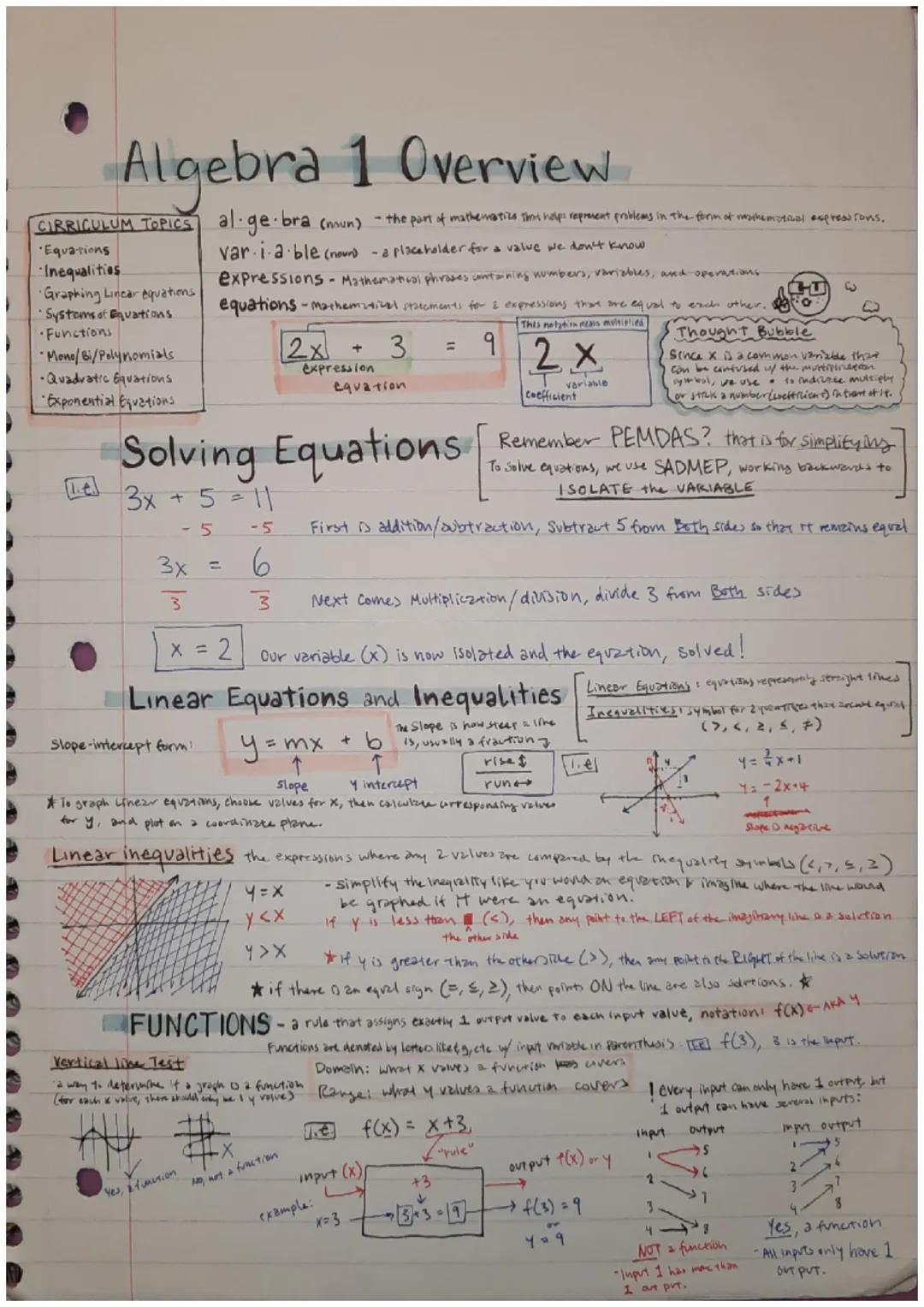
Algebra Fundamentals and Linear Equations
Algebra is the branch of math that represents problems using mathematical expressions. When working with equations (mathematical statements showing two expressions are equal), your goal is to isolate the variable (the placeholder for unknown values).
To solve equations, use SADMEP—the reverse of PEMDAS. First, handle addition/subtraction by performing the opposite operation on both sides. Then tackle multiplication/division to isolate your variable. For example, to solve 3x + 5 = 11, subtract 5 from both sides , then divide by 3 to get x = 2.
Linear equations represent straight lines and are commonly written in slope-intercept form: y = mx + b, where m is the slope (how steep the line is) and b is the y-intercept. To graph these equations, choose values for x, calculate corresponding y-values, and plot the points. The slope can be positive (line rises) or negative (line falls).
Pro Tip: When working with inequalities (using <, >, ≤, ≥), solve them like regular equations, but remember: for < or ≤, shade the area to the LEFT of the line; for > or ≥, shade to the RIGHT. When there's an equal sign (=, ≤, ≥), include the line itself in your solution.
Functions are special relationships where each input has exactly one output, written as f(x). The vertical line test helps determine if a graph represents a function—if any vertical line crosses the graph more than once, it's not a function. Remember that the domain shows what x-values a function covers, while the range shows possible y-values.
2
of 2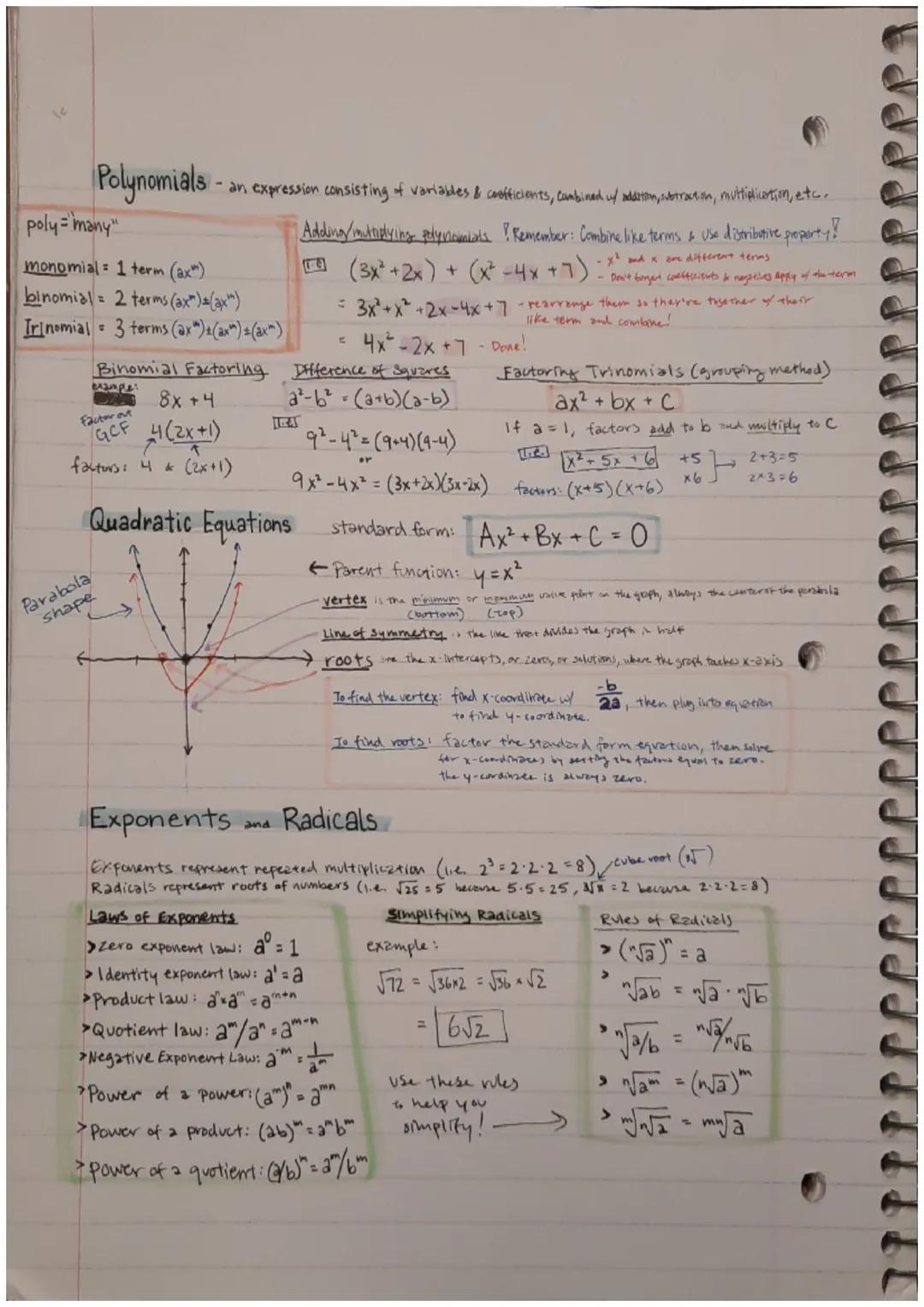
Polynomials and Advanced Equations
Polynomials are expressions with variables and coefficients combined through operations like addition and multiplication. They're classified by the number of terms: monomials have one term, binomials have two, and trinomials have three. When working with polynomials, remember to combine like terms when adding and use the distributive property when multiplying.
Factoring polynomials helps solve equations. For the difference of squares pattern , recognize that you're breaking the expression into two binomials. When factoring trinomials in the form x² + 5x + 6, look for two numbers that multiply to give 6 and add to give 5 (in this case, 2 and 3).
Quadratic equations create parabola shapes when graphed. The vertex is the minimum or maximum point, while the roots (or zeros) are where the graph crosses the x-axis. To find the vertex, use the formula x = -b/2a for the x-coordinate, then plug that value back into the equation to find y.
Remember: Exponents and radicals are opposites of each other. An exponent like 2³ means 2×2×2=8, while a radical like √25=5 means 5²=25.
Working with exponents requires knowing the key laws: a⁰=1, a¹=a, aᵐ×aⁿ=aᵐ⁺ⁿ, and a⁻ᵐ=1/aᵐ. For radicals, simplify by finding perfect squares or cubes first. Use properties like √(ab)=√a×√b and √=√a/√b to break down complex expressions into simpler forms.
We thought you’d never ask...
What is the Knowunity AI companion?
Our AI companion is specifically built for the needs of students. Based on the millions of content pieces we have on the platform we can provide truly meaningful and relevant answers to students. But its not only about answers, the companion is even more about guiding students through their daily learning challenges, with personalised study plans, quizzes or content pieces in the chat and 100% personalisation based on the students skills and developments.
Where can I download the Knowunity app?
You can download the app in the Google Play Store and in the Apple App Store.
Is Knowunity really free of charge?
That's right! Enjoy free access to study content, connect with fellow students, and get instant help – all at your fingertips.
Similar Content
Most popular content in Algebra 1
9Most popular content
9Can't find what you're looking for? Explore other subjects.
Students love us — and so will you.
4.6/5App Store
4.7/5Google Play
The app is very easy to use and well designed. I have found everything I was looking for so far and have been able to learn a lot from the presentations! I will definitely use the app for a class assignment! And of course it also helps a lot as an inspiration.
Stefan SiOS user
This app is really great. There are so many study notes and help [...]. My problem subject is French, for example, and the app has so many options for help. Thanks to this app, I have improved my French. I would recommend it to anyone.
Samantha KlichAndroid user
Wow, I am really amazed. I just tried the app because I've seen it advertised many times and was absolutely stunned. This app is THE HELP you want for school and above all, it offers so many things, such as workouts and fact sheets, which have been VERY helpful to me personally.
AnnaiOS user
Algebra 199 views·Updated May 30, 2026·2 pagesTop Tips for Excelling in Algebra 1 Tests
Bella@rocket_cat
Algebra 1 is the foundation for all higher math, teaching you how to solve and graph equations, work with functions, and manipulate expressions. This summary covers essential concepts from basic equation-solving to more advanced topics like quadratics and polynomials that... Show more
1
of 2Sign up to see the content. It's free!
- Access to all documents
- Improve your grades
- Join milions of students
Algebra Fundamentals and Linear Equations
Algebra is the branch of math that represents problems using mathematical expressions. When working with equations (mathematical statements showing two expressions are equal), your goal is to isolate the variable (the placeholder for unknown values).
To solve equations, use SADMEP—the reverse of PEMDAS. First, handle addition/subtraction by performing the opposite operation on both sides. Then tackle multiplication/division to isolate your variable. For example, to solve 3x + 5 = 11, subtract 5 from both sides , then divide by 3 to get x = 2.
Linear equations represent straight lines and are commonly written in slope-intercept form: y = mx + b, where m is the slope (how steep the line is) and b is the y-intercept. To graph these equations, choose values for x, calculate corresponding y-values, and plot the points. The slope can be positive (line rises) or negative (line falls).
Pro Tip: When working with inequalities (using <, >, ≤, ≥), solve them like regular equations, but remember: for < or ≤, shade the area to the LEFT of the line; for > or ≥, shade to the RIGHT. When there's an equal sign (=, ≤, ≥), include the line itself in your solution.
Functions are special relationships where each input has exactly one output, written as f(x). The vertical line test helps determine if a graph represents a function—if any vertical line crosses the graph more than once, it's not a function. Remember that the domain shows what x-values a function covers, while the range shows possible y-values.
2
of 2Sign up to see the content. It's free!
- Access to all documents
- Improve your grades
- Join milions of students
Polynomials and Advanced Equations
Polynomials are expressions with variables and coefficients combined through operations like addition and multiplication. They're classified by the number of terms: monomials have one term, binomials have two, and trinomials have three. When working with polynomials, remember to combine like terms when adding and use the distributive property when multiplying.
Factoring polynomials helps solve equations. For the difference of squares pattern , recognize that you're breaking the expression into two binomials. When factoring trinomials in the form x² + 5x + 6, look for two numbers that multiply to give 6 and add to give 5 (in this case, 2 and 3).
Quadratic equations create parabola shapes when graphed. The vertex is the minimum or maximum point, while the roots (or zeros) are where the graph crosses the x-axis. To find the vertex, use the formula x = -b/2a for the x-coordinate, then plug that value back into the equation to find y.
Remember: Exponents and radicals are opposites of each other. An exponent like 2³ means 2×2×2=8, while a radical like √25=5 means 5²=25.
Working with exponents requires knowing the key laws: a⁰=1, a¹=a, aᵐ×aⁿ=aᵐ⁺ⁿ, and a⁻ᵐ=1/aᵐ. For radicals, simplify by finding perfect squares or cubes first. Use properties like √(ab)=√a×√b and √=√a/√b to break down complex expressions into simpler forms.
We thought you’d never ask...
What is the Knowunity AI companion?
Our AI companion is specifically built for the needs of students. Based on the millions of content pieces we have on the platform we can provide truly meaningful and relevant answers to students. But its not only about answers, the companion is even more about guiding students through their daily learning challenges, with personalised study plans, quizzes or content pieces in the chat and 100% personalisation based on the students skills and developments.
Where can I download the Knowunity app?
You can download the app in the Google Play Store and in the Apple App Store.
Is Knowunity really free of charge?
That's right! Enjoy free access to study content, connect with fellow students, and get instant help – all at your fingertips.
Similar Content
Most popular content in Algebra 1
9Most popular content
9Can't find what you're looking for? Explore other subjects.
Students love us — and so will you.
4.6/5App Store
4.7/5Google Play
The app is very easy to use and well designed. I have found everything I was looking for so far and have been able to learn a lot from the presentations! I will definitely use the app for a class assignment! And of course it also helps a lot as an inspiration.
Stefan SiOS user
This app is really great. There are so many study notes and help [...]. My problem subject is French, for example, and the app has so many options for help. Thanks to this app, I have improved my French. I would recommend it to anyone.
Samantha KlichAndroid user
Wow, I am really amazed. I just tried the app because I've seen it advertised many times and was absolutely stunned. This app is THE HELP you want for school and above all, it offers so many things, such as workouts and fact sheets, which have been VERY helpful to me personally.
AnnaiOS user